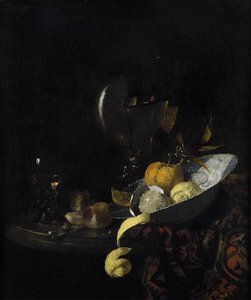
Portretul lui Willem Kalf

Cele 82 cele mai faimoase picturi ale lui Willem Kalf, fiecare unică în felul ei

Actualizat Noiembrie 2026 · clasat în funcție de scorul nostru de popularitate (căutări, vizite și comenzi pentru fiecare operă) · 86 lucrări ale lui Willem Kalf în catalogul nostru

Pe scurt

Still Life with an oriental Rug (1660) este pictura lui Willem Kalf care atrage cele mai multe priviri; originalul aparține Muzeul Ashmolean de Artă și Arheologie, Oxford. După aceasta, privirea se îndreaptă către Still-Life (1665) și Still-Life with a Nautilus Cup (detail) (1662). Dintre cele 86 opere ale lui Willem Kalf din catalogul nostru, acestea 82 sunt cele mai celebre, fiecare fiind o piesă unică, prezentată împreună cu anul creării, muzeul deținător și motivul pentru care aceasta rămâne memorabilă.

1619 – 1693, Rotterdam Baroque Cele mai multe lucrări: Museum Boijmans Van Beuningen

Cele mai importante 10 picturi ale lui Willem Kalf, prin ochii galeriei

1
Still Life with an oriental Rug (1660) de Willem Kalf

Still Life with an oriental Rug

1660 · Acrylic On Canvas · Muzeul Ashmolean de Artă și Arheologie, Oxford

The painting’s creation coincided with the zenith of Dutch economic dominance—a period marked by unchallenged control over global trade routes and a flourishing mercantile culture. The wealth generated from overseas ventures financed ambitious artistic endeavors, fostering an environment where artists like Kalf could explore innovative stylistic approaches and engage in intellectual discourse. Furthermore, the humanist spirit of the time permeated artistic expression, emphasizing human dignity and rational thought—values subtly conveyed…

2
Still-Life (1665) de Willem Kalf

Still-Life

1665 · Oil On Canvas · Rijksmuseum, Amsterdam

In this 1665 work, Still-Life, Willem Kalf presents a quiet arrangement of objects that reflects the prosperity of the Dutch Golden Age. Born in Rotterdam, Netherlands, in 1619, the artist developed a specific way of seeing that would define much of his career until his death in 1693. This particular painting captures a moment of stillness, focusing on the tactile reality of a bowl of oranges and various metalware set…

3
Still-Life with a Nautilus Cup (detail) (1662) de Willem Kalf

Still-Life with a Nautilus Cup (detail)

1662 · Oil On Canvas · Muzeul Thyssen-Bornemisza, Madrid

In the quiet, shadowed corners of the seventeenth-century Dutch Golden Age, few artists captured the intoxicating essence of prosperity quite like Willem Kalf. His masterpiece, Still-Life with a Nautilus Cup (detail), is far more than a mere arrangement of objects; it is a meticulously choreographed performance of light, texture, and prestige. As one gazes upon this breathtaking composition, they are immediately transported into a world of refined luxury, where every…

4
Still-life (detail) (1650) de Willem Kalf

Still-life (detail)

1650 · Oil On Canvas · Muzeul Ermitaj, Sankt Petersburg

Willem Kalf's “Still Life,” painted around 1650 and now residing within the hallowed halls of The Hermitage Museum in St. Petersburg, is more than just a depiction of fruit and glass; it’s a meticulously crafted window into the burgeoning wealth and extravagant tastes of 17th-century Holland. Kalf, a master of the “pronkstilleven” – literally “showy still lifes” – elevated the genre to an art form, transforming everyday objects into symbols…

5
Still-Life with Drinking-Horn (1653) de Willem Kalf

Still-Life with Drinking-Horn

1653 · Oil On Canvas · National Gallery, Londra

A Window Into Dutch Opulence: Willem Kalf’s Still Life with Drinking Horn Willem Kalf stands as one of the most recognizable figures in the pantheon of Dutch Golden Age painters, celebrated primarily for his breathtakingly detailed depictions of interiors and still lifes that captured the essence of aristocratic life during the seventeenth century. Born in Rotterdam in 1619 into a family steeped in mercantile success—his father served as a municipal…

6
Still-Life with Glass Goblet and Fruit (1655) de Willem Kalf

Still-Life with Glass Goblet and Fruit

1655 · Oil On Canvas · Muzeele Statale din Berlin, Berlin

A soft, unseen light spills across a draped table, catching the curve of a gleaming glass goblet and the velvety skin of ripening fruit. The scene feels suspended in a moment of profound stillness, where the deep shadows of a dark background push the objects forward into the viewer's space. Oranges and apples rest in a careful arrangement, their warm hues of burnt orange and golden yellow glowing against the…

7
Pronk Still Life With Holbein Bowl, Nautilus Cup și fructe (1678) de Willem Kalf

Pronk Still Life With Holbein Bowl, Nautilus Cup și fructe

1678 · Pictură în ulei · Galeria Națională a Danemarcei, Copenhaga

The painting titled Pronk Still Life with Holbein Bowl, Nautilus Cup, Glass Goblet and Fruit Dish was executed by the artist Willem Kalf. This work dates to 1678. It belongs to the genre of pronkstilleven, which translates to ostentatious still life. This classification refers to a specific type of Dutch Golden Age composition that focuses on the depiction of luxury and high-status objects.

8
Still-Life with Fruit, Glassware, and a Wanli Bowl (1659) de Willem Kalf

Still-Life with Fruit, Glassware, and a Wanli Bowl

1659 · Oil On Canvas · Metropolitan Museum of Art, New York

The Opulent Stillness of Willem Kalf’s “Still Life with Fruit, Glassware, and a Wanli Bowl” Willem Kalf's "Still Life with Fruit, Glassware, and a Wanli Bowl," painted in 1659, is more than just a depiction of objects arranged on a table; it’s a meticulously crafted window into the lavish world of 17th-century Dutch society. This remarkable artwork, now housed at The Metropolitan Museum of Art, embodies the pinnacle of the…

Păiți celebrele picturi ale lui Willem Kalf, de la numărul 11 la 82

11Still-Life with Porcelain and a Nautilus Cup (1660) de Willem KalfStill-Life with Porcelain and a Nautilus Cup1660 · Muzeul Thyssen-Bornemisza 12Still-Life with an Aquamanile, Fruit, and a Nautilus Cup (1660) de Willem KalfStill-Life with an Aquamanile, Fruit, and a Nautilus Cup1660 · Muzeul Thyssen-Bornemisza 13Still Life Fruit, Goblet and Salver (1660) de Willem KalfStill Life Fruit, Goblet and Salver1660 14Still life with shell cup, glasses and a lemon (1663) de Willem KalfStill life with shell cup, glasses and a lemon1663 · Museum der bildenden Künste 15Still Life with a Porcelain Vase, Silver-gilt Ewer and Glasses (1643) de Willem KalfStill Life with a Porcelain Vase, Silver-gilt Ewer and Glasses1643 · Los Angeles County Museum of Art 16Peasant Interior with Woman at a Well (1642) de Willem KalfPeasant Interior with Woman at a Well1642 · Saint Louis Art Museum 17Farm interior with a woman at a well (1640) de Willem KalfFarm interior with a woman at a well1640 · Museum der bildenden Künste 18Still life with weaponry, silverware and mirror image of the artist (1644) de Willem KalfStill life with weaponry, silverware and mirror image of the artist1644 19Intérieur de cuisine (1646) de Willem KalfIntérieur de cuisine1646 · Musée Fabre 20Merchandise on display for a shop (1642) de Willem KalfMerchandise on display for a shop1642 · Colecțiile Statale de Pictură din Bavaria 21Farm interior with a kneeling man (1645) de Willem KalfFarm interior with a kneeling man1645 · Museum Boijmans Van Beuningen 22Boerderij-interieur met zittende vrouw, man op een ladder en figuur in de deuropening (1644) de Willem KalfBoerderij-interieur met zittende vrouw, man op een ladder en figuur in de deuropening1644 · Staatliche Kunsthalle Karlsruhe 23Interior of a barn (1644) de Willem KalfInterior of a barn1644 · Museum Boijmans Van Beuningen 24Still Life with a Ming Jug (1653) de Willem KalfStill Life with a Ming Jug1653 · Alte Pinakothek 25Still Life with Ewer, Vessels and Pomegranate (1640) de Willem KalfStill Life with Ewer, Vessels and Pomegranate1640 · J. Paul Getty Museum 26Interior of a Kitchen (1642) de Willem KalfInterior of a Kitchen1642 · Metropolitan Museum of Art 27Pronk Still Life with a Chinese Sugar Bowl (1662) de Willem KalfPronk Still Life with a Chinese Sugar Bowl1662 · Statens Museum For Kunst 28Still Life with a Ming Bowl (1657) de Willem KalfStill Life with a Ming Bowl1657 · Museum Boijmans Van Beuningen 29Still-Life with Lemon, Oranges and Glass of Wine (1663) de Willem KalfStill-Life with Lemon, Oranges and Glass of Wine1663 · Staatliche Kunsthalle 30Still Life with Shells and Coral (1690) de Willem KalfStill Life with Shells and Coral1690 · Mauritshuis 31Still Life with Fruit and Wineglasses on a Silver Plate (1659) de Willem KalfStill Life with Fruit and Wineglasses on a Silver Plate1659 · Mauritshuis 32Still-Life with a Late Ming Ginger Jar (1669) de Willem KalfStill-Life with a Late Ming Ginger Jar1669 · Museum of Art 33Still Life with Shells (1653) de Willem KalfStill Life with Shells1653 · Mauritshuis 34Wineglass and a Bowl of Fruit (1663) de Willem KalfWineglass and a Bowl of Fruit1663 · Cleveland Museum of Art 35A Kitchen Corner (1643) de Willem KalfA Kitchen Corner1643 · Detroit Institute of Arts 36Still Life with Columbine Goblet (1660) de Willem KalfStill Life with Columbine Goblet1660 · Detroit Institute of Arts 37Still Llife with a Roemer (1659) de Willem KalfStill Llife with a Roemer1659 · Mauritshuis 38kitchen - piece (1647) de Willem Kalfkitchen - piece1647 39Kitchen interior (1642) de Willem KalfKitchen interior1642 · Fondation Custodia 40Kitchen Interior (1650) de Willem KalfKitchen Interior1650 41Still Life with Glasses and a Silver Bowl (1656) de Willem KalfStill Life with Glasses and a Silver Bowl1656 · Muzeul de Artă Fine din Budapesta 42Still life with shell cup, shells, coral and lacquer box (1653) de Willem KalfStill life with shell cup, shells, coral and lacquer box1653 · Museum de Fundatie 43Still Life with Fruit and a Nautilus Cup (1660) de Willem KalfStill Life with Fruit and a Nautilus Cup1660 44Still Life with Ginger jar (1660) de Willem KalfStill Life with Ginger jar1660 45Still life with shells and a jewel box (1653) de Willem KalfStill life with shells and a jewel box1653 · Kunsthandel P. de Boer 46Nautilus shell (Stilleben mit Nautiluspokal) (1660) de Willem KalfNautilus shell (Stilleben mit Nautiluspokal)1660 · Foundation E.G. Bührle Collection 47Still life with a golden goblet (1657) de Willem KalfStill life with a golden goblet1657 · Gemäldegalerie 48Still life with a nautilus cup (1660) de Willem KalfStill life with a nautilus cup1660 · Gemäldegalerie 49Still Life Silver Gilt Goblet and Bowl of Fruit (1660) de Willem KalfStill Life Silver Gilt Goblet and Bowl of Fruit1660 50Still Life with Fruit, Glassware, and a Wanli Bowl (1659) de Willem KalfStill Life with Fruit, Glassware, and a Wanli Bowl1659 · Metropolitan Museum of Art 51Still Life with Lemon Peel (1664) de Willem KalfStill Life with Lemon Peel1664 · Muzeul de Artă Plastică din Boston 52Still Life with Bekerschroef, Rummer and Covered Porcelain Pot (1669) de Willem KalfStill Life with Bekerschroef, Rummer and Covered Porcelain Pot1669 · Het Prinsenhof 53Still life with columbine cup and porcelain bowl with fruit (1666) de Willem KalfStill life with columbine cup and porcelain bowl with fruit1666 54kitchenpiece (1666) de Willem Kalfkitchenpiece1666 · Museum Rotterdam 55Still life with porcelain lidded jar, shell cup and gilt silver ewer (1662) de Willem KalfStill life with porcelain lidded jar, shell cup and gilt silver ewer1662 · Gebruder Douwes 56Still life with a Chinese porcelain bowl (1662) de Willem KalfStill life with a Chinese porcelain bowl1662 · Fondation Custodia 57Still Life Silver Gilt Goblet, Porcelain Bowl, Glassware and Peeled Orange (1665) de Willem KalfStill Life Silver Gilt Goblet, Porcelain Bowl, Glassware and Peeled Orange1665 · Muzeul Kelvingrove 58Pronk still life (1643) de Willem KalfPronk still life1643 · Amsterdam Museum 59Still life with a porcelain bowl with fruit and glasses on a round marble table (1660) de Willem KalfStill life with a porcelain bowl with fruit and glasses on a round marble table1660 · Groninger Museum 60Kitchen interior (1663) de Willem KalfKitchen interior1663 · Museum Boijmans Van Beuningen 61Still life with glasses and fruit (1663) de Willem KalfStill life with glasses and fruit1663 · National Gallery of Victoria 62Intérieur de cuisine de Willem KalfIntérieur de cuisine 63Still-Life with Silver Bowl, Glasses, and Fruit (1658) de Willem KalfStill-Life with Silver Bowl, Glasses, and Fruit1658 · Wallraf-Richartz-Museum 64Kitchen Interior de Willem KalfKitchen InteriorMuzeul Israel 65Still Life (1660) de Willem KalfStill Life1660 · National Gallery of Art 66Still Life with Chinese Bowl and Fruit de Willem KalfStill Life with Chinese Bowl and Fruit 67Cabbages on a Table Top de Willem KalfCabbages on a Table TopMuzeul Național din Varșovia 68Nature morte à la gourde d'argent de Willem KalfNature morte à la gourde d'argentMinneapolis Institute of Art 69Nature morte de Willem KalfNature morte 70Nature morte au nautile de Willem KalfNature morte au nautileMusée des Beaux-Arts de Strasbourg 71Nature morte au römer de Willem KalfNature morte au römerPalais des Beaux-Arts de Lille 72Nature morte au citron de Willem KalfNature morte au citron 73Le vieux puits de Willem KalfLe vieux puitsMusée des Beaux-Arts de Strasbourg 74INTERIEUR D'UNE CUISINE RUSTIQUE de Willem KalfINTERIEUR D'UNE CUISINE RUSTIQUEMuzeul Luvru 75Închisoarea cu Flacon de Pielgrin, Candelabrul și Vase Porcelană și Fruct de Willem KalfÎnchisoarea cu Flacon de Pielgrin, Candelabrul și Vase Porcelană și FructGuildhall Art Gallery 76Still Life with Silver Jug (1657) de Willem KalfStill Life with Silver Jug1657 · Rijksmuseum 77Still Life with a Chinese Porcelain Jar (1669) de Willem KalfStill Life with a Chinese Porcelain Jar1669 · Indianapolis Museum of Art 78Still-Life with a Nautilus Cup (1662) de Willem KalfStill-Life with a Nautilus Cup1662 · Muzeul Thyssen-Bornemisza 79William still life de Willem KalfWilliam still lifeNational Gallery 80Still-Life (1653) de Willem KalfStill-Life1653 · Muzeul Ermitaj 81Still-Life with Chinese Porcelain Bowl (1662) de Willem KalfStill-Life with Chinese Porcelain Bowl1662 · Muzeele Statale din Berlin 82USTENSILES DE CUISINE de Willem KalfUSTENSILES DE CUISINEMuzeul Luvru

Piesele celebre ale lui Willem Kalf, perioadă cu perioadă

Subiectele care i-au captivat privirea lui Willem Kalf

Cele patru teme care revin cel mai des în aceste opere originale, fiecare având cel mai sublim exemplu.

Muzeele care păstrează originalele lui Willem Kalf

Cele 8 muzee care dețin cele mai multe dintre picturile de pe această pagină.

Muzee Oraș Lucrări lui Willem Kalf Picturi din această listă
Museum Boijmans Van Beuningen, RotterdamMuseum Boijmans Van Beuningen Rotterdam 5 Interior of a barn, Farm interior with a kneeling man, Interior of a barn
Muzeul Thyssen-Bornemisza, MadridMuzeul Thyssen-Bornemisza Madrid 4 Still-Life with a Nautilus Cup (detail), Still-Life with Porcelain and a Nautilus Cup, Still-Life with an Aquamanile, Fruit, and a Nautilus Cup
Mauritshuis, HaagMauritshuis Haag 4 Still Life with Shells and Coral, Still Life with Fruit and Wineglasses on a Silver Plate, Still Life with Shells
Metropolitan Museum of Art, New YorkMetropolitan Museum of Art New York 3 Still-Life with Fruit, Glassware, and a Wanli Bowl, Interior of a Kitchen, Still Life with Fruit, Glassware, and a Wanli Bowl
Rijksmuseum, AmsterdamRijksmuseum Amsterdam 2 Still-Life, Still Life with Silver Jug
Muzeul Ermitaj, Sankt PetersburgMuzeul Ermitaj Sankt Petersburg 2 Still-life (detail), Still-Life
National Gallery, LondraNational Gallery Londra 2 Still-Life with Drinking-Horn, William still life
Muzeele Statale din Berlin, BerlinMuzeele Statale din Berlin Berlin 2 Still-Life with Glass Goblet and Fruit, Still-Life with Chinese Porcelain Bowl

Willem Kalf de-a lungul deceniilor: o piesă unică pentru fiecare

Lucrări pe deceniu

Alege o deceniu pentru a descoperi opera originală care îl definește.

Picturile lui Willem Kalf: întrebări pentru galerie

Care este cea mai celebră operă a lui Willem Kalf?Află răspunsul

Still Life with an oriental Rug (1660), Muzeul Ashmolean de Artă și Arheologie, Oxford. Urmează Still-Life (1665) și Still-Life with a Nautilus Cup (detail) (1662).

La ce vârstă a creat Willem Kalf Still Life with an oriental Rug?Află răspunsul

41 ani: Still Life with an oriental Rug datează din 1660, iar Willem Kalf s-a născut în 1619.

Care sunt cele mai celebre zece picturi ale lui Willem Kalf?Află răspunsul

Still Life with an oriental Rug, Still-Life, Still-Life with a Nautilus Cup (detail), Still-life (detail), Still-Life with Drinking-Horn, Still-Life with Glass Goblet and Fruit, Pronk Still Life With Holbein Bowl, Nautilus Cup și fructe, Still-Life with Fruit, Glassware, and a Wanli Bowl, Interior of a barn și Still Life with the Drinking Horn of the Saint Sebastian Archers' Guild, Lobster and Glasses. Clasamentul de mai sus indică anul și muzeul pentru fiecare piesă.

Câte lucrări ale lui Willem Kalf sunt cunoscute?Află răspunsul

Catalogul nostru cuprinde 86 lucrări ale lui Willem Kalf, datate între 1640 și 1690.

Unde pot fi vizualizate originalele celor mai faimoși Willem Kalf?Află răspunsul

În principal în Museum Boijmans Van Beuningen (Rotterdam), Muzeul Thyssen-Bornemisza (Madrid) și Mauritshuis (Haag). Tabelul cu muzee de mai sus le enumeră pe toate.

În ce perioadă a creat Willem Kalf cele mai cunoscute picturi?Află răspunsul

În 1660s: 31 dintre cele 82 lucrări de pe această pagină au fost realizate atunci, fiind Still Life with an oriental Rug dintre acestea.

Care este cea mai veche și care este cea mai recentă pictură a lui Willem Kalf?Află răspunsul

Pe această pagină, cea mai veche lucrare datează din Farm interior with a woman at a well (1640), iar cea mai recentă este din Still Life with Shells and Coral (1690).

Ce teme prefera Willem Kalf?Află răspunsul

Fruit (23), Glassware (20) și Still life (16), din cele 82 lucrări de pe această pagină.

Cu ce materiale a pictat cel mai des Willem Kalf?Află răspunsul

Oil On Canvas, pentru 58 dintre cele 82 lucrări de pe această pagină.

Din ce curent artistic face parte opera lui Willem Kalf?Află răspunsul

Baroque și Dutch golden age, judecând după originalele de pe această pagină.

Ce originale de Willem Kalf pot vedea la Museum Boijmans Van Beuningen?Află răspunsul

Interior of a barn, Farm interior with a kneeling man și Interior of a barn: Museum Boijmans Van Beuningen, Rotterdam deține 5 dintre lucrările de pe această pagină.

Willem Kalf: un portret al artistului

O via cufundată în opulență: Lumea lui Willem Kalf

Willem Kalf, un nume sinonim cu naturalele moarte fastuoase din Epoca de Aur olandeză, s-a născut în Rotterdam în 1619, într-o familie cu resurse confortabile. Tatăl său, Jan Jansz Calff, deținea funcții în cadrul guvernului municipal, oferindu-i tânărului Willem o educație ce a împletit siguranța financiară cu expunerea la lumea mercantilă în plină expansiune, o lume care avea să îi influențeze profund arta ulterior. Deși detaliile referitoare la primii ani de formare ai lui Kalf rămân parțial misterioase, știm că a cunoscut o perioadă de dezvoltare artistică în Paris, în deceniul 1630, integrându-se în comunitatea vibrantă a artiștilor flamenzi care activau în Saint-Germain-des-Prés. Această experiență formativă l-a îndreptat inițial către interioare rustice la scară mică și naturi moarte modeste — începuturi smerite care s-au transformat, în timp, în grandioasele pronkstilleven pentru care este celebrat astăzi. Pierderea ambilor părinți până în 1638 l-a determinat să revină în Țările de Jos, pregătind scena pentru perioada sa de maturitate artistică.

De la începuturi modeste la spectacolul măiestriei

Primele lucrări pariziene ale lui Kalf dezvăluie un artist aflat în căutarea propriului drum. Aceste picturi reprezentau adesea compoziții simple — legume, ustensile de bucătărie obișnuite, precum găleți și tigăi — plasate pe fundaluri întunecate, unde figurile erau doar sugerate, mai degrabă decât complet realizate. Acest stil oglindea tradițiile picturale predominante în Flandra la începutul secolului al XVII-lea, în special opera unor artiști precum David Teniers cel Tânăr. Totuși, ambiția lui Kalf a depășit rapid aceste compoziții modeste. La întoarcerea sa în Țările de Jos, el a început o evoluție remarcabilă către ceea ce avea să devină stilul său emblematic: pronkstilleven, sau „natura moartă ostentativă”. Acestea nu erau simple reprezentări ale unor obiecte; erau expoziții atent construite de bogăție și rafinament, prezentând piese de lux precum vase de argint, porțelan delicat, fructe exotice și veselă de sticlă strălucitoare.

Arta iluziei și rezonanța simbolică Ceea ce distingea cu adevărat pronkstilleven-ul lui Kalf era măiestria sa fără egal în manipularea luminii și a texturii. El poseda o capacitate extraordinară de a reda calitățile reflective ale argintului, translucența sticlei și suprafețele catifelate ale fructelor cu un realism care taie respirația. Compozițiile sale nu erau aranjamente hazardate; erau orchestrări meticulos planificate, concepute pentru a surprinde jocul de lumini și umbre, creând un sentiment de profunzime și dramă. Deși structura de bază a picturilor sale — dispunerea obiectelor — rămânea relativ constantă, fiecare lucrare era o dovadă a abilității lui Kalf de a varia texturile și de a surprinde nuanțe subtile ale luminii. Dincolo de strălucirea tehnică pură, însă, se ascundea o dimensiune simbolică discretă. Obiectele opulente pe care le picta nu erau doar frumoase; ele făceau referire la teme precum trecerea timpului, bogăția și natura efemeră a plăcerilor pământești — un omagiu adus tradiției vanitas, atât de prezentă în pictura olandeză.

Moștenire și influență

Impactul lui Willem Kalf s-a extins mult dincolo de propria sa producție prolifică. Naturalele sale semi-monocrome au exercitat o influență notabilă asupra artei franceze, în special în cercul fraților Le Nain, care îi admirau utilizarea sofisticată a luminii și umbrei. Deși anumite lucrări individuale pot să nu fie la fel de recunoscute ca cele ale unor contemporeni, contribuția lui Kalf la acest gen este incontestabilă. El a ajutat la definirea pronkstilleven-ului, capturând spiritul societății olandeze din secolul al XVII-lea — o perioadă marcată de o prosperitate economică fără precedent și de o clasă mercantilă în ascensiune, dornică să își afișeze bogăția și rafinamentul. Astăzi, picturile sale adoră colecții de muzee prestigioase din întreaga lume, inclusiv Museum Boijmans Van Beuningen din Rotterdam, National Gallery of Art din Washington D.C. și Muzeul Getty, asigurându-se că moștenirea sa de maestru al naturelor moarte olandeze continuă să inspire uimire și admirație. Atenția sa meticuloasă la detalii și utilizarea magistrală a luminii rămân repere ale excelenței artistice.

Explorări suplimentare