Portretul lui Paul Sandby

Cele 79 cele mai faimoase picturi ale lui Paul Sandby, o selecție de galerie

Actualizat Noiembrie 2026 · clasat în funcție de scorul nostru de popularitate (căutări, vizite și comenzi pentru fiecare operă) · 79 lucrări ale lui Paul Sandby în catalogul nostru

Pe scurt

Dintre toate originalele lăsate de Paul Sandby, cea mai faimoasă este Man standing in a landscape. Imediat după acestea urmează Horse Fair on Bruntsfield Links, Edinburgh (1750) și London Cries: A Muffin Man (1759). Catalogul nostru cuprinde 79 lucrări ale lui Paul Sandby; galeria a păstrat cele 79 pe care lumea le admiră cel mai mult, fiecare fiind prezentată împreună cu data, muzeul și povestea sa.

1798 – 1863, Nottingham Romanticism Cele mai multe lucrări: Yale Center for British Art

Cele mai importante 10 picturi ale lui Paul Sandby: selecția galeriei

1
Man standing in a landscape de Paul Sandby

Man standing in a landscape

Charcoal

Paul Sandby presents a quiet study in Man standing in a landscape. The work captures a gentleman in period clothing, frozen in a three-quarter pose. He looks toward the left, his figure occupying much of the vertical space against a simplified rural scene. The man remains the central focus, a solitary presence amidst the soft suggestions of buildings and structures on the horizon.

2
Horse Fair on Bruntsfield Links, Edinburgh (1750) de Paul Sandby

Horse Fair on Bruntsfield Links, Edinburgh

1750 · Watercolor · Scottish National Gallery, Edinburgh

Paul Sandby: The Father of Modern Landscape Painting Paul Sandby RA stands as a pivotal figure in the history of British landscape painting, recognized not merely for his artistic skill but for establishing a new aesthetic tradition that profoundly impacted subsequent generations. Born in Nottingham to Thomas Sandby, a textile worker, Paul’s early life was marked by self-education and an innate fascination with observation—qualities that would prove instrumental in shaping…

3
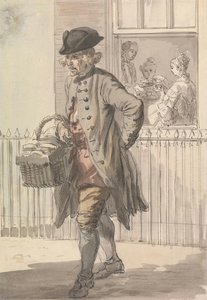
London Cries: A Muffin Man (1759) de Paul Sandby

London Cries: A Muffin Man

1759 · Drawing · Yale Center for British Art, New Haven

This evocative drawing, titled "London Cries: A Muffin Man," transports the modern viewer directly into the bustling, atmospheric heart of 18th-century London. The scene is rendered with a captivating immediacy that speaks volumes about daily commerce and human interaction. At the center moves the muffin man, his basket laden with tempting goods, embodying a moment of everyday ritual. His figure, complete with a distinctive hat and mustache, anchors the composition,…

4
Windsor Castle from the Great Park de Paul Sandby

Windsor Castle from the Great Park

Watercolor

This watercolor on paper, titled Windsor Castle from the Great Park, offers a quiet glimpse into the English landscape through the eyes of Paul Sandby. The work captures the castle as it sits within its surrounding parkland, viewed through a screen of foreground foliage. It is a piece that reflects the artist's deep connection to the terrain, specifically the areas around Windsor where he spent significant time sketching and observing…

5
Miss Marsden - back view de Paul Sandby

Miss Marsden - back view

Chalk

Miss Marsden - back view by Paul Sandby presents a focused portrait study of a woman viewed from behind. The subject is captured in period attire, emphasizing the silhouette and structural details of 19th-century fashion. Her clothing consists of a fitted bodice and a long skirt finished with a ruffled hem.

6
The Laterna Magica (1760) de Paul Sandby

The Laterna Magica

1760 · Watercolor · British Museum, Londra

Paul Sandby’s “The Laterna Magica,” painted in 1760, isn't merely a depiction of a room; it’s a meticulously crafted illusion, a vibrant snapshot of a world fascinated by the burgeoning technology of optical projection. More than just a charming scene of gentlemen observing a theatrical display, this watercolor offers a profound glimpse into the intellectual and social currents of 18th-century England – a period grappling with scientific advancement, artistic convention,…

7
London Cries: A Man with a Bottle (1759) de Paul Sandby

London Cries: A Man with a Bottle

1759 · Acrylic On Canvas · Yale Center for British Art, New Haven

Paul Sandby's "London Cries: A Man with a Bottle," painted in 1759, isn’t merely a depiction of a street scene; it’s a vibrant, almost theatrical window into the bustling heart of eighteenth-century London. This watercolor, now meticulously reproduced as a hand-painted artwork by WahooArt, captures a moment of everyday commerce and perhaps, a touch of wry observation, offering a glimpse into the lives of ordinary people within the grand tapestry…

8
The Meteor of August 18, 1783, as seen from the East Angle of the North Terrace, Windsor Castle (1783) de Paul Sandby

The Meteor of August 18, 1783, as seen from the East Angle of the North Terrace, Windsor Castle

1783 · Watercolor · Yale Center for British Art, New Haven

Paul Sandby's watercolor, “The Meteor of August 18, 1783,” isn’t merely a depiction of a fleeting astronomical event; it’s a window into the collective wonder and scientific curiosity of late 18th-century England. Painted from the East Angle of the North Terrace at Windsor Castle, the scene captures a pivotal moment – the transit of a meteor across the night sky – as observed by a small group of onlookers. The…

Selecția pentru Paul Sandby continuă, de la 11 la 79

11Study of a coachman de Paul SandbyStudy of a coachmanNational Portrait Gallery of Sweden 12Thomas Sandby and His Family de Paul SandbyThomas Sandby and His Family 13A Group of Four Children, with Dogs de Paul SandbyA Group of Four Children, with Dogs 14The Bayswater Road, Paddington de Paul SandbyThe Bayswater Road, Paddington 15Sketch of an elegant lady de Paul SandbySketch of an elegant lady 16Two Coaches with Passengers de Paul SandbyTwo Coaches with Passengers 17View of the Powder Magazine in Hyde Park de Paul SandbyView of the Powder Magazine in Hyde Park 18A riverside landscape de Paul SandbyA riverside landscape 19Back of the Public House near Bayswater de Paul SandbyBack of the Public House near Bayswater 20Windsor Park de Paul SandbyWindsor Park 21A Sleeping Woman; Study of a Head de Paul SandbyA Sleeping Woman; Study of a Head 22Travelers Entering a Town de Paul SandbyTravelers Entering a Town 23Ross Castle, Killarney, with villagers on a ferryboat de Paul SandbyRoss Castle, Killarney, with villagers on a ferryboat 24Windsor Great Park de Paul SandbyWindsor Great Park 25St. George's Gate, Canterbury de Paul SandbySt. George's Gate, Canterbury 26Rochester, Kent de Paul SandbyRochester, Kent 27Views of Windsor Castle de Paul SandbyViews of Windsor Castle 28The Iron Forge between Dolgelli and Barmouth 1 de Paul SandbyThe Iron Forge between Dolgelli and Barmouth 1 29The Light Steps, Hastings de Paul SandbyThe Light Steps, Hastings 30An Italianate landscape with women washing clothes de Paul SandbyAn Italianate landscape with women washing clothes 31The Cemetery Gate of St Augustine's Monastery Canterbury de Paul SandbyThe Cemetery Gate of St Augustine's Monastery Canterbury 32The Encampment in St James's Park de Paul SandbyThe Encampment in St James's Park 33A Boy Crawling on the Floor de Paul SandbyA Boy Crawling on the Floor 34A mother and child seated in a garden de Paul SandbyA mother and child seated in a garden 35A wooded river landscape with figures and cattle, a castle beyond de Paul SandbyA wooded river landscape with figures and cattle, a castle beyond 36The North Terrace of Windsor Castle looking west de Paul SandbyThe North Terrace of Windsor Castle looking west 37Naval post with three soldiers de Paul SandbyNaval post with three soldiers 38Part of the Banqueting Hall of the Royal Palace at Eltham de Paul SandbyPart of the Banqueting Hall of the Royal Palace at Eltham 39Man driving a donkey, and man leading a cart de Paul SandbyMan driving a donkey, and man leading a cart 40Woolwich from the Conduit Hill, the Thames estuary beyond de Paul SandbyWoolwich from the Conduit Hill, the Thames estuary beyond 41Young lady writing at a table de Paul SandbyYoung lady writing at a table 42A rural landscape de Paul SandbyA rural landscape 43A cottage by a river with figures in the foreground de Paul SandbyA cottage by a river with figures in the foreground 44The garden front of Old Somerset House, London de Paul SandbyThe garden front of Old Somerset House, London 45Henry VIII Gateway, Windsor Castle de Paul SandbyHenry VIII Gateway, Windsor Castle 46Young boy on a see-saw de Paul SandbyYoung boy on a see-saw 47Children on a see-saw de Paul SandbyChildren on a see-saw 48Young man, seated, holding a riding crop de Paul SandbyYoung man, seated, holding a riding crop 49Two of the artist's children with their nurse, seated in a garden de Paul SandbyTwo of the artist's children with their nurse, seated in a garden 50The Iron Forge between Dolgelli and Barmouth de Paul SandbyThe Iron Forge between Dolgelli and Barmouth 51View from a London terrace de Paul SandbyView from a London terrace 52Windsor Castle: The Round Tower, Royal Court and Devil (1767) de Paul SandbyWindsor Castle: The Round Tower, Royal Court and Devil1767 · National Gallery of Victoria 53Buildwas de Paul SandbyBuildwas 54View down a valley towards distant buildings, trees in the foreground de Paul SandbyView down a valley towards distant buildings, trees in the foreground 55Derwent Waster de Paul SandbyDerwent Waster 56Edinburgh Castle de Paul SandbyEdinburgh Castle 57View of Tonbridge de Paul SandbyView of Tonbridge 58View of Rackett Lodge, Wandsworth, London de Paul SandbyView of Rackett Lodge, Wandsworth, London 59Study of a donkey de Paul SandbyStudy of a donkey 60Old Windsor Green de Paul SandbyOld Windsor Green 61Middleham Castle, Yorkshire de Paul SandbyMiddleham Castle, Yorkshire 62An extensive river landscape with travellers de Paul SandbyAn extensive river landscape with travellers 63A horse and cart leaving a harbour de Paul SandbyA horse and cart leaving a harbour 64Woolwich from the Conduit Hill, the Thames beyond de Paul SandbyWoolwich from the Conduit Hill, the Thames beyond 65Cows in a Park de Paul SandbyCows in a Park 66Study of a Tree de Paul SandbyStudy of a Tree 67Trees and house seen from a meadow - Bishopgate de Paul SandbyTrees and house seen from a meadow - Bishopgate 68A shepherd driving his flock before a Scottish castle de Paul SandbyA shepherd driving his flock before a Scottish castle 69South East View of Windsor Castle From the Park de Paul SandbySouth East View of Windsor Castle From the Park 70A horse de Paul SandbyA horse 71An old grey horse tethered to a tree, a boy resting nearby de Paul SandbyAn old grey horse tethered to a tree, a boy resting nearby 72Foresters In Windsor Great Park de Paul SandbyForesters In Windsor Great Park 73View Of Windsor Castle And Part Of The Town From The Spital Hill de Paul SandbyView Of Windsor Castle And Part Of The Town From The Spital Hill 74An extensive wooded river landscape with an amorous couple making music under a tree de Paul SandbyAn extensive wooded river landscape with an amorous couple making music under a tree 75Sanby paul the spread eagle tavern millbank de Paul SandbySanby paul the spread eagle tavern millbank 76Llangollen, Denbighshire de Paul SandbyLlangollen, Denbighshire 77Part of the Old Bridge at Shrewsbury with two arches of the new one de Paul SandbyPart of the Old Bridge at Shrewsbury with two arches of the new one 78Cow­Girl in the Windsor Great Park de Paul SandbyCow­Girl in the Windsor Great Park 79A Man and a Saddled Horse de Paul SandbyA Man and a Saddled HorseYale Center for British Art

Subiectele care i-au captivat privirea lui Paul Sandby

Cele patru teme care revin cel mai des în aceste opere originale, fiecare având cel mai sublim exemplu.

Muzeele care păstrează originalele lui Paul Sandby

Cele 5 muzee care dețin cele mai multe dintre picturile de pe această pagină.

Muzee Oraș Lucrări lui Paul Sandby Picturi din această listă
Yale Center for British Art, New HavenYale Center for British Art New Haven 4 London Cries: A Muffin Man, London Cries: A Man with a Bottle, The Meteor of August 18, 1783, as seen from the East Angle of the North Terrace, Windsor Castle
Scottish National Gallery, EdinburghScottish National Gallery Edinburgh 1 Horse Fair on Bruntsfield Links, Edinburgh
British Museum, LondraBritish Museum Londra 1 The Laterna Magica
National Portrait Gallery of Sweden, SträngnäsNational Portrait Gallery of Sweden Strängnäs 1 Study of a coachman
National Gallery of Victoria, MelbourneNational Gallery of Victoria Melbourne 1 Windsor Castle: The Round Tower, Royal Court and Devil

Întrebări ale colecționarilor despre picturile lui Paul Sandby

Pentru ce operă este cel mai cunoscut Paul Sandby?Află răspunsul

Man standing in a landscape. Urmează Horse Fair on Bruntsfield Links, Edinburgh (1750) și London Cries: A Muffin Man (1759).

Care sunt cele mai celebre zece picturi ale lui Paul Sandby?Află răspunsul

Man standing in a landscape, Horse Fair on Bruntsfield Links, Edinburgh, London Cries: A Muffin Man, Windsor Castle from the Great Park, Miss Marsden - back view, The Laterna Magica, London Cries: A Man with a Bottle, The Meteor of August 18, 1783, as seen from the East Angle of the North Terrace, Windsor Castle, Boy with a whip și Study of a woman pointing. Clasamentul de mai sus indică anul și muzeul pentru fiecare piesă.

Câte picturi a lăsat Paul Sandby?Află răspunsul

Catalogul nostru conține 79 lucrări ale lui Paul Sandby.

În ce muzee sunt expuse capodoperele lui Paul Sandby?Află răspunsul

În principal în Yale Center for British Art (New Haven), Scottish National Gallery (Edinburgh) și British Museum (Londra). Tabelul cu muzee de mai sus le enumeră pe toate.

Ce subiecte a ales cel mai des Paul Sandby?Află răspunsul

Buildings (16), Landscape (10) și Gardens and parks (10), din cele 79 lucrări de pe această pagină.

Ce tehnică a folosit cel mai des Paul Sandby?Află răspunsul

Watercolor, pentru 4 dintre cele 79 lucrări de pe această pagină.

Din ce mișcare artistică face parte Paul Sandby?Află răspunsul

Romanticism și Neoclassicism, judecând după originalele de pe această pagină.

Ce lucrări ale lui Paul Sandby sunt expuse la Yale Center for British Art?Află răspunsul

London Cries: A Muffin Man, London Cries: A Man with a Bottle și The Meteor of August 18, 1783, as seen from the East Angle of the North Terrace, Windsor Castle: Yale Center for British Art, New Haven deține 4 dintre lucrările de pe această pagină.

Paul Sandby: viață și operă

Paul Sandby RA: Un pionier al picturii de peisaj și al desenului topografic

Paul Sandby (1731 – 7 noiembrie 1809) este o figură centrală în istoria picturii britanice, recunoscut nu doar pentru măiestria sa artistică, ci și pentru că a stabilit o tradiție estetică nouă care a influențat profund generațiile ulterioare. Născut în Nottingham, copil fiind al lui Thomas Sandby, un țesător, viața timpurie a lui Paul a fost marcată de autoeducație și de o fascinație innată pentru observație – calități care au contribuit esențial la formarea carierei sale extraordinare ca cartograf și pictor. Spre deosebire de mulți artiști ai vremii sale, care urmau o pregătire formală, Sandby a perfecționat arta sa independent, imersându-se în lumea naturală și documentând cu meticulozitate frumusețea ei prin acuarelă.
  • Viața timpurie și formarea: Anii de formare ai lui Paul au impregnat o apreciere profundă pentru detaliu și acuratețe – abilități care s-au tradus ulterior în mod natural în eforturile sale cartografice. Fratele său, Thomas, un alt desenator, a încurajat această inclinație artistică, promovând experimentarea și cultivând un spirit de colaborare.
  • Serviciul militar și expediția în Scoția: Implicarea lui Sandby în departamentul de desen militar din Tower of London l-a propulsat într-un rol care i-a expus grandorii Scoției în timpul Rebeliunii Jacobite. Această misiune i-a fost însărcinată cu crearea de hărți topografice și schițe ale peisajelor scoțiene – un proiect care l-a consacrat ca vizionar al istoriei și l-a transformat într-unul dintre cei mai importanți pictori de peisaj ai vremii sale.
  • Colaborare și stil artistic: Parteneriatul lui Sandby cu Thomas a fost crucial pentru dezvoltarea sa artistică. Împreună, au fondat o academie în Nottingham, atrăgând tineri artiști dornici să învețe de la expertiza lor. Stilul lor distinctiv – caracterizat prin culori luminoase și o reprezentare magistrală a perspectivei atmosferice – a devenit imediat recunoscut și profund influent.
  • Recunoașterea regală și contribuții arhitecturale: Legătura lui Sandby cu George al III-lea i-a ridicat statutul în comunitatea artistică, asigurându-i poziții la Academia Militară din Woolwich și Parcul Regal Windsor. Proiectele sale arhitecturale, inclusiv Vila Cumberland, au demonstrat versatilitatea sa și au consolidat moștenirea sa ca un constructor vizionar care a căutat să armonizeze arta și natura.
  • Moștenire și influență: Peisajele lui Sandby, celebre pentru realismul lor de neegalat – o dovadă a dedicării sale la captarea nuanțelor iluminării și texturii naturale – au stabilit-o ca pe un pionier al picturii romantice. Lucrările sale au promovat puterea expresivă a culorii și a luminii, inspirând artiști din întreaga Britanie și dincolo de granițele ei să îmbrățișeze o nouă sensibilitate estetică care pune accent pe rezonanța emoțională alături de acuratețea vizuală.
Sandby a fost un observator meticulos al Scoției – capturat în acuarele iconice precum „The Light Steps” și „West View of the City of Edinburgh” – care l-a consacrat ca pe un creator al unei noi viziuni asupra artei, combinând observația atentă cu o sensibilitate poetică. Acvarele sale nu sunt doar reprezentări vizuale ale peisajelor, ci și expresii emoționale ale experienței umane în fața naturii.

De la desen tehnic la pictură de peisaj: Evoluția unui artist

Sandby a început ca un desenator tehnic, excelând în crearea de hărți topografice precise și schițe detaliate. Această experiență l-a învățat să observe cu atenție, să analizeze formele și să documenteze cu acuratețe. Cu toate acestea, pasiunea lui pentru frumusețea naturală l-a determinat să se îndepărteze de rigorile desenului tehnic și să exploreze potențialul expresiv al culorii și luminii în acuarelă. În serviciul său militar la Tower of London, Sandby a fost expus la peisajele Scoției, unde a început să creeze schițe și picturi care au captat esența acestor locuri. Aceste lucrări au demonstrat o nouă abordare a picturii de peisaj – una care nu se concentra doar pe reprezentarea fidelă a formelor, ci și pe evocarea atmosferei și a emoțiilor. Sandby a fost influențat de pictori precum Claude Lorrain și Nicolas Poussin, care au folosit acuarela pentru a crea imagini idilice și romantice ale naturii. Cu toate acestea, Sandby a dezvoltat un stil unic, caracterizat prin culori luminoase, pensate delicate și o atenție deosebită la efectele luminii și umbrei.

Colaborare și influență: Academia din Nottingham și rolul său în dezvoltarea artei britanice

Sandby a fondat împreună cu fratele său o academie de artă în Nottingham, care a devenit un centru important pentru formarea artiștilor în Anglia. Academia a atras tineri talentați din întreaga țară, dornici să învețe de la experiența lui Sandby și a lui Thomas. Prin predarea sa și prin crearea de lucrări de artă, Sandby a contribuit semnificativ la dezvoltarea artei britanice. El a promovat o nouă abordare a picturii de peisaj, care pune accent pe expresia emoțională și pe captarea frumuseții naturale. Sandby a fost un mentor dedicat, care a inspirat generații de artiști. Lucrările sale au influențat mulți dintre cei mai importanți pictori britanici ai vremii, inclusiv Thomas Gainsborough și John Constable.

Recunoaștere și moștenire: Un artist venerat

Paul Sandby a fost recunoscut deopotrivă ca un cartograf talentat și ca un pictor prolific. Lucrările sale au fost expuse în cele mai importante galerii din Europa, iar el a primit numeroase premii și onorarii pentru contribuțiile sale la artă. După moartea sa, Sandby a fost considerat unul dintre cei mai importanți pictori de peisaj ai vremii sale. Moștenirea sa artistică continuă să inspire artiștii și să fascineze publicul până în ziua de azi. Sandby este adesea numit „tatăl picturii de peisaj moderne”, un titlu bine-meritat pentru rolul său fundamental în formarea unei noi viziuni asupra artei britanice.