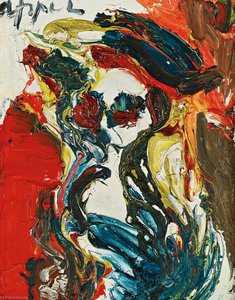
Portretul lui Karel Appel

Cele 41 cele mai faimoase picturi ale lui Karel Appel, fiecare unică în felul ei

Actualizat Octombrie 2026 · clasat în funcție de scorul nostru de popularitate (căutări, vizite și comenzi pentru fiecare operă) · 41 lucrări ale lui Karel Appel în catalogul nostru

Pe scurt

Square Man, Karel Appel, 1951 (1951) este pictură lui Karel Appel care atrage cele mai multe priviri. După aceasta, privirea se îndreaptă către Untitled (1960) și Three Figures (1952). Dintre cele 41 opere ale lui Karel Appel din catalogul nostru, acestea 41 sunt cele mai celebre, fiecare fiind o piesă unică, prezentată împreună cu anul creării, muzeul deținător și motivul pentru care aceasta rămâne memorabilă.

1921 – 2006, Amsterdam Cobra Cele mai multe lucrări: Muzeul Israel

Cele mai importante 10 picturi ale lui Karel Appel, prin ochii galeriei

1
Square Man, Karel Appel, 1951 (1951) de Karel Appel

Square Man, Karel Appel, 1951

1951 · Oil On Canvas

Square Man, Karel Appel, 1951 is an oil on canvas painting created by the artist Karel Appel. This work was executed in Paris in 1951. The physical presence of the piece is defined by its nearly square proportions, measuring 120,5 cm in height and 118 cm in width, with a depth of 4 cm.

2
Untitled (1960) de Karel Appel

Untitled

1960 · Screenprint · Tate Britain, Londra

In the landscape of post-war European modernism, few voices resonate with as much raw, unbridled vitality as that of Karel Appel. His 1960 work, Untitled, serves as a breathtaking manifesto of the COBRA movement, an avant-garde collective that sought to strip away the suffocating layers of academic tradition in favor of something far more primal. To encounter this piece is to witness a deliberate rebellion; it is not merely a…

Păiți celebrele picturi ale lui Karel Appel, de la numărul 11 la 41

Subiectele care i-au captivat privirea lui Karel Appel

Cele patru teme care revin cel mai des în aceste opere originale, fiecare având cel mai sublim exemplu.

Muzeele care păstrează originalele lui Karel Appel

Cele 6 muzee care dețin cele mai multe dintre picturile de pe această pagină.

Muzeu Oraș Lucrări lui Karel Appel Picturi din această listă
Muzeul Israel, IerusalimMuzeul Israel Ierusalim 3 Three Figures, Man and Woman (Homme et femme), Head Burst on Red
Tate Britain, LondraTate Britain Londra 2 Untitled, Untitled (from For Jorn)
Muzeul Regal de Arte Frumoase din Anvers, AntwerpenMuzeul Regal de Arte Frumoase din Anvers Antwerpen 2 Flying Man, Animal and Child on Blue Background
Art Institute of Chicago, ChicagoArt Institute of Chicago Chicago 1 Untitled
Colecțiile Statale de Pictură din Bavaria, MunchenColecțiile Statale de Pictură din Bavaria Munchen 1 Figure and Suns
Statens Museum For Kunst, CopenhagaStatens Museum For Kunst Copenhaga 1 Uden titel

Karel Appel de-a lungul deceniilor: o piesă unică pentru fiecare

Lucrări pe deceniu

Alege o deceniu pentru a descoperi opera originală care îl definește.

Picturile lui Karel Appel: întrebări pentru galerie

Care este cea mai celebră operă a lui Karel Appel?Află răspunsul

Square Man, Karel Appel, 1951 (1951). Urmează Untitled (1960) și Three Figures (1952).

La ce vârstă a creat Karel Appel Square Man, Karel Appel, 1951?Află răspunsul

30 ani: Square Man, Karel Appel, 1951 datează din 1951, iar Karel Appel s-a născut în 1921.

Care sunt cele mai celebre zece picturi ale lui Karel Appel?Află răspunsul

Square Man, Karel Appel, 1951, Untitled, Three Figures, Hip, Hip, Hoorah, Questioning Children, Hip, Hip, Hoorah (Hiep, hiep, hoera ), Blauw naakt, Étienne Martin, The Big Ear și Beast. Clasamentul de mai sus indică anul și muzeul pentru fiecare piesă.

Câte lucrări ale lui Karel Appel sunt cunoscute?Află răspunsul

Catalogul nostru cuprinde 41 lucrări ale lui Karel Appel, datate între 1949 și 1976.

Unde pot fi vizualizate originalele celor mai faimoși Karel Appel?Află răspunsul

În principal în Muzeul Israel (Ierusalim), Tate Britain (Londra) și Muzeul Regal de Arte Frumoase din Anvers (Antwerpen). Tabelul cu muzee de mai sus le enumeră pe toate.

În ce perioadă a creat Karel Appel cele mai cunoscute picturi?Află răspunsul

În 1950s: 18 dintre cele 41 lucrări de pe această pagină au fost realizate atunci, fiind Square Man, Karel Appel, 1951 dintre acestea.

Care este cea mai veche și care este cea mai recentă pictură a lui Karel Appel?Află răspunsul

Pe această pagină, cea mai veche lucrare datează din Hip, Hip, Hoorah (1949), iar cea mai recentă este din Untitled (from For Jorn) (1976).

Ce teme prefera Karel Appel?Află răspunsul

Organic forms (2), Abstract (2) și Color field (2), din cele 41 lucrări de pe această pagină.

Cu ce materiale a pictat cel mai des Karel Appel?Află răspunsul

Oil On Canvas, pentru 4 dintre cele 41 lucrări de pe această pagină.

Din ce curent artistic face parte opera lui Karel Appel?Află răspunsul

Cobra, judecând după originalele de pe această pagină.

Ce originale de Karel Appel pot vedea la Muzeul Israel?Află răspunsul

Three Figures, Man and Woman (Homme et femme) și Head Burst on Red: Muzeul Israel, Ierusalim deține 3 dintre lucrările de pe această pagină.

Karel Appel: un portret al artistului

A Life Painted in Bold Strokes: The World of Karel Appel

Christiaan Karel Appel, known affectionately as ‘Kik’ from childhood, burst onto the post-war art scene like a vibrant explosion of color and energy. Born in Amsterdam in 1921, his early life was steeped in the everyday rhythms of working-class Holland – his father a barber, his lineage tracing back to French Huguenots through his mother. This grounding, however, would soon be superseded by an irrepressible artistic drive that defied convention and ultimately reshaped the landscape of European art. A pivotal moment arrived at age fourteen with his first painting, a still life of fruit, followed shortly after by a paint set and easel gifted by his uncle Karel Chevalier, who also provided early instruction. These gifts weren’t merely tools; they were keys unlocking a world where imagination reigned supreme. The shadow of the Second World War loomed large over Appel’s formative years. Studying at the Rijksakademie van Beeldende Kunsten in Amsterdam during the German occupation proved challenging, yet it was there he forged lifelong bonds with fellow artists Corneille and Constant, friendships that would prove crucial to his artistic evolution. Facing opposition from his parents regarding his chosen path and fearing forced labor under Nazi rule, Appel bravely left home, choosing a life dedicated to art over conformity.

The CoBrA Revolution: Spontaneity and the Childlike Vision

Appel’s artistic journey truly ignited with the formation of the CoBrA group in 1948 – an acronym derived from Copenhagen, Brussels, and Amsterdam, representing the movement's core cities. Alongside Corneille, Constant, Jan Nieuwenhuys, and Christian Dotremont, Appel spearheaded a radical departure from established artistic norms. CoBrA wasn’t merely a style; it was a philosophy rooted in spontaneity, experimentation, and a profound embrace of the untamed creativity found in children's art and primitive cultures. Influenced by masters like Pablo Picasso and Henri Matisse, as well as the raw energy of Jean Dubuffet, Appel rejected rigid formalism in favor of intuitive expression. He began sculpting in 1947, utilizing assemblage techniques – constructing works from found materials painted in a bold palette of white, red, yellow, blue, and black. This period saw him involved with the Experimentele Groep, further solidifying his commitment to artistic innovation. The controversial fresco "Questioning Children" (1949), commissioned for Amsterdam City Hall, exemplified CoBrA’s provocative spirit but also sparked public outcry, ultimately leading to its being covered up – a testament to the movement’s challenging nature. Appel drew inspiration from Danish and Nordic mythology, weaving these ancient narratives into his increasingly abstract compositions. He believed that art should be free of academic conventions and embrace the primal energy of childhood.

Early Influences and Artistic Development

Appel’s artistic sensibilities were profoundly shaped by his upbringing in Amsterdam's working-class district. His father’s profession instilled a sense of practicality alongside an appreciation for craftsmanship, while his mother’s Huguenot heritage fostered intellectual curiosity and a connection to European history. The gift of a paint set from his uncle Karel Chevalier at the age of fourteen proved transformative, sparking his passion for painting and introducing him to techniques championed by Picasso and Matisse. Crucially, Appel's association with Corneille and Constant during his time at the Rijksakademie cemented these friendships and fostered collaborative experimentation. These formative relationships instilled in him a belief that art should be born from unfiltered emotion and observation—a conviction that would permeate his entire oeuvre.

International Recognition and Artistic Legacy

Appel’s artistic breakthrough arrived in 1954 with his debut exhibition at Martha Jackson Gallery in New York City, securing him a prominent place within the burgeoning Abstract Expressionist movement. His inclusion in “The New Decade” exhibition at MoMA solidified his reputation as a visionary artist who dared to challenge established aesthetic standards. Throughout the subsequent decades, Appel continued to produce monumental murals and sculptures that captivated audiences worldwide. Despite initial resistance from critics and public opinion regarding CoBrA’s radical approach, Appel experienced a resurgence of acclaim in the Netherlands after 1990, culminating in major retrospectives organized by Rudy Fuchs in Amsterdam and Brussels. His enduring influence can be seen in contemporary artists who embrace spontaneity and reject traditional artistic boundaries—a testament to Karel Appel's unwavering conviction that art possesses the power to express the deepest recesses of human experience.

Toate cele 41 de lucrări ale lui Karel Appel →