Portretul lui Hiroshige

Picturi Hiroshige: Cele 100 de cele mai faimoase, prin ochii unei galerii

Actualizat Octombrie 2026 · clasat în funcție de scorul nostru de popularitate (căutări, vizite și comenzi pentru fiecare operă) · 353 lucrări ale lui Hiroshige în catalogul nostru

Pe scurt

În ochii galeriei, cea mai celebră pictură a lui Hiroshige este Early Department from a Daimyo, a cărei originală este expusă la Nakagawa-machi Bato Hiroshige Museum of Art, Nagasaki. The maple leaves of Mama, Tekona shrine and Tsugi bridge (1857) și Hakone (1834) completează trioul pe care orice ochi îl recunoaște. Dintre cele 353 opere ale lui Hiroshige din catalogul nostru, galeria prezintă mai jos cele 100 cele mai faimoase, fiecare fiind originală, cu anul creării, muzeul de păstrare și elementul care o face unică.

1797 – 1858, Tokyo Japanese landscape painting Cele mai multe lucrări: Nakagawa-machi Bato Hiroshige Museum of Art

Cele mai apreciate 10 picturi ale lui Hiroshige din galerie

1
Early Department from a Daimyo de Hiroshige

Early Department from a Daimyo

Woodblock Print · Nakagawa-machi Bato Hiroshige Museum of Art, Nagasaki

In the delicate dance of lines and muted pigments, Utagawa Hiroshige’s Early Department from a Daimyo invites us to step through a portal into the heart of Edo-period Japan. This exquisite woodblock print captures a moment of vibrant communal life along a bustling riverside, where the rigid structures of social hierarchy melt into the shared leisure of a sunny afternoon. As we gaze upon the scene, we are not merely…

2
The maple leaves of Mama, Tekona shrine and Tsugi bridge (1857) de Hiroshige

The maple leaves of Mama, Tekona shrine and Tsugi bridge

1857 · Woodblock Print · Van Gogh Museum, Amsterdam

Utagawa Hiroshige (1797-1858), arguably the last titan of *ukiyo-e*, didn't merely depict landscapes; he crafted them into meditations on beauty and impermanence. “The Maple Leaves of Mama, Tekona Shrine and Tsugi Bridge,” created in 1857 during a period of significant societal transformation—the waning influence of feudal Japan as Western ideas crept in—stands as a testament to his enduring artistic legacy. More than just a visual record, it’s an embodiment of…

3
Hakone (1834) de Hiroshige

Hakone

1834 · Woodblock Print · Indianapolis Museum of Art, Indianapolis

Utagawa Hiroshige’s “Hakone,” created in 1834, is more than just a landscape; it's a poetic meditation on the beauty and transience of nature within Edo-period Japan. This woodblock print, part of his renowned series "The Fifty-three Stations of the Tōkaidō," captures a specific moment along the vital trade route connecting Tokyo (then Edo) with Kyoto. However, Hiroshige elevates this seemingly simple depiction of a mountain pass into something profoundly evocative,…

4
Station 36, Goyu; Kyoka Tokaido Series (1855) de Hiroshige

Station 36, Goyu; Kyoka Tokaido Series

1855 · Woodblock Print · Indianapolis Museum of Art, Indianapolis

In the delicate interplay of ink and paper, Utagawa Hiroshige’s "Station 36, Goyu; Kyoka Tokaido Series" offers much more than a mere topographical record of a journey. Completed in 1855, this exquisite woodblock print serves as a profound distillation of Edo-period sensibilities, capturing a yearning for tranquility amidst the burgeoning dynamism of a Japan in transition. As the nation stood at a pivotal crossroads between ancient feudal traditions and the…

5
Fushimi, Stația #51 (1842) de Hiroshige

Fushimi, Stația #51

1842 · Acrilic pe pânză întinsă · Indianapolis Museum of Art, Indianapolis

Hiroshige’s Fushimi Station #51: A Snapshot of Edo Tranquility Utagawa Hiroshige, născut Andō Tokutarō în 1797 în orașul vibrant Edo (astăzi Tokyo), este o figură emblematică în lumea *ukiyo-e*, picturile lumii plutitoare japoneze, și reprezintă ultima glorie a acestei forme de artă tradițională. În ciuda rădăcinilor sale solide în obiceiurile japonești ale gravurii pe lemn, Hiroshige a depășit simpla reproducere, infuzând peisajele cu o sensibilitate poetică care a resonat profund…

6
Ichikoku Bridge in the Eastern Capital (Tōto: Ichikoku bashi) (1858) de Hiroshige

Ichikoku Bridge in the Eastern Capital (Tōto: Ichikoku bashi)

1858 · Woodblock Print · Indianapolis Museum of Art, Indianapolis

The Ichikoku Bridge spans a quiet stretch of water in the Eastern Capital. Beneath its wooden arch, two boats drift through the current. People move across the structure, some carrying backpacks and others clutching small handbags. A mountain rises in the distance, watching over the scene. Trees frame the edges of the view, their leaves casting shadows near the water's edge.

7
Shinagawa Sunrise from the series Fifty-three Stations on the Tokaido Road (1834) de Hiroshige

Shinagawa Sunrise from the series Fifty-three Stations on the Tokaido Road

1834 · Woodblock Print · Hill-Stead Museum, Farmington

In the soft, burgeoning light of a nineteenth-century morning, Utagawa Hiroshige invites us to witness a moment of profound stillness along the Tōkaidō road. Shinagawa Sunrise is not merely a depiction of a coastal village; it is a masterclass in the art of atmosphere. As the sun begins its ascent, the boundary between the heavens and the earth dissolves into a luminous haze. The water of the bay reflects a…

8
The Rokugo River Ferry, Kawasaki, from the series the Fifty-three Stations of the Tokaido (Hoeido edition ) de Hiroshige

The Rokugo River Ferry, Kawasaki, from the series the Fifty-three Stations of the Tokaido (Hoeido edition )

Woodblock Print · Nakagawa-machi Bato Hiroshige Museum of Art, Nagasaki

In the delicate dance of woodblock printing, few masters captured the ephemeral beauty of Japanese life as profoundly as Utagawa Hiroshige. His masterpiece, The Rokugo River Ferry, Kawasaki, serves as a breathtaking window into the Edo period, inviting the viewer to step onto the bustling banks of one of the most vital crossings on the Tokaido road. This evocative scene from his legendary series, The Fifty-three Stations of the Tokaido,…

9
Itsukushima in Aki Province (1858) de Hiroshige

Itsukushima in Aki Province

1858 · Woodblock Print · Brooklyn Museum, Brooklyn

In the delicate interplay of mist and water, Itsukushima in Aki Province offers more than a mere glimpse of a Japanese landmark; it provides a profound meditation on the ephemeral nature of existence. Created by the legendary ukiyo-e master Ando Hiroshige in 1858, this woodcut print captures the spiritual essence of the Itsukushima shrine area with a poetic sensitivity that remains unparalleled. As one gazes upon the composition, the eye…

10
Tenryu River Ferry Crossing, Mitsuke, from the series The Fifty-three Stations of the Tokaido (Gyosho Edition) de Hiroshige

Tenryu River Ferry Crossing, Mitsuke, from the series The Fifty-three Stations of the Tokaido (Gyosho Edition)

Woodblock Print · Nakagawa-machi Bato Hiroshige Museum of Art, Nagasaki

The woodblock print depicts a section of the Tenryu River near the station of Mitsuke. In the center of the composition, a large sandbank divides the water into two distinct currents. Several small wooden boats occupy the river, with figures positioned within them to manage the crossing. Some vessels are moored directly against the central sandbank, while others navigate the moving water. The far shore is visible in the distance,…

Picturi cu Hiroshige, clasate de la 11 la 100

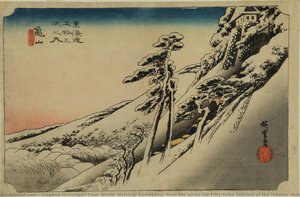
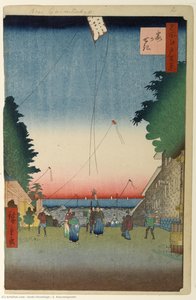
11Perpelor și Vitele de Struguri (1800) de HiroshigePerpelor și Vitele de Struguri1800 · Indianapolis Museum of Art 12The Pine Woods of Miho in Suruga Province (Suruga Miho no matsubara) (1858) de HiroshigeThe Pine Woods of Miho in Suruga Province (Suruga Miho no matsubara)1858 · Indianapolis Museum of Art 1362 (55) Komakata Hall and Azuma Bridge (1857) de Hiroshige62 (55) Komakata Hall and Azuma Bridge1857 · Brooklyn Museum 14Evening Snow at Kanbara (1834) de HiroshigeEvening Snow at Kanbara1834 · Los Angeles County Museum of Art 15Dawn in the licensed quarters (1857) de HiroshigeDawn in the licensed quarters1857 · Art Gallery of New South Wales 16Vederea de Noapte a Saruwakacho de HiroshigeVederea de Noapte a Saruwakacho 17Station 28, Fukuroi (1855) de HiroshigeStation 28, Fukuroi1855 · Indianapolis Museum of Art 18Evening Snow at Asakusa or Woman with Umbrella from the series Eight Views of the Environs of Edo (1800) de HiroshigeEvening Snow at Asakusa or Woman with Umbrella from the series Eight Views of the Environs of Edo1800 · Hill-Stead Museum 19Keishi (Kyoto), Capital (1834) de HiroshigeKeishi (Kyoto), Capital1834 · Indianapolis Museum of Art 20Hara: View of Ashitakayama and Fuji (1855) de HiroshigeHara: View of Ashitakayama and Fuji1855 · Indianapolis Museum of Art 21Yokkaichi (Station #44) (1834) de HiroshigeYokkaichi (Station #44)1834 · Indianapolis Museum of Art 22Desolate Wintry Scene, Hamamatsu, from the series the Fifty-three Stations of the Tokaido (Hoeido edition) de HiroshigeDesolate Wintry Scene, Hamamatsu, from the series the Fifty-three Stations of the Tokaido (Hoeido edition)Nakagawa-machi Bato Hiroshige Museum of Art 23Noge and Yokohama in Musashi Province (Musashi, Noge, Yokohama) (1858) de HiroshigeNoge and Yokohama in Musashi Province (Musashi, Noge, Yokohama)1858 · Indianapolis Museum of Art 24Wild sea breaking on the rocks (1856) de HiroshigeWild sea breaking on the rocks1856 25Șirasuga, Shiomi-zaka zu (Vederea asupra Pârului Shima) (1833) de HiroshigeȘirasuga, Shiomi-zaka zu (Vederea asupra Pârului Shima)1833 · Indianapolis Museum of Art 26Mt.Fuji on the Left, Yoshiwara, from the series the Fifty-three Stations of the Tokaido (Hoeido edition) de HiroshigeMt.Fuji on the Left, Yoshiwara, from the series the Fifty-three Stations of the Tokaido (Hoeido edition)Nakagawa-machi Bato Hiroshige Museum of Art 27Tsukuda Offing in the Eastern Capital (Tōto: Tsukuda oki) (1858) de HiroshigeTsukuda Offing in the Eastern Capital (Tōto: Tsukuda oki)1858 · Indianapolis Museum of Art 28Kawachi (1853) de HiroshigeKawachi1853 · Indianapolis Museum of Art 29The Dye Craft Shops of Arimatsu, Narumi, from the series The Fifty-three Stations of the Tokaido (Gyosho edition) de HiroshigeThe Dye Craft Shops of Arimatsu, Narumi, from the series The Fifty-three Stations of the Tokaido (Gyosho edition)Nakagawa-machi Bato Hiroshige Museum of Art 30View of Shiomi Slope, Shirasuka, from the series The Fifty-three Stations of the Tokaido (Gyosho edition) de HiroshigeView of Shiomi Slope, Shirasuka, from the series The Fifty-three Stations of the Tokaido (Gyosho edition)Nakagawa-machi Bato Hiroshige Museum of Art 31Entrance to Enoshima in Sagami Province (Sagami Enoshima iriguchi) (1858) de HiroshigeEntrance to Enoshima in Sagami Province (Sagami Enoshima iriguchi)1858 · Indianapolis Museum of Art 32Morning Mist, Mishima, from the series the Fifty-three Stations of the Tokaido (Hoeido edition ) de HiroshigeMorning Mist, Mishima, from the series the Fifty-three Stations of the Tokaido (Hoeido edition )Nakagawa-machi Bato Hiroshige Museum of Art 33The Imagire Sea Ferry, Maisaka, from the series The Fifty-three Stations of the Tokaido (Gyosho edition) de HiroshigeThe Imagire Sea Ferry, Maisaka, from the series The Fifty-three Stations of the Tokaido (Gyosho edition)Nakagawa-machi Bato Hiroshige Museum of Art 34Sukiya Riverbank in the Eastern Capital (Tōto sukiya kaigan) (1858) de HiroshigeSukiya Riverbank in the Eastern Capital (Tōto sukiya kaigan)1858 · Indianapolis Museum of Art 35Satta Pass, Yui, from the series the Fifty-three Stations of the Tokaido (Hoeido edition) de HiroshigeSatta Pass, Yui, from the series the Fifty-three Stations of the Tokaido (Hoeido edition)Nakagawa-machi Bato Hiroshige Museum of Art 36True View of Imagire, Maisaka, from the series the Fifty-three Stations of the Tokaido (Hoeido edition) de HiroshigeTrue View of Imagire, Maisaka, from the series the Fifty-three Stations of the Tokaido (Hoeido edition)Nakagawa-machi Bato Hiroshige Museum of Art 37Kanbara, Noapte Albă (1834) de HiroshigeKanbara, Noapte Albă1834 · Indianapolis Museum of Art 38Clear Winter Morning, Kameyama, from the series the Fifty-three Stations of the Tokaido (Hoeido edition) de HiroshigeClear Winter Morning, Kameyama, from the series the Fifty-three Stations of the Tokaido (Hoeido edition)Nakagawa-machi Bato Hiroshige Museum of Art 39The Tenryu River, Mitsuke, from the series the Fifty-three Stations of the Tokaido (Hoeido edition) de HiroshigeThe Tenryu River, Mitsuke, from the series the Fifty-three Stations of the Tokaido (Hoeido edition)Nakagawa-machi Bato Hiroshige Museum of Art 40The Seven-ri Ferry Crossing, Kuwana, from the series the Fifty-three Stations of the Tokaido (Hoeido edition) de HiroshigeThe Seven-ri Ferry Crossing, Kuwana, from the series the Fifty-three Stations of the Tokaido (Hoeido edition)Nakagawa-machi Bato Hiroshige Museum of Art 41Aronia and Bullfinch de HiroshigeAronia and Bullfinch 42Găsesc gâștele în Katata (1834) de HiroshigeGăsesc gâștele în Katata1834 · Indianapolis Museum of Art 43Yugyoji Temple, Fujisawa, from the series the Fifty-three Stations of the Tokaido (Hoeido edition) de HiroshigeYugyoji Temple, Fujisawa, from the series the Fifty-three Stations of the Tokaido (Hoeido edition)Nakagawa-machi Bato Hiroshige Museum of Art 44Travellers and Soliciting Women, Goyu, from the series the Fifty-three Stations of the Tokaido (Hoeido edition) de HiroshigeTravellers and Soliciting Women, Goyu, from the series the Fifty-three Stations of the Tokaido (Hoeido edition)Nakagawa-machi Bato Hiroshige Museum of Art 45The Totoumi Bank of the Oi River, Kanaya, from the series the Fifty-three Stations of the Tokaido (Hoeido edition) de HiroshigeThe Totoumi Bank of the Oi River, Kanaya, from the series the Fifty-three Stations of the Tokaido (Hoeido edition)Nakagawa-machi Bato Hiroshige Museum of Art 46The Suruga Bank of the Oi River, Shimada, from the series the Fifty-three Stations of the Tokaido (Hoeido edition) de HiroshigeThe Suruga Bank of the Oi River, Shimada, from the series the Fifty-three Stations of the Tokaido (Hoeido edition)Nakagawa-machi Bato Hiroshige Museum of Art 47Kyoka Tokaido Series, Kanagawa (Yokohama) de HiroshigeKyoka Tokaido Series, Kanagawa (Yokohama)Indianapolis Museum of Art 48Distant View of Miho, Ejiri, from the series the Fifty-three Stations of the Tokaido (Hoeido edition) de HiroshigeDistant View of Miho, Ejiri, from the series the Fifty-three Stations of the Tokaido (Hoeido edition)Nakagawa-machi Bato Hiroshige Museum of Art 49Mt. Fuji in the Morning, Hara, from the series the Fifty-three Stations of the Tokaido (Hoeido edition) de HiroshigeMt. Fuji in the Morning, Hara, from the series the Fifty-three Stations of the Tokaido (Hoeido edition)Nakagawa-machi Bato Hiroshige Museum of Art 50A Horse Fair, Chiriu, from the series the Fifty-three Stations of the Tokaido (Hoeido edition) de HiroshigeA Horse Fair, Chiriu, from the series the Fifty-three Stations of the Tokaido (Hoeido edition)Nakagawa-machi Bato Hiroshige Museum of Art 51Wakasa (1853) de HiroshigeWakasa1853 · Indianapolis Museum of Art 52Distant View of Mt.Akiba, Kakegawa, from the series the Fifty-three Stations of the Tokaido (Hoeido edition) de HiroshigeDistant View of Mt.Akiba, Kakegawa, from the series the Fifty-three Stations of the Tokaido (Hoeido edition)Nakagawa-machi Bato Hiroshige Museum of Art 53The Ichiri-Han Sea Ferry, Arai, from the series The Fifty-three Stations of the Tokaido (Gyosho edition) de HiroshigeThe Ichiri-Han Sea Ferry, Arai, from the series The Fifty-three Stations of the Tokaido (Gyosho edition)Nakagawa-machi Bato Hiroshige Museum of Art 54Gateway Entrance to the Atsuta Shrine on the Beach, Miya, from the series The Fifty-three Stations of the Tokaido (Gyosho edition) de HiroshigeGateway Entrance to the Atsuta Shrine on the Beach, Miya, from the series The Fifty-three Stations of the Tokaido (Gyosho edition)Nakagawa-machi Bato Hiroshige Museum of Art 55Akasaka, from the series The Fifty-three Stations of the Tokaido (Gyosho edition) de HiroshigeAkasaka, from the series The Fifty-three Stations of the Tokaido (Gyosho edition)Nakagawa-machi Bato Hiroshige Museum of Art 56The Sakawa River, Odawara, from the series the Fifty-three Stations of the Tokaido (Hoeido edition) de HiroshigeThe Sakawa River, Odawara, from the series the Fifty-three Stations of the Tokaido (Hoeido edition)Nakagawa-machi Bato Hiroshige Museum of Art 57A Footpath between Ricefield, Hiratsuka, from the series the Fifty-three Stations of the Tokaido (Hoeido edition) de HiroshigeA Footpath between Ricefield, Hiratsuka, from the series the Fifty-three Stations of the Tokaido (Hoeido edition)Nakagawa-machi Bato Hiroshige Museum of Art 58Awa Province: Whirlpool at Naruto (1853) de HiroshigeAwa Province: Whirlpool at Naruto1853 5973 The City Flourishing, the Tanabata Festival (1857) de Hiroshige73 The City Flourishing, the Tanabata Festival1857 60Sarugababa Plain, Futagawa, from the series the Fifty-three Stations of the Tokaido (Hoeido edition) de HiroshigeSarugababa Plain, Futagawa, from the series the Fifty-three Stations of the Tokaido (Hoeido edition)Nakagawa-machi Bato Hiroshige Museum of Art 61Local Specialty Teahouse, Mariko, from the series the Fifty-three Stations of the Tokaido (Hoeido edition) de HiroshigeLocal Specialty Teahouse, Mariko, from the series the Fifty-three Stations of the Tokaido (Hoeido edition)Nakagawa-machi Bato Hiroshige Museum of Art 62Sakanoshita de HiroshigeSakanoshitaIndianapolis Museum of Art 63Stația 23, Fujieda de HiroshigeStația 23, FujiedaIndianapolis Museum of Art 64Marsh Grasses and Mandarin Ducks de HiroshigeMarsh Grasses and Mandarin Ducks 6550th station, Minakuchi de Hiroshige50th station, Minakuchi 66Sakanoshita: the Throwing Away the Brush Peak (1834) de HiroshigeSakanoshita: the Throwing Away the Brush Peak1834 · Brooklyn Museum 67Shibaura Bay of Musashi Province (801) de HiroshigeShibaura Bay of Musashi Province801 · Metropolitan Museum of Art 68Koyurugi Beach of Sagami Province (801) de HiroshigeKoyurugi Beach of Sagami Province801 · Metropolitan Museum of Art 69Honmoku Bay of Musashi Province (801) de HiroshigeHonmoku Bay of Musashi Province801 · Metropolitan Museum of Art 70Untitled (Two Rabbits, Pampas Grass, and Full Moon) (1851) de HiroshigeUntitled (Two Rabbits, Pampas Grass, and Full Moon)1851 7111. Kiyomizu Hall and Shinobazu Pond at Ueno (1857) de Hiroshige11. Kiyomizu Hall and Shinobazu Pond at Ueno1857 7285. Kinokuni Hill and Distant View of Akasaka and the Tameike Pond (1857) de Hiroshige85. Kinokuni Hill and Distant View of Akasaka and the Tameike Pond1857 7376 Bamboo Quay by Kyōbashi Bridge (1857) de Hiroshige76 Bamboo Quay by Kyōbashi Bridge1857 7458 (52) Sudden Shower over Shin-Ōhashi bridge and Atake (1857) de Hiroshige58 (52) Sudden Shower over Shin-Ōhashi bridge and Atake1857 · Tokyo Fuji Art Museum 75103. Senju Great Bridge (1857) de Hiroshige103. Senju Great Bridge1857 7618. The Ōji Inari Shrine (1857) de Hiroshige18. The Ōji Inari Shrine1857 77113. Aoi Slope Outside Toranomon Gate (1857) de Hiroshige113. Aoi Slope Outside Toranomon Gate1857 78114. Bikuni Bridge in Snow (1857) de Hiroshige114. Bikuni Bridge in Snow1857 7970 (60) The Mouth of the Nakagawa River (1857) de Hiroshige70 (60) The Mouth of the Nakagawa River1857 802. Kasumigaseki (1857) de Hiroshige2. Kasumigaseki1857 8115. Suwa Bluff in Nippori (1857) de Hiroshige15. Suwa Bluff in Nippori1857 8263 (69) The Ayase River and Kanegafuchi (1857) de Hiroshige63 (69) The Ayase River and Kanegafuchi1857 83115. The Takata Riding Grounds (1857) de Hiroshige115. The Takata Riding Grounds1857 8486. Naitō Shinjuku in Yotsuya (1857) de Hiroshige86. Naitō Shinjuku in Yotsuya1857 8516. Flower Park and Dangozaka Slope in Sendagi (1857) de Hiroshige16. Flower Park and Dangozaka Slope in Sendagi1857 8668 (59) Open Garden at the Hachiman Shrine in Fukagawa (1857) de Hiroshige68 (59) Open Garden at the Hachiman Shrine in Fukagawa1857 8710. Sunrise at Kanda Myōjin Shrine (1857) de Hiroshige10. Sunrise at Kanda Myōjin Shrine1857 88Peach and Long-tailed Bird de HiroshigePeach and Long-tailed Bird 89Golden Pheasant in Bracken de HiroshigeGolden Pheasant in Bracken 90The Imado Bridge at the Foot of Mount Matsuchi (801) de HiroshigeThe Imado Bridge at the Foot of Mount Matsuchi801 · Metropolitan Museum of Art 91Dog (1858) de HiroshigeDog1858 · Indianapolis Museum of Art 92118. Kitsunebi on New Year's Night Under the Enoki Tree near Ōji (1857) de Hiroshige118. Kitsunebi on New Year's Night Under the Enoki Tree near Ōji1857 93109. Minami Shinagawa and Samezu Coast (1857) de Hiroshige109. Minami Shinagawa and Samezu Coast1857 94Night View of Matsuchiyama and the San (1857) de HiroshigeNight View of Matsuchiyama and the San1857 · Los Angeles County Museum of Art 95Akasaka nr. 37 de HiroshigeAkasaka nr. 37Indianapolis Museum of Art 96Shiojiri Pass in Shinano Province (Shinano Shiojiritōge) (1858) de HiroshigeShiojiri Pass in Shinano Province (Shinano Shiojiritōge)1858 · Indianapolis Museum of Art 97Yoshiwara de HiroshigeYoshiwaraIndianapolis Museum of Art 98Fuchu, No. 20 de HiroshigeFuchu, No. 20Indianapolis Museum of Art 99Woman Walking in the Snow (1850) de HiroshigeWoman Walking in the Snow1850 · Metropolitan Museum of Art 10082. Moon Viewing (1857) de Hiroshige82. Moon Viewing1857

Piesele celebre ale lui Hiroshige, perioadă cu perioadă

Subiectele care i-au captivat privirea lui Hiroshige

Cele patru teme care revin cel mai des în aceste opere originale, fiecare având cel mai sublim exemplu.

Muzeele care păstrează originalele lui Hiroshige

Cele 8 muzee care dețin cele mai multe dintre picturile de pe această pagină.

Muzeu Oraș Lucrări lui Hiroshige Picturi din această listă
Nakagawa-machi Bato Hiroshige Museum of Art, NagasakiNakagawa-machi Bato Hiroshige Museum of Art Nagasaki 30 Early Department from a Daimyo, The Rokugo River Ferry, Kawasaki, from the series the Fifty-three Stations of the Tokaido (Hoeido edition ), Tenryu River Ferry Crossing, Mitsuke, from the series The Fifty-three Stations of the Tokaido (Gyosho Edition)
Indianapolis Museum of Art, IndianapolisIndianapolis Museum of Art Indianapolis 36 Hakone, Station 36, Goyu; Kyoka Tokaido Series, Fushimi, Stația #51
Metropolitan Museum of Art, New YorkMetropolitan Museum of Art New York 8 Shibaura Bay of Musashi Province, Koyurugi Beach of Sagami Province, Honmoku Bay of Musashi Province
Brooklyn Museum, BrooklynBrooklyn Museum Brooklyn 4 Itsukushima in Aki Province, 62 (55) Komakata Hall and Azuma Bridge, Sakanoshita: the Throwing Away the Brush Peak
Hill-Stead Museum, FarmingtonHill-Stead Museum Farmington 3 Shinagawa Sunrise from the series Fifty-three Stations on the Tokaido Road, Evening Snow at Asakusa or Woman with Umbrella from the series Eight Views of the Environs of Edo
Los Angeles County Museum of Art, Los AngelesLos Angeles County Museum of Art Los Angeles 2 Evening Snow at Kanbara, Night View of Matsuchiyama and the San
Van Gogh Museum, AmsterdamVan Gogh Museum Amsterdam 1 The maple leaves of Mama, Tekona shrine and Tsugi bridge
Art Gallery of New South Wales, SydneyArt Gallery of New South Wales Sydney 1 Dawn in the licensed quarters

Hiroshige, o pictură emblematică pe deceniu

Lucrări pe deceniu

Alege o deceniu pentru a descoperi opera originală care îl definește.

Picturile lui Hiroshige: răspunsurile galeriei

Care este cea mai celebră pictură a lui Hiroshige?Află răspunsul

Early Department from a Daimyo, Nakagawa-machi Bato Hiroshige Museum of Art, Nagasaki. Urmează The maple leaves of Mama, Tekona shrine and Tsugi bridge (1857) și Hakone (1834).

Care sunt cele mai importante 10 picturi ale lui Hiroshige?Află răspunsul

Early Department from a Daimyo, The maple leaves of Mama, Tekona shrine and Tsugi bridge, Hakone, Station 36, Goyu; Kyoka Tokaido Series, Fushimi, Stația #51, Ichikoku Bridge in the Eastern Capital (Tōto: Ichikoku bashi), Shinagawa Sunrise from the series Fifty-three Stations on the Tokaido Road, The Rokugo River Ferry, Kawasaki, from the series the Fifty-three Stations of the Tokaido (Hoeido edition ), Itsukushima in Aki Province și Tenryu River Ferry Crossing, Mitsuke, from the series The Fifty-three Stations of the Tokaido (Gyosho Edition). Clasamentul de mai sus indică anul și muzeul pentru fiecare piesă.

Câte lucrări a creat Hiroshige?Află răspunsul

Catalogul nostru cuprinde 353 lucrări ale lui Hiroshige, datate între 1833 și 1858.

Unde sunt expuse cele mai celebrele opere originale ale lui Hiroshige?Află răspunsul

În principal în Nakagawa-machi Bato Hiroshige Museum of Art (Nagasaki), Indianapolis Museum of Art (Indianapolis) și Metropolitan Museum of Art (New York). Tabelul cu muzee de mai sus le enumeră pe toate.

Când a creat Hiroshige cele mai faimoase picturi?Află răspunsul

În 1850s: 43 dintre cele 100 lucrări de pe această pagină au fost realizate atunci, fiind The maple leaves of Mama, Tekona shrine and Tsugi bridge dintre acestea.

Care sunt cele mai vechi și cele mai recente opere celebre ale lui Hiroshige?Află răspunsul

Pe această pagină, cea mai veche lucrare datează din Șirasuga, Shiomi-zaka zu (Vederea asupra Pârului Shima) (1833), iar cea mai recentă este din Ichikoku Bridge in the Eastern Capital (Tōto: Ichikoku bashi) (1858).

La ce subiecte s-a întors cel mai des Hiroshige?Află răspunsul

Edo period (31), Ukiyo-e (23) și Woodblock print (21), din cele 100 lucrări de pe această pagină.

În ce tehnică a lucrat cel mai mult Hiroshige?Află răspunsul

Woodblock Print, pentru 61 dintre cele 100 lucrări de pe această pagină.

Cu ce mișcare este asociat(ă) Hiroshige?Află răspunsul

Japanese landscape painting, judecând după originalele de pe această pagină.

Ce opere originale ale lui Hiroshige deține Nakagawa-machi Bato Hiroshige Museum of Art?Află răspunsul

Early Department from a Daimyo, The Rokugo River Ferry, Kawasaki, from the series the Fifty-three Stations of the Tokaido (Hoeido edition ) și Tenryu River Ferry Crossing, Mitsuke, from the series The Fifty-three Stations of the Tokaido (Gyosho Edition): Nakagawa-machi Bato Hiroshige Museum of Art, Nagasaki deține 29 dintre lucrările de pe această pagină.

Pot solicita o reproducere manuală a unei picturi a lui Hiroshige?Află răspunsul

Da, ca reproducere: originalul rămâne în muzeu, însă orice pictură de pe această pagină poate fi pictată manual pentru tine, la comandă, unic pentru tine, direct de pe pagina proprie a picturii.

Hiroshige: artistul

A Poetic Vision of Edo Japan: The Life and Art of Utagawa Hiroshige

Utagawa Hiroshige, născut Andō Tokutarō în 1797 în orașul vibrant Edo (Tokyo modern), se ridică ca o figură centrală în lumea *ukiyo-e*, sau “imagini ale lumii plutitoare”. Deși profund înrădăcinat în tradițiile tipografiei japoneze pe lemn, Hiroshige a transcendat simpla reproducere, infuzând peisajele cu o sensibilitate poetică care a rezonat adânc atât în Japonia, cât și mai târziu, peste granițele sale, în lumea de artă occidentală. Viața sa s-a desfășurat într-o perioadă de pace relativă și prosperitate sub shogunatul Tokugawa, dar și una marcată de schimbări sociale crescânde și de eventuala vestimizare – forțe care au contribuit în cele din urmă la declinul *ukiyo-e*, chiar dacă au amplificat moștenirea sa durabilă. Inițial destinat unui drum mai convențional în cadrul unei familii samurai – tatăl său fiind paznic al focului, Hiroshige a fost atras de aspirațiile sale artistice, începând un stagiu de ucenicie sub îndrumarea lui Utagawa Toyohiro, un maestru al școlii Utagawa. Aceasta s-a dovedit a fi o întorsătură crucială, îndepărtându-l de reprezentările populare ale curtezanelor și actrițelor favorizate de mulți artiști *ukiyo-e*, către un focus pe peisaj, un gen pe care l-a redefinit în cele din urmă.

From Genre Scenes to Evocative Landscapes

Lucrările timpurii ale lui Hiroshige au respectat convențiile școlii sale, prezentând portrete și scene din viața de zi cu zi. Cu toate acestea, îmbrățișarea peisajului l-a diferențiat cu adevărat. Influentați de maeștrii anteriori precum Hokusai – ale cărui *Cele Treizeci și șase de vederi ale Muntelui Fuji* captivează deja publicul, Hiroshige a dezvoltat un stil unic caracterizat prin perspectivă atmosferică, palete subtile de culori și o sensibilitate profundă la schimbările anotimpurilor. El nu doar reprezenta locuri; el evoca starea lor de spirit, surprinzând esența unui moment specific în timp. Seria *Cele cincizeci și trei de stații ale Tōkaidō* (1833–1834), probabil cea mai celebră realizare a sa, documenta călătoria de-a lungul drumului Tōkaidō, ruta principală care lega Edo de Kyoto, nu ca un simplu jurnal de călătorie, ci ca o serie de vignette evocatoare – o ploaie bruscă la Shono, o vedere îndepărtată a Muntelui Fuji din Kanaya, activitatea aglomerată de la Odawara. Fiecare print este impregnat cu un sentiment de trecătoare și liniște, invitând privitorii să experimenteze călătoria alături de călătorii. A maîtrizat *bokashi*, o tehnică care implică mai multe impresii pentru a crea gradații subtile de culoare, adăugând profunzime și atmosferă compozițiilor sale.

A Master of Atmosphere and Technique

Abilitățile tehnice ale lui Hiroshige au fost la fel de remarcabile ca viziunea sa artistică. El nu se concentra doar pe reprezentarea precisă; el căuta să surprindă *sentimentul* unui loc. Utilizarea culorilor sale, deși adesea restrânsă comparativ cu a unor contemporani, a fost crucială pentru a obține acest efect. De multe ori, el a folosit mai multe plăci pentru o singură culoare, permițându-i să creeze nuanțe subtile și efecte atmosferice care au fost incredibil de dificil de replicat. Culoarea delicată albastră în reprezentările sale ale ploii sau ceața, tonurile calde ale frunzișului toamnei – acestea nu au fost accidentale; erau elemente deliberate concepute pentru a evoca emoții și senzații specifice. Dincolo de *bokashi*, Hiroshige era priceput la utilizarea spațiului liber – *ma* – un concept central al esteticii japoneze, permițând zonelor de pe print să „respire” și îmbunătățind în același timp sentimentul general de liniște. Seria sa *O sută de vederi celebre din Edo* (1856–1858) a demonstrat în continuare măiestria sa, oferind perspective intime asupra vieții și peisajelor orașului său iubit.

The Enduring Legacy: Japonisme and Beyond

Deși tradiția *ukiyo-e* a început să slăbească după moartea lui Hiroshige în 1858 – o scădere accelerată de către venirea culturii occidentale sub Restaurarea Meiji și fluxul ulterior de cultură occidentală – influența sa asupra lumii artistice s-a dovedit remarcabil de durabilă. În ultimele decenii ale secolului al XIX-lea, printurile japoneze au inundat Europa, declanșând un fenomen cunoscut sub numele de *Japonisme*. Artiști precum Édouard Manet, Claude Monet și Edgar Degas au fost captivați de compozițiile îndrăznețe, perspectivele aplatizate și schemele de culori neconvenționale ale *ukiyo-e*, incorporând aceste elemente în propriile lor lucrări. Vincent van Gogh a fost în special fascinat de printurile lui Hiroshige, creând copii mai multor dintre ele, inclusiv „Plum Park in Kameido”, demonstrând admirația sa profundă pentru stilul japonez al maestrului. Moartea lui Hiroshige a marcat începutul rapid al declinului genului *ukiyo-e*, în special în fața vestimizării care a urmat Restaurarea Meiji și fluxul ulterior de cultură occidentală. Opera sa a avut o influență puternică asupra picturii europene occidentale spre sfârșitul secolului al XIX-lea, fiind parte a unei tendințe de a împrumuta estetica japoneză în alte domenii. Hiroshige este amintit astăzi nu numai ca un artist strălucit, ci și ca un ambasador cultural care a ajutat la punerea în legătură Estul și Vestul, lăsând o amprentă indelebilă asupra istoriei artei.

Notable Works

  • Cele cincizeci și trei de stații ale Tōkaidō: Cea mai celebră serie a lui Hiroshige, reprezentând călătoria de-a lungul drumului Tōkaidō.
  • O sută de vederi celebre din Edo: O reprezentare captivantă a vieții și peisajelor din orașul său iubit.
  • Influența seriei lui Van Gogh "Japonaiserie": Include "Plum Park in Kameido", demonstrând admirația profundă a lui Van Gogh pentru stilul japonez al maestrului Hiroshige.

Toate cele 353 de lucrări ale lui Hiroshige →