Portretul lui Hendrik Goltzius

Cele 98 cele mai faimoase picturi ale lui Hendrik Goltzius, fiecare unică în felul ei

Actualizat Noiembrie 2026 · clasat în funcție de scorul nostru de popularitate (căutări, vizite și comenzi pentru fiecare operă) · 110 lucrări ale lui Hendrik Goltzius în catalogul nostru

Pe scurt

Venus și Adonis (1614) este pictura lui Hendrik Goltzius care atrage cele mai multe priviri; originalul aparține Alte Pinakothek, Munchen. După aceasta, privirea se îndreaptă către Hercules and Cacus (1613) și Standard-bearer (1587). Dintre cele 110 opere ale lui Hendrik Goltzius din catalogul nostru, acestea 98 sunt cele mai celebre, fiecare fiind o piesă unică, prezentată împreună cu anul creării, muzeul deținător și motivul pentru care aceasta rămâne memorabilă.

1558 – 1617, Bracht Manierism Cele mai multe lucrări: Rijksmuseum

Cele mai importante 10 picturi ale lui Hendrik Goltzius, prin ochii galeriei

1
Venus și Adonis (1614) de Hendrik Goltzius

Venus și Adonis

1614 · Ulei pe pânză · Alte Pinakothek, Munchen

A sta în fața operei „Venus și Adonis” de Hendrick Goltzius înseamnă a păși direct în atmosfera vibrantă și plină de încărcătură emoțională a primului Baroc. Finalizată în 1614, această capodoperă realizată în ulei pe pânză transcende simpla reprezentare; este o narațiune capturată în pigment—un moment de profundă intimitate plasat pe fundalul mitologiei clasice. Scena se desfășoară cu un dramatic uimitor, atras de privitor în interacțiunea tandră, dar puternică, dintre…

2
Hercules and Cacus (1613) de Hendrik Goltzius

Hercules and Cacus

1613 · Oil On Canvas · Mauritshuis, Haag

Hendrick Goltzius's “Hercules and Cacus,” painted in 1613, isn’t merely a depiction of a legendary hero; it’s a visceral embodiment of strength, conflict, and the enduring power of narrative. This monumental work, now residing within the Palazzo Vecchio in Florence, immediately commands attention with its dynamic composition and dramatic chiaroscuro – the masterful use of light and shadow that sculpts both form and emotion. Goltzius, a pivotal figure in the…

3
Standard-bearer (1587) de Hendrik Goltzius

Standard-bearer

1587 · Engraving · Rijksmuseum, Amsterdam

Hendrik Goltzius: A Master of Northern Mannerism Hendrik Goltzius (1558–1617) stands as one of the most influential figures in Dutch art history, a titan whose legacy continues to resonate through centuries. Born in Bracht or Millebrecht near Duisburg, his early life was marked by tragedy – a devastating fire claimed his infant brother’s life and left him with a debilitating deformity in his right hand. Ironically, this physical limitation proved…

4
Jupiter (1592) de Hendrik Goltzius

Jupiter

1592 · Acrylic On Canvas · Los Angeles County Museum of Art, Los Angeles

Hendrik Goltzius’s Jupiter & Antiope: A Symphony of Mannerism Hendrik Goltzius's engraving “Jupiter & Antiope” stands as a testament to the flourishing Northern Mannerist style, capturing a dramatic mythological narrative with unparalleled sophistication and emotional resonance. Executed in 1612, this artwork transcends mere depiction; it’s an immersive experience of artistic innovation and humanist contemplation—a piece that continues to captivate audiences centuries later. Subject Matter: The engraving portrays Jupiter, king of…

5
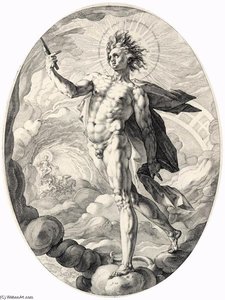
Juno (from the Four Deities) (1596) de Hendrik Goltzius

Juno (from the Four Deities)

1596 · Engraving · Philbrook Museum of Art, Tulsa

A single scepter rests in a hand that holds the gravity of the heavens. In this 1596 engraving, Juno sits amidst a swirling architecture of clouds, her form emerging from the monochrome depths of the copper plate. She is the Roman protector of marriage and childbirth, yet here she appears as a study in stillness against a restless sky. The oval frame contains her seated posture, a quiet center within…
6
Venus between Ceres and Bacchus (1590) de Hendrik Goltzius

Venus between Ceres and Bacchus

1590 · Oil On Canvas · Musées Royaux des Beaux-Arts, Bruxelles

To gaze upon this magnificent canvas is to step directly into a moment suspended in mythological splendor. Venus between Ceres and Bacchus, painted around 1590 by Hendrik Goltzius, is far more than a mere depiction of classical figures; it is an elaborate tapestry woven from themes of fertility, divine love, and the cyclical nature of life itself. The composition immediately draws the eye into a richly populated scene where three…

7
Crucified Christ with Mary, John the evangelist and Mary Magdalene (1600) de Hendrik Goltzius

Crucified Christ with Mary, John the evangelist and Mary Magdalene

1600 · Oil On Copper · Staatliche Kunsthalle Karlsruhe, Karlsruhe

The vertical axis of the wooden cross pierces a turbulent sky, a dark expanse of swirling charcoal and grey clouds. At the summit, the pale skin of Christ catches a sharp, directional light, casting the body into a stark relief against the gloom. Below him, the composition anchors itself in grief. To the left, Mary is draped in deep blue robes that hold the shadows of the scene. To the…

8
Self-Portrait, c. 1593-1594 (1594) de Hendrik Goltzius

Self-Portrait, c. 1593-1594

1594 · Graphite Pencil · Albertina, Viena

This exquisite pencil drawing, dating to approximately 1593-1594, offers us an intimate encounter with the self, rendered by the masterful hand of Hendrik Goltzius. It is more than a mere likeness; it is a carefully constructed meditation on status, intellect, and enduring presence. The subject gazes out from the confines of the oval frame with a directness that seems to pierce the veil of centuries. His bearing speaks volumes—a quiet…

9
Portrait of the Shell Collector Jan Govertsen van der Aer (1545–1612) (1603) de Hendrik Goltzius

Portrait of the Shell Collector Jan Govertsen van der Aer (1545–1612)

1603 · Oil On Canvas

The portrait depicts Jan Govertsen van der Aer, a textile merchant and shell collector, seated in a formal pose. He is positioned slightly off-center to the right, occupying much of the frame. He wears a black tunic with a simple open collar, and his facial features are defined by a mustache and a beard. His hands and face are illuminated by a soft, diffused light, while the background remains dark…

10
Portrait of Hendrick Jansz. Spijcker, called De Veer, as Flag Bearer (1590) de Hendrik Goltzius

Portrait of Hendrick Jansz. Spijcker, called De Veer, as Flag Bearer

Hendrick Jansz. Spijcker, known as De Veer, is captured in a three-quarter length portrait that emphasizes physical strength and social standing. Positioned slightly off-center, the subject possesses a muscularity that defines the Mannerist style. His gaze and posture suggest a man of military identity, reinforced by his role as a flag bearer. The composition relies on a sense of dynamic movement, breaking the stillness often found in formal portraiture.

Păiți celebrele picturi ale lui Hendrik Goltzius, de la numărul 11 la 98

11Farnese Hercules (1592) de Hendrik GoltziusFarnese Hercules1592 12Portrait of the Sculptor Giambologna (1591) de Hendrik GoltziusPortrait of the Sculptor Giambologna1591 13Publius Horatius (1586) de Hendrik GoltziusPublius Horatius1586 14Ixion (1588) de Hendrik GoltziusIxion1588 15Vitellius (1595) de Hendrik GoltziusVitellius1595 · Castle Caputh 16Christ on the Cold Stone with Two Angels (1602) de Hendrik GoltziusChrist on the Cold Stone with Two Angels1602 · Rhode Island School of Design Museum of Art 17The Circumcision (1607) de Hendrik GoltziusThe Circumcision1607 · Kingston Lacy 18Portrait of a Scholar (1599) de Hendrik GoltziusPortrait of a Scholar1599 · Bonnefanten Museum 19De rust van Christus (1607) de Hendrik GoltziusDe rust van Christus1607 · Centraal Museum 20Adam und Eva (1595) de Hendrik GoltziusAdam und Eva1595 21Quis evadet. (1594) de Hendrik GoltziusQuis evadet.1594 22The Rich Kitchen (1603) de Hendrik GoltziusThe Rich Kitchen1603 23Adone (1605) de Hendrik GoltziusAdone1605 24Virgin and Child with Angels (1607) de Hendrik GoltziusVirgin and Child with Angels1607 25Helen of Troy (1615) de Hendrik GoltziusHelen of Troy1615 · Currier Gallery of Art 26Vertumnus and Pomona (1615) de Hendrik GoltziusVertumnus and Pomona1615 · Fitzwilliam Museum 27Old Woman with a Young Man (1614) de Hendrik GoltziusOld Woman with a Young Man1614 · Musée de la Chartreuse de Douai 28Susanna and the Elders (1615) de Hendrik GoltziusSusanna and the Elders1615 · Muzeul de Artă Plastică din Boston 29St. Sebastian being consoled by an angel (1615) de Hendrik GoltziusSt. Sebastian being consoled by an angel1615 · Westfälisches Landesmuseum 30Allegory of the brevity of life (1611) de Hendrik GoltziusAllegory of the brevity of life1611 · Kunstmuseum Basel 31Apame Usurps the King's Crown or The Four Powers (1614) de Hendrik GoltziusApame Usurps the King's Crown or The Four Powers1614 32Adam (1613) de Hendrik GoltziusAdam1613 · Wadsworth Atheneum 33Lot and his daughters (1616) de Hendrik GoltziusLot and his daughters1616 · Rijksmuseum 34Saturn (1592) de Hendrik GoltziusSaturn1592 · Los Angeles County Museum of Art 35Vénus et l'Amour épiés par un satyre, dit autrefois Jupiter et Antiope Alternative title(s) Jupiter et Antiope (1616) de Hendrik GoltziusVénus et l'Amour épiés par un satyre, dit autrefois Jupiter et Antiope Alternative title(s) Jupiter et Antiope1616 · Muzeul Luvru 36Dirck Volkertsz Coornhert (1590) de Hendrik GoltziusDirck Volkertsz Coornhert1590 · Rijksmuseum 37Man of Sorrows with a Chalice (Christ as Redeemer) (1614) de Hendrik GoltziusMan of Sorrows with a Chalice (Christ as Redeemer)1614 38Danae receiving Jupiter as a shower of gold. Alternative titles The Sleeping Danae Being Prepared to Receive Jupiter Danaë (1603) de Hendrik GoltziusDanae receiving Jupiter as a shower of gold. Alternative titles The Sleeping Danae Being Prepared to Receive Jupiter Danaë1603 · Los Angeles County Museum of Art 39Portrait of Frederick de Vries (1597) de Hendrik GoltziusPortrait of Frederick de Vries1597 · Rijksmuseum 40Hercules and Cacus (1613) de Hendrik GoltziusHercules and Cacus1613 · Frans Halsmuseum 41Minerva (1611) de Hendrik GoltziusMinerva1611 · Muzeul Frans Hals 42The Dragon Devouring the Companions of Cadmus (1588) de Hendrik GoltziusThe Dragon Devouring the Companions of Cadmus1588 · National Gallery of Canada 43Circumcision in the Church of St Bavo at Haarlem (1594) de Hendrik GoltziusCircumcision in the Church of St Bavo at Haarlem1594 · British Museum 44Venus and Mars Surprised by Vulcan (1585) de Hendrik GoltziusVenus and Mars Surprised by Vulcan1585 · J. Paul Getty Museum 45Fall of Man (1608) de Hendrik GoltziusFall of Man1608 · Muzeul Ermitaj 46Portrait of Sculptor Giambologna (1591) de Hendrik GoltziusPortrait of Sculptor Giambologna1591 · Teylers Museum 47Icarus (1588) de Hendrik GoltziusIcarus1588 48The Artist's Right Hand (1588) de Hendrik GoltziusThe Artist's Right Hand1588 49Tantalus (1588) de Hendrik GoltziusTantalus1588 50Pygmalion and Galatea (1593) de Hendrik GoltziusPygmalion and Galatea1593 51St. Andrew (1589) de Hendrik GoltziusSt. Andrew1589 52St. Paul (1589) de Hendrik GoltziusSt. Paul1589 53St. James the Great (1589) de Hendrik GoltziusSt. James the Great1589 54St. James the Less (1589) de Hendrik GoltziusSt. James the Less1589 55Bacchus (1590) de Hendrik GoltziusBacchus1590 56Apollo (1588) de Hendrik GoltziusApollo1588 57Adam and Eve (The Fall of Man) (1608) de Hendrik GoltziusAdam and Eve (The Fall of Man)1608 58Head of a Young Woman (1605) de Hendrik GoltziusHead of a Young Woman1605 59David (1597) de Hendrik GoltziusDavid1597 60Jahel (1597) de Hendrik GoltziusJahel1597 61Judith (1597) de Hendrik GoltziusJudith1597 62Venus and Amor (1595) de Hendrik GoltziusVenus and Amor1595 63Who will be Spared? (1594) de Hendrik GoltziusWho will be Spared?1594 64Diana discovers Callisto's Pregnancy (1599) de Hendrik GoltziusDiana discovers Callisto's Pregnancy1599 65Susanna and the Elders (1595) de Hendrik GoltziusSusanna and the Elders1595 · Muzeul Național din Varșovia 66Untitled (AQQLD6) (1595) de Hendrik GoltziusUntitled (AQQLD6)1595 67Virgin and Child with Angels (detail) (1607) de Hendrik GoltziusVirgin and Child with Angels (detail)1607 68Mercury (1611) de Hendrik GoltziusMercury1611 · Frans Halsmuseum 69Christ the Redeemer (1613) de Hendrik GoltziusChrist the Redeemer1613 70Diana Discovers Callisto's Pregnancy (1599) de Hendrik GoltziusDiana Discovers Callisto's Pregnancy1599 · Bonnefanten Museum 71Eve (1615) de Hendrik GoltziusEve1615 72Untitled (AQQLDE) (1613) de Hendrik GoltziusUntitled (AQQLDE)1613 · Musée des Beaux-Arts de Strasbourg 73Jupiter and Antiope (1612) de Hendrik GoltziusJupiter and Antiope1612 74Cadmus slays the dragon (1617) de Hendrik GoltziusCadmus slays the dragon1617 · Statens Museum For Kunst 75The Fall of Man (1616) de Hendrik GoltziusThe Fall of Man1616 · National Gallery of Art 76Dying Adonis Alternative title(s) The blood of the dead Adonis turns into an anemone (Ovid, Met. X 735) (1609) de Hendrik GoltziusDying Adonis Alternative title(s) The blood of the dead Adonis turns into an anemone (Ovid, Met. X 735)1609 · Rijksmuseum 77Minerva (1611) de Hendrik GoltziusMinerva1611 · Frans Halsmuseum 78Venus (1596) de Hendrik GoltziusVenus1596 · Kunstpalast 79Calphurnius (1586) de Hendrik GoltziusCalphurnius1586 · Rijksmuseum 80Helios (1589) de Hendrik GoltziusHelios1589 · Los Angeles County Museum of Art 81Lot and his Daughters (1616) de Hendrik GoltziusLot and his Daughters1616 · Rijksmuseum 82Mercurius (1611) de Hendrik GoltziusMercurius1611 · Muzeul Frans Hals 83Portrait of the Sculptor Pierre Francheville (1591) de Hendrik GoltziusPortrait of the Sculptor Pierre Francheville1591 · Rijksmuseum 84Entombment of Christ (Matthew 27:59–61; Mark 15:46–47; Luke 23:53–56; John 19:38–42) de Hendrik GoltziusEntombment of Christ (Matthew 27:59–61; Mark 15:46–47; Luke 23:53–56; John 19:38–42)Muzeul Național din Varșovia 85The Baptism of Christ (1608) de Hendrik GoltziusThe Baptism of Christ1608 · Muzeul Ermitaj 86Jupiter și Antiope (1612) de Hendrik GoltziusJupiter și Antiope1612 · Frans Halsmuseum 87Self-Portrait (1592) de Hendrik GoltziusSelf-Portrait1592 · Graphische Sammlung Albertina 88Lycaon Transformată în Lupă (1589) de Hendrik GoltziusLycaon Transformată în Lupă1589 · Los Angeles County Museum of Art 89Magdalene and Angel (1610) de Hendrik GoltziusMagdalene and Angel1610 90Without Ceres and Bacchus, Venus would Freeze (1599) de Hendrik GoltziusWithout Ceres and Bacchus, Venus would Freeze1599 · Philadelphia Museum of Art 91Apollo Killing the Python (1589) de Hendrik GoltziusApollo Killing the Python1589 · Los Angeles County Museum of Art 92Phaethon from the Four Disgracers series (1588) de Hendrik GoltziusPhaethon from the Four Disgracers series1588 · National Gallery Prague 93Untitled (AQQLE6) de Hendrik GoltziusUntitled (AQQLE6)Galeria Națională din Armenia 94Apollo (1588) de Hendrik GoltziusApollo1588 · Rijksmuseum 95Unequal lovers de Hendrik GoltziusUnequal lovers 96Sine Cerere et Libero friget Venus (Without Ceres and Bacchus, Venus Would Freeze) (1603) de Hendrik GoltziusSine Cerere et Libero friget Venus (Without Ceres and Bacchus, Venus Would Freeze)1603 · Philadelphia Museum of Art 97Vertumnus en Pomona (1613) de Hendrik GoltziusVertumnus en Pomona1613 · Rijksmuseum 98Juno receiving the eyes of Argus from Mercury (1615) de Hendrik GoltziusJuno receiving the eyes of Argus from Mercury1615 · Museum Boijmans Van Beuningen

Piesele celebre ale lui Hendrik Goltzius, perioadă cu perioadă

Subiectele care i-au captivat privirea lui Hendrik Goltzius

Cele patru teme care revin cel mai des în aceste opere originale, fiecare având cel mai sublim exemplu.

Muzeele care păstrează originalele lui Hendrik Goltzius

Cele 8 muzee care dețin cele mai multe dintre picturile de pe această pagină.

Muzee Oraș Lucrări lui Hendrik Goltzius Picturi din această listă
Rijksmuseum, AmsterdamRijksmuseum Amsterdam 10 Standard-bearer, Lot and his daughters, Dirck Volkertsz Coornhert
Los Angeles County Museum of Art, Los AngelesLos Angeles County Museum of Art Los Angeles 6 Jupiter, Saturn, Danae receiving Jupiter as a shower of gold. Alternative titles The Sleeping Danae Being Prepared to Receive Jupiter Danaë
Frans Halsmuseum, HarenFrans Halsmuseum Haren 4 Hercules and Cacus, Mercury, Minerva
Bonnefanten Museum, MaastrichtBonnefanten Museum Maastricht 2 Portrait of a Scholar, Diana Discovers Callisto's Pregnancy
Muzeul Frans Hals, HaarlemMuzeul Frans Hals Haarlem 2 Minerva, Mercurius
Muzeul Ermitaj, Sankt PetersburgMuzeul Ermitaj Sankt Petersburg 2 Fall of Man, The Baptism of Christ
Muzeul Național din Varșovia, VarșoviaMuzeul Național din Varșovia Varșovia 2 Susanna and the Elders, Entombment of Christ (Matthew 27:59–61; Mark 15:46–47; Luke 23:53–56; John 19:38–42)
Philadelphia Museum of Art, PhiladelphiaPhiladelphia Museum of Art Philadelphia 2 Without Ceres and Bacchus, Venus would Freeze, Sine Cerere et Libero friget Venus (Without Ceres and Bacchus, Venus Would Freeze)

Hendrik Goltzius de-a lungul deceniilor: o piesă unică pentru fiecare

Lucrări pe deceniu

Alege o deceniu pentru a descoperi opera originală care îl definește.

Picturile lui Hendrik Goltzius: întrebări pentru galerie

Care este cea mai celebră operă a lui Hendrik Goltzius?Află răspunsul

Venus și Adonis (1614), Alte Pinakothek, Munchen. Urmează Hercules and Cacus (1613) și Standard-bearer (1587).

La ce vârstă a creat Hendrik Goltzius Venus și Adonis?Află răspunsul

56 ani: Venus și Adonis datează din 1614, iar Hendrik Goltzius s-a născut în 1558.

Care sunt cele mai celebre zece picturi ale lui Hendrik Goltzius?Află răspunsul

Venus și Adonis, Hercules and Cacus, Standard-bearer, Jupiter, Juno (from the Four Deities), Venus between Ceres and Bacchus, Crucified Christ with Mary, John the evangelist and Mary Magdalene, Self-Portrait, c. 1593-1594, Portrait of the Shell Collector Jan Govertsen van der Aer (1545–1612) și Portrait of Hendrick Jansz. Spijcker, called De Veer, as Flag Bearer. Clasamentul de mai sus indică anul și muzeul pentru fiecare piesă.

Câte lucrări ale lui Hendrik Goltzius sunt cunoscute?Află răspunsul

Catalogul nostru cuprinde 110 lucrări ale lui Hendrik Goltzius, datate între 1585 și 1617.

Unde pot fi vizualizate originalele celor mai faimoși Hendrik Goltzius?Află răspunsul

În principal în Rijksmuseum (Amsterdam), Los Angeles County Museum of Art (Los Angeles) și Frans Halsmuseum (Haren). Tabelul cu muzee de mai sus le enumeră pe toate.

În ce perioadă a creat Hendrik Goltzius cele mai cunoscute picturi?Află răspunsul

În 1590s: 31 dintre cele 98 lucrări de pe această pagină au fost realizate atunci, fiind Jupiter dintre acestea.

Care este cea mai veche și care este cea mai recentă pictură a lui Hendrik Goltzius?Află răspunsul

Pe această pagină, cea mai veche lucrare datează din Venus and Mars Surprised by Vulcan (1585), iar cea mai recentă este din Cadmus slays the dragon (1617).

Ce teme prefera Hendrik Goltzius?Află răspunsul

Man (36), Woman (23) și Mythology (18), din cele 98 lucrări de pe această pagină.

Cu ce materiale a pictat cel mai des Hendrik Goltzius?Află răspunsul

Engraving, pentru 30 dintre cele 98 lucrări de pe această pagină.

Din ce curent artistic face parte opera lui Hendrik Goltzius?Află răspunsul

Manierism, judecând după originalele de pe această pagină.

Ce originale de Hendrik Goltzius pot vedea la Rijksmuseum?Află răspunsul

Standard-bearer, Lot and his daughters și Dirck Volkertsz Coornhert: Rijksmuseum, Amsterdam deține 10 dintre lucrările de pe această pagină.

Hendrik Goltzius: un portret al artistului

Early Life and Artistic Foundations

Hendrik Goltzius, a name synonymous with the vibrant dynamism of Northern Mannerism in Dutch art, emerged from humble beginnings in the Rhineland region of Germany. Born around 1558 in Mulebrecht, near Viersen – a town steeped in artistic tradition due to his family’s lineage as stained-glass painters – Goltzius's early life was shaped by exposure to both visual arts and craftsmanship. His father, Jan Goltz II, continued the family legacy, establishing a workshop dedicated to creating intricate glass designs. This formative environment instilled within him an appreciation for detail, precision, and the transformative power of artistic skill. However, fate intervened dramatically when he was just three years old; a devastating fire ravaged their home in Duisburg, leaving him with a permanently deformed right hand – a physical characteristic that would ironically become his greatest asset as an engraver. This injury, rather than hindering his potential, fostered a unique and powerful control over the burin, allowing him to develop a distinctive “swelling line” technique, where he manipulated the tool’s pressure to create varying thicknesses of lines, adding depth and nuance to his prints in a way few others could achieve. His early training was further solidified by studying under Dirck Volckertszoon Coornhert, a renowned polymath and engraver in Cleves, who introduced him to the technical intricacies of copperplate engraving – a crucial step towards mastering his craft.

A Career Forged in Haarlem

The pivotal moment in Goltzius’s artistic journey arrived in 1577 when he relocated with Coornhert to Haarlem, a thriving center for printmaking and trade within the burgeoning Dutch Republic. This move marked not just a geographical shift but also the beginning of a prolific and influential career. Haarlem offered him a vibrant artistic community, access to wealthy patrons eager to acquire exquisite prints, and a stimulating environment conducive to experimentation and innovation. He quickly established himself as a respected engraver, securing commissions from prominent figures like Philip Galle, who employed him to produce a series of engravings depicting the history of Lucretia – a project that showcased his burgeoning talent for dramatic composition and meticulous detail. Goltzius’s workshop flourished, employing numerous assistants and producing an astonishing volume of work, ranging from faithful reproductions of master prints to original designs reflecting his own artistic vision. His ambition extended beyond mere replication; he sought to elevate the status of engraving within the art world, challenging established conventions and pushing the boundaries of technique.

Technique and Artistic Innovation

Goltzius’s genius lay not only in his technical mastery but also in his innovative approach to engraving. He was a pioneer of the “dot and lozenge” technique – a sophisticated method of creating tonal shading by strategically placing dots within lozenge-shaped spaces, meticulously crafted through cross-hatching. This technique allowed him to achieve an unprecedented level of realism and atmospheric depth in his prints, rivaling the effects of oil painting. His command of the burin was legendary; many art historians consider it to be comparable to that of Albrecht Dürer, the undisputed master of German engraving. He didn’t merely copy existing works; he transformed them, imbuing them with a sense of movement, drama, and psychological insight. Furthermore, Goltzius's engravings were frequently used as models for other artists, notably Bartholomeäus Spranger, whose Mannerist style was profoundly influenced by Goltzius’s innovative techniques. His willingness to experiment extended beyond engraving; he also ventured into painting, producing a series of works that demonstrated his versatility and artistic range – including chiaroscuro woodcuts that showcased his ability to manipulate light and shadow with remarkable skill.

Legacy and Recognition

Hendrik Goltzius’s impact on the history of art is undeniable. During his lifetime, he enjoyed widespread recognition throughout Europe, attracting the patronage of royalty and nobility alike. His journey to Italy in 1590 solidified his reputation as a leading figure in the international art scene, where he sought inspiration from classical sculpture and Renaissance painting. His legacy continues to resonate today, with his engravings and paintings held in prestigious collections around the world – including the Rijksmuseum in Amsterdam, the Metropolitan Museum of Art in New York, and the British Museum in London. Goltzius’s work exemplifies the dynamism and sophistication of Northern Mannerism, bridging the gap between Renaissance tradition and Baroque innovation. He remains a pivotal figure in the development of printmaking, his techniques and artistic vision continuing to inspire artists and scholars centuries after his death in 1617. His unique approach to engraving—combining technical precision with expressive flair—established him as one of the most important and influential engravers of his time, securing his place within the pantheon of great masters.