Portretul lui Franz Defregger

Cele 89 cele mai faimoase picturi ale lui Franz Defregger, fiecare unică în felul ei

Actualizat Noiembrie 2026 · clasat în funcție de scorul nostru de popularitate (căutări, vizite și comenzi pentru fiecare operă) · 92 lucrări ale lui Franz Defregger în catalogul nostru

Pe scurt

Going to School este pictură lui Franz Defregger care atrage cele mai multe priviri. După aceasta, privirea se îndreaptă către Tyrolean Farmer (1860) și Zither Player and Two Girls (1860). Dintre cele 92 opere ale lui Franz Defregger din catalogul nostru, acestea 89 sunt cele mai celebre, fiecare fiind o piesă unică, prezentată împreună cu anul creării, muzeul deținător și motivul pentru care aceasta rămâne memorabilă.

1835 – 1921, Stronach Realism Cele mai multe lucrări: Colecțiile Statale de Pictură din Bavaria

Cele mai importante 10 picturi ale lui Franz Defregger, prin ochii galeriei

1
Going to School de Franz Defregger

Going to School

In Going to School, Franz Defregger captures a lively moment of daily life as a group of nine children makes their way up a hill. The children are dressed for their lessons, some carrying books tucked under their arms. Their movement toward the schoolhouse suggests the start of a busy day.

2
Tyrolean Farmer (1860) de Franz Defregger

Tyrolean Farmer

1860 · Oil On Board

In "Tyrolean Farmer" by Franz Defregger, the world narrows to a single, weathered face. This close-up bust portrait centers an elderly man against a dark, indistinct background that offers no distraction from his presence. He wears a wide-brimmed hat, a silhouette that frames a thick, white beard. The subject, likely a Tyrolean farmer, stares forward from an eye-level perspective. This direct gaze establishes an immediate, quiet emotional connection between the…

3
Zither Player and Two Girls (1860) de Franz Defregger

Zither Player and Two Girls

1860 · Oil

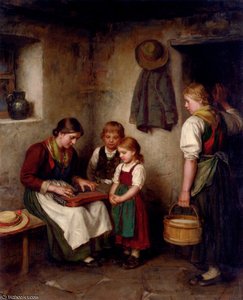
In the painting Zither Player and Two Girls by Franz Defregger, a quiet, domestic scene unfolds within a rustic interior. The composition is centered around three human figures and a dog, arranged in a triangular formation that directs the eye toward the central subject. A man sits on a bench, focused on playing a zither. He is accompanied by two young women dressed in traditional Tyrolean folk attire. In the…

4
Reclining female nude (1860) de Franz Defregger

Reclining female nude

1860 · Oil

In "Reclining female nude" by Franz Defregger, the composition centers on a single figure. The body is positioned diagonally across the frame, leaning against a draped structure. This arrangement creates a sense of quiet repose. The subject rests in a state of stillness, framed by the heavy, vertical folds of fabric that contrast with the organic lines of the anatomy. The perspective is a close-up, eye-level view that draws the…

5
Girl reading (1860) de Franz Defregger

Girl reading

1860 · Oil On Canvas

In "Girl reading" by Franz Defregger, the composition settles into a close-up, medium shot. The subject is captured from the chest up, positioned slightly off-center against a void of deep blacks. This darkness pushes the figure forward, creating a sense of intimacy and quietude. The grayscale palette strips away the distraction of color, leaving only the essential interplay of light and shadow. It is a study of stillness.

6
Portr. of a man with decorations (1860) de Franz Defregger

Portr. of a man with decorations

1860 · Oil

The oil portrait titled Portr. of a man with decorations is a work by the Austrian artist Franz Defregger. Created about 1860, this piece captures an elderly man in a moment of quietude. The subject is rendered with a focus on the weight of years and the presence of his distinction.

7
Liesal girl (half- length ) (1860) de Franz Defregger

Liesal girl (half- length )

1860 · Oil

The artwork titled Liesal girl (half- length ) is a painting by the Austrian artist Franz Defregger. This specific piece was created about 1860. The composition focuses on a single human figure, presented in a half-length format that centers the subject within the frame.

8
Portrait of a young girl (1860) de Franz Defregger

Portrait of a young girl

1860 · Oil On Canvas

Franz Defregger’s Portrait of a young girl, created about 1860, presents a centered, bust-length study of a single subject. The girl is positioned against a dark, indistinct background that pushes her figure toward the viewer. She possesses wavy, dark hair and gazes directly at the observer, establishing an intimate connection through her steady, frontal orientation. This directness is framed by the soft focus and classical realism that define the work's…

9
Peasants in front of the house (1860) de Franz Defregger

Peasants in front of the house

1860 · Oil On Canvas

The scene known as Peasants in front of the house emerges from the brush of Franz Defregger, an artist whose life was deeply rooted in the rugged landscapes of his homeland. Born in Iselsberg-Stronach, Austria, Defregger carries the spirit of the Tyrolean countryside into his work. This particular piece dates to about 1860, a period when the artist was beginning to find his voice amidst the realities of rural existence.…

10
Peasant-scene ( Talk over the marriage ) (1860) de Franz Defregger

Peasant-scene ( Talk over the marriage )

1860 · Oil On Canvas · Deutsches Museum, Berlin

In Peasant-scene ( Talk over the marriage ), Franz Defregger centers the gravity of the room upon a single wooden table. Six peasants gather in a tight semi-circle, their bodies leaning inward to form a closed ring of intimacy. This arrangement traps the viewer within the rustic interior, making the social interaction feel immediate and private. The figures are locked in a serious discussion, perhaps negotiating the terms of a…

Păiți celebrele picturi ale lui Franz Defregger, de la numărul 11 la 89

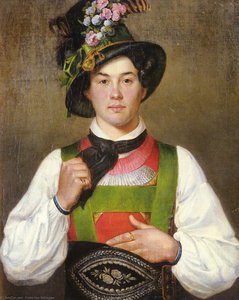
11The Blacksmith (1850) de Franz DefreggerThe Blacksmith1850 · Minneapolis Institute of Art 12the bath of a child (1868) de Franz Defreggerthe bath of a child1868 13The Last Muster (Oil Sketch) (1872) de Franz DefreggerThe Last Muster (Oil Sketch)1872 · Colecțiile Statale de Pictură din Bavaria 14Tyrolean Home Guard returning from the war of 1809. (1876) de Franz DefreggerTyrolean Home Guard returning from the war of 1809.1876 · Alte Nationalgalerie 15The Visit (1875) de Franz DefreggerThe Visit1875 · Colecțiile Statale de Pictură din Bavaria 16The Last Contingent (1874) de Franz DefreggerThe Last Contingent1874 17Children with a bird + cage. (1874) de Franz DefreggerChildren with a bird + cage.1874 18Family scene in front of the house (1872) de Franz DefreggerFamily scene in front of the house1872 19Die Kraftprobe (1878) de Franz DefreggerDie Kraftprobe1878 20The Storming of the Roter Turm in the Sendling Bauernschlacht 1705 (1881) de Franz DefreggerThe Storming of the Roter Turm in the Sendling Bauernschlacht 17051881 · Lenbachhaus 21The Storming of the Roter Turm in München by the Oberländer Peasants on Christmas Morning 1705 (1881) de Franz DefreggerThe Storming of the Roter Turm in München by the Oberländer Peasants on Christmas Morning 17051881 · Colecțiile Statale de Pictură din Bavaria 22Female Portrait in Black (1885) de Franz DefreggerFemale Portrait in Black1885 23Young Peasant Girl (1885) de Franz DefreggerYoung Peasant Girl1885 24Peasant Girl (1885) de Franz DefreggerPeasant Girl1885 25Portrait of a Peasant Girl (1885) de Franz DefreggerPortrait of a Peasant Girl1885 26Tyrolean Woman with Hat (1885) de Franz DefreggerTyrolean Woman with Hat1885 27Man with Beard (1879) de Franz DefreggerMan with Beard1879 28Tyrolean Peasant Woman with Hat (1885) de Franz DefreggerTyrolean Peasant Woman with Hat1885 29The Salon Tyrolean (1882) de Franz DefreggerThe Salon Tyrolean1882 30merry society of young peasants in an inn (1882) de Franz Defreggermerry society of young peasants in an inn1882 31portrait of a girl (1885) de Franz Defreggerportrait of a girl1885 32The young Mother (1884) de Franz DefreggerThe young Mother1884 33Young Girl (1890) de Franz DefreggerYoung Girl1890 34Portrait of a Young Girl (1888) de Franz DefreggerPortrait of a Young Girl1888 35Assembly of Tyrolean Freedom Fighters (1886) de Franz DefreggerAssembly of Tyrolean Freedom Fighters1886 36Tyrolean Hunter (1887) de Franz DefreggerTyrolean Hunter1887 · Augustiner Museum 37portrait of an old man (1890) de Franz Defreggerportrait of an old man1890 38Young man with pipe (1892) de Franz DefreggerYoung man with pipe1892 39The War Council of Andreas Hofer in the Year 1809 (1897) de Franz DefreggerThe War Council of Andreas Hofer in the Year 18091897 · Colecțiile Statale de Pictură din Bavaria 40The Painter Franz von Lenbach (1895) de Franz DefreggerThe Painter Franz von Lenbach1895 · Lenbachhaus 41The Strength Test (1898) de Franz DefreggerThe Strength Test1898 42interior scene with peasants (1896) de Franz Defreggerinterior scene with peasants1896 43Scene in a country- inn (1899) de Franz DefreggerScene in a country- inn1899 44group of peasant people in a cottage (1899) de Franz Defreggergroup of peasant people in a cottage1899 45The sick dachshund (1903) de Franz DefreggerThe sick dachshund1903 46Girl Portrait with Headscarf (1907) de Franz DefreggerGirl Portrait with Headscarf1907 47Young peasant-girl (1913) de Franz DefreggerYoung peasant-girl1913 48Girl with rake + letter (1915) de Franz DefreggerGirl with rake + letter1915 49Andreas Hofer - Franz von Defregger (2026) de Franz DefreggerAndreas Hofer - Franz von Defregger2026 50The Story Of St. Nicholas de Franz DefreggerThe Story Of St. Nicholas 51The Salon-Tyrolean (1882) de Franz DefreggerThe Salon-Tyrolean1882 · Alte Nationalgalerie 52The Burning Seppenhaus in Reith (1890) de Franz DefreggerThe Burning Seppenhaus in Reith1890 · Lenbachhaus 53Head of girl (1890) de Franz DefreggerHead of girl1890 · Regional Gallery in Liberec 54Bust Portrait of a Tyrolean Peasant de Franz DefreggerBust Portrait of a Tyrolean PeasantColecțiile Statale de Pictură din Bavaria 55Portrait of a girl de Franz DefreggerPortrait of a girl 56portrait of a peasant de Franz Defreggerportrait of a peasant 57Brand in Reith de Franz DefreggerBrand in Reith 58Schauspieler de Franz DefreggerSchauspieler 59Alte Strasse de Franz DefreggerAlte Strasse 60Erstürmung des Roten Turmes de Franz DefreggerErstürmung des Roten Turmes 61Portrait of the artist de Franz DefreggerPortrait of the artist 62Kindbildnis de Franz DefreggerKindbildnis 63Poacher in the Alpine dairy hut de Franz DefreggerPoacher in the Alpine dairy hut 64Difficult question de Franz DefreggerDifficult questionRegional Gallery in Liberec 65Portrait of a Man de Franz DefreggerPortrait of a ManColecțiile Statale de Pictură din Bavaria 66Nicolaus Gysis de Franz DefreggerNicolaus Gysis 67Portrait of a girl de Franz DefreggerPortrait of a girl 68Training of monkeys Affendresur de Franz DefreggerTraining of monkeys Affendresur 69Wallfahrer de Franz DefreggerWallfahrer 70Bauernbursch Mit Pfeife de Franz DefreggerBauernbursch Mit Pfeife 71A Pan de Franz DefreggerA Pan 72The Zither Player de Franz DefreggerThe Zither Player 73A tyrolean peasant de Franz DefreggerA tyrolean peasant 74The Last Contingent de Franz DefreggerThe Last ContingentColecțiile Statale de Pictură din Bavaria 75Hunter And Maid In The Kuchl At Happy Geplauder de Franz DefreggerHunter And Maid In The Kuchl At Happy Geplauder 76A Bavarian Peasant Girl - de Franz DefreggerA Bavarian Peasant Girl - 77Girl Portrait de Franz DefreggerGirl PortraitColecțiile Statale de Pictură din Bavaria 78A Bavarian Peasant Girl de Franz DefreggerA Bavarian Peasant Girl 79Defegger Franz von Jungen Bauern de Franz DefreggerDefegger Franz von Jungen Bauern 80Ein junges Mädchen (The Little Girl) de Franz DefreggerEin junges Mädchen (The Little Girl) 81Die marchenerzahlerin de Franz DefreggerDie marchenerzahlerin 82The music lesson de Franz DefreggerThe music lesson 83Mother's Pride de Franz DefreggerMother's Pride 84Die erste studienreise de Franz DefreggerDie erste studienreise 85Idle Hours in the Harem de Franz DefreggerIdle Hours in the Harem 86Abschied der jager de Franz DefreggerAbschied der jager 87Der zitherspieler Auf Der Alm de Franz DefreggerDer zitherspieler Auf Der Alm 88A young man in tyrolean costume de Franz DefreggerA young man in tyrolean costume 89The happy family de Franz DefreggerThe happy family

Piesele celebre ale lui Franz Defregger, perioadă cu perioadă

Subiectele care i-au captivat privirea lui Franz Defregger

Cele patru teme care revin cel mai des în aceste opere originale, fiecare având cel mai sublim exemplu.

Muzeele care păstrează originalele lui Franz Defregger

Cele 7 muzee care dețin cele mai multe dintre picturile de pe această pagină.

Muzee Oraș Lucrări lui Franz Defregger Picturi din această listă
Colecțiile Statale de Pictură din Bavaria, MunchenColecțiile Statale de Pictură din Bavaria Munchen 8 The Last Muster (Oil Sketch), The Visit, The Storming of the Roter Turm in München by the Oberländer Peasants on Christmas Morning 1705
Lenbachhaus, MunchenLenbachhaus Munchen 3 The Storming of the Roter Turm in the Sendling Bauernschlacht 1705, The Painter Franz von Lenbach, The Burning Seppenhaus in Reith
Alte Nationalgalerie, BerlinAlte Nationalgalerie Berlin 2 Tyrolean Home Guard returning from the war of 1809., The Salon-Tyrolean
Regional Gallery in Liberec, LibericeRegional Gallery in Liberec Liberice 2 Head of girl, Difficult question
Deutsches Museum, BerlinDeutsches Museum Berlin 1 Peasant-scene ( Talk over the marriage )
Minneapolis Institute of Art, MinneapolisMinneapolis Institute of Art Minneapolis 1 The Blacksmith
Augustiner Museum, FreiburgAugustiner Museum Freiburg 1 Tyrolean Hunter

Franz Defregger de-a lungul deceniilor: o piesă unică pentru fiecare

Lucrări pe deceniu

Alege o deceniu pentru a descoperi opera originală care îl definește.

Picturile lui Franz Defregger: întrebări pentru galerie

Care este cea mai celebră operă a lui Franz Defregger?Află răspunsul

Going to School. Urmează Tyrolean Farmer (1860) și Zither Player and Two Girls (1860).

Care sunt cele mai celebre zece picturi ale lui Franz Defregger?Află răspunsul

Going to School, Tyrolean Farmer, Zither Player and Two Girls, Reclining female nude, Girl reading, Portr. of a man with decorations, Liesal girl (half- length ), Portrait of a young girl, Peasants in front of the house și Peasant-scene ( Talk over the marriage ). Clasamentul de mai sus indică anul și muzeul pentru fiecare piesă.

Câte lucrări ale lui Franz Defregger sunt cunoscute?Află răspunsul

Catalogul nostru cuprinde 92 lucrări ale lui Franz Defregger, datate între 1850 și 1915.

Unde pot fi vizualizate originalele celor mai faimoși Franz Defregger?Află răspunsul

În principal în Colecțiile Statale de Pictură din Bavaria (Munchen), Lenbachhaus (Munchen) și Alte Nationalgalerie (Berlin). Tabelul cu muzee de mai sus le enumeră pe toate.

În ce perioadă a creat Franz Defregger cele mai cunoscute picturi?Află răspunsul

În 1880s: 16 dintre cele 89 lucrări de pe această pagină au fost realizate atunci, fiind The Storming of the Roter Turm in the Sendling Bauernschlacht 1705 dintre acestea.

Care este cea mai veche și care este cea mai recentă pictură a lui Franz Defregger?Află răspunsul

Pe această pagină, cea mai veche lucrare datează din The Blacksmith (1850), iar cea mai recentă este din Girl with rake + letter (1915).

Ce teme prefera Franz Defregger?Află răspunsul

Woman (15), Man (13) și Portrait (11), din cele 89 lucrări de pe această pagină.

Cu ce materiale a pictat cel mai des Franz Defregger?Află răspunsul

Oil On Canvas, pentru 21 dintre cele 89 lucrări de pe această pagină.

Din ce curent artistic face parte opera lui Franz Defregger?Află răspunsul

Realism și Munich school, judecând după originalele de pe această pagină.

Ce originale de Franz Defregger pot vedea la Colecțiile Statale de Pictură din Bavaria?Află răspunsul

The Last Muster (Oil Sketch), The Visit și The Storming of the Roter Turm in München by the Oberländer Peasants on Christmas Morning 1705: Colecțiile Statale de Pictură din Bavaria, Munchen deține 8 dintre lucrările de pe această pagină.

Franz Defregger: un portret al artistului

Early Life and Artistic Awakening in the Tyrolean Landscape

Franz von Defregger’s story begins amidst the dramatic beauty of Tyrol, Austria – a region steeped in history, folklore, and rugged mountain landscapes. Born on April 30th, 1835, in Strohn, a small hamlet nestled within the foothills of the Alps, his early life was profoundly shaped by the rhythms of rural existence. His parents, Michael and Maria Defregger, were farmers – hardworking individuals who instilled in their children a deep connection to the land, a respect for tradition, and an appreciation for the simple pleasures of country life. However, this idyllic setting was soon disrupted by tragedy; when Franz was still young, a devastating typhoid epidemic swept through the region, claiming the lives of his mother and two sisters. This profound loss cast a long shadow over his childhood, leaving him with a sense of vulnerability and a yearning for solace – a need that would ultimately find expression in his art. Despite these sorrows, a spark of creativity began to flicker within him. He displayed an early aptitude for music, finding comfort and release in playing the flugelhorn within local bands, and simultaneously developed a natural talent for drawing and woodcarving, skills he honed through practical work alongside his father on the family farm. These nascent artistic pursuits were entirely self-taught, born from keen observation of the world around him – the weathered faces of farmers, the intricate patterns of snowflakes, the majestic sweep of the mountain ranges. The decision to pursue art professionally wasn’t a sudden one; it was a deliberate act of courage and conviction, fueled by a desire to transform personal experience into something meaningful and enduring.

Formal Training and the Embrace of Munich

Recognizing his burgeoning talent, Franz's father, despite facing considerable hardship, made a bold decision: he sold the family farm in 1858, sacrificing their financial security for the uncertain path of an artist. This act of faith signaled not just a career change but a profound commitment to his artistic aspirations. Franz then embarked on a journey to Innsbruck, where he apprenticed under the esteemed sculptor Michael Stolz – a move that proved pivotal in shaping his technical skills and understanding of form. However, Stolz quickly recognized that Franz’s true calling lay in painting, skillfully guiding him towards an introduction to Karl von Piloty, a highly influential figure at the Academy of Fine Arts in Munich. This marked a transformative moment in Defregger's artistic development; from 1860 to 1861, he attended preparatory classes under Hermann Dyck, laying the foundation for his formal artistic education. A subsequent period of study at the École des Beaux-Arts in Paris (1863-1865) exposed him to the vibrant and experimental atmosphere of the Barbizon school – a movement characterized by its emphasis on plein air painting, naturalistic landscapes, and a rejection of academic conventions. The Barbizon painters’ focus on capturing the essence of light and atmosphere profoundly influenced Defregger's style, imbuing his later works with a sense of luminosity and emotional depth. Returning to Munich, he formally enrolled at the Academy, immersing himself in the traditions of the Munich School – an artistic collective known for its meticulous realism, historical narratives, and celebration of Bavarian identity.

A Style Rooted in Tyrolean Life and Historical Narrative

Franz von Defregger’s artistic style is instantly recognizable for its deeply rooted connection to his native Tyrol and its inhabitants. He didn't simply paint landscapes; he painted *life* – the everyday routines, the joys and sorrows, the triumphs and struggles of the people who called this rugged region home. His paintings are imbued with a remarkable sense of realism, capturing not just physical appearances but also the subtle nuances of emotion, social interaction, and cultural identity. He was particularly adept at portraying Tyrolean peasants – farmers, woodcutters, musicians, and storytellers – rendering them with dignity, empathy, and an unwavering respect for their traditions. This fascination with rural life extended to historical subjects as well; Defregger frequently depicted scenes from the Tyrolean national uprising of 1809, a pivotal moment in the region’s history, particularly focusing on the heroic figure of Andreas Hofer – a symbol of resistance and independence. Works like *Andreas Hofer mit seinen Beratern in Innsbruck* (1879) are not merely historical accounts; they are powerful narratives that celebrate courage, loyalty, and the enduring spirit of the Tyrolean people. The influence of the Barbizon school is evident in his landscapes – capturing the atmospheric beauty of the Tyrolean mountains and valleys with a masterful understanding of light and color. However, Defregger’s true genius lay in his ability to seamlessly blend realism with narrative storytelling, creating works that are both visually stunning and emotionally resonant.

Recognition, Legacy, and Enduring Appeal

Franz von Defregger's talent quickly gained recognition within the artistic circles of Munich. In 1878, he achieved a significant milestone by becoming a professor of history painting at the Munich Art Academy – a position he held until 1910, shaping the artistic development of countless aspiring painters. His works were exhibited widely throughout Germany and Austria, garnering critical acclaim and attracting a devoted following. He received numerous accolades for his contributions to art and culture, including the Order of Merit of Bavaria (1883) and the Prussian Order of Merit for Science and the Arts – testament to his enduring influence. Notably, he established both a private home in Munich (the Defregger House) and a residence in Bolzano (Villa Defregger), further cementing his connection to his homeland. Even today, streets are named in his honor in Vienna, Bolzano, and Gries am Brenner – a lasting tribute to the esteem in which he was held by the people of Tyrol. Franz von Defregger passed away on January 2nd, 1921, leaving behind a rich artistic legacy that continues to captivate viewers with its evocative depictions of Tyrolean life, historical narratives, and enduring celebration of the region’s spirit. His paintings remain cherished for their honesty, emotional depth, and ability to transport us back in time to a world of simple pleasures, heroic deeds, and profound human connection.