Portretul lui Ferdinand Hodler

Picturi Ferdinand Hodler: Cele 100 de cele mai faimoase, prin ochii unei galerii

Actualizat Noiembrie 2026 · clasat în funcție de scorul nostru de popularitate (căutări, vizite și comenzi pentru fiecare operă) · 609 lucrări ale lui Ferdinand Hodler în catalogul nostru

Pe scurt

În ochii galeriei, cea mai celebră pictură a lui Ferdinand Hodler este Eiger, Monch and Jungfrau in Moonlight (1908). Woman in Ecstasy (1911) și Eiger, Monch and Jungfrau in Moonlight (1908) completează trioul pe care orice ochi îl recunoaște. Dintre cele 609 opere ale lui Ferdinand Hodler din catalogul nostru, galeria prezintă mai jos cele 100 cele mai faimoase, fiecare fiind originală, cu anul creării, muzeul de păstrare și elementul care o face unică.

1853 – 1918, Berna Symbolism, parallelism & harmony Cele mai multe lucrări: Galeria Națională din Bosnia și Herțegovina

Cele mai apreciate 10 picturi ale lui Ferdinand Hodler din galerie

1
Eiger, Monch and Jungfrau in Moonlight (1908) de Ferdinand Hodler

Eiger, Monch and Jungfrau in Moonlight

1908 · Oil On Canvas

In the quietude of 1908, Ferdinand Hodler captured a nocturnal moment in his painting, Eiger, Monch and Jungfrau in Moonlight. The scene is dominated by three majestic mountains, arranged with a distinct sense of scale: the leftmost peak appears smaller, followed by a middle mountain with a slightly larger summit, while the rightmost peak stands as the largest of the trio. Above this rugged landscape, two airplanes traverse the sky—one…

2
Woman in Ecstasy (1911) de Ferdinand Hodler

Woman in Ecstasy

1911 · Oil On Canvas

To encounter Ferdinand Hodler’s Woman in Ecstasy is to step into a realm where the boundaries between the physical form and the ethereal spirit dissolve. Painted in 1911, this monumental canvas serves as a cornerstone of the Art Nouveau movement, capturing far more than a mere moment of movement; it embodies an entire era's yearning for beauty, transcendence, and liberation. The painting depicts a woman caught in the throes of…

3
Eiger, Monch and Jungfrau in Moonlight (1908) de Ferdinand Hodler

Eiger, Monch and Jungfrau in Moonlight

1908 · Oil On Canvas

In this 1908 oil on canvas, the landscape is dominated by three majestic mountain peaks: the Eiger, the Monch, and the Jungfrau. These summits are arranged in a rhythmic, ascending scale, with the leftmost peak appearing smaller, followed by a middle mountain with a slightly larger summit, and the rightmost peak standing as the largest of the trio. The scene is set during a moonlight night, characterized by a palette…

4
Sunset on Lake Geneva (1915) de Ferdinand Hodler

Sunset on Lake Geneva

1915 · Oil On Canvas · Kunsthaus Zürich, Zurich

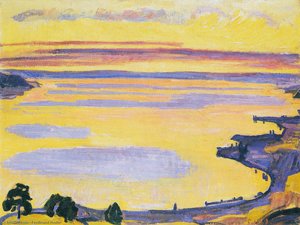
The painting depicts a sunset over Lake Geneva. The sky above the water is rendered in shades of yellow, orange, and pink, creating a vibrant atmosphere. In the foreground, mountains are visible, providing depth to the landscape. A boat is positioned on the water, contributing to the serene scene.

5
Study of two figures (1897) de Ferdinand Hodler

Study of two figures

1897 · Acrylic On Paper · Galeria Națională din Bosnia și Herțegovina, Sarajevo

Ferdinand Hodler’s “Study of Two Figures” is not a grand, dramatic statement; rather, it's an invitation to linger in the quiet intimacy of a shared moment. Painted in 1897, this graphite drawing on paper captures two women seated together, their postures suggesting a profound sense of contemplation and perhaps even melancholy. Hodler, a pivotal figure within Swiss Symbolism, wasn’t interested in literal representation but rather in conveying emotional atmosphere and…

6
Unity (1911) de Ferdinand Hodler

Unity

1911 · Painting

In the monumental mural Unity, created in 1911, Ferdinand Hodler presents a profound meditation on the collective human spirit. This expansive work, stretching across an impressive scale, transcends mere portraiture to become a rhythmic tapestry of existence. The composition is masterfully arranged in rows of figures that seem to pulse with a shared vitality; some individuals press toward the foreground with palpable presence, while others recede into the background, creating…

7
Lake Geneva in Chexbres (1904) de Ferdinand Hodler

Lake Geneva in Chexbres

1904 · Oil On Canvas

To gaze upon Ferdinand Hodler's Lake Geneva in Chexbres is to be invited into a moment suspended between the vastness of nature and the quiet contemplation of the human spirit. This magnificent oil on canvas, dating from 1904, captures more than just a picturesque vista; it encapsulates the very essence of the Swiss landscape filtered through the profound lens of an artistic master. The scene unfolds across a broad expanse…

8
Composition study (1887) de Ferdinand Hodler

Composition study

1887 · Oil On Canvas · Galeria Națională din Bosnia și Herțegovina, Sarajevo

Ferdinand Hodler's "Composition Study," created in 1887, isn’t merely a sketch of three figures engaged in strenuous activity; it’s a profound meditation on the human condition, rendered with an arresting blend of anatomical precision and evocative symbolism. This work, now housed within the Tretyakov Gallery in Moscow, offers a rare glimpse into the artist's deeply personal vision – a world shaped by loss, contemplation, and a fascination with the ephemeral…

9
Self-portrait with stand (1879) de Ferdinand Hodler

Self-portrait with stand

1879 · Oil On Canvas · Kunst Museum Winterthur | Reinhart am Stadtgarten, Winterthur

To stand before Ferdinand Hodler’s Self-portrait with stand is to encounter a moment suspended between public presentation and private contemplation. This striking work, dating from 1879, captures the artist not merely as a likeness, but as a study in poised masculinity and burgeoning artistic self-awareness. The subject, impeccably dressed in a suit and tie, adopts a formal bearing, suggesting an occasion of importance or perhaps simply the necessary facade required…

10
The Wetterhorn (1912) de Ferdinand Hodler

The Wetterhorn

1912 · Oil On Canvas

To stand before Ferdinand Hodler’s The Wetterhorn is to be enveloped by the sublime majesty of the Swiss Alps, rendered through a lens of profound introspection. Painted in 1912, this oil on canvas masterpiece transcends mere topographical depiction; it is a meditation on permanence against the backdrop of fleeting human experience. The sheer scale of the snow-covered peak dominates the composition, its striking blue hue lending the entire scene an…

Picturi cu Ferdinand Hodler, clasate de la 11 la 100

11Hilly Landscape with Ravens, in the Bernese Oberland (1910) de Ferdinand HodlerHilly Landscape with Ravens, in the Bernese Oberland1910 12View of Lake Leman from Chexbres (1905) de Ferdinand HodlerView of Lake Leman from Chexbres1905 · Kunstmuseum Basel 13Stockhorn chain (blue sky) de Ferdinand HodlerStockhorn chain (blue sky) 14Woman on her deathbed de Ferdinand HodlerWoman on her deathbed 15Lake Geneva from Chexbres (1904) de Ferdinand HodlerLake Geneva from Chexbres1904 · Musée cantonal des Beaux-Arts 16Portrait of Fraulein Kyburz (1873) de Ferdinand HodlerPortrait of Fraulein Kyburz1873 · Rhode Island School of Design Museum of Art 17Portrait of a Spanish woman de Ferdinand HodlerPortrait of a Spanish woman 18Studies of self-portrait (1911) de Ferdinand HodlerStudies of self-portrait1911 19Портрет Берти Ходлер (1902) de Ferdinand HodlerПортрет Берти Ходлер1902 · Galeria Națională din Bosnia și Herțegovina 20Landscape of the Swiss Alps (1918) de Ferdinand HodlerLandscape of the Swiss Alps1918 · Muzeul Israel 21The fall in Silvaplana (1907) de Ferdinand HodlerThe fall in Silvaplana1907 · Kunsthaus Zürich 22Thun with symmetric mirroring (1909) de Ferdinand HodlerThun with symmetric mirroring1909 · Musée d'Art et d'Histoire de Genève 23Jeanne Cerani-Charles de Ferdinand HodlerJeanne Cerani-Charles 24Day (Truth) de Ferdinand HodlerDay (Truth)Art Institute of Chicago 25From Le Grand Muveran Villars (1912) de Ferdinand HodlerFrom Le Grand Muveran Villars1912 · Von der Heydt Museum 26The cobbler by the window (1882) de Ferdinand HodlerThe cobbler by the window1882 27Forest Stream at Champery (1916) de Ferdinand HodlerForest Stream at Champery1916 28The shoemaker (1878) de Ferdinand HodlerThe shoemaker1878 29Modern Rütli (1878) de Ferdinand HodlerModern Rütli1878 · Gottfried Keller Foundation 30The Reaper (1878) de Ferdinand HodlerThe Reaper1878 31Gymnasts' Banquet (1877) de Ferdinand HodlerGymnasts' Banquet1877 · Kunsthaus Zürich 32The Miller, his Son and the Donkey (1888) de Ferdinand HodlerThe Miller, his Son and the Donkey1888 · Musée d'Art et d'Histoire de Genève 33The Disillusioned One (1892) de Ferdinand HodlerThe Disillusioned One1892 · Los Angeles County Museum of Art 34Study of the disappointed souls or Weary of life (1891) de Ferdinand HodlerStudy of the disappointed souls or Weary of life1891 35Overall study of the life of weary (1887) de Ferdinand HodlerOverall study of the life of weary1887 36Surprised by the Storm (1887) de Ferdinand HodlerSurprised by the Storm1887 37Night (1890) de Ferdinand HodlerNight1890 38Worship (1893) de Ferdinand HodlerWorship1893 39Childhood (1893) de Ferdinand HodlerChildhood1893 · Städel Museum 40Battle scenes (1896) de Ferdinand HodlerBattle scenes1896 41The Halberdier (1895) de Ferdinand HodlerThe Halberdier1895 · Dallas Museum of Art 42View into Infinity (1903) de Ferdinand HodlerView into Infinity1903 · Hamburger Kunsthalle 43The Adored Youth (1904) de Ferdinand HodlerThe Adored Youth1904 44Character study (1902) de Ferdinand HodlerCharacter study1902 45The Woodcutter (1910) de Ferdinand HodlerThe Woodcutter1910 · Von der Heydt Museum 46Character study (1906) de Ferdinand HodlerCharacter study1906 47Farewell participating female figure (1908) de Ferdinand HodlerFarewell participating female figure1908 48Pulling soldiers (1908) de Ferdinand HodlerPulling soldiers1908 49The working mower (1909) de Ferdinand HodlerThe working mower1909 50Pulling soldiers (1908) de Ferdinand HodlerPulling soldiers1908 51Woman in Ecstasy (1911) de Ferdinand HodlerWoman in Ecstasy1911 52Jeanne Günzburger (1912) de Ferdinand HodlerJeanne Günzburger1912 · Toledo Museum of Art 53Portrait of Emma Schmidt-Müller (1915) de Ferdinand HodlerPortrait of Emma Schmidt-Müller1915 54Josef Müller (1916) de Ferdinand HodlerJosef Müller1916 55Der Frühling (Fassung IV) (1912) de Ferdinand HodlerDer Frühling (Fassung IV)1912 56The Patient (1914) de Ferdinand HodlerThe Patient1914 · Kunstmuseum Basel 57Head of a Soldier (1917) de Ferdinand HodlerHead of a Soldier1917 · Art Institute of Chicago 58Valentine Godé-Darel one day before her death (1915) de Ferdinand HodlerValentine Godé-Darel one day before her death1915 · Kunstmuseum Basel 59Swearing from behind (1912) de Ferdinand HodlerSwearing from behind1912 60Two swearing (1912) de Ferdinand HodlerTwo swearing1912 61Study of self-portrait (1916) de Ferdinand HodlerStudy of self-portrait1916 62Standing draped figure (1913) de Ferdinand HodlerStanding draped figure1913 63Untitled (529) de Ferdinand HodlerUntitled (529) 64Lake Thun Landscape de Ferdinand HodlerLake Thun Landscape 65Female figure with garland (1895) de Ferdinand HodlerFemale figure with garland1895 · Galeria Națională din Bosnia și Herțegovina 66Self portrait (1916) de Ferdinand HodlerSelf portrait1916 67Prayer in the Saint Pierre Cathedral in Geneva (1882) de Ferdinand HodlerPrayer in the Saint Pierre Cathedral in Geneva1882 · Building of the Winterthur Museum of Art 68Mother and Child de Ferdinand HodlerMother and Child 69Pulling soldiers (1908) de Ferdinand HodlerPulling soldiers1908 70Walking at the forest edge (1885) de Ferdinand HodlerWalking at the forest edge1885 71Lake Geneva on the evening in Chexbres (1895) de Ferdinand HodlerLake Geneva on the evening in Chexbres1895 72Lake Thun, Symmetric reflection (1905) de Ferdinand HodlerLake Thun, Symmetric reflection1905 73The river Aare in Solothurn (1915) de Ferdinand HodlerThe river Aare in Solothurn1915 74The Orator (1912) de Ferdinand HodlerThe Orator1912 75What are flowers saing (1893) de Ferdinand HodlerWhat are flowers saing1893 76Lake Geneva with Mont Blanc in the morning light (1918) de Ferdinand HodlerLake Geneva with Mont Blanc in the morning light1918 77The Lake Geneva from Chexbres (1898) de Ferdinand HodlerThe Lake Geneva from Chexbres1898 78Spring (1901) de Ferdinand HodlerSpring1901 79Transfiguration (1906) de Ferdinand HodlerTransfiguration1906 80Valentine Godé-Darel on her Deathbed (1915) de Ferdinand HodlerValentine Godé-Darel on her Deathbed1915 81Emotion (study) (1902) de Ferdinand HodlerEmotion (study)1902 82valentine gode darel sun de Ferdinand Hodlervalentine gode darel sun 83The road to Evordes de Ferdinand HodlerThe road to Evordes 84The Black Lutschina (1905) de Ferdinand HodlerThe Black Lutschina1905 85A morning in Interlaken (1875) de Ferdinand HodlerA morning in Interlaken1875 · Kunstmuseum Bern 86Dying cadet (1896) de Ferdinand HodlerDying cadet1896 87Thun, Stockhornkette (1910) de Ferdinand HodlerThun, Stockhornkette1910 88Thunersee with Niesen de Ferdinand HodlerThunersee with Niesen 89The road to a particular interest (1890) de Ferdinand HodlerThe road to a particular interest1890 · Kunst Museum Winterthur | Reinhart am Stadtgarten 90Portrait of Berthe Jacques, wife of the artist (1894) de Ferdinand HodlerPortrait of Berthe Jacques, wife of the artist1894 91Figure study (1901) de Ferdinand HodlerFigure study1901 · Galeria Națională din Bosnia și Herțegovina 92Sensation (1901) de Ferdinand HodlerSensation1901 93Lake Silvaplana in Autumn (1907) de Ferdinand HodlerLake Silvaplana in Autumn1907 · Kunsthaus Zürich 94Dents du Midi in Clouds (1917) de Ferdinand HodlerDents du Midi in Clouds1917 95Grammont de Ferdinand HodlerGrammont 96Autumn Landscape near Solothurn de Ferdinand HodlerAutumn Landscape near Solothurn 97The reader 1 de Ferdinand HodlerThe reader 1Muzeul Thyssen-Bornemisza 98untitled (774) de Ferdinand Hodleruntitled (774) 99Prayer in the Cathedral of St. Pierre, Geneva (1882) de Ferdinand HodlerPrayer in the Cathedral of St. Pierre, Geneva1882 100At the foot of the Petit Saleve (1890) de Ferdinand HodlerAt the foot of the Petit Saleve1890

Piesele celebre ale lui Ferdinand Hodler, perioadă cu perioadă

Subiectele care i-au captivat privirea lui Ferdinand Hodler

Cele patru teme care revin cel mai des în aceste opere originale, fiecare având cel mai sublim exemplu.

Muzeele care păstrează originalele lui Ferdinand Hodler

Cele 8 muzee care dețin cele mai multe dintre picturile de pe această pagină.

Muzee Oraș Lucrări lui Ferdinand Hodler Picturi din această listă
Galeria Națională din Bosnia și Herțegovina, SarajevoGaleria Națională din Bosnia și Herțegovina Sarajevo 74 Study of two figures, Composition study, Портрет Берти Ходлер
Kunsthaus Zürich, ZurichKunsthaus Zürich Zurich 16 Sunset on Lake Geneva, The fall in Silvaplana, Gymnasts' Banquet
Kunstmuseum Basel, BaselKunstmuseum Basel Basel 5 View of Lake Leman from Chexbres, The Patient, Valentine Godé-Darel one day before her death
Musée d'Art et d'Histoire de Genève, GenevaMusée d'Art et d'Histoire de Genève Geneva 8 Thun with symmetric mirroring, The Miller, his Son and the Donkey
Art Institute of Chicago, ChicagoArt Institute of Chicago Chicago 3 Day (Truth), Head of a Soldier
Von der Heydt Museum, WuppertalVon der Heydt Museum Wuppertal 3 From Le Grand Muveran Villars, The Woodcutter
Kunst Museum Winterthur | Reinhart am Stadtgarten, WinterthurKunst Museum Winterthur | Reinhart am Stadtgarten Winterthur 2 Self-portrait with stand, The road to a particular interest
Städel Museum, Frankfurt pe MainStädel Museum Frankfurt pe Main 3 Childhood

Ferdinand Hodler, o pictură emblematică pe deceniu

Lucrări pe deceniu

Alege o deceniu pentru a descoperi opera originală care îl definește.

Picturile lui Ferdinand Hodler: răspunsurile galeriei

Care este cea mai celebră pictură a lui Ferdinand Hodler?Află răspunsul

Eiger, Monch and Jungfrau in Moonlight (1908). Urmează Woman in Ecstasy (1911) și Eiger, Monch and Jungfrau in Moonlight (1908).

Ce vârstă avea Ferdinand Hodler când a finalizat Eiger, Monch and Jungfrau in Moonlight?Află răspunsul

55 ani: Eiger, Monch and Jungfrau in Moonlight datează din 1908, iar Ferdinand Hodler s-a născut în 1853.

Care sunt cele mai importante 10 picturi ale lui Ferdinand Hodler?Află răspunsul

Eiger, Monch and Jungfrau in Moonlight, Woman in Ecstasy, Eiger, Monch and Jungfrau in Moonlight, Sunset on Lake Geneva, Study of two figures, Unity, Lake Geneva in Chexbres, Composition study, Self-portrait with stand și The Wetterhorn. Clasamentul de mai sus indică anul și muzeul pentru fiecare piesă.

Câte lucrări a creat Ferdinand Hodler?Află răspunsul

Catalogul nostru cuprinde 609 lucrări ale lui Ferdinand Hodler, datate între 1873 și 1918.

Unde sunt expuse cele mai celebrele opere originale ale lui Ferdinand Hodler?Află răspunsul

În principal în Galeria Națională din Bosnia și Herțegovina (Sarajevo), Kunsthaus Zürich (Zurich) și Kunstmuseum Basel (Basel). Tabelul cu muzee de mai sus le enumeră pe toate.

Când a creat Ferdinand Hodler cele mai faimoase picturi?Află răspunsul

În 1910s: 29 dintre cele 100 lucrări de pe această pagină au fost realizate atunci, fiind Woman in Ecstasy dintre acestea.

Care sunt cele mai vechi și cele mai recente opere celebre ale lui Ferdinand Hodler?Află răspunsul

Pe această pagină, cea mai veche lucrare datează din Portrait of Fraulein Kyburz (1873), iar cea mai recentă este din Landscape of the Swiss Alps (1918).

La ce subiecte s-a întors cel mai des Ferdinand Hodler?Află răspunsul

Landscape (24), Mountains (13) și Swiss alps (9), din cele 100 lucrări de pe această pagină.

În ce tehnică a lucrat cel mai mult Ferdinand Hodler?Află răspunsul

Oil On Canvas, pentru 43 dintre cele 100 lucrări de pe această pagină.

Cu ce mișcare este asociat(ă) Ferdinand Hodler?Află răspunsul

Symbolism, parallelism & harmony și Art nouveau, judecând după originalele de pe această pagină.

Ce opere originale ale lui Ferdinand Hodler deține Galeria Națională din Bosnia și Herțegovina?Află răspunsul

Study of two figures, Composition study și Портрет Берти Ходлер: Galeria Națională din Bosnia și Herțegovina, Sarajevo deține 5 dintre lucrările de pe această pagină.

Ferdinand Hodler: artistul

Arhitectura Mortalității

Născut în Berna, Elveția, în 1853, primii ani ai lui Ferdinand Hodler au fost definiți de o durere tăcută și persistentă. Înainte de a ajunge la adolescență, tuberculosis care i-a luat tatăl și doi frați mai mici a lăsat un gol imens în căminul său. Această prima întâlnire cu pierderea a devenit un motiv recurent în opera sa, o umbră care l-ar fi urmărit de la începuturile modeste ale uceniciei sale până la culminele carierei sale profesionale. Și-a început formarea ca pictor decorativ, ajutându-și tatăl vitrele cu lucrări comerciale de semnalizări, o educație practică ce i-a insuflat o stăpânire precisă a liniei și a formei. Această bază în meșteșug i-a oferit rigoarea tehnică ce ar fi susținut, mai târziu, anchetele sale filozofice mai complexe.

Mutarea sa la Geneva în 1871 a marcat o despărțire de cerințele comerciale ale tinereții sale. În oraș, a căutat o implicare mai profundă în artă, participând la conferințe științifice și copind lucrările maeștrilor din muzeul local. Aici a început să se îndepărteze de realismul meticulos al primelor sale peisaje și portrete. Nu mai era mulțumit să replice pur și simplu decorul Alpilor elvețieni sau asemănarea unui model; căuta să surprindă ritmurile subiacente ale existenței. Această tranziție de la obiectiv la subiectiv l-ar fi condus, în cele din urmă, spre dezvoltarea unui limbaj vizual complet propriu.

Logica Paralelismului

Cea mai semnificativă contribuție a lui Hodler la evoluția picturii moderne a fost teoria paralelismului. Aceasta nu era doar o tehnică compozițională, ci o modalitate de a vedea lumea ca pe o serie de modele ritmice, interconectate. El observa cum formele din natură — panta unui munte, curbura unui memb uman sau reflexia în apă — se oglindeau adesea una în alta într-o armonie geometrică structurată. Prin aranjarea figurilor și a elementelor de peisaj în aceste cadențe repetitive și ritmice, a încercat să reprezinte ordinea structurală pe care o credea guvernată de lumea naturală. Această abordare i-a permis să parcurgă distanța dintre realitatea fizică a unei scene și starea emoțională a observatorului.

Opera sa a ocupat adesea spațiul dintre Simbolism și o sensibilitate modernă, mai structurată. În lucrări precum Noaptea, finalizată în 1890, a explorat teme ale odihnei și mortalității prin figuri culcate, un subiect care a provocat gusturile dominante ale vremii. Capacitatea sa de a îmbina forma clasică cu o intensitate modernă, aproape structurală, este evidentă în Adevărul II (1897). Nu s-a bazat pe brushwork-ul haotic al contemporanilor săi; în schimb, a folosit o paletă deliberată, adesea temperată, de ocră, maro și verde, pentru a crea un sentiment de permanență și greutate. Peșterile sale nu erau simple ferestre către o scenă, ci medii organizate în care spiritul uman și peisajul erau legate de o geometrie comună.

O Viață în Peisaje

Peisajul elvețian a rămas o prezență constantă în opera sa, în special măreția Alpilor. El vedea aceste munți nu doar ca pe niște elemente topografice, ci ca pe entități spirituale. Reprezentările sale ale Eiger, Monch și Jungfrau, sau vederile de la Dents du Midi, reflectă dorința de a traduce scara munților într-un limbaj al rezonanței emoționale. A utilizat adesea un proces de stratificare, aplicând lavouri subțiri de culoare peste un impasto mai gros pentru a obține o luminozitate specifică, în special în studiile sale tardive despre lumina de deasupra Lacului Geneva. Aceste lucrări demonstrează o stăpânire a atmosferei, capturând calitatea eterică și difuză a luminii alpine fără a sacrifica integritatea structurală a terenului.

Până la moartea sa de la Geneva în 1918, Hodler se consacrase ca o figură centrală în istoria artei elvețiene. Influența sa poate fi observată în dezvoltarea Expresionismului, deoarece accentul său pus pe emoția subiectivă și pe forma ritmică a oferit o fundație celor care au căutat să depășească reprezentarea tradițională. A rămas un pictor cu o profunzitate psihologică remarcabilă, folosind instrumentele meseriei sale pentru a confrunta întrebările fundamentale ale vieții și morții. Moștenirea sa se regăsește în modul în care a forțat privitorul să privească dincolo de suprafața lumii pentru a găsi tiparele silențioase și repetitive care o țin unită.