Portretul lui Constantin Meunier

Picturi Constantin Meunier: Cele 51 de cele mai faimoase, prin ochii unei galerii

Actualizat Noiembrie 2026 · clasat în funcție de scorul nostru de popularitate (căutări, vizite și comenzi pentru fiecare operă) · 51 lucrări ale lui Constantin Meunier în catalogul nostru

Pe scurt

În ochii galeriei, cea mai celebră pictură a lui Constantin Meunier este Holy-Water Font (1854), a cărei originală este expusă la Muzeul Regal de Arte Frumoase din Anvers, Antwerpen. Women Working in a Glass Factory (1878) și Return of the Miners (1850) completează trioul pe care orice ochi îl recunoaște. Dintre cele 51 opere ale lui Constantin Meunier din catalogul nostru, galeria prezintă mai jos cele 51 cele mai faimoase, fiecare fiind originală, cu anul creării, muzeul de păstrare și elementul care o face unică.

1831 – 1905, Etterbeek Social realism Cele mai multe lucrări: Muzeul Regal de Arte Frumoase din Anvers

Cele mai apreciate 10 picturi ale lui Constantin Meunier din galerie

1
Holy-Water Font (1854) de Constantin Meunier

Holy-Water Font

1854 · Oil On Canvas · Muzeul Regal de Arte Frumoase din Anvers, Antwerpen

A solitary woman stands within a dim, quiet interior, her presence defined by the soft light catching the edge of a blue shawl. She is positioned beside a weathered stone holy water font, her hand resting upon its cold surface. The room is a study in shadow, where deep blues and earthy browns recede into a heavy, somber darkness. A checkered floor provides a geometric anchor to the scene, its…

3
Return of the Miners (1850) de Constantin Meunier

Return of the Miners

1850 · Oil On Canvas · Muzeul Regal de Arte Frumoase din Anvers, Antwerpen

Return of the Miners by Constantin Meunier presents a group of laborers moving through an industrial landscape. The figures are positioned in the foreground, walking toward the right side of the frame. These workers, specifically miners, are depicted amidst a setting characterized by the presence of distant smokestacks and rooftops. The scene captures the physical reality of the working class during the Industrial Revolution, focusing on the specific lives of…

4
The Pithead (1850) de Constantin Meunier

The Pithead

The Pithead is an oil painting by Constantin Meunier, created about 1850. The work depicts a scene of heavy industrial labor, focusing on the physical toil of the working class. A single male figure occupies the foreground, positioned slightly off-center and moving toward the viewer. His expression is strained, and his heavy clothing reflects the grit of his environment. The composition centers on this individual amidst a setting of industrial…

5
Saint Stephen as a Martyr (1866) de Constantin Meunier

Saint Stephen as a Martyr

1866 · Oil On Canvas · Museum of Fine Arts Ghent (MSK), Ghent

Constantin Meunier painted Saint Stephen as a Martyr about 1866. The work depicts the martyrdom of Saint Stephen, focusing on the immediate aftermath of the event. The central figure lies horizontally across the lower third of the canvas, a lifeless body dressed in white robes that are stained with crimson blood. His eyes remain open, directed toward the upper edge of the frame. A second figure, draped in dark, heavy…

6
Saint Stephen (1867) de Constantin Meunier

Saint Stephen

The oil painting titled Saint Stephen emerges from the shadows of history, a somber creation by the Belgian artist Constantin Meunier. This work, rendered on canvas, captures a moment of profound stillness. It exists as a quiet meditation on sacrifice, appearing to have been produced about 1867. The figure lies caught in a perpetual state of repose, a subject that demands a slow, steady gaze to truly witness.

7
Episode from the Peasants' Revolt. The Fire of Turnhout (1798-1799) (1878) de Constantin Meunier

Episode from the Peasants' Revolt. The Fire of Turnhout (1798-1799)

1878 · Oil · Museum of Fine Arts Ghent (MSK), Ghent

The canvas holds a heavy, dark air. In the lower left, a group of figures huddles together, their bodies pressed into a tight, desperate knot. They are shadows among shadows. A man’s white shirt catches a stray, pale light, cutting through the gloom like a sharp intake of breath. Above them, the world is breaking. A turbulent landscape stretches toward the upper right, where the sky is bruised and thick…

8
Organ Grinder (1873) de Constantin Meunier

Organ Grinder

1873 · Oil On Canvas · Muzeul Regal de Arte Frumoase din Anvers, Antwerpen

In this oil painting, Constantin Meunier presents a solitary young man caught in a moment of quiet stillness. The figure sits alone, his posture suggesting a heavy sense of exhaustion or perhaps a deep, inward contemplation. He appears to be an organ grinder, a man whose life is defined by the labor of his trade and the solitude that often accompanies it. The scene feels intimate, pulling the viewer into…

9
Two women at the Tobacco Factory in Seville (1883) de Constantin Meunier

Two women at the Tobacco Factory in Seville

1883 · Oil

Two women occupy the foreground of this 1883 oil painting, their presence commanding the vertical space of the composition. One figure is draped in a soft pink dress, while the other wears white, creating a visual tension against the warm, earthy tones of the workshop. They stand amidst a bustling environment, their refined silhouettes contrasting with the industrial backdrop of the factory. The lighting, descending from the upper left, catches…

Picturi cu Constantin Meunier, clasate de la 11 la 51

11The Flood of Leuven in 1891 (1896) de Constantin MeunierThe Flood of Leuven in 18911896 12Whaler (1902) de Constantin MeunierWhaler1902 · Finnish National Gallery 13Portrait of the Artist Gustave Poirier (1900) de Constantin MeunierPortrait of the Artist Gustave Poirier1900 · Museum of Fine Arts Ghent (MSK) 14De buildrager, (1898) de Constantin MeunierDe buildrager, (1898) 15Steel Foundry (1850) de Constantin MeunierSteel Foundry1850 · Muzeul Regal de Arte Frumoase din Anvers 16Unloading a Sailing Ship (1878) de Constantin MeunierUnloading a Sailing Ship1878 · Muzeul Regal de Arte Frumoase din Anvers 17The removal of the cracked melting pot (1885) de Constantin MeunierThe removal of the cracked melting pot1885 · Muzeele Regale de Arte Frumoase din Belgia 18Cigar Makers in Sevilla (1882) de Constantin MeunierCigar Makers in Sevilla1882 · Muzeul Regal de Arte Frumoase din Anvers 19Mining Area (1882) de Constantin MeunierMining Area1882 · Muzeul Regal de Arte Frumoase din Anvers 20In the Black Country (1893) de Constantin MeunierIn the Black Country1893 · Musée d'Orsay 21Calvary (1900) de Constantin MeunierCalvary1900 · Museum of Fine Arts Ghent (MSK) 22Collier with Safety Lamp de Constantin MeunierCollier with Safety LampMuzeul Regal de Arte Frumoase din Anvers 23Man at the Press de Constantin MeunierMan at the PressMuzeele Regale de Arte Frumoase din Belgia 24The bust of a docker de Constantin MeunierThe bust of a dockerOldenburg State Museum for Art and Cultural History 25Buste d'emmanuel chabrier de Constantin MeunierBuste d'emmanuel chabrier 26Purtaurul (1887) de Constantin MeunierPurtaurul1887 · Staatliche Kunsthalle Karlsruhe 27In a Salt Refinery at Rupelmonde de Constantin MeunierIn a Salt Refinery at RupelmondeMuzeele Regale de Arte Frumoase din Belgia 28Rupelmonde de Constantin MeunierRupelmondeMuzeul Regal de Arte Frumoase din Anvers 29Pupil in the Snow de Constantin MeunierPupil in the SnowMuzeul Regal de Arte Frumoase din Anvers 30An Old Bridge de Constantin MeunierAn Old BridgeMuzeul Regal de Arte Frumoase din Anvers 31The Blue Tavern de Constantin MeunierThe Blue TavernMuzeul Regal de Arte Frumoase din Anvers 32Abandoned shaft de Constantin MeunierAbandoned shaftMuzeele Regale de Arte Frumoase din Belgia 33Black Country – Borinage de Constantin MeunierBlack Country – BorinageMuzeele Regale de Arte Frumoase din Belgia 34Le faucheur de Constantin MeunierLe faucheur 35The sower, (1890) de Constantin MeunierThe sower, (1890) 36Monument Au Travail (Bruxelles) de Constantin MeunierMonument Au Travail (Bruxelles) 37Monument Au Travail (Detail) (2) de Constantin MeunierMonument Au Travail (Detail) (2) 38Monument Au Travail (Detail) (7) de Constantin MeunierMonument Au Travail (Detail) (7) 39Monument Au Travail (Detail) de Constantin MeunierMonument Au Travail (Detail) 40Monument Au Travail (Detail) (5) de Constantin MeunierMonument Au Travail (Detail) (5) 41Monument Au Travail (Detail) (3) de Constantin MeunierMonument Au Travail (Detail) (3) 42Monument Au Travail (Detail) (4) de Constantin MeunierMonument Au Travail (Detail) (4) 43Der huttenarbeiter, (1890) de Constantin MeunierDer huttenarbeiter, (1890) 44Der hafenarbeiter (2) de Constantin MeunierDer hafenarbeiter (2) 45Der hafenarbeiter de Constantin MeunierDer hafenarbeiter 46Cheval a L'abreuvoir, (1899) de Constantin MeunierCheval a L'abreuvoir, (1899) 47The sower, (2) (1890) de Constantin MeunierThe sower, (2) (1890) 48Monument Au Travail (Detail) (6) de Constantin MeunierMonument Au Travail (Detail) (6) 49Triptych of the Mine (1902) de Constantin MeunierTriptych of the Mine1902 · Muzeele Regale de Arte Frumoase din Belgia 50The hiercheuse (1887) de Constantin MeunierThe hiercheuse1887 · Muzeele Regale de Arte Frumoase din Belgia 51Removal of a Broken Crucible (1884) de Constantin MeunierRemoval of a Broken Crucible1884 · Muzeele Regale de Arte Frumoase din Belgia

Piesele celebre ale lui Constantin Meunier, perioadă cu perioadă

Subiectele care i-au captivat privirea lui Constantin Meunier

Cele patru teme care revin cel mai des în aceste opere originale, fiecare având cel mai sublim exemplu.

Muzeele care păstrează originalele lui Constantin Meunier

Cele 7 muzee care dețin cele mai multe dintre picturile de pe această pagină.

Muzee Oraș Lucrări lui Constantin Meunier Picturi din această listă
Muzeul Regal de Arte Frumoase din Anvers, AntwerpenMuzeul Regal de Arte Frumoase din Anvers Antwerpen 14 Holy-Water Font, Return of the Miners, The Pithead
Muzeele Regale de Arte Frumoase din Belgia, BruxellesMuzeele Regale de Arte Frumoase din Belgia Bruxelles 10 Women Working in a Glass Factory, Tobacco Factory, Seville, The removal of the cracked melting pot
Museum of Fine Arts Ghent (MSK), GhentMuseum of Fine Arts Ghent (MSK) Ghent 4 Saint Stephen as a Martyr, Episode from the Peasants' Revolt. The Fire of Turnhout (1798-1799), Portrait of the Artist Gustave Poirier
Finnish National Gallery, HelsinkiFinnish National Gallery Helsinki 1 Whaler
Musée d'Orsay, ParisMusée d'Orsay Paris 1 In the Black Country
Oldenburg State Museum for Art and Cultural History, OldenburgOldenburg State Museum for Art and Cultural History Oldenburg 1 The bust of a docker
Staatliche Kunsthalle Karlsruhe, KarlsruheStaatliche Kunsthalle Karlsruhe Karlsruhe 1 Purtaurul

Constantin Meunier, o pictură emblematică pe deceniu

Lucrări pe deceniu

Alege o deceniu pentru a descoperi opera originală care îl definește.

Picturile lui Constantin Meunier: răspunsurile galeriei

Care este cea mai celebră pictură a lui Constantin Meunier?Află răspunsul

Holy-Water Font (1854), Muzeul Regal de Arte Frumoase din Anvers, Antwerpen. Urmează Women Working in a Glass Factory (1878) și Return of the Miners (1850).

Ce vârstă avea Constantin Meunier când a finalizat Holy-Water Font?Află răspunsul

23 ani: Holy-Water Font datează din 1854, iar Constantin Meunier s-a născut în 1831.

Care sunt cele mai importante 10 picturi ale lui Constantin Meunier?Află răspunsul

Holy-Water Font, Women Working in a Glass Factory, Return of the Miners, The Pithead, Saint Stephen as a Martyr, Saint Stephen, Episode from the Peasants' Revolt. The Fire of Turnhout (1798-1799), Organ Grinder, Two women at the Tobacco Factory in Seville și Tobacco Factory, Seville. Clasamentul de mai sus indică anul și muzeul pentru fiecare piesă.

Câte lucrări a creat Constantin Meunier?Află răspunsul

Catalogul nostru cuprinde 51 lucrări ale lui Constantin Meunier, datate între 1850 și 1902.

Unde sunt expuse cele mai celebrele opere originale ale lui Constantin Meunier?Află răspunsul

În principal în Muzeul Regal de Arte Frumoase din Anvers (Antwerpen), Muzeele Regale de Arte Frumoase din Belgia (Bruxelles) și Museum of Fine Arts Ghent (MSK) (Ghent). Tabelul cu muzee de mai sus le enumeră pe toate.

Când a creat Constantin Meunier cele mai faimoase picturi?Află răspunsul

În 1880s: 8 dintre cele 51 lucrări de pe această pagină au fost realizate atunci, fiind Two women at the Tobacco Factory in Seville dintre acestea.

Care sunt cele mai vechi și cele mai recente opere celebre ale lui Constantin Meunier?Află răspunsul

Pe această pagină, cea mai veche lucrare datează din Return of the Miners (1850), iar cea mai recentă este din Whaler (1902).

La ce subiecte s-a întors cel mai des Constantin Meunier?Află răspunsul

Shadows (6), Man (6) și Earthy tones (4), din cele 51 lucrări de pe această pagină.

În ce tehnică a lucrat cel mai mult Constantin Meunier?Află răspunsul

Oil On Canvas, pentru 9 dintre cele 51 lucrări de pe această pagină.

Cu ce mișcare este asociat(ă) Constantin Meunier?Află răspunsul

Social realism, judecând după originalele de pe această pagină.

Ce opere originale ale lui Constantin Meunier deține Muzeul Regal de Arte Frumoase din Anvers?Află răspunsul

Holy-Water Font, Return of the Miners și The Pithead: Muzeul Regal de Arte Frumoase din Anvers, Antwerpen deține 14 dintre lucrările de pe această pagină.

Constantin Meunier: artistul

A Life Forged in Industry: The World of Constantin Meunier

Constantin Meunier, born in the Brussels suburb of Etterbeek in 1831, was an artist profoundly shaped by the burgeoning industrial revolution and its impact on the human spirit. His life story is one interwoven with hardship and a deep-seated empathy for the working class—a narrative that would become the defining characteristic of his artistic output. The shadow of personal tragedy fell early; his father’s suicide cast a long pall over his childhood, instilling in him perhaps a heightened sensitivity to suffering and vulnerability. This formative experience, coupled with growing up amidst the factories and laborers of Brussels, fueled a lifelong commitment to portraying the dignity and struggle inherent in manual labor. Initially drawn to sculpture, studying at the Academy of Fine Arts in Brussels under Louis Jehotte and Charles-Auguste Fraikin, Meunier’s artistic path took an unexpected turn after encountering Gustave Courbet's groundbreaking realism. The raw honesty of “The Stone Breakers” resonated deeply, leading him to believe that painting offered a more potent medium for addressing the pressing social issues of his time. For nearly three decades, from 1857 to 1884, he dedicated himself primarily to this art form, meticulously documenting the lives unfolding around him.

From Social Realism to Monumental Visions

Meunier’s early paintings reveal a keen observational eye and an emerging concern for everyday life. Works like “The Salle St Roch” (1857) and “A Trappist Funeral” (1860) demonstrate his ability to capture the atmosphere of ordinary moments, but it was his immersion into the world of industry that truly ignited his artistic vision. He became a chronicler of the working class—the miners descending into the earth’s depths, the dockworkers straining under heavy loads, the steelworkers battling the fiery furnace. Paintings such as “Melting Steel at the Factory at Seraing” (1882) and “Returning from the Pit” (1884) are not merely depictions of labor; they are powerful statements about human endurance, resilience, and the often-brutal realities of industrial life. These works weren’t simply representations of physical exertion; they conveyed a profound sense of dignity amidst hardship, capturing the stoicism and quiet strength of those who toiled in these demanding environments. He sought to portray not just the mechanics of labor but also the human cost—the weariness, the risk, and the sacrifices made by working men and women.

The Influence of Courbet and the Rise of Social Realism

Constantin Meunier’s artistic trajectory was significantly influenced by Gustave Courbet's revolutionary approach to painting. Courbet’s commitment to depicting contemporary life with unflinching realism—particularly his iconic “The Stone Breakers”—provided a crucial catalyst for Meunier’s own artistic development. Meunier, like Courbet, rejected the idealized and romanticized depictions of subjects prevalent in academic art, instead choosing to focus on the lives of ordinary people, particularly those marginalized by society. This shift marked a departure from traditional artistic conventions and paved the way for what would become known as social realism—an artistic movement dedicated to portraying the realities of working-class life with honesty and empathy. Meunier’s early works demonstrate this influence clearly, capturing the gritty details of industrial settings and the faces of laborers with remarkable precision and sensitivity.

A Period in Spain: Religious Themes Amidst Industrial Realism

Around 1882, under the sponsorship of the Belgian government, Meunier embarked on a journey to Spain. This trip proved to be a temporary respite from his primary focus on industrial subjects, as he was commissioned to produce paintings primarily on religious themes. During this period, he created works such as “The Café Concert,” “Procession on Good Friday,” and “The Tobacco Factory at Seville.” While these paintings showcased Meunier’s versatility and technical skill, they also marked a departure from his earlier commitment to social realism. However, even within these religious scenes, Meunier's characteristic empathy for the human condition shone through—he depicted the figures with a profound understanding of their emotions and struggles. Upon returning to Belgium, he felt an irresistible pull back to sculpture, recognizing its unique capacity to convey the physicality and monumental presence of labor.

The Monument to Labour: A Lasting Legacy

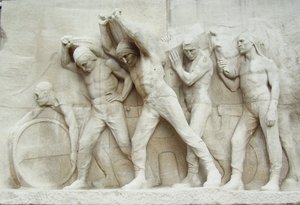
Perhaps Meunier’s most ambitious undertaking was the “Monument to Labour,” a sprawling, multi-faceted work acquired by the Belgian state. This monumental project wasn't simply a sculpture; it was an entire artistic ecosystem designed to celebrate the contributions of the working class. It comprised four stone bas-reliefs representing industry, mining, harvest, and the harbor—each panel teeming with figures engaged in their respective trades. Complementing these were four bronze statues: the sower, the smith, the miner, and the ancestor—archetypal representations of labor through the ages. At the heart of it all stood a poignant bronze group titled “Maternity,” acknowledging the vital role of women and family within this world. The "Monument to Labour" wasn’t just about depicting work; it was about elevating it, imbuing it with a sense of nobility and recognizing its fundamental importance to society. This monumental work stands as a testament to Meunier's belief in the dignity of labor and his commitment to portraying the lives of working people with respect and compassion.

Constantin Meunier’s Enduring Significance

Constantin Meunier’s artistic legacy endures through his powerful paintings and sculptures, which continue to resonate with audiences worldwide. The Museum Constantin Meunier, established in 1939 within the walls of his last home and studio in Ixelles, Brussels, serves as a fitting tribute to his life and work, housing approximately 150 of his creations. His art remains relevant not only for its historical significance but also for its timeless message about the dignity of labor and the importance of social consciousness. Meunier’s ability to capture the human spirit amidst the relentless march of industrial progress ensures his place as a pivotal figure in Belgian and European art history—an artist who dared to look beyond the surface and reveal the profound beauty and inherent worth within the lives of ordinary people.