Portretul lui Andrea Di Bartolo

Picturi Andrea Di Bartolo: Cele 28 de cele mai faimoase, prin ochii unei galerii

Actualizat Noiembrie 2026 · clasat în funcție de scorul nostru de popularitate (căutări, vizite și comenzi pentru fiecare operă) · 30 lucrări ale lui Andrea Di Bartolo în catalogul nostru

Pe scurt

În ochii galeriei, cea mai celebră pictură a lui Andrea Di Bartolo este Coronation of the Virgin (1410), a cărei originală este expusă la Pinacoteca di Brera, Milano. St. Jerome in the Wildrness (1515) și The Presentation of the Virgin in the Temple (1400) completează trioul pe care orice ochi îl recunoaște. Dintre cele 30 opere ale lui Andrea Di Bartolo din catalogul nostru, galeria prezintă mai jos cele 28 cele mai faimoase, fiecare fiind originală, cu anul creării, muzeul de păstrare și elementul care o face unică.

1360 – 1428, Siena Sienese school Cele mai multe lucrări: National Gallery of Art

Cele mai apreciate 10 picturi ale lui Andrea Di Bartolo din galerie

1
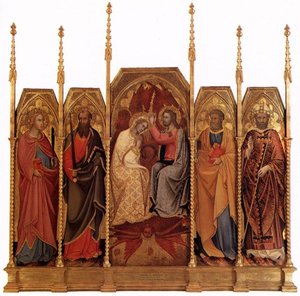
Coronation of the Virgin (1410) de Andrea Di Bartolo

Coronation of the Virgin

1410 · Oil On Canvas · Pinacoteca di Brera, Milano

To stand before this depiction of the Coronation of the Virgin is to be transported across the veil of time, into a realm where earthly grandeur meets divine glory. The scene unfolds with breathtaking solemnity and vibrant energy, capturing that singular moment when Mary, the Mother of God, is elevated to her heavenly throne. Andrea di Bartolo’s masterful hand guides our gaze through this sacred gathering, presenting not merely an…

2
St. Jerome in the Wildrness (1515) de Andrea Di Bartolo

St. Jerome in the Wildrness

1515 · Oil On Panel · The Bowes Museum, Barnard Castle

In the quiet, rugged expanse of a landscape that feels more European than Syrian, we encounter a moment of profound spiritual intensity. St. Jerome in the Wilderness is not merely a depiction of a saint; it is an immersive experience of penance and prayer. As the viewer’s eye meets the kneeling figure of St. Jerome, there is an immediate sense of the weight of devotion. The artist captures the saint…

3
The Presentation of the Virgin in the Temple (1400) de Andrea Di Bartolo

The Presentation of the Virgin in the Temple

1400 · Tempera On Panel · National Gallery of Art, Washington

The Presentation of the Virgin in the Temple by Andrea Di Bartolo captures a pivotal moment from the life of the Madonna. Created about 1400/1405, the work illustrates the young Virgin Mary taking leave of her parents, Anna and Joachim. This narrative is drawn from an apocryphal account attributed to the evangelist Matthew, rather than the canonical Gospels.

4
Madonna of Humility, The Blessing Christ, Two Angels, and a Donor [obverse] (1380) de Andrea Di Bartolo

Madonna of Humility, The Blessing Christ, Two Angels, and a Donor [obverse]

1380 · Tempera On Panel · National Gallery of Art, Washington

The late 14th-century Sienese School finds a profound expression in this tempera and gold leaf panel. Seated upon a patterned cushion, the Virgin Mary nurtures the infant Christ, a composition that emphasizes maternal intimacy within a rigid, hierarchical structure. The gold ground provides a non-naturalistic, divine backdrop, reflecting an omnipresent light that transcends earthly space. This portable altarpiece, dated to approximately 1380, utilizes a vertical arrangement to guide the viewer…

5
Christ on the Cross [reverse] (1380) de Andrea Di Bartolo

Christ on the Cross [reverse]

1380 · Tempera On Panel · National Gallery of Art, Washington

The viewer encounters Christ on the Cross [reverse], a work by Andrea Di Bartolo that dates to about 1380/1390. This panel functions as a simplified version of a portable diptych, a small and intimate object designed for private contemplation. While the obverse of such an icon typically presents a Madonna and Child, this specific side focuses entirely on the central figure of the Crucifixion. It is a quiet, solitary scene…

6
The Crucifixion (1400) de Andrea Di Bartolo

The Crucifixion

1400 · Tempera On Panel · Metropolitan Museum of Art, New York

In this panoramic composition, we find ourselves witnessing a profound moment of religious tragedy. The scene is crowded, filled with a dense assembly of mourners and soldiers that presses against the foreground, creating a sense of immediate, heavy presence. At the center, the figure of Christ is suspended on the cross, flanked by two thieves, while angels hover within the sky above. The composition is characteristic of the Sienese Gothic…

7
The Assumption of the Virgin with St. Thomas and Two Donors (Ser Palamedes and his Son Matthew) (1390) de Andrea Di Bartolo

The Assumption of the Virgin with St. Thomas and Two Donors (Ser Palamedes and his Son Matthew)

1390 · Tempera On Panel · Virginia Museum of Fine Arts, Richmond

The composition ascends vertically, guiding the eye from the earthly realm toward a divine summit. At the center of this spiritual movement, the Virgin Mary rises through layers of angelic figures, her presence framed by a background of gold leaf that eliminates earthly shadows. This Sienese Gothic approach creates a flattened, sacred space where light is even and pervasive. The figures are defined by rhythmic, organic shapes and the precise,…

8
Den hellige Blasius (1395) de Andrea Di Bartolo

Den hellige Blasius

1395 · Tempera On Panel · Muzeul Național de Artă, Arhitectură și Design, Oslo

The gaze meets Den hellige Blasius, a painting that holds a steady, sacred presence. This work by Andrea Di Bartolo brings a singular figure into view, presenting a religious scene or person through the lens of late medieval devotion. The subject, Saint Blasius, emerges from a background of gold, appearing as a quiet pillar of faith. Every line of the figure seems to carry the weight of a prayer, frozen…

9
The Crucifixion (1390) de Andrea Di Bartolo

The Crucifixion

1390 · Tempera On Panel · Muzeul Național din Varșovia, Varșovia

The Crucifixion by Andrea Di Bartolo emerges from the shadows of the late fourteenth century, a solemn vision captured around 1400. This work places the viewer directly before the central event of Christian history, presenting the Crucifixion of Jesus Christ with a profound sense of spiritual weight. Every line and color choice works to anchor this sacred moment in a space that feels both otherworldly and deeply felt.

10
Saint Stephen (panel from the right pilaster of an altarpiece) (1397) de Andrea Di Bartolo

Saint Stephen (panel from the right pilaster of an altarpiece)

1397 · Tempera On Panel · Victoria and Albert Museum, Londra

Saint Stephen (panel from the right pilaster of an altarpiece) is a work by Andrea Di Bartolo. This fragmentary panel originated as part of a series of superimposed figures from the right pilaster of an unidentified Italian altarpiece. The wood panel captures the first Christian martyr, Saint Stephen, in a moment of quiet, heavy presence. He is depicted with the symbols of his devotion and his end: a book held…

Picturi cu Andrea Di Bartolo, clasate de la 11 la 28

Subiectele care i-au captivat privirea lui Andrea Di Bartolo

Cele patru teme care revin cel mai des în aceste opere originale, fiecare având cel mai sublim exemplu.

Muzeele care păstrează originalele lui Andrea Di Bartolo

Cele 8 muzee care dețin cele mai multe dintre picturile de pe această pagină.

Muzee Oraș Lucrări lui Andrea Di Bartolo Picturi din această listă
National Gallery of Art, WashingtonNational Gallery of Art Washington 5 The Presentation of the Virgin in the Temple, Madonna of Humility, The Blessing Christ, Two Angels, and a Donor [obverse], Christ on the Cross [reverse]
Musée du Petit Palais, AvignonMusée du Petit Palais Avignon 3 Saint Bishop, Saint Anthony Abbot, Saint Costanzo
Detroit Institute of Arts, DetroitDetroit Institute of Arts Detroit 2 Christ in Benediction, Madonna and Child
Pinacoteca di Brera, MilanoPinacoteca di Brera Milano 1 Coronation of the Virgin
The Bowes Museum, Barnard CastleThe Bowes Museum Barnard Castle 1 St. Jerome in the Wildrness
Metropolitan Museum of Art, New YorkMetropolitan Museum of Art New York 1 The Crucifixion
Virginia Museum of Fine Arts, RichmondVirginia Museum of Fine Arts Richmond 1 The Assumption of the Virgin with St. Thomas and Two Donors (Ser Palamedes and his Son Matthew)
Muzeul Național de Artă, Arhitectură și Design, OsloMuzeul Național de Artă, Arhitectură și Design Oslo 1 Den hellige Blasius

Andrea Di Bartolo, o pictură emblematică pe deceniu

Lucrări pe deceniu

Alege o deceniu pentru a descoperi opera originală care îl definește.

Picturile lui Andrea Di Bartolo: răspunsurile galeriei

Care este cea mai celebră pictură a lui Andrea Di Bartolo?Află răspunsul

Coronation of the Virgin (1410), Pinacoteca di Brera, Milano. Urmează St. Jerome in the Wildrness (1515) și The Presentation of the Virgin in the Temple (1400).

Ce vârstă avea Andrea Di Bartolo când a finalizat Coronation of the Virgin?Află răspunsul

50 ani: Coronation of the Virgin datează din 1410, iar Andrea Di Bartolo s-a născut în 1360.

Care sunt cele mai importante 10 picturi ale lui Andrea Di Bartolo?Află răspunsul

Coronation of the Virgin, St. Jerome in the Wildrness, The Presentation of the Virgin in the Temple, Madonna of Humility, The Blessing Christ, Two Angels, and a Donor [obverse], Christ on the Cross [reverse], The Crucifixion, The Assumption of the Virgin with St. Thomas and Two Donors (Ser Palamedes and his Son Matthew), Den hellige Blasius, The Crucifixion și Saint Stephen (panel from the right pilaster of an altarpiece). Clasamentul de mai sus indică anul și muzeul pentru fiecare piesă.

Câte lucrări a creat Andrea Di Bartolo?Află răspunsul

Catalogul nostru cuprinde 30 lucrări ale lui Andrea Di Bartolo, datate între 1380 și 1424.

Unde sunt expuse cele mai celebrele opere originale ale lui Andrea Di Bartolo?Află răspunsul

În principal în National Gallery of Art (Washington), Musée du Petit Palais (Avignon) și Detroit Institute of Arts (Detroit). Tabelul cu muzee de mai sus le enumeră pe toate.

Când a creat Andrea Di Bartolo cele mai faimoase picturi?Află răspunsul

În 1400s: 8 dintre cele 28 lucrări de pe această pagină au fost realizate atunci, fiind The Presentation of the Virgin in the Temple dintre acestea.

Care sunt cele mai vechi și cele mai recente opere celebre ale lui Andrea Di Bartolo?Află răspunsul

Pe această pagină, cea mai veche lucrare datează din Madonna of Humility, The Blessing Christ, Two Angels, and a Donor [obverse] (1380), iar cea mai recentă este din Madonna and Child (1424).

La ce subiecte s-a întors cel mai des Andrea Di Bartolo?Află răspunsul

Gold background (14), Woman (7) și Child (6), din cele 28 lucrări de pe această pagină.

În ce tehnică a lucrat cel mai mult Andrea Di Bartolo?Află răspunsul

Tempera On Panel, pentru 19 dintre cele 28 lucrări de pe această pagină.

Cu ce mișcare este asociat(ă) Andrea Di Bartolo?Află răspunsul

Sienese school, judecând după originalele de pe această pagină.

Ce opere originale ale lui Andrea Di Bartolo deține National Gallery of Art?Află răspunsul

The Presentation of the Virgin in the Temple, Madonna of Humility, The Blessing Christ, Two Angels, and a Donor [obverse] și Christ on the Cross [reverse]: National Gallery of Art, Washington deține 5 dintre lucrările de pe această pagină.

Andrea Di Bartolo: artistul

O moștenire a devotamentului senese

În inima vibrantă a Școlii de la Siena, Andrea Di Bartolo a apărut ca un maestru al cărui pensulă a capturat intensitatea spirituală profundă a erei sale. Fiul și ucenicul pictorului prominent Bartolo di Fredi, călătoria artistică a lui Andrea a fost profund înrădăcinată în tradițiile atelierului tatălui său. Anii săi de început au fost petrecuți fiind imersat în comenzile prestigioase care treceau prin studioul familiei sale, o perioadă de ucenicie care a pus temelia unei cariere definite de devotamentul religios și măiestria tehnică. Lucrând alături de lumenari precum Luca di Tommè, acesta a contribuit la lucrări comunitare semnificative, inclusiv un altarpiece pentru gilda cizmarilor din catedrala de la Siena, marcând prima sa prezență documentată în analele istoriei artei.

Artisticitatea lui Andrea Di Bartolo nu se limita doar la pânză; el a fost un creator versatil, activând ca pictor, designer de vitralii și iluminator de manuscrise. Opera sa a pus adesea punți între grația eterică a tradiției Gotice și umanismul emergent care, în cele din urmă, ar defini Renașterea. În subiectele sale religioase, se descoperă o atenție meticuloasă la detalii și o capacitate pentru profunzime narativă. Fie că înscrie liniștea solitudinii lui Sfântul Ieronim în pustiu sau tensiunea dramatică a unei Crucifixionări, Andrea poseda capacitatea de a ancora compozițiile sale prin structuri puternice care atrag privitorul într-o stare de contemplare.

Măiestria luminii și a narativului

Prowess-ul tehnic al lui Andrea Di Bartolo este cel mai evident în capacitatea sa de a manipula lumina și textura pentru a evoca emoție. Lucrările sale prezintă adesea o calitate luminoasă, unde jocul dintre umbră și strălucire oglindește luptele spirituale interne ale subiectelor sale. În reprezentările figurilor sacre, există un simț palpabil al greutății și prezenței; plisele ritmatice și grele ale robei unui cardinal sau transluciditatea delicată a unui văl sunt randate cu o precizie care face ca divinul să pară tangibil, uman. Această măiestrie i-a permis să creeze opere care serviu ca predici ca silente, bogate în vocabular simbolic destinat să inspire pioștenia credincioșilor.

Dincolo de abilitatea sa individuală, semnificația istorică a lui Andrea rezidă în rolul său în peisajul în evoluție al Italiei centrale și de nord. Activ pe parcursul sfârșitului secolului al XIV-lea și începutului secolului al XV-lea, el a ajutat la menținerea prestigiului Școlii de la Siena într-o perioadă de mare tranziție. Contribuțiile sale la altarpiece, vitralii și manuscrise iluminate au asigurat ca viziunea sa artistică să pătrundă în diverse aspecte ale vieții religioase din Siena și orașele din împrejurimi. Prin dedicarea sa atât pentru complexitatea decorativă a artelor sale, cât și pentru frumusețea solemnă a subiectelor sale, Andrea Di Bartolo a lăsat o amprentă indelibilă pe moștenirea vizuală a Italiei.