


1


Actualizat Octombrie 2026 · clasat în funcție de scorul nostru de popularitate (căutări, vizite și comenzi pentru fiecare operă) · 1.220 lucrări ale lui Albrecht Dürer în catalogul nostru
In short
Of all the originals Albrecht Dürer left, the most famous is Knight, Death, and the Devil (1513). Close behind it come Țaraie (1502) and Портрет на млад човек с мастило и размити цветове (1493). Our catalog holds 1,220 works by Albrecht Dürer; the gallery has kept the 100 the world admires most, each shown with its date, its museum and its story.

Young Hare - A Masterclass in Naturalism Albrecht Dürer’s 1502 watercolor masterpiece transcends mere animal portraiture; it is a profound study of nature and a testament to the artist's unparalleled skill. This remarkably detailed depiction of a young hare captures not just its physical form, but also a sense of quiet alertness and fleeting beauty that resonates with viewers centuries later. It stands as one of Dürer’s most celebrated works,…

Descoperă eleganța atemporală a capodoperei lui Albrecht Dürer Un portret al tinereții și al introspecției „Autoportretul la vârsta de 22 de ani” al lui Albrecht Dürer este o reprezentare captivantă a unui tânăr, emanând o aură de solemnitate și introspecție. Subiectul, probabil chiar Dürer însuși, ține în mână o plantă de spini, adăugând un strat de profunzime simbolică întregii compoziții. Acest portret timpuriu oferă o privire asupra talentului înfloritor al…

Feast Of The Rose Garlands: A Renaissance Masterpiece The Feast of the Rose Garlands, painted by Albrecht Dürer in 1506, stands as an enduring testament to the artistic brilliance of the Northern Renaissance and a profound meditation on faith and divine grace. More than just a depiction of biblical narrative—the birth of Jesus Christ surrounded by angels and saints—it’s a meticulously crafted visual symphony that embodies the stylistic innovations and…

Albrecht Dürer’s Self-Portrait at 26 stands as an emblem of the Northern Renaissance, transcending mere representation to embody a profound exploration of identity and artistic ambition. Painted in 1498, this oil on panel masterpiece resides within the Museo Nacional del Prado in Madrid, offering viewers a captivating glimpse into the mind of one of Europe’s most influential artists.

Albrecht Dürer și Adorarea Magiilor: O Simfonie de Lumină și Credință în Renașterea Germană Renașterea germană, un vârtej de descoperiri intelectuale și artistice care a schimbat fundamental percepția asupra lumii și a artei, a fost dominată de figuri emblematice precum Albrecht Dürer. Acest maestru pictor și gravor din Nürnberg nu doar că a înregistrat cu meticulozitate detalii ale naturii și umanității, ci și că a creat opere care continuă să…

A Glimpse into Artistic Maturity: Dürer’s Self-Portrait at 22 This striking self-portrait, created in 1500 by the masterful Albrecht Dürer, is far more than a simple likeness; it's a bold statement of artistic identity and a pivotal work within the Northern Renaissance. Painted when he was just twenty-eight years old (though misdated as 1493), this piece resides in the Louvre Museum and showcases Dürer’s remarkable skill and evolving style. He…

Adorația Troiței (Altarul Landauer) izvorăște din pensula lui Albrecht Dürer, o prezență care cucerește atenția privitorului prin dimensiunea sa colosală și prin greutatea sa spirituală. Creată în 1511, această operă monumentală surprinde un moment de convergență celestială. Ea există ca un imn vizual profund, în care divinul și terestrul se întâlnește într-un singur act unitar de venerare. Atmosfera pare să se îngroașe sub masa figurilor adunate în acest spațiu sacru,…

Realizată în 1507 în timpul celei de-a doua vizite a lui Albrecht Dürer în Italia, această captivantă portretizare oferă o perspectivă rară și intimă asupra lumii femeilor venețiene din înalta Renaștere. Depășind simpla reprezentare fizică, pictura este un studiu al contemplației tăcute și a frumuseții subtile, demonstrând adaptarea magistrală a lui Dürer a tehnicilor artistice italiene în sensibilitatea sa nord-europeană.

Albrecht Dürer’s “Christ Among the Doctors” (1506) nu este doar o pictură; este o fereastră către un moment intim din istoria artei renascentiste. Această operă, realizată în ulei pe lemn, ne oferă o perspectivă rară asupra unei scene intelectuale vibrante: Iisus, la vârsta de doisprezece ani, angajat într-o dezbatere științifică cu savanți distinși în Templul din Ierusalim – un fragment biblic relatat în Evanghelia lui Luca. Mai mult decât o…
 ・Sărbătoarea ghirlandelor de trandafiri (detaliu)1506 · Galeria Națională din Praga
12
 Petrecerea de Rosenkranz1506
13
 Autoportret
14
 Портрет на млада Венецианка1505 · Muzeul Kunsthistorisches din Viena
15
 Self-Portrait at the Age of Twenty Eight1500 · Colecțiile Statale de Pictură din Bavaria
16
 The Four Apostles1526 · Colecțiile Statale de Pictură din Bavaria
17
 Knight, Death and the Devil1513 · Staatliche Kunsthalle Karlsruhe
18
 The Knight Death and The Devil
19
 The Men's Bath1497 · British Museum
20
 St Jerome in the Wilderness1495 · National Gallery
21
 The Sea Monster1498 · Metropolitan Museum of Art
22
 View of the Arco Valley in the Tyrol1495 · Muzeul Luvru
23
 Crucifixion1508 · Metropolitan Museum of Art
24
 The Seven Sorrows of the Virgin1496 · Alte Pinakothek
25
 St Jerome Penitent in the Wilderness1496 · Metropolitan Museum of Art
26
 Harrowing of Hell or, Christ in Limbo (No. 14)1512 · Metropolitan Museum of Art
27
 Life of the Virgin: 18. The Coronation of the Virgin1510 · Graphische Sammlung Albertina
28
 Iepurele1502 · Albertina
29
 Small Passion: 2. Expulsion from the Paradise1510 · British Museum
30
 Self-Portrait in a Fur-Collared Robe1500 · Alte Pinakothek
31
 Agony in the Garden1515 · Metropolitan Museum of Art
32
 The Temptation of the Idler or The Dream of the Doctor1498 · Metropolitan Museum of Art
33
 Hands of an Apostle1508
34
 St Peter and St John Healing the Cripple (No. 16)1513 · Metropolitan Museum of Art
35
 Saint Eustace1501
36
 Cortişorul Castelului Vechi din Innsbruck cu nori1494 · Graphische Sammlung Albertina
37
 The Bagpiper1514 · Metropolitan Museum of Art
38
 The Harrowing of Hell or Christ in Limbo, from The Large Passion1510 · Albertina
39
 Sudarium Displayed by Two Angels1513 · Metropolitan Museum of Art
40
 Bărbați silvani cu scuturi heraldice1499 · Alte Pinakothek
41
 The Virgin Mary in Prayer1518 · Muzeele Statale din Berlin
42
 Pattern from the Series of Six Knots 31505 · British Museum
43
 Sfântul Eustache1501 · National Gallery of Victoria
44
 Martiriul celor Zece Mii1508 · Muzeul Kunsthistorisches din Viena
45
 St Jerome in his Study1514 · Staatliche Kunsthalle
46
 St Christopher1511 · British Museum
47
 Upper Body of Christ1508
48
 Portrait of William Pirckheimer1503
49
 Portrait of Erasmus1520 · Muzeul Luvru
50
 Adam1507 · Muzeul Prado
51
 Studiu de un bărbat în vârstă de 93 de ani1521 · Graphische Sammlung Albertina
52
 Erasmus of Rotterdam1501
53
 The Emperors Charlemagne and Sigismund1510 · Courtauld Gallery
54
 Jabach Altar: Saints Simeon and Lazarus1500 · Colecțiile Statale de Pictură din Bavaria
55
 Wing of a Blue Roller1512 · Graphische Sammlung Albertina
56
 The Small Courier1496
57
 Self-Portrait at 261498 · Muzeul Prado
58
 Virgin and child with a pear1512 · Muzeul Kunsthistorisches din Viena
59
 Crowning with Thorns1504
60
 Small Passion: 9. Christ Washing Peter's Feet1511 · British Museum
61
 Head of an Angel1506 · Graphische Sammlung Albertina
62
 Portrait Of A Woman With Her Hair Down1497 · Städelsche Kunstinstitut Und Städtische Galerie
63
 Eve1507 · Muzeul Prado
64
 Way to Calvary1527 · Accademia Carrara di Belle Arti Bergamo
65
 Traumgesicht. Dürer dokumentiert einen seiner Albträume1525 · Muzeul Kunsthistorisches din Viena
66
 Jabach Altar: Saints Joseph and Joachim1504 · Colecțiile Statale de Pictură din Bavaria
67
 Adoration of the Magi1504 · Galleria degli Uffizi
68
 Virgin and Child1516 · Metropolitan Museum of Art
69
 The Southern Hemisphere of the Celestial Globe1515 · British Museum
70
 Martyrdom of the Ten Thousand1496 · Graphische Sammlung Albertina
71
 Satyr Family1505
72
 Study of Hands1506 · Blasius Collection
73
 Triumphal Arch (detail)1515 · Germanisches Nationalmuseum
74
 Life of the Virgin: 6. Marriage of the Virgin1504 · Graphische Sammlung Albertina
75
 Study of a Man with a Drill1496 · Musée Bonnat
76
 Small Passion: 32. Christ and the Disciples at Emmaus1511 · British Museum
77
 Illustration to Revelationes Sancte Birgitte1500 · British Museum
78
 Self-Portrait at 26 (detail)1498 · Muzeul Prado
79
 The Cook And His Wife1496
80
 The Flagellation1511
81
 Man Of Sorrows With Hands Raised1500
82
 Prudentia1494
83
 The Four Witches1497
84
 Christ on the Cross with the Virgin and St John1510 · British Museum
85
 Ecce Homo1499 · Graphische Sammlung Albertina
86
 The Seven Trumpets Are Given to the Angels1498
87
 The Battle of the Angels1498
88
 Studies of Self-Portrait, Hand and Pillow1493 · Metropolitan Museum of Art
89
 Christ before Caiaphas (No. 4)1512 · Metropolitan Museum of Art
90
 Jakob Fugger The Rich1518 · Staatsgalerie
91
 The Annunciation1511
92
 The coat of arms with the skull1507
93
 În grădina pădurii cu fântână înzidită prin care doi oameni sunt așezați1505
94
 St Simon1523 · Metropolitan Museum of Art
95
 Sfântul Cinstit Suprăgând1511
96
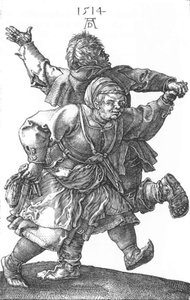 Peasant Couple Dancing1514 · Metropolitan Museum of Art
97
 Studies on the Proportions of the Female Body1528 · Staatsbibliothek Bamberg
98
 The Revelation of St John: 11. St Michael Fighting the Dragon1498 · Staatliche Kunsthalle
99
 Maica Sfântă Oferind Laptele1512 · Graphische Sammlung Albertina
100
 Портрет Максимилиана I1518 · Graphische Sammlung Albertina
The four subjects that come back most often in these originals, each with its finest example.
Cele 8 muzee care dețin cele mai multe dintre picturile de pe această pagină.
| Muzeu | Oraș | Lucrări lui Albrecht Dürer | Picturi din această listă |
|---|---|---|---|
 Metropolitan Museum of Art |
New York | 52 | The Sea Monster, Crucifixion, St Jerome Penitent in the Wilderness |
 Graphische Sammlung Albertina |
Viena | 51 | Life of the Virgin: 18. The Coronation of the Virgin, Cortişorul Castelului Vechi din Innsbruck cu nori, Studiu de un bărbat în vârstă de 93 de ani |
 British Museum |
Londra | 67 | The Men's Bath, Small Passion: 2. Expulsion from the Paradise, Pattern from the Series of Six Knots 3 |
 Muzeul Kunsthistorisches din Viena |
Viena | 30 | Adorația Troiței (Altarul Landauer), Portretul unei tinere venețience, Портрет на млада Венецианка |
 Muzeul Prado |
Madrid | 9 | Autorportret, Adam, Self-Portrait at 26 |
 Colecțiile Statale de Pictură din Bavaria |
Munchen | 10 | Self-Portrait at the Age of Twenty Eight, The Four Apostles, Jabach Altar: Saints Simeon and Lazarus |
 Alte Pinakothek |
Munchen | 26 | The Seven Sorrows of the Virgin, Self-Portrait in a Fur-Collared Robe, Bărbați silvani cu scuturi heraldice |
 Albertina |
Viena | 19 | Țaraie, Iepurele, The Harrowing of Hell or Christ in Limbo, from The Large Passion |
Pick a decade to see the original that defines it.
Descoperă eleganța atemporală a capodoperei lui Albrecht Dürer Un portret al tinereții și al introspecției „Autoportretul la vârsta de 22 de ani” al lui Albrecht Dürer este o reprezentare captivantă a unui tânăr, emanând o aură de solemnitate și introspecție. Subiectul, probabil chiar Dürer însuși, ține în mână o plantă de spini, adăugând un strat de profunzime simbolică întregii compoziții. Acest portret timpuriu oferă o privire asupra talentului înfloritor al…
Young Hare - A Masterclass in Naturalism Albrecht Dürer’s 1502 watercolor masterpiece transcends mere animal portraiture; it is a profound study of nature and a testament to the artist's unparalleled skill. This remarkably detailed depiction of a young hare captures not just its physical form, but also a sense of quiet alertness and fleeting beauty that resonates with viewers centuries later. It stands as one of Dürer’s most celebrated works,…

In the quiet, hallowed halls of the Alte Pinakothek in Munich, there exists a masterpiece that does more than merely occupy space; it commands a profound silence. Albrecht Dürer’s "The Four Apostles," completed in 1526, stands as a monumental achievement of the German Renaissance, offering a window into an era where humanism and religious devotion were inextricably entwined. This is not simply a portrait of four men; it is a…
Knight, Death, and the Devil (1513). Țaraie (1502) and Портрет на млад човек с мастило и размити цветове (1493) come next.
42 years old: Knight, Death, and the Devil dates from 1513, and Albrecht Dürer was born in 1471.
Knight, Death, and the Devil, Țaraie, Портрет на млад човек с мастило и размити цветове, Feast Of The Rose Garlands, Autorportret, Adorarea Magiilor, Self-portrait at 22,1493, louvre, Adorația Troiței (Altarul Landauer), Portretul unei tinere venețience și Cristos între doctori. The ranking above gives each one's year and museum.
Our catalog holds 1,220 works by Albrecht Dürer, dated from 1493 to 1528.
Mostly in Metropolitan Museum of Art (New York), Graphische Sammlung Albertina (Viena) și British Museum (Londra). The museum table above lists them all.
In 1500s: 33 of the 100 works on this page were made then, Țaraie among them.
On this page, the earliest is Портрет на млад човек с мастило и размити цветове (1493) and the latest Studies on the Proportions of the Female Body (1528).
Renaissance (34), Renaissance art (27) și Engraving (11), across the 100 works on this page.
Engraving, for 23 of the 100 works on this page.
Renașterea nordică, judging by the originals on this page.
The Sea Monster, Crucifixion și St Jerome Penitent in the Wilderness: the Metropolitan Museum of Art, New York holds 14 of the works on this page.
Yes, as a reproduction: the original stays in its museum, but any painting on this page can be painted by hand for you, made to order one at a time, from the painting's own page.
In the bustling Franconian city of Nuremberg, a place where the air often carried the scent of metal and the precision of fine handiwork, Albrecht Dürer entered the world in 1471. He was born into a household defined by the steady, disciplined rhythm of craftsmanship. His father, Albrecht Dürer the Elder, was a successful goldsmith who had brought his trade and his lineage to the city. This environment of meticulous labor and material mastery provided the very soil in which the young boy's talents would eventually take root.
While his father might have envisioned a life spent working with precious metals, the boy possessed a different kind of hunger. His hands were drawn not to the hammer of the smith, but to the delicate precision of drawing and the profound possibilities of the image. This innate inclination would eventually transform him into a man of many disciplines. He would become a painter, a draftsman, a writer, and a printmaker, each role allowing him to explore the world through a different lens of observation and technical skill.
His early years were shaped by this tension between the family trade and his own burgeoning identity. The discipline of the goldsmith's workshop instilled in him a rigorous work ethic that he would carry into every medium he touched. Even as a child, his talent was evident, appearing in early works such as a silverpoint self-portrait from about 1484. This early sign of his skill hinted at the complex, intellectual artist he was destined to become.
In the bustling streets of Nuremberg, the boy Albrecht was shaped by the steady, disciplined rhythm of his father's workshop. His father, a goldsmith who had traveled from Hungary to find his fortune, brought with him a lineage of meticulous craftsmanship. Young Albrecht began his training under his father's watchful eye, learning the precision required to work with metal. Yet, the boy's hand possessed a different kind of grace. It was evident to those around him that his true calling lay not in the shaping of gold, but in the fluid movement of a drawing tool across a surface.
By the age of thirteen, his talent led him away from the family trade and into the workshop of Michael Wolgemut, the leading artist of the city. This transition marked the beginning of a profound immersion into the visual language of the age. From 1486 to 1490, he labored under Wolgemut, absorbing the secrets of composition and design. He found himself surrounded by the heavy scent of ink and the constant activity of woodcut illustration. This period of apprenticeship was a deep education in the mechanics of image-making, where he learned how to translate complex ideas into the stark, powerful lines of a woodblock.
His early development was marked by a precocious ability to capture the world with startling accuracy. Even as a teenager, his skill was evident in his early drawings, such as a silverpoint self-portrait created when he was barely thirteen. These formative years in Nuremberg provided the technical foundation upon which his entire career would be built, blending the rigorous work ethic of a goldsmith with the expansive vision of a master illustrator.
Driven by a restless curiosity to master the secrets of form and perspective, Dürer turned his gaze toward the south. In 1494, he embarked on his first trip to Italy, seeking the source of the new artistic language emerging from the Mediterranean. He wandered through Venice and Bologna in the late 1490s, absorbing the classical motifs and the harmonious compositions that defined the Italian style. This was no mere sightseeing; he was a student of a different way of seeing. He sought to understand how the masters of the south organized space and human figure, bringing these lessons back to the northern lands.
His second sojourn to Italy occurred between 1505 and 1507, a period that further refined his understanding of proportion and grace. He did not simply adopt the Italian manner; instead, he merged it with his own meticulous northern sensibility. This synthesis allowed him to create works that possessed both the structural clarity of the south and the intense detail of his German upbringing. Even in his later years, his curiosity remained active, leading him through the Netherlands between 1520 and 1521. He remained a man in constant motion, always searching for the mathematical and visual truths that governed the natural world.
The workshop of a true craftsman is a place of intense labor, and Dürer found his greatest purpose in the rhythmic precision of the print. He was a man of immense technical skill, capable of both carving relief into woodblocks and working with the sharp, decisive bite of the metal burin. While many of his contemporaries used these methods merely to replicate existing images, he transformed the very nature of the medium. He turned printmaking into an independent art form, one that carried its own weight and dignity. Throughout his long career, he produced over 300 prints, each a product of his tireless hand and searching eye.
His mastery was most evident when he turned to the intaglio process, using copper plates to achieve a depth of tone that few could match. He did not rely on simple shading; instead, he built his images through a complex language of lines. By employing hatching, cross-hatching, and even double hatching, he could mimic the subtle shifts of light and shadow found in the natural world. This meticulous approach allowed him to move beyond the flat surfaces of earlier woodcuts, creating a sense of volume and atmosphere that felt startlingly real to those who held the paper.
Dürer sought to find the hidden logic within the visible world, believing that art should be grounded in the certainties of mathematics and science. He did not merely observe the surface of things; he applied a rigorous, analytical approach to the way light falls upon a limb or how a body occupies space. This commitment to the mathematical foundations of representation allowed him to achieve a profound understanding of anatomy and proportion. He moved beyond the simple imitation of nature, striving instead to grasp the underlying rules that govern its form. Through this disciplined eye, he achieved a remarkable naturalism that felt both deeply human and intellectually precise.
His hand possessed a unique ability to bridge two distant worlds. He took the meticulous, sharp-edged precision of the Northern European tradition and infused it with the grace and harmonious composition he encountered in Italy. This synthesis allowed him to render textures with an almost obsessive attention to detail, yet he maintained a sense of fluid elegance. He even adopted the subtle blending of tones known as sfumato, using it to soften transitions and add a sense of atmospheric depth to his compositions. This marriage of technical rigor and aesthetic grace gave his work a weight and presence that was entirely his own.
The hunger to translate complex spiritual truths into wood and metal drove much of his creative output. In 1498, he produced the Apocalypse series, a collection of fourteen woodcuts that captured the intense imagery of the Book of Revelation. These prints demonstrated how much detail could be carved into a simple woodblock. His reach into the realm of engraving allowed for even greater precision, as seen in his 1504 engraving of Adam and Eve. This work sought to capture the human form with a new sense of anatomical accuracy. He also applied his skill to large-scale religious commissions, such as the Feast of the Rose Garlands altarpiece in 1506.
As he matured, his engravings became more introspective and intellectually dense. Between 1513 and 1514, he produced several works that are often called his master engravings, including Melencolia I and Saint Jerome in His Study. These pieces moved beyond simple illustration to explore profound psychological states through intricate line work and shadow. Even in his later years, his hand remained steady and purposeful. In 1526, he completed the Four Apostles, a work that continued his lifelong pursuit of combining technical mastery with deep spiritual meaning.
The shadow cast by Dürer reaches deep into the history of Western art, touching the very way we perceive the creator's place in society. He sought to move the artist away from the status of a mere craftsman, laboring in a workshop to produce goods, and toward the dignity of an intellectual practitioner. This shift was fueled by his own rigorous study of the mathematical and scientific foundations of beauty. In his final years, he codified these convictions in his theoretical writings, including the Four Books of Human Proportion, published about 1528. Through these texts, he argued that art was a discipline of the mind, requiring a deep understanding of geometry and the natural world.
He acted as a vital bridge between two distinct worlds, weaving the meticulous, symbolic traditions of Northern Europe into the harmonious ideals of the Italian Renaissance. By absorbing the classical motifs and perspective of the south and blending them with the exacting detail of his German roots, he created a visual language that was entirely his own. This synthesis allowed for a new kind of naturalism, one that did not sacrifice spiritual depth for the sake of anatomical accuracy. His meticulous realism remains a point of study for scholars and artists who seek to understand the precise intersection of observation and expression.
To follow the path of his hand, one must travel across many borders, for his presence is felt in the great halls of Europe and beyond. In London, the British Museum holds a vast assembly of sixty-seven of his works, offering a deep look into the precision of his vision. Those who seek the spirit of his engravings might find themselves in Vienna at the Albertina, where fifty-one of his pieces remain preserved. The city of New York also keeps a significant portion of his output, with forty-seven works held within the Metropolitan Museum of Art.
The weight of his legacy is felt heavily in Germany as well. The Staatliche Museen zu Berlin maintains thirty-one of his works, while the Alte Pinakothek in Munich preserves twenty-nine. These collections allow us to witness the evolution of his skill, from the early silverpoint drawings of his youth to the complex, layered compositions of his later years. One might find the Four Apostles in Munich or the intricate details of his woodcuts in the various archives of Berlin.


