A Scottish Visionary: The Life and Art of Sir Joseph Noel Paton
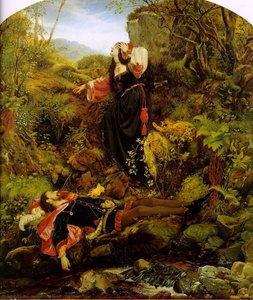
Sir Joseph Noel Paton, a name synonymous with the evocative beauty of Victorian fairy paintings and allegorical scenes, was more than just an artist; he was a weaver of myths, a chronicler of legends, and a profound observer of the human spirit. Born in Dunfermline, Scotland, on December 13, 1821, into a family deeply rooted in the traditions of damask weaving – his parents were skilled designers and artisans – Paton’s early life was saturated with intricate patterns, meticulous craftsmanship, and a deep appreciation for detail—qualities that would profoundly shape his artistic vision. Initially involved in his family's business, directing design at a muslin factory, he soon recognized a different calling, a yearning to translate the world of imagination into tangible form. This desire led him to Dunfermline Art Academy, where he honed his skills and laid the foundation for a career that would ultimately transcend local boundaries and secure his place as one of Scotland’s most celebrated artists.Early Influences and the Pre-Raphaelite Connection
Paton's artistic journey was not forged in isolation; it was shaped by a confluence of influences, both personal and external. His upbringing amidst the complex designs of damask weaving instilled within him an innate understanding of pattern, texture, and the interplay of light and shadow—elements that would become hallmarks of his distinctive style. Crucially, he also developed a deep fascination with Scottish folklore and Celtic legends, fueled by family stories and a growing interest in the rich tapestry of his nation’s heritage. This passion for mythic narratives found its expression in his early works, such as “The Quarrel of Oberon and Titania” (1847), a vibrant depiction of Shakespeare's mischievous fairies that immediately established his reputation for capturing fantastical scenes with remarkable realism and psychological depth. Interestingly, Paton’s artistic trajectory intersected briefly with the Pre-Raphaelite Brotherhood—an influential movement known for its dedication to detail, symbolism, and a return to medieval art—though he ultimately declined a formal invitation to join their ranks. This decision, however, doesn't diminish his connection to the movement; his work shares many of the Pre-Raphaelites’ core values, particularly their meticulous attention to detail and their willingness to explore complex themes through allegorical imagery. John Everett Millais, a key figure within the Brotherhood, recognized Paton’s talent early on, inviting him to study alongside him at the Royal Academy in London—a pivotal moment that exposed Paton to the prevailing artistic currents of the era.The Development of a Unique Style: Myth, Faith, and Victorian Sensibilities
Paton's artistic style evolved over time, reflecting his deepening engagement with both mythology and religious themes. His early works were characterized by their dynamic compositions, rich colors, and meticulous rendering of detail—qualities that immediately captivated audiences. However, as he matured as an artist, he began to infuse his paintings with a greater sense of emotional complexity and psychological nuance. “Luther Discovering Justification by Faith” (1866), for example, is not merely a historical depiction; it’s a powerful meditation on faith, doubt, and the struggle against oppression—a theme that resonated deeply with Victorian society grappling with questions of morality and social reform. He skillfully blended elements of Celtic folklore, biblical narratives, and allegorical symbolism to create works that were both visually stunning and intellectually stimulating. Paton's ability to imbue mythological subjects with human emotions – portraying fairies as passionate beings caught in conflict, or depicting religious figures as vulnerable individuals wrestling with profound questions—set him apart from many of his contemporaries. His work is a testament to the power of art to transcend mere representation and engage with the deepest aspects of the human experience.Royal Recognition and Artistic Legacy
Paton’s artistic achievements were recognized by the highest echelons of Scottish society. In 1866, he was appointed Her Majesty's Linmer for Scotland—a prestigious honor bestowed upon artists who served as official portrait painters to the royal family—and knighted two years later in recognition of his significant contributions to the arts and Scottish culture. This elevation solidified his status as a leading figure in the Victorian art world and ensured that his work would be showcased at court and celebrated throughout the nation. Beyond his official appointments, Paton continued to produce works that reflected his evolving artistic vision—paintings like “Puck and Fairies” (1855) and "In Die Malo" (1882), which explored themes of pleasure, mortality, and the pursuit of happiness—demonstrating a remarkable consistency in style and subject matter. His legacy extends beyond his paintings; he was also a respected antiquarian, collecting arms and armor, and a poet of considerable merit, publishing two volumes of poetry that further enriched his artistic output.A Lasting Impression: Paton’s Place in Art History
Sir Joseph Noel Paton passed away on December 26, 1901, leaving behind a rich artistic legacy that continues to captivate audiences today. His works are now housed in prominent museums and collections across Scotland and beyond—including the Scottish National Gallery and the National Records of Scotland—ensuring his art remains accessible for generations to come. While he never formally joined the Pre-Raphaelite Brotherhood, his work shares their commitment to detail, symbolism, and narrative storytelling. However, Paton’s unique blend of Celtic mythology, religious themes, and Victorian sensibilities sets him apart as a truly original artist—a master storyteller who used paint and brush to transport viewers to worlds of enchantment, faith, and profound human experience. His paintings are not merely historical artifacts; they are living embodiments of imagination, faith, and artistic vision – a testament to the enduring power of art to inspire, provoke, and illuminate the complexities of the human condition.Întrebări și răspunsuri
Cât de populare sunt operele lui Sir Joseph Noel Paton?
Statistici despre lucrările lui Sir Joseph Noel Paton sunt disponibile pe pagina de Statistici a artistului.
Pot să explorez lucrările lui Sir Joseph Noel Paton în funcție de starea de spirit?
Spațiu pe stări de spirit lui Sir Joseph Noel Paton este o pagină care organizează operele de artă ale artistului în funcție de starea de spirit.
Pot să vizualizez lucrările lui Sir Joseph Noel Paton în funcție de tehnică?
Operele lui Sir Joseph Noel Paton pot fi vizualizate pe baza mediului utilizat în pagina de Toate mediile a artistului.