Early Life and Artistic Beginnings
Sanford Robinson Gifford, a name synonymous with the serene beauty of American landscapes, was born on July 10, 1823, in Greenfield, New York – a small town nestled amidst the rolling hills of Saratoga County. His childhood unfolded in Hudson, a picturesque riverside community steeped in history and artistic tradition. Gifford’s upbringing wasn't one of formal academic pursuits initially; instead, he was immersed in the practical world of his family’s iron foundry business. However, from a young age, a deep fascination with art ignited within him, fueled by observations of the natural world and an admiration for the works of Thomas Cole, a pivotal figure in the burgeoning Hudson River School movement. Recognizing this nascent talent, Gifford's parents encouraged him to pursue his artistic inclinations, leading him to study under John Rubens Smith, a distinguished British watercolorist who had established himself as a respected drawing master in New York City. Smith’s instruction provided Gifford with a solid foundation in technique and perspective – essential tools for capturing the nuances of light and form. Following his studies with Smith, Gifford further honed his skills at the National Academy of Design, absorbing the principles of academic art while simultaneously seeking inspiration from the evolving landscape aesthetic championed by Cole and other contemporaries.The Influence of Luminism and European Travels
Gifford’s artistic journey took a significant turn in the mid-1850s when he embarked on a transformative trip to Europe. This extended sojourn, spanning over two years, proved instrumental in shaping his distinctive style – a movement known as Luminism. He was profoundly influenced by J.M.W. Turner, the celebrated British landscape painter, whose masterful use of light and atmospheric effects captivated Gifford’s imagination. He spent considerable time studying Turner's techniques at the National Gallery in London, meticulously analyzing how he rendered the ephemeral qualities of light and shadow. Beyond Turner, Gifford also explored the works of French Barbizon School painters, absorbing their emphasis on capturing the essence of nature through direct observation and a focus on tonal values. His travels extended to Belgium, Holland, Germany, Switzerland, and Italy, each location contributing to his evolving artistic vocabulary. In Rome, he spent a considerable period immersed in the study of classical ruins and Italian landscapes, further refining his ability to translate natural beauty onto canvas. This European experience wasn’t merely a superficial imitation; it represented a profound shift in Gifford's approach to landscape painting – moving away from idealized representations towards a more nuanced and atmospheric style.A Master of Light and Atmospheric Effects
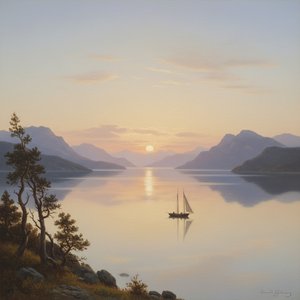
Gifford’s artistic hallmark lay in his extraordinary ability to capture the subtle interplay of light and atmosphere within his landscapes. He eschewed dramatic, theatrical compositions in favor of scenes that conveyed a sense of quiet contemplation and serene beauty. His paintings are characterized by soft, diffused light, delicate gradations of color, and an almost ethereal quality – hallmarks of Luminism. Gifford’s technique involved working on a small scale, meticulously layering thin washes of paint to build up tonal values and create the illusion of depth and atmosphere. He paid close attention to details, rendering foliage with remarkable precision while maintaining a sense of overall harmony and balance. His compositions often featured familiar New York landscapes – the Catskill Mountains, the Hudson River Valley, and the Adirondack wilderness – but he approached these subjects with an innovative sensibility, prioritizing mood and feeling over literal representation. Gifford’s paintings weren't simply depictions of scenery; they were evocative expressions of his personal response to the natural world.Notable Works and Legacy
Sanford Robinson Gifford’s artistic legacy is firmly established within the annals of American landscape painting. His work has been exhibited at prestigious institutions, including the Metropolitan Museum of Art in New York City, where several of his most celebrated paintings reside. *Tivoli* (1868), a captivating depiction of an Italian hillside village bathed in golden light, stands as one of his most iconic works and is now part of the museum’s permanent collection. Similarly, *Mount Mansfield* (1858) showcases his skill in capturing the rugged beauty of Vermont's mountains. Gifford’s travels to the Rocky Mountains in 1870 resulted in a series of paintings that documented the dramatic landscapes of the American West – a relatively new subject for an artist primarily associated with the Eastern landscape tradition. Despite his prolific output, Gifford remained a largely unsung figure during his lifetime. However, following his death in New York City on August 29, 1880, his work gained increasing recognition and appreciation. A comprehensive catalog of his paintings, published posthumously, revealed the breadth and depth of his artistic achievement – documenting over 700 works created throughout his career. Gifford’s influence can be seen in the work of subsequent generations of American landscape painters, solidifying his place as a pivotal figure in the development of Luminism and the Hudson River School.Întrebări și răspunsuri
Unde pot vedea operele lui Sanford Robinson Gifford în ordine cronologică?
Există o cronologie a lucrărilor lui Sanford Robinson Gifford: pagina Cronologia operelor de artă a artistului ordonează operele în funcție de data creației.
De unde este Sanford Robinson Gifford?
Sanford Robinson Gifford s-a născut în Statele Unite ale Americii.
Din ce epocă face parte Sanford Robinson Gifford?
Sanford Robinson Gifford a activat în perioada Secolul al XIX-lea. Această perioadă situează activitatea artistului în context istoric.