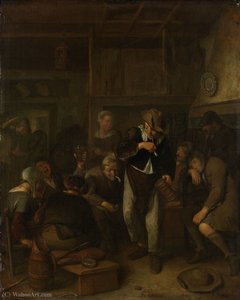
Portretul lui Richard Brakenburgh

Cele 45 cele mai faimoase picturi ale lui Richard Brakenburgh, o selecție de galerie

Actualizat Noiembrie 2026 · clasat în funcție de scorul nostru de popularitate (căutări, vizite și comenzi pentru fiecare operă) · 46 lucrări ale lui Richard Brakenburgh în catalogul nostru

Pe scurt

Dintre toate originalele lăsate de Richard Brakenburgh, cea mai faimoasă este Tavern Scene (1692), din colecția Nationalmuseum, Stockholm. Imediat după acestea urmează Tavern interior with dancing peasants, (1690) și Interior with a company celebrating Twelfth Night, the Feast of Epiphany (1690). Catalogul nostru cuprinde 46 lucrări ale lui Richard Brakenburgh; galeria a păstrat cele 45 pe care lumea le admiră cel mai mult, fiecare fiind prezentată împreună cu data, muzeul și povestea sa.

1650 – 1702, Haarlem Dutch golden age Cele mai multe lucrări: Colecțiile Statale de Pictură din Bavaria

Cele mai importante 10 picturi ale lui Richard Brakenburgh: selecția galeriei

1
Tavern Scene (1692) de Richard Brakenburgh

Tavern Scene

1692 · Oil On Canvas · Nationalmuseum, Stockholm

A single light source, perhaps a guttering candle, strikes the scene from the left. It catches the white fabric of a woman’s garment in the foreground, turning her into a bright anchor amidst a sea of ochre and deep brown. Around her, the tavern breathes with a heavy, crowded energy. Figures lean into one another, their postures shaped by the weight of conversation and the pull of drink. The air…

2
Tavern interior with dancing peasants, (1690) de Richard Brakenburgh

Tavern interior with dancing peasants,

1690 · Oil On Canvas · Muzeul Kunsthistorisches din Viena, Viena

Step into the warmth of this 1690 tavern scene, where the air seems thick with the scent of spilled ale and the sound of rhythmic footsteps. Richard Brakenburgh has captured a fleeting moment of celebration among the peasantry, drawing us into a crowded, lively interior. The composition pulls the viewer through a deep perspective, moving from the immediate, tactile details of the foreground into a shadowy, bustling crowd that recedes…

3
Interior with a company celebrating Twelfth Night, the Feast of Epiphany (1690) de Richard Brakenburgh

Interior with a company celebrating Twelfth Night, the Feast of Epiphany

1690 · Oil On Canvas · Muzeul Kunsthistorisches din Viena, Viena

In this work, titled Interior with a company celebrating Twelfth Night, the Feast of Epiphany, we find ourselves observing a quiet moment of communal gathering. Painted by Richard Brakenburgh in 1690, the scene captures a specific social ritual. It is a fine example of genre art, focusing on the everyday interactions and festivities of the period. The subject matter centers on a group of people gathered for the Twelfth Night…

4
Réunion dans un cabaret de Richard Brakenburgh

Réunion dans un cabaret

Oil On Canvas

The air inside the cabaret feels thick, heavy with the scent of spilled ale and the warmth of too many bodies gathered in a single room. Light flickers from candles, casting long, dancing shadows that stretch across the floor and climb the walls. In the center of this swirling chaos, a group of figures moves in a rhythmic dance, their forms blurring slightly as they spin. Around them, the tavern…

5
Merry Company (1676) de Richard Brakenburgh

Merry Company

Richard Brakenburgh's Merry Company captures a lively social gathering, likely situated within a tavern or a domestic setting. The scene focuses on a group of people engaged in conversation and leisure, embodying the 'Merry Company' theme prevalent in Dutch Golden Age painting. This subject matter reflects the communal spirit and social interactions of the seventeenth century.

6
The Resurrection of Christ and the Visit of the Women to the Tomb (1676) de Richard Brakenburgh

The Resurrection of Christ and the Visit of the Women to the Tomb

In The Resurrection of Christ and the Visit of the Women to the Tomb, Richard Brakenburgh orchestrates a scene of intense, sudden movement. The composition follows a dynamic pyramidal structure that draws the eye upward toward a burst of light in the upper center. From this celestial radiance, a luminous, winged angelic figure descends, gesturing toward the earthly events unfolding below. The perspective is set slightly from below, which lends…

8
Monk's Entertainment in a Roman Cloister (1680) de Richard Brakenburgh

Monk's Entertainment in a Roman Cloister

1680 · Oil On Canvas · Slovak National Gallery, Bratislava

In Monk's Entertainment in a Roman Cloister, Richard Brakenburgh employs a sophisticated chiaroscuro technique to define the cavernous interior. A single, unseen light source from the left casts strong highlights onto faces and hands, allowing them to emerge from deep, atmospheric shadows. This dramatic interplay of light and dark creates a sense of depth and bustling activity within the crowded space. Through precise perspective, the artist organizes the overlapping clusters…

9
Portrait of a young woman (1683) de Richard Brakenburgh

Portrait of a young woman

1683 · Oil

In "Portrait of a young woman" by Richard Brakenburgh, the subject is captured in a three-quarter length pose. She sits centrally, anchored against a dark and atmospheric background that recedes into shadow. The color palette relies on deep blacks and browns, creating a somber foundation for the figure. This darkness pushes the subject forward, making her presence feel immediate and singular.

10
merry party (1686) de Richard Brakenburgh

merry party

1686 · Oil · Museum Gouda, Gouda

The air in the room feels heavy with the scent of spilled ale and uninhibited laughter. A dense crowd of figures presses together in a crowded interior, their bodies caught in a moment of boisterous social indulgence. To the right, a large, heavy curtain hangs in deep folds, framing the scene like a stage set for a play that has already reached its climax. Light spills from the upper left,…

Selecția pentru Richard Brakenburgh continuă, de la 11 la 45

11A Game of Cards at an Inn (1683) de Richard BrakenburghA Game of Cards at an Inn1683 · Statens Museum For Kunst 12Tavern Interior with a Maidservant and Drinkers (1680) de Richard BrakenburghTavern Interior with a Maidservant and Drinkers1680 · Hallwyl Museum 13Adoration of the Shepherds (1694) de Richard BrakenburghAdoration of the Shepherds1694 · Colecțiile Statale de Pictură din Bavaria 14An Interior with Figures (1689) de Richard BrakenburghAn Interior with Figures1689 · National Gallery of Ireland 15The Eve of Saint Nicholas (1690) de Richard BrakenburghThe Eve of Saint Nicholas1690 · Muzeul Frans Hals 16Dance in a Cottage (1699) de Richard BrakenburghDance in a Cottage1699 · Nationalmuseum 17merry party (1691) de Richard Brakenburghmerry party1691 · Muzeul Frans Hals 18A family on a terrace. (1691) de Richard BrakenburghA family on a terrace.1691 19The Feast of St. Nicholas (1698) de Richard BrakenburghThe Feast of St. Nicholas1698 20Family Scene (1680) de Richard BrakenburghFamily Scene1680 · Muzeul Fitzwilliam din Cambridge 21May Queen Festival (1700) de Richard BrakenburghMay Queen Festival1700 · Muzeul de Artă Fine din Budapesta 22Dutch Merchants Trading in a Chinese Harbor (1683) de Richard BrakenburghDutch Merchants Trading in a Chinese Harbor1683 · Groninger Museum 23Celebration of a Birth (1683) de Richard BrakenburghCelebration of a Birth1683 24Interior of a Farmhouse (1699) de Richard BrakenburghInterior of a Farmhouse1699 · Muzeul Fitzwilliam din Cambridge 25Intérieur d'auberge de Richard BrakenburghIntérieur d'aubergeMuzeul Luvru 26Cabaret Interior de Richard BrakenburghCabaret InteriorPetit Palais 27Jolly Company de Richard BrakenburghJolly CompanyMuzeul Regal de Arte Frumoase din Anvers 28Figural scene against architecture de Richard BrakenburghFigural scene against architectureMuzeul Național din Varșovia 29INTERIEUR D'UN ESTAMINET de Richard BrakenburghINTERIEUR D'UN ESTAMINET 30SCENE GALANTE de Richard BrakenburghSCENE GALANTE 31LE LEVER DE LA MARIEE de Richard BrakenburghLE LEVER DE LA MARIEE 32Feast of St Nicholas de Richard BrakenburghFeast of St NicholasMuzeul de Artă Fine din Budapesta 33Family Portrait (1670) de Richard BrakenburghFamily Portrait1670 · The Art Museum RIGA BOURSE 34St Nicholas Eve (1685) de Richard BrakenburghSt Nicholas Eve1685 · Amstelkring Museum 35The doctor's visit. de Richard BrakenburghThe doctor's visit.Museum Boijmans Van Beuningen 36Moines et religieuses en goguette de Richard BrakenburghMoines et religieuses en goguette 37In the tavern. de Richard BrakenburghIn the tavern. 38Family Having Breakfast de Richard BrakenburghFamily Having Breakfast 39Merry company. de Richard BrakenburghMerry company.Museum Boijmans Van Beuningen 40Gallant scene at Palais des Beaux-Arts de Lille. de Richard BrakenburghGallant scene at Palais des Beaux-Arts de Lille. 41Celebration of a Birth de Richard BrakenburghCelebration of a BirthDulwich Picture Gallery 42Merry company de Richard BrakenburghMerry companyMuzeul de Artă Fine din Budapesta 43The Feast of St. Nicholas de Richard BrakenburghThe Feast of St. NicholasRijksmuseum 44A Medical Practitioner Taking a Girl's Pulse and Holding a Flask of Her Urine de Richard BrakenburghA Medical Practitioner Taking a Girl's Pulse and Holding a Flask of Her Urine 45Peasant's inn de Richard BrakenburghPeasant's innRijksmuseum

Subiectele care i-au captivat privirea lui Richard Brakenburgh

Cele patru teme care revin cel mai des în aceste opere originale, fiecare având cel mai sublim exemplu.

Muzeele care păstrează originalele lui Richard Brakenburgh

Cele 8 muzee care dețin cele mai multe dintre picturile de pe această pagină.

Muzee Oraș Lucrări lui Richard Brakenburgh Picturi din această listă
Colecțiile Statale de Pictură din Bavaria, MunchenColecțiile Statale de Pictură din Bavaria Munchen 3 Merry Company, The Resurrection of Christ and the Visit of the Women to the Tomb, Adoration of the Shepherds
Muzeul de Artă Fine din Budapesta, BudapestaMuzeul de Artă Fine din Budapesta Budapesta 3 May Queen Festival, Feast of St Nicholas, Merry company
Nationalmuseum, StockholmNationalmuseum Stockholm 2 Tavern Scene, Dance in a Cottage
Muzeul Kunsthistorisches din Viena, VienaMuzeul Kunsthistorisches din Viena Viena 2 Tavern interior with dancing peasants,, Interior with a company celebrating Twelfth Night, the Feast of Epiphany
Muzeul Frans Hals, HaarlemMuzeul Frans Hals Haarlem 2 The Eve of Saint Nicholas, merry party
Muzeul Fitzwilliam din Cambridge, CambridgeMuzeul Fitzwilliam din Cambridge Cambridge 2 Family Scene, Interior of a Farmhouse
Museum Boijmans Van Beuningen, RotterdamMuseum Boijmans Van Beuningen Rotterdam 2 The doctor's visit., Merry company.
Rijksmuseum, AmsterdamRijksmuseum Amsterdam 2 The Feast of St. Nicholas, Peasant's inn

Richard Brakenburgh deceniu cu deceniu: originalul care definește fiecare

Lucrări pe deceniu

Alege o deceniu pentru a descoperi opera originală care îl definește.

Întrebări ale colecționarilor despre picturile lui Richard Brakenburgh

Pentru ce operă este cel mai cunoscut Richard Brakenburgh?Află răspunsul

Tavern Scene (1692), Nationalmuseum, Stockholm. Urmează Tavern interior with dancing peasants, (1690) și Interior with a company celebrating Twelfth Night, the Feast of Epiphany (1690).

Ce vârstă avea Richard Brakenburgh când a fost creată Tavern Scene?Află răspunsul

42 ani: Tavern Scene datează din 1692, iar Richard Brakenburgh s-a născut în 1650.

Care sunt cele mai celebre zece picturi ale lui Richard Brakenburgh?Află răspunsul

Tavern Scene, Tavern interior with dancing peasants,, Interior with a company celebrating Twelfth Night, the Feast of Epiphany, Réunion dans un cabaret, Merry Company, The Resurrection of Christ and the Visit of the Women to the Tomb, Drinkers and Musicians in a Cabaret, with Child with a Hoop, Monk's Entertainment in a Roman Cloister, Portrait of a young woman și merry party. Clasamentul de mai sus indică anul și muzeul pentru fiecare piesă.

Câte picturi a lăsat Richard Brakenburgh?Află răspunsul

Catalogul nostru cuprinde 46 lucrări ale lui Richard Brakenburgh, datate între 1670 și 1700.

În ce muzee sunt expuse capodoperele lui Richard Brakenburgh?Află răspunsul

În principal în Colecțiile Statale de Pictură din Bavaria (Munchen), Muzeul de Artă Fine din Budapesta (Budapesta) și Nationalmuseum (Stockholm). Tabelul cu muzee de mai sus le enumeră pe toate.

În ce ani a pictat Richard Brakenburgh cele mai cunoscute opere?Află răspunsul

În 1680s: 10 dintre cele 45 lucrări de pe această pagină au fost realizate atunci, fiind Monk's Entertainment in a Roman Cloister dintre acestea.

Care sunt prima și ultima pictură originală celebră a lui Richard Brakenburgh?Află răspunsul

Pe această pagină, cea mai veche lucrare datează din Family Portrait (1670), iar cea mai recentă este din May Queen Festival (1700).

Ce subiecte a ales cel mai des Richard Brakenburgh?Află răspunsul

People (19), Figures (10) și Table (9), din cele 45 lucrări de pe această pagină.

Ce tehnică a folosit cel mai des Richard Brakenburgh?Află răspunsul

Oil On Canvas, pentru 12 dintre cele 45 lucrări de pe această pagină.

Din ce mișcare artistică face parte Richard Brakenburgh?Află răspunsul

Dutch golden age, judecând după originalele de pe această pagină.

Ce lucrări ale lui Richard Brakenburgh sunt expuse la Colecțiile Statale de Pictură din Bavaria?Află răspunsul

Merry Company, The Resurrection of Christ and the Visit of the Women to the Tomb și Adoration of the Shepherds: Colecțiile Statale de Pictură din Bavaria, Munchen deține 3 dintre lucrările de pe această pagină.

Richard Brakenburgh: viață și operă

O viață capturată în Epoca de Aur

Născut în orașul istoric Haarlem, în Țările de Jos, Richard Brakenburgh a apărut ca o figură notabilă în cadrul tapiseriei vibrante a Epocilor de Aur olandeze. Viața și măiestria sa artistică erau profund înrădăcinate în solul cultural al orașului Haarlem, unde și-a dezvoltat o sensibilitate aparte pentru capturarea momentelor intime, adesea zgomotoase, ale vieții din secolul al XVII-lea. În timp ce anumite relatări istorice sugerează că poseda sufletul unui poet vesel, adevăratul său moștenire rezidă în brushstroke-urile care au dat viață pulsului social al erei sale. Călătoria sa prin lumea artei a fost marcată de o legătură strânsă cu tradițiile locale ale patriei sale, iar prezența sa în Leeuwarden în deceniile târzii ale secolului al XVII-lea sugerează o mobilitate care i-a permis influenței sale să depășească locul nașterii.

Rădăcinile artistice și influențele stilistice

Evoluția stilului lui Richard Brakenburgh a fost modelată de maeștrii care l-au precedat și de cei care i-au fost contemporani. El este recunoscut ca fiind elevul lui Hendrik Mommers, un instructor a cărui abilitate de a picta scene de genie ingenioase a oferit un model fundamental pentru propriile explorări ale interacțiunii umane realizate de Richard Brakenburgh. Totuși, umbrele unor maeștri și mai mari îi stăteau mereu peste lucrări; influența lui Jan Steen a fost profundă, ghidându-l spre crearea unor compoziții complexe, animate de forța narativă. Există, de asemenea, un dialog stilistic semnificativ între Richard Brakenburgh și Bernard Schendel, amândoi artiștii împărtășind aceeași epocă și o abordare similară a subiectelor lor. O mare parte din estetica sa poate fi urmărită până la tradiția lui Adriaen van Ostade, în special prin capacitatea sa de a surprinde petrecerile și adunările vesele cu un sentiment de energie spontană.

Stăpânirea Genului și a Tehnicii

Opera lui Richard Brakenburgh este celebrată pentru capacitatea sa de a transforma scene obișnuite în ferestre extraordinare către trecut. El s-a specializat în picturi de gen care surprindeau convivialitatea vieții de tavernă, unde clincotul vaselor și zumzetul conversațiilor par aproape audibile prin pânza picturii. Abilitatea sa tehnică este evidentă în utilizarea chiaroscuro-ului, apelând la un joc dramatic de lumină și umbră pentru a sculpta figurile și pentru a imprima interioarelor sale un sentiment de mister primitor. Fie că surprinde o han plin de viață sau o celebrare festivă de sezon, compozițiile sale sunt caracterizate de:

  • Perspectivă Precisă: O abilitate remarcabilă de a utiliza perspectiva liniară pentru a crea adâncime în spații aglomerate și slab iluminate.
  • Detaliu Luminos: Aplicarea abilă a luminii pentru a capta marginiile obiectelor de sticlă, texturile vestimentelor rustice și suprafețele uzate ale mobilierului din lemn.
  • Adâncime Narativă: O așezare ingenioasă a figurilor care ghidează privirea spectatorului printr-o scenă armonioasă, dar plină de energie.

Moștenire și Semnificație Istorică

Deși opera sa este adesea remarcată pentru măiestria execuției și pentru finisajul său impecabil, adevărata importanță a lui Richard Brakenburgh rezidă în rolul său de cronicar al țesăturii sociale olandeze. Păințile sale pictate servesc drept instantaneuri durabile ale unei epoci prospere, capturând atât demnitatea portretelor de familie, cât și bucuria neîncetată a sărbătorilor comunitare. Succesul său a fost atât de remarcabil încât a oferit stabilitate familiei sale, asigurându-i văduvei o rentă în Frisia după trecerea sa în neîntuneric. Astăzi, contribuțiile sale la Epoca de Aur olandeză rămân esențiale, oferind privitorilor moderni o experiență imersivă într-o lume în care granițele dintre trecutul istoric și momentul prezent se dizolvă într-un mod absolut fascinant.