The Sculptor of Imperial Grandeur
Pyotr Karlovich Klodt, often known by his aristocratic title Baron Peter Clodt von Jürgensburg, stands as a monumental figure in the annals of Russian art history. Born in 1805 in the cultural heart of Saint Petersburg, Klodt was a man whose artistic vision was inextricably linked to the splendor of the Imperial era. Coming from a distinguished family of Baltic Germans with a lineage of high-ranking military officers, his early life was steeped in the discipline and prestige of the Russian Empire. While he began his professional journey as an artillery officer, his true calling lay in the delicate yet powerful medium of bronze and stone. His innate fascination with the animal kingdom—specifically the muscular elegance and untamed spirit of the horse—would eventually propel him to international acclaim, transforming the streets of Saint Petersburg into a gallery of living, breathing motion.
The artistic evolution of Klodt was a masterful synthesis of competing movements. He emerged during a period where the dramatic, emotional swells of Romanticism were beginning to take hold, yet he found his true voice through the disciplined lens of Neoclassicism. Drawing profound inspiration from the works of masters like Antonio Canova and the timeless principles of Grecian sculpture, Klodt prioritized anatomical precision and formal restraint. This allowed him to achieve a rare feat in sculpture: the ability to convey intense psychological depth and physical dynamism without sacrificing the dignity of classical form. His meticulous study of proportion ensured that every sinew and muscle in his equestrian works felt authentic, earning him the legendary praise of Tsar Nicholas I, who famously remarked that Klodt created horses finer than any prize stallion.
Mastery of Motion and Monumental Legacy
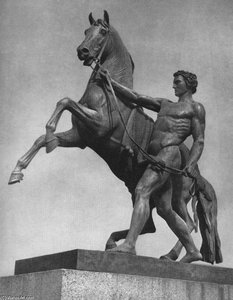
Klodt’s most enduring contribution to the cityscape of Saint Petersburg is perhaps his ability to capture a single, breathless moment in time. His most celebrated achievement, the Horse Tamers group installed on the Anichkov Bridge in 1851, serves as a testament to his technical virtuosity. In these bronze figures, the struggle between man and beast is rendered with such remarkable realism that the viewer can almost sense the heat of the breath and the tension of the reins. This mastery of movement extended to his larger-scale commemorative works, including his collaborative efforts on monumental statues that defined the imperial aesthetic. His work was not merely about decoration; it was about the projection of power, stability, and the sophisticated cultural identity of a rising empire.
Beyond his equestrian triumphs, Klodt’s repertoire included significant contributions to the tradition of public monuments. He was responsible for the bronze statue of the famed fabulist Ivan Krylov in the Summer Garden, a project that marked a historic milestone as the first monument dedicated to a poet within the Russian Empire. Through such works, Klodt bridged the gap between the glorification of the state and the celebration of cultural intellect. His career, which saw him rise to become the head of the Imperial Foundry in 1838, left an indelible mark on the sculptural landscape of Europe. Even today, his legacy persists in the rhythmic pulse of his bronze horses, which continue to gallop through history, embodying the eternal dance between classical order and romantic passion.