


1


Actualizat Noiembrie 2026 · clasat în funcție de scorul nostru de popularitate (căutări, vizite și comenzi pentru fiecare operă) · 35 lucrări ale lui Pieter Wouwerman în catalogul nostru
Pe scurt
Dintre toate originalele lăsate de Pieter Wouwerman, cea mai faimoasă este Forest with staffage figures (1642), din colecția Villa Vauban, Luxembourg. Imediat după acestea urmează Dice-Playing Soldiers in Front of an Inn (1652) și Officer on Horseback (1660). Catalogul nostru cuprinde 35 lucrări ale lui Pieter Wouwerman; galeria a păstrat cele 31 pe care lumea le admiră cel mai mult, fiecare fiind prezentată împreună cu data, muzeul și povestea sa.


 View of Paris seen from the Place Dauphine1660 · Statens Museum For Kunst
12
 Frederik Hendrik at the surrender of Maastricht, 22 August 16321650 · Rijksmuseum
13
 Hunting party on horseback with servants and dogs1661 · Staatliche Kunsthalle Karlsruhe
14
 Beach Scene with Fisher Woman1668 · Gemäldegalerie Alte Meister im Schloss Wilhelmshöhe
15
 View of Paris with the tower and porch of Nesle, in the backgroud the Pont Neuf and la Place Dauphine1664
16
 Landscape with a dapple grey horse1667 · Museum Boijmans Van Beuningen
17
 The storming of Coevorden, December 30, 16721672 · Rijksmuseum
18
 Horsemarket in Delft1670 · Het Prinsenhof
19
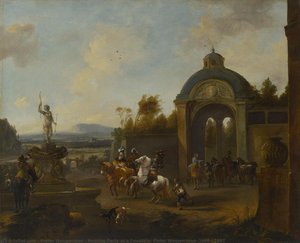 Hunting Party at a Fountain, Pieter Wouwerman, 1660 - 16821682 · Rijksmuseum
20
 Cavalry Skirmish with Foot SoldiersMuzeul Regal de Arte Frumoase din Anvers
21
 Departure for huntingMuzeul Național din Varșovia
22
 The watering place
23
 Landscape with a genre sceneMuzeul Național din Varșovia
24
 Setting Off On A Falcon Hunt
25
 The stableFitzwilliam Museum
26
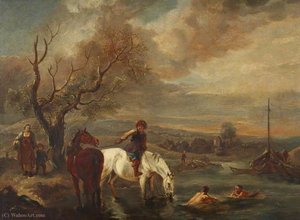 Country Scene with a Man on Horseback and Bathers
27
 Landscape with resting travellers
28
 Cavalry Men by a Suttler's Tent
29
 Dune landscape with figuresCleveland Museum of Art
30
 Encampment beside an Ale HouseFitzwilliam Museum
31
 Vânătoare de căprioareMuzeul Ermitaj
Cele patru teme care revin cel mai des în aceste opere originale, fiecare având cel mai sublim exemplu.
Cele 8 muzee care dețin cele mai multe dintre picturile de pe această pagină.
| Muzee | Oraș | Lucrări lui Pieter Wouwerman | Picturi din această listă |
|---|---|---|---|
 Muzeul Național din Varșovia |
Varșovia | 3 | Groom and horses, Departure for hunting, Landscape with a genre scene |
 Rijksmuseum |
Amsterdam | 3 | Frederik Hendrik at the surrender of Maastricht, 22 August 1632, The storming of Coevorden, December 30, 1672, Hunting Party at a Fountain, Pieter Wouwerman, 1660 - 1682 |
 Staatliche Kunsthalle Karlsruhe |
Karlsruhe | 2 | The Collision, Hunting party on horseback with servants and dogs |
 Muzeul Ermitaj |
Sankt Petersburg | 2 | Horses in the Pasture, Vânătoare de căprioare |
 Gemäldegalerie Alte Meister im Schloss Wilhelmshöhe |
Kassel | 2 | Landscape with horsemen at a blacksmith, Beach Scene with Fisher Woman |
 Fitzwilliam Museum |
2 | The stable, Encampment beside an Ale House | |
 Villa Vauban |
Luxembourg | 1 | Forest with staffage figures |
 Colecțiile Statale de Pictură din Bavaria |
Munchen | 1 | Dice-Playing Soldiers in Front of an Inn |
Alege o deceniu pentru a descoperi opera originală care îl definește.

Forest with staffage figures (1642), Villa Vauban, Luxembourg. Urmează Dice-Playing Soldiers in Front of an Inn (1652) și Officer on Horseback (1660).
19 ani: Forest with staffage figures datează din 1642, iar Pieter Wouwerman s-a născut în 1623.
Forest with staffage figures, Dice-Playing Soldiers in Front of an Inn, Officer on Horseback, The Combat, The Collision, Groom and horses, Army Camp, Horses in the Pasture, Landscape with horsemen at a blacksmith și Sandhills with Figure. Clasamentul de mai sus indică anul și muzeul pentru fiecare piesă.
Catalogul nostru cuprinde 35 lucrări ale lui Pieter Wouwerman, datate între 1642 și 1682.
În principal în Muzeul Național din Varșovia (Varșovia), Rijksmuseum (Amsterdam) și Staatliche Kunsthalle Karlsruhe (Karlsruhe). Tabelul cu muzee de mai sus le enumeră pe toate.
În 1660s: 7 dintre cele 31 lucrări de pe această pagină au fost realizate atunci, fiind Officer on Horseback dintre acestea.
Pe această pagină, cea mai veche lucrare datează din Forest with staffage figures (1642), iar cea mai recentă este din Hunting Party at a Fountain, Pieter Wouwerman, 1660 - 1682 (1682).
Groom and horses, Departure for hunting și Landscape with a genre scene: Muzeul Național din Varșovia, Varșovia deține 3 dintre lucrările de pe această pagină.