Portretul lui Philipp Peter Roos

Cele 92 cele mai faimoase picturi ale lui Philipp Peter Roos, o selecție de galerie

Actualizat Noiembrie 2026 · clasat în funcție de scorul nostru de popularitate (căutări, vizite și comenzi pentru fiecare operă) · 93 lucrări ale lui Philipp Peter Roos în catalogul nostru

Pe scurt

Dintre toate originalele lăsate de Philipp Peter Roos, cea mai faimoasă este Goats and Flock of Sheep (1681), din colecția Colecțiile Statale de Pictură din Bavaria, Munchen. Imediat după acestea urmează Piece of Livestock (1681) și Landscape with Cattle and Shepherd (1681). Catalogul nostru cuprinde 93 lucrări ale lui Philipp Peter Roos; galeria a păstrat cele 92 pe care lumea le admiră cel mai mult, fiecare fiind prezentată împreună cu data, muzeul și povestea sa.

1657 – 1706, Sankt Goar Baroque Cele mai multe lucrări: Colecțiile Statale de Pictură din Bavaria

Cele mai importante 10 picturi ale lui Philipp Peter Roos: selecția galeriei

3
Landscape with Cattle and Shepherd (1681) de Philipp Peter Roos

Landscape with Cattle and Shepherd

1681 · Oil On Canvas · Colecțiile Statale de Pictură din Bavaria, Munchen

Landscape with Cattle and Shepherd is a work by the German Baroque painter Philipp Peter Roos. Created about 1681, the painting reflects the artist's specialized focus on pastoral scenes and animal subjects. Roos was a significant figure in the development of Italianate landscapes, often characterized by his intimate study of livestock and the natural environment.

4
Piece of Livestock (1681) de Philipp Peter Roos

Piece of Livestock

1681 · Oil On Canvas · Colecțiile Statale de Pictură din Bavaria, Munchen

In Piece of Livestock, Philipp Peter Roos organizes a pastoral scene through a close-up, ground-level perspective that establishes an immediate intimacy with the subjects. The composition is dominated by a large, seated cow positioned slightly to the right of the center. To the left, a smaller lamb or calf provides a sense of scale, while a woman interacts with a dog in the space behind the primary subject. This arrangement…

7
Liberation of Io (1681) de Philipp Peter Roos

Liberation of Io

In this Baroque-style oil painting, the mythological drama of the Liberation of Io unfolds with a sudden, heavy intensity. Created by Philipp Peter Roos about 1681, the scene captures a moment of profound tension between the divine and the mortal. A massive, powerful bull dominates the foreground, its muscular form rendered with a weight that feels almost tangible. This central figure looms over the landscape, its presence commanding the space…

8
Piece of Cattle (1681) de Philipp Peter Roos

Piece of Cattle

1681 · Oil On Canvas · Colecțiile Statale de Pictură din Bavaria, Munchen

This oil on canvas painting, dated 1681, presents a monochromatic scene rendered in various shades of gray. In the foreground, a young woman is positioned amidst a group of livestock, including sheep or goats. The composition is a medium shot, placing the human subject and the animals in the immediate front and middle ground. The terrain is undulating, forming rolling hills that recede into a background of hazy mountains and…

10
Shepherd with Cow, Sheep and Goats in Italian Mountain Landscape (1680) de Philipp Peter Roos

Shepherd with Cow, Sheep and Goats in Italian Mountain Landscape

1680 · Oil

The scene unfolds in Shepherd with Cow, Sheep and Goats in Italian Mountain Landscape, a work that captures a quiet moment of pastoral life. This painting, created about 1680, brings together a shepherd and his diverse herd amidst a rugged, mountainous setting. The figures and animals exist within a landscape that feels both immediate and deeply rooted in the natural world.

Selecția pentru Philipp Peter Roos continuă, de la 11 la 92

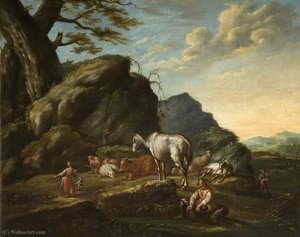
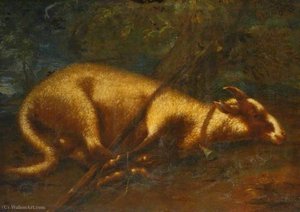
11Goat Herd with a Goatherd (1680) de Philipp Peter RoosGoat Herd with a Goatherd1680 · Slovak National Gallery 12The Herd (1698) de Philipp Peter RoosThe Herd1698 · Yekaterinburg Museum of Fine Arts 13Cattle Piece (1688) de Philipp Peter RoosCattle Piece1688 · Statens Museum For Kunst 14Landscape with a Bull, Sheep and Goats (1688) de Philipp Peter RoosLandscape with a Bull, Sheep and Goats1688 · Statens Museum For Kunst 15A Shepherd with his Herd (1688) de Philipp Peter RoosA Shepherd with his Herd1688 · Statens Museum For Kunst 16Goats and Sheep (1690) de Philipp Peter RoosGoats and Sheep1690 · Muzeul Național din Cracovia 17Goats and Sheep (1690) de Philipp Peter RoosGoats and Sheep1690 · Muzeul Național din Cracovia 18Shepherd's Idyl in a Romantic Landscape with Ruins (1700) de Philipp Peter RoosShepherd's Idyl in a Romantic Landscape with Ruins1700 · Slovak National Gallery 19Herd by an Ancient Well (1700) de Philipp Peter RoosHerd by an Ancient Well1700 · Slovak National Gallery 20Shepherd Couple and Small Livestock in Italian Landscape (1710) de Philipp Peter RoosShepherd Couple and Small Livestock in Italian Landscape1710 · Colecțiile Statale de Pictură din Bavaria 21Orpheus and the animals (1700) de Philipp Peter RoosOrpheus and the animals1700 · Gemäldegalerie 22Shepherd and sheeps (1700) de Philipp Peter RoosShepherd and sheeps1700 · Musée d'art et d'histoire de Narbonne 23Various animals gathered before Noah's Ark (1669) de Philipp Peter RoosVarious animals gathered before Noah's Ark1669 · Muzeul Prado 24A Military Encampment (1655) de Philipp Peter RoosA Military Encampment1655 · Detroit Institute of Arts 25Landscape with Cattle, Goats and Figures de Philipp Peter RoosLandscape with Cattle, Goats and Figures 26Caravan at the Fountain (1681) de Philipp Peter RoosCaravan at the Fountain1681 · Colecțiile Statale de Pictură din Bavaria 27Shepherd Scene (1680) de Philipp Peter RoosShepherd Scene1680 · Bratislava City Gallery 28Herdestück (1681) de Philipp Peter RoosHerdestück1681 · Colecțiile Statale de Pictură din Bavaria 29Piece of Cattle (1681) de Philipp Peter RoosPiece of Cattle1681 · Colecțiile Statale de Pictură din Bavaria 30Herdestück (1681) de Philipp Peter RoosHerdestück1681 · Colecțiile Statale de Pictură din Bavaria 31The Animals Leave the Ark of Noah (1680) de Philipp Peter RoosThe Animals Leave the Ark of Noah1680 32Bolognese Dog (1688) de Philipp Peter RoosBolognese Dog1688 · Statens Museum For Kunst 33The Rest after the Hunt (1695) de Philipp Peter RoosThe Rest after the Hunt1695 34Ravine with a Stream, a Shepherd and His Herd de Philipp Peter RoosRavine with a Stream, a Shepherd and His HerdNational Gallery Prague 35Herd with Sleeping Shepherds de Philipp Peter RoosHerd with Sleeping ShepherdsMuzeul Kunsthistorisches din Viena 36Landscape with a Grotto (1690) de Philipp Peter RoosLandscape with a Grotto1690 · Muzeul Ermitaj 37Shepherd with Goat Herd, Horse and Two Dogs de Philipp Peter RoosShepherd with Goat Herd, Horse and Two DogsColecțiile Statale de Pictură din Bavaria 38Landscape with Cattle de Philipp Peter RoosLandscape with CattleNational Gallery of Ireland 39Landscape with shepherd and animals de Philipp Peter RoosLandscape with shepherd and animalsMuzeul Național de Arte Fine din Buenos Aires 40Landscape with figures and animals de Philipp Peter RoosLandscape with figures and animalsMuzeul Național de Arte Fine din Buenos Aires 41Shepherd and animals in a landscape de Philipp Peter RoosShepherd and animals in a landscapeMuzeul Național de Arte Fine din Buenos Aires 42Shepherd and animals in a landscape de Philipp Peter RoosShepherd and animals in a landscapeMuzeul Național de Arte Fine din Buenos Aires 43Landscape with Goatherd and Goats de Philipp Peter RoosLandscape with Goatherd and GoatsMuzeul de Artă Plastică din Boston 44Horse and Goats Grazing de Philipp Peter RoosHorse and Goats GrazingNational Gallery Prague 45Shepherd with a Herd of Sheep and Goats de Philipp Peter RoosShepherd with a Herd of Sheep and GoatsNational Gallery Prague 46Landscape de Philipp Peter RoosLandscape 47A Landscape with a Milkmaid de Philipp Peter RoosA Landscape with a Milkmaid 48Rider Meeting de Philipp Peter RoosRider MeetingMuzeul Kunsthistorisches din Viena 49Pigeons de Philipp Peter RoosPigeonsStatens Museum For Kunst 50Landscape with a Waterfall de Philipp Peter RoosLandscape with a WaterfallMuzeul Ermitaj 51Dead Hare de Philipp Peter RoosDead HareNationalmuseum 52Landscape with Flock of Sheep de Philipp Peter RoosLandscape with Flock of SheepMuzeul Kunsthistorisches din Viena 53Sheep and Goat in a Rocky Landscape, de Philipp Peter RoosSheep and Goat in a Rocky Landscape,Städel Museum 54Landskap med hjord de Philipp Peter RoosLandskap med hjordNationalmuseum 55A Goat Resting de Philipp Peter RoosA Goat RestingNationalmuseum 56Grasing sheeps de Philipp Peter RoosGrasing sheeps 57Landscape with Sheep de Philipp Peter RoosLandscape with SheepHarvard Art Museums 58Rams with ruins in the background de Philipp Peter RoosRams with ruins in the backgroundMuzeul Național din Varșovia 59Herd in the mountains de Philipp Peter RoosHerd in the mountainsMuzeul Național din Varșovia 60Cattle at the waterfall de Philipp Peter RoosCattle at the waterfallMuzeul Național din Varșovia 61Birds in a Landscape de Philipp Peter RoosBirds in a Landscape 62Landscape with Shepherd Boy and Sheep de Philipp Peter RoosLandscape with Shepherd Boy and Sheep 63The stag hunt de Philipp Peter RoosThe stag hunt 64Horse and Goats de Philipp Peter RoosHorse and Goats 65Landscape with Shepherd, Sheep and Dog de Philipp Peter RoosLandscape with Shepherd, Sheep and Dog 66Landscape with Bull, Goats and Attendant de Philipp Peter RoosLandscape with Bull, Goats and Attendant 67Sheep and Landscape de Philipp Peter RoosSheep and Landscape 68Cattle and Sheep de Philipp Peter RoosCattle and Sheep 69A Goatherd and His Flock de Philipp Peter RoosA Goatherd and His FlockCalke Abbey 70Landscape with Sheep de Philipp Peter RoosLandscape with Sheep 71The Shepherd and His Horse de Philipp Peter RoosThe Shepherd and His Horse 72Pastoral landscape de Philipp Peter RoosPastoral landscape 73Shepherd with Dog, Goats and Sheep de Philipp Peter RoosShepherd with Dog, Goats and Sheep 74Cattle in an Italian Landscape de Philipp Peter RoosCattle in an Italian Landscape 75Landscape with Cattle de Philipp Peter RoosLandscape with Cattle 76A waterfall de Philipp Peter RoosA waterfall 77A Shepherd Boy with Sheep, Goats and Cattle de Philipp Peter RoosA Shepherd Boy with Sheep, Goats and CattleBelton House 78Goatherd and Goats de Philipp Peter RoosGoatherd and Goats 79Sheep de Philipp Peter RoosSheep 80Hounds Attacking a Bull de Philipp Peter RoosHounds Attacking a Bull 81Herdsman Sleeping Amidst His Sheep, Goats and Cattle de Philipp Peter RoosHerdsman Sleeping Amidst His Sheep, Goats and Cattle 82Goats de Philipp Peter RoosGoats 83Farm Animals in a Landscape with an Old Man Drinking de Philipp Peter RoosFarm Animals in a Landscape with an Old Man Drinking 84Herdsman with Sheep and Goats de Philipp Peter RoosHerdsman with Sheep and GoatsNostell Priory 85Landscape with Goats and Cattle de Philipp Peter RoosLandscape with Goats and Cattle 86A Shepherd and His Flock in a Landscape de Philipp Peter RoosA Shepherd and His Flock in a LandscapeNostell Priory 87Study of Goats de Philipp Peter RoosStudy of Goats 88Studies in Human and Animal Anatomy de Philipp Peter RoosStudies in Human and Animal Anatomy 89Italianate Landscape with a Goat and Sheep de Philipp Peter RoosItalianate Landscape with a Goat and Sheep 90A Goat, Sheep and a Dog Resting in a Landscape de Philipp Peter RoosA Goat, Sheep and a Dog Resting in a Landscape 91Landscape with a Herd de Philipp Peter RoosLandscape with a HerdMuzeul Ermitaj 92Vacile și caprele beau într-o pâcură de Philipp Peter RoosVacile și caprele beau într-o pâcurăFondazione Brescia Musei

Subiectele care i-au captivat privirea lui Philipp Peter Roos

Cele patru teme care revin cel mai des în aceste opere originale, fiecare având cel mai sublim exemplu.

Muzeele care păstrează originalele lui Philipp Peter Roos

Cele 8 muzee care dețin cele mai multe dintre picturile de pe această pagină.

Muzee Oraș Lucrări lui Philipp Peter Roos Picturi din această listă
Colecțiile Statale de Pictură din Bavaria, MunchenColecțiile Statale de Pictură din Bavaria Munchen 15 Goats and Flock of Sheep, Piece of Livestock, Landscape with Cattle and Shepherd
Statens Museum For Kunst, CopenhagaStatens Museum For Kunst Copenhaga 5 Cattle Piece, Landscape with a Bull, Sheep and Goats, A Shepherd with his Herd
Muzeul Național de Arte Fine din Buenos Aires, Buenos AiresMuzeul Național de Arte Fine din Buenos Aires Buenos Aires 4 Landscape with shepherd and animals, Landscape with figures and animals, Shepherd and animals in a landscape
Slovak National Gallery, BratislavaSlovak National Gallery Bratislava 3 Goat Herd with a Goatherd, Shepherd's Idyl in a Romantic Landscape with Ruins, Herd by an Ancient Well
National Gallery Prague, PragaNational Gallery Prague Praga 3 Ravine with a Stream, a Shepherd and His Herd, Horse and Goats Grazing, Shepherd with a Herd of Sheep and Goats
Muzeul Kunsthistorisches din Viena, VienaMuzeul Kunsthistorisches din Viena Viena 3 Herd with Sleeping Shepherds, Rider Meeting, Landscape with Flock of Sheep
Muzeul Ermitaj, Sankt PetersburgMuzeul Ermitaj Sankt Petersburg 3 Landscape with a Grotto, Landscape with a Waterfall, Landscape with a Herd
Nationalmuseum, StockholmNationalmuseum Stockholm 3 Dead Hare, Landskap med hjord, A Goat Resting

Philipp Peter Roos deceniu cu deceniu: originalul care definește fiecare

Lucrări pe deceniu

Alege o deceniu pentru a descoperi opera originală care îl definește.

Întrebări ale colecționarilor despre picturile lui Philipp Peter Roos

Pentru ce operă este cel mai cunoscut Philipp Peter Roos?Află răspunsul

Goats and Flock of Sheep (1681), Colecțiile Statale de Pictură din Bavaria, Munchen. Urmează Piece of Livestock (1681) și Landscape with Cattle and Shepherd (1681).

Ce vârstă avea Philipp Peter Roos când a fost creată Goats and Flock of Sheep?Află răspunsul

24 ani: Goats and Flock of Sheep datează din 1681, iar Philipp Peter Roos s-a născut în 1657.

Care sunt cele mai celebre zece picturi ale lui Philipp Peter Roos?Află răspunsul

Goats and Flock of Sheep, Piece of Livestock, Landscape with Cattle and Shepherd, Piece of Livestock, Resting Flock with Shepherds, Resting Flock with Shepherds, Liberation of Io, Piece of Cattle, Returning Flock with Shepherds și Shepherd with Cow, Sheep and Goats in Italian Mountain Landscape. Clasamentul de mai sus indică anul și muzeul pentru fiecare piesă.

Câte picturi a lăsat Philipp Peter Roos?Află răspunsul

Catalogul nostru cuprinde 93 lucrări ale lui Philipp Peter Roos, datate între 1669 și 1700.

În ce muzee sunt expuse capodoperele lui Philipp Peter Roos?Află răspunsul

În principal în Colecțiile Statale de Pictură din Bavaria (Munchen), Statens Museum For Kunst (Copenhaga) și Muzeul Național de Arte Fine din Buenos Aires (Buenos Aires). Tabelul cu muzee de mai sus le enumeră pe toate.

În ce ani a pictat Philipp Peter Roos cele mai cunoscute opere?Află răspunsul

În 1680s: 21 dintre cele 92 lucrări de pe această pagină au fost realizate atunci, fiind Goats and Flock of Sheep dintre acestea.

Care sunt prima și ultima pictură originală celebră a lui Philipp Peter Roos?Află răspunsul

Pe această pagină, cea mai veche lucrare datează din Various animals gathered before Noah's Ark (1669), iar cea mai recentă este din Shepherd's Idyl in a Romantic Landscape with Ruins (1700).

Ce subiecte a ales cel mai des Philipp Peter Roos?Află răspunsul

Landscape (33), Animals (29) și Goats (19), din cele 92 lucrări de pe această pagină.

Ce tehnică a folosit cel mai des Philipp Peter Roos?Află răspunsul

Oil On Canvas, pentru 18 dintre cele 92 lucrări de pe această pagină.

Din ce mișcare artistică face parte Philipp Peter Roos?Află răspunsul

Baroque, judecând după originalele de pe această pagină.

Ce lucrări ale lui Philipp Peter Roos sunt expuse la Colecțiile Statale de Pictură din Bavaria?Află răspunsul

Goats and Flock of Sheep, Piece of Livestock și Landscape with Cattle and Shepherd: Colecțiile Statale de Pictură din Bavaria, Munchen deține 15 dintre lucrările de pe această pagină.

Philipp Peter Roos: viață și operă

Păstorul de la Tivoli: Viața și Moștenirea lui Philipp Peter Roos

În lumina aurie a Barocului italian, puține nume evocă serenitatea pastorală a mediului rural la fel de puternic ca Philipp Peter Roos. Cunoscut istoriei prin pseudonimul său evocator, Rosa di Tivoli, acest maestru născut în Germania a transformat genul peisajului prin prin intermediul unei conexiuni profunde, aproape vizcerale, cu lumea naturală. Născut în 1655 în regiunea Renului — mai exact lângă Sankt Goar — Roos a fost destinat pensulei încă de la primii ani. El a fost fiul lui Johann Heinrich Roos, un pictor de peisaje respectat, care i-a oferit lecțiile fundamentale de armonie tonală și echilibru compozitonal ce ar fi definit ulterior stilul matur al artistului. Această ucenicie timpurie nu a fost doar o chestiune de tehnică; a fost o imersie într-un mod de a vede ที vedea lumea prin prisma luminii, a umbrei și a demnității liniștite a pământului.

Traiectoria vieții lui Roos s-a schimbat dramatic în 1677, un moment precipitat de generozitatea lui Charles I, Landgraf al Hesse-Kassel. Recunoscând talentul emergent al tânărului pictor, Landgraful a oferit mijloacele financiare pentru ca Roos să pornească într-o călătorie transformatoare către Roma. Această migrare de la tradițiile germanice în inima Barocului italian i-a permis lui Roos să absoarbă energia vibrantă a artei romane. Aici a căutat mentorat sub îndemânătosul Giacinto Brandi, a cărui influență a ajutat la rafinarea capacității lui Roos de a îmbina structura clasică cu un realism spontan și atmosferic. Această perioadă petrecută în Roma a fost, de asemenea, una profund personală; în acești ani a căzut la pova de Isabella Brandi, fiica mentorului său. Unirea lor l-ar fi condus în cele din urmă spre stabilirea în Tivoli, o mișcare care i-ar fi legat pentru totdeauna identitatea de peisajul pe care îl iubea atât de mult.

Un Studio Viu: Artă și Lumea Naturală

Ceea ce distinge cu adevărat opera lui Rosa di Tivoli este autenticitatea fără egal a subiectelor sale animale. Spre deosebire de mulți dintre contemporanii săi, care foloseau animalele ca simple elemente decorative într-un peisaj, Roos trata fiecare creatură — de la taurul masiv la capra agilă — cu reverența unui portretist. Rezidența sa din Tivoli a fost faimos concepută ca un concept asemănător unui studio viu; el întreținea o colecție vastă de animale exotice și domestice, transformând efectiv împrejurimile sale într-o studiu continuu al mișcării, anatomiei și temperamentului. Această proximitate intimă i-a permis să surprindă tresărirea subtilă a unei urechi sau tensiunea musculară a unei fiare sub stres, oferind picturilor sale o vitalitate uluitoare.

Măiestria sa tehnică este evidentă în modul în care a navigat prin complexitățile esteticii baroce. În timp ce compozițiile sale se bazează adesea pe calitățile serene și atmosferice ale Epocii de Aur olandeze, ele sunt infuzate cu o intensitate dramatică caracteristică școlii italiene. Lucrările sale prezintă frecvent:

  • Serenitate Pastorală: Scenarii idilice în care păstorii și vitele există într-o stare de armonie atemporală și liniștită.
  • Acțiune Dramatică: Momente rare, dar remarcabile, de tensiune, precum reprezentările sale de talhari care atacă prada, ceea ce demonstrează capacitatea sa de a reda conflictul brut, naturalistic.
  • Stăpânire Tonală: O utilizare sofisticată a paletelor cromatică muted, terestre, care ancorează peisajele sale într-un simț de realism profund și adâncime atmosferică.

Semnificația Istorică și Spiritul Baroc

Importanța istorică a lui Philipp Peter Roos rezidă în capacitatea sa de a face puntea între tradițiile structurate ale peisajului din Europa de Nord și drama emoționantă, plină de lumină, a Italiei. El a apărut într-o epocă în care cercetarea științifică a început să exija observații mai precise ale lumii naturale, chiar în timp ce temele religioase și mitologice încă dominau conștiința artistică. În picturile sale, se găsește atât detaliul meticulos al unui naturalist, cât și sufletul poetic al unui romantic. Documentând flora și fauna mediului rural roman cu o asemenea devotare, el a creat un record vizual care este, în egală măsură, despre spiritul epocii, cât și despre subiectele în sine.

Deși a decedat în 1706, lăsând în urmă o moștenire gravată în însăși solul de la Tivoli, influența sa a persistat. El rămâne o figură de pivot pentru oricine studiază evoluția picturii animaliere și dezvoltarea peisajului italian. Prin ochii săi, nu vedem doar o colecție de animale de la câmp; asistăm la o celebrare profundă a vieții în formele sale cele mai fundamentale și neîmprospătate. Opera sa continuă să rezoneze ca o mărturie a puterii observației și a frumuseții durabile a idealului pastoral.