Portretul lui Ludwig Meidner

Cele 19 cele mai faimoase picturi ale lui Ludwig Meidner, fiecare unică în felul ei

Actualizat Noiembrie 2026 · clasat în funcție de scorul nostru de popularitate (căutări, vizite și comenzi pentru fiecare operă) · 22 lucrări ale lui Ludwig Meidner în catalogul nostru

Pe scurt

Max Herrmann-Neisse (1913) este pictura lui Ludwig Meidner care atrage cele mai multe priviri; originalul aparține Art Institute of Chicago, Chicago. După aceasta, privirea se îndreaptă către Despair (III) (1914) și Blowing the Shofar (1937). Dintre cele 22 opere ale lui Ludwig Meidner din catalogul nostru, acestea 19 sunt cele mai celebre, fiecare fiind o piesă unică, prezentată împreună cu anul creării, muzeul deținător și motivul pentru care aceasta rămâne memorabilă.

1884 – 1966 Expressionism Cele mai multe lucrări: Jewish Museum Frankfurt

Cele mai importante 10 picturi ale lui Ludwig Meidner, prin ochii galeriei

1
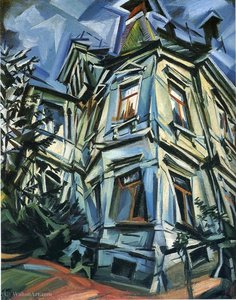
Max Herrmann-Neisse (1913) de Ludwig Meidner

Max Herrmann-Neisse

1913 · Oil On Canvas · Art Institute of Chicago, Chicago

The gaze of the subject meets us in this 1913 portrait, a moment frozen in oil by the hand of Ludwig Meidner. This work captures Max Herrmann-Neisse, a figure who moved through the intellectual circles of Berlin as a poet and theater critic. The artist, Ludwig Meidner, finds his way into the inner lives of the city's literati, and here he settles upon the face of this specific writer. There…

2
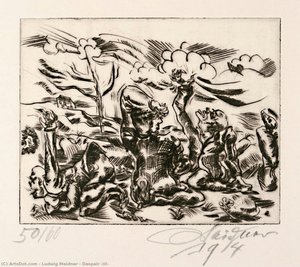
Despair (III) (1914) de Ludwig Meidner

Despair (III)

1914 · Woodcut · Jewish Museum Frankfurt, Frankfurt

Despair (III) by Ludwig Meidner is a monochromatic woodcut print created about 1914. The composition is tightly cropped, focusing the viewer's attention on a central group of figures situated within a desolate landscape. These figures are depicted in a state of distress, their forms conveying a sense of suffering or abandonment. In the background, a small building is visible, providing a solitary point of reference within the empty surroundings. The…

3
Blowing the Shofar (1937) de Ludwig Meidner

Blowing the Shofar

1937 · Drawing · Jewish Museum Frankfurt, Frankfurt

In the evocative depths of Ludwig Meidner’s 1937 work, Blowing the Shofar, we are transported to a moment of profound spiritual and auditory intensity. This striking black and white drawing captures more than just a ritualistic act; it captures the very breath of a culture. The subject, a man draped in a heavy, hooded robe, is caught in the visceral moment of exhaling into the shofar—a ram’s horn instrument central…

4
Gas Chamber (1945) de Ludwig Meidner

Gas Chamber

1945 · Jewish Museum Frankfurt, Frankfurt

Meidner’s charcoal drawing of a gas chamber was probably produced prior to the spring of 1945. Following the liberation of the extermination camps, numerous photos and eyewitness accounts circulated documenting the fact that in the majority of the death camps the gas chambers were disguised as shower blocks, complete with shower heads, in order to prevent panic among those being sent to their deaths. This detail, intriguing in its perfidy,…

Păiți celebrele picturi ale lui Ludwig Meidner, de la numărul 11 la 19

Subiectele care i-au captivat privirea lui Ludwig Meidner

Cele patru teme care revin cel mai des în aceste opere originale, fiecare având cel mai sublim exemplu.

Muzeele care păstrează originalele lui Ludwig Meidner

Cele 2 muzee care dețin cele mai multe dintre picturile de pe această pagină.

Muzee Oraș Lucrări lui Ludwig Meidner Picturi din această listă
Jewish Museum Frankfurt, FrankfurtJewish Museum Frankfurt Frankfurt 13 Despair (III), Blowing the Shofar, Gas Chamber
Art Institute of Chicago, ChicagoArt Institute of Chicago Chicago 1 Max Herrmann-Neisse

Ludwig Meidner de-a lungul deceniilor: o piesă unică pentru fiecare

Lucrări pe deceniu

Alege o deceniu pentru a descoperi opera originală care îl definește.

Picturile lui Ludwig Meidner: întrebări pentru galerie

Care este cea mai celebră operă a lui Ludwig Meidner?Află răspunsul

Max Herrmann-Neisse (1913), Art Institute of Chicago, Chicago. Urmează Despair (III) (1914) și Blowing the Shofar (1937).

La ce vârstă a creat Ludwig Meidner Max Herrmann-Neisse?Află răspunsul

29 ani: Max Herrmann-Neisse datează din 1913, iar Ludwig Meidner s-a născut în 1884.

Care sunt cele mai celebre zece picturi ale lui Ludwig Meidner?Află răspunsul

Max Herrmann-Neisse, Despair (III), Blowing the Shofar, Gas Chamber, Untitled (327), Ecstatic Figure, Male Head, Male Head with Kippah and Tallit, Male Portrait with Kippah și Two Praying Jews. Clasamentul de mai sus indică anul și muzeul pentru fiecare piesă.

Câte lucrări ale lui Ludwig Meidner sunt cunoscute?Află răspunsul

Catalogul nostru cuprinde 22 lucrări ale lui Ludwig Meidner, datate între 1913 și 1950.

Unde pot fi vizualizate originalele celor mai faimoși Ludwig Meidner?Află răspunsul

În principal în Jewish Museum Frankfurt (Frankfurt) și Art Institute of Chicago (Chicago). Tabelul cu muzee de mai sus le enumeră pe toate.

În ce perioadă a creat Ludwig Meidner cele mai cunoscute picturi?Află răspunsul

În 1930s: 5 dintre cele 19 lucrări de pe această pagină au fost realizate atunci, fiind Blowing the Shofar dintre acestea.

Care este cea mai veche și care este cea mai recentă pictură a lui Ludwig Meidner?Află răspunsul

Pe această pagină, cea mai veche lucrare datează din Max Herrmann-Neisse (1913), iar cea mai recentă este din The Sacrifice of Manoah (1950).

Ce teme prefera Ludwig Meidner?Află răspunsul

Portrait (3), Man (2) și Tallit (2), din cele 19 lucrări de pe această pagină.

Cu ce materiale a pictat cel mai des Ludwig Meidner?Află răspunsul

Drawing, pentru 5 dintre cele 19 lucrări de pe această pagină.

Din ce curent artistic face parte opera lui Ludwig Meidner?Află răspunsul

Expressionism, judecând după originalele de pe această pagină.

Ce originale de Ludwig Meidner pot vedea la Jewish Museum Frankfurt?Află răspunsul

Despair (III), Blowing the Shofar și Gas Chamber: Jewish Museum Frankfurt, Frankfurt deține 13 dintre lucrările de pe această pagină.

Ludwig Meidner: un portret al artistului

A Life Shaped by Change

Born in Bernstadt, Germany, in 1884, Ludwig Meidner began his adult life far from the canvas. He first followed his parents' wishes by taking up an apprenticeship as a stonemason, though he did not complete this training. His path eventually led him to the Royal School of Art in Breslau and later to Paris, where he studied at the Académie Julian and Cormon Academies. During these years in Paris, he met Amedeo Modigliani, a connection that placed him at the center of a changing artistic landscape. After returning to Berlin, he worked as a fashion illustrator and draftsman, finding his footing within the city's growing avant-garde circles.

The years leading up to the First World War brought a profound shift in his vision. In 1912, he began creating what are often called his apocalyptic landscapes. These works featured chaotic scenes of urban life, with comets crossing skies like shells and buildings appearing on the verge of collapse. While some saw these images as predictions of the coming war, they were also reflections of the intense energy and social unrest present in the modern metropolis. His involvement with the Die Pathetiker group further solidified his place in the German expressionist movement.

Faith and Displacement

The devastation of the First World War changed Meidner deeply. Having served in the German military as an infantry soldier and a French interpreter, he emerged from the conflict with a different perspective on life and art. He turned toward Orthodox Judaism, finding a new source of meaning through religious themes. His work began to include portraits of prophets and scenes of Jewish ritual, such as his 1937 drawing, Blowing the Shofar. This period saw him moving away from pure expressionist chaos toward more structured, religious imagery that explored the inner experience of faith.

The rise of the Nazi party forced another period of movement and hardship. In 1935, Meidner moved to Cologne to teach at a Jewish school, but the increasing pressure in Germany became impossible to ignore. His work was included in the 1937 Degenerate Art exhibition in Munich, an event that marked him as a target of the regime. In August 1939, he and his wife, Else Meidner, fled to England. Life in London was difficult; he was interned at Huyton Camp and later on the Isle of Man. During these years of exile, he lived in near poverty, often relying on the support of the local Jewish community while continuing to draw and paint from his observations of the world around him.

A Return to Germany

After many years in England, Meidner chose to return to Germany in 1953. He settled in Frankfurt, a city that offered him both a sense of stability and a connection to his heritage. This later period of his life was marked by a renewed recognition within the German art scene. In 1964, he received the Order of Merit of the Federal Republic of Germany and became a member of the Berlin Academy of Fine Arts. His late works continued to reflect his lifelong engagement with both the physical world and the spiritual realm.

Meidner passed away in Darmstadt in 1966. His legacy remains visible in major institutions such as the Jewish Museum Frankfurt, the Museum of Modern Art in New York, and the Metropolitan Museum of Art. Through his varied roles as a painter, printmaker, and writer, he left behind a body of work that documented the turbulent transitions of the twentieth century.