Portretul lui Léon Bakst

Cele 100 cele mai faimoase picturi ale lui Léon Bakst, o selecție de galerie

Actualizat Noiembrie 2026 · clasat în funcție de scorul nostru de popularitate (căutări, vizite și comenzi pentru fiecare operă) · 154 lucrări ale lui Léon Bakst în catalogul nostru

Pe scurt

Dintre toate originalele lăsate de Léon Bakst, cea mai faimoasă este Design cu flori în grilă, din colecția The Baltimore Museum of Art, Baltimore. Imediat după acestea urmează Costume design for the ballet ''Cleopatra'' (1909) și Operatic costume designs (1911). Catalogul nostru cuprinde 154 lucrări ale lui Léon Bakst; galeria a păstrat cele 100 pe care lumea le admiră cel mai mult, fiecare fiind prezentată împreună cu data, muzeul și povestea sa.

1866 – 1924, Hrodna Art nouveau Cele mai multe lucrări: The Baltimore Museum of Art

Cele mai importante 10 picturi ale lui Léon Bakst: selecția galeriei

1
Design cu flori în grilă de Léon Bakst

Design cu flori în grilă

Pictură · The Baltimore Museum of Art, Baltimore

Design with Flowers in Grid – Léon Bakst: A Pioneer of Ballet Russes Aesthetics Léon Bakst (1866-1924) stands as an undeniable titan amongst Russian artists, forever etched in the annals of theatrical design and profoundly influencing the burgeoning Art Deco movement. Born Leyb-Khaim Izrailevich Rosenberg in Grodno—a city then nestled within the vast expanse of Imperial Russia—Bakst’s artistic trajectory wasn't merely successful; it was revolutionary, propelled by an innate talent…

2
Costume design for the ballet ''Cleopatra'' (1909) de Léon Bakst

Costume design for the ballet ''Cleopatra''

1909 · Painting

This work, titled Costume design for the ballet ''Cleopatra'', was created by the artist Léon Bakst. It represents a significant moment in the history of theatrical aesthetics, specifically designed for the ballet Cleopatra. The piece dates to 1909, a period when the artist was establishing a new visual language for the stage.

3
Operatic costume designs (1911) de Léon Bakst

Operatic costume designs

1911 · Painting

Operatic costume designs, created by Léon Bakst in 1911, captures a moment of theatrical movement. The work features two women in elaborate attire; one is dressed in a blue garment accented with green circles, while the other wears red. Their poses suggest a choreographed interaction, with one figure appearing to dance while holding the arm of her companion.

4
Drawing young divinity Narcisse costume, ballet Diaghilev (1911) de Léon Bakst

Drawing young divinity Narcisse costume, ballet Diaghilev

1911 · Watercolor

The scene unfolds through Drawing young divinity Narcisse costume, ballet Diaghilev, a vision conceived by the artist Léon Bakst. This work captures a specific moment of theatrical creation from 1911. It exists as a design for the set of the ballet Narcisse, a production that first met its audience at the Théâtre de Monte Carlo in 1911. The atmosphere of the stage is shaped by the creative energy of the…

6
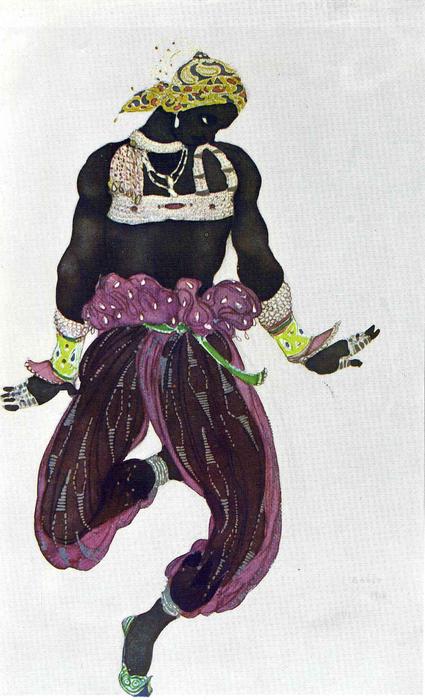
Scheherazade negre argent (1910) de Léon Bakst

Scheherazade negre argent

1910 · Watercolor

A solitary male figure commands the space, frozen in a moment of theatrical tension. He leans into a stylized pose, his body elongated to emphasize a sense of rhythmic movement that seems to pulse even in stillness. The silhouette is defined by sharp, geometric lines—the triangular peak of a headpiece and the rectangular weight of his garments—which create a striking contrast against the dark, somber atmosphere. Every muscle and fold…

7
Scheherezade odalisque (1910) de Léon Bakst

Scheherezade odalisque

1910 · Watercolor

The artwork titled Scheherezade odalisque was created by the artist Léon Bakst. This specific piece is a watercolor illustration produced in 1910. The work originates from a period when the artist was actively involved in the visual development of the Ballets Russes, contributing to the aesthetic language of theatrical productions such as Scheherazade.

8
The Butterfly (Costume Design for Anna Pavlova) (1913) de Léon Bakst

The Butterfly (Costume Design for Anna Pavlova)

1913 · Gouache · Muzeul de Artă Plastică din Boston, Boston

The Butterfly (Costume Design for Anna Pavlova) is a dynamic costume design illustration created in 1913. The composition features a central female figure captured in a mid-stride or dancing pose. She is surrounded by expansive, swirling fabric elements that suggest the wings of a butterfly. The color palette is dominated by primary colors, specifically bright yellow and deep cobalt blue, accented with orange and white.

9
Portrait of Miss Paoloff (1916) de Léon Bakst

Portrait of Miss Paoloff

1916 · Oil

The Portrait of Miss Paoloff by Léon Bakst captures a fleeting moment of grace. In this work, the ballerina Miss Paoloff appears mid-movement, her body caught in a dynamic pose that suggests the energy of a live performance. She wears her performance attire, a tutu that seems to catch the light as she moves through the space. The scene feels suspended in time, as if the dancer has just pivoted…

10
Portrait of the Marchesa Casati (1912) de Léon Bakst

Portrait of the Marchesa Casati

1912 · Charcoal

This work, titled Portrait of the Marchesa Casati, is a striking study by the artist Léon Bakst. Created about 1912, the portrait captures the likeness of the Marchesa Casati in a moment of quiet contemplation. It is a piece that reflects the artist's ability to translate a specific presence onto paper through a focused, intimate lens.

Selecția pentru Léon Bakst continuă, de la 11 la 100

11Portrait of the Marchesa Casati (1912) de Léon BakstPortrait of the Marchesa Casati1912 12fantasy on modern costume (atalanta) (1912) de Léon Bakstfantasy on modern costume (atalanta)1912 13The sleeping beauty eastern prince and his page (1916) de Léon BakstThe sleeping beauty eastern prince and his page1916 14Portrait of a Lady (1917) de Léon BakstPortrait of a Lady1917 15Mme Ida Rubinstein (1917) de Léon BakstMme Ida Rubinstein1917 · Metropolitan Museum of Art 16Samarkand Sultan (1922) de Léon BakstSamarkand Sultan1922 17russian peasant woman (1922) de Léon Bakstrussian peasant woman1922 18Dmitry Filosof portrait (1897) de Léon BakstDmitry Filosof portrait1897 19Art open letter of Red Cross (1904) de Léon BakstArt open letter of Red Cross1904 20supper (1902) de Léon Bakstsupper1902 21cleopatre danse juive (1910) de Léon Bakstcleopatre danse juive1910 22helene de sparte ida rubinstein in act iv (1912) de Léon Baksthelene de sparte ida rubinstein in act iv1912 23The Supper (1902) de Léon BakstThe Supper1902 24Big Philanthropic Puppet Bazaar, St. Petersburg (1899) de Léon BakstBig Philanthropic Puppet Bazaar, St. Petersburg1899 25Medee (Jean Anouilh) de Léon BakstMedee (Jean Anouilh) 26Leonid Massine de Léon BakstLeonid Massine 27Portrait of Jean Cocteau de Léon BakstPortrait of Jean Cocteau 28Ida Rubinstein de Léon BakstIda Rubinstein 29untitled (4764) de Léon Bakstuntitled (4764) 30untitled (1211) de Léon Bakstuntitled (1211) 31untitled (1495) de Léon Bakstuntitled (1495) 32Costume Design For 'la Fée De Richesse' de Léon BakstCostume Design For 'la Fée De Richesse' 33St. Sebastian, from ''The Martyr of St. Sebastian'' de Léon BakstSt. Sebastian, from ''The Martyr of St. Sebastian'' 34helene de sparte costume for ida rubinstein as helene de Léon Baksthelene de sparte costume for ida rubinstein as helene 35Ballet Music - Introduction (Humphrey Searle) de Léon BakstBallet Music - Introduction (Humphrey Searle) 36untitled (4724) de Léon Bakstuntitled (4724) 37untitled (9134) de Léon Bakstuntitled (9134) 38Costume for Nijinsky (1910) de Léon BakstCostume for Nijinsky1910 39scheherezade odalisque (1910) de Léon Bakstscheherezade odalisque1910 40le dieu bleu a young rajah (1911) de Léon Bakstle dieu bleu a young rajah1911 41narcisse the nymph echo (1911) de Léon Bakstnarcisse the nymph echo1911 42Le dieu bleu a young rajah (1911) de Léon BakstLe dieu bleu a young rajah1911 43fantasie sur le costume moderne (1910) de Léon Bakstfantasie sur le costume moderne1910 44Vase (self-portrait) (1906) de Léon BakstVase (self-portrait)1906 45Scheherezade odalisque (1910) de Léon BakstScheherezade odalisque1910 46Narcisse a youth (1911) de Léon BakstNarcisse a youth1911 47Le dieu bleu Nijinsky in title role (1911) de Léon BakstLe dieu bleu Nijinsky in title role1911 48loiseau de feu costume pour tamara karsavina (1910) de Léon Bakstloiseau de feu costume pour tamara karsavina1910 49Fantasy on modern costume (1910) de Léon BakstFantasy on modern costume1910 50scheherazade negre argent (1910) de Léon Bakstscheherazade negre argent1910 51The Firebird, the tsarevna (1910) de Léon BakstThe Firebird, the tsarevna1910 52loiseau de feu the firebird (1910) de Léon Bakstloiseau de feu the firebird1910 53Narcisse -Boeotian (1911) de Léon BakstNarcisse -Boeotian1911 54Portrait of Russian painter Filipp Andreevich Maljawin de Léon BakstPortrait of Russian painter Filipp Andreevich Maljawin 55scheherezade scenery (1910) de Léon Bakstscheherezade scenery1910 56le martyre de saint sebastien ida rubinstein as st sebastian (1911) de Léon Bakstle martyre de saint sebastien ida rubinstein as st sebastian1911 57Costume Design for 'Scheherazade' (1910) de Léon BakstCostume Design for 'Scheherazade'1910 58The Firebird, costume for Tamara Karsavina (1910) de Léon BakstThe Firebird, costume for Tamara Karsavina1910 59scheherazade la sultane bleue (1910) de Léon Bakstscheherazade la sultane bleue1910 60narcisse a youth (1911) de Léon Bakstnarcisse a youth1911 61Sketch for the ballet 'La Peri', by Paul Dukas (1911) de Léon BakstSketch for the ballet 'La Peri', by Paul Dukas1911 62Scheherazade shah shahriar (1910) de Léon BakstScheherazade shah shahriar1910 63cleopatre greek dancer (1910) de Léon Bakstcleopatre greek dancer1910 64Front cover of Comoedia (1909) de Léon BakstFront cover of Comoedia1909 65loiseau de feu michel fokine as tsarevitch (1910) de Léon Bakstloiseau de feu michel fokine as tsarevitch1910 66Scheherazade la sultane bleue (1910) de Léon BakstScheherazade la sultane bleue1910 67cleopatre syrian dance (1909) de Léon Bakstcleopatre syrian dance1909 68narcisse a nymph (1911) de Léon Bakstnarcisse a nymph1911 69Le martyre de Saint Sebastien act I set design (1911) de Léon BakstLe martyre de Saint Sebastien act I set design1911 70Le martyre de Saint Sebastien act IV set design (1911) de Léon BakstLe martyre de Saint Sebastien act IV set design1911 71The carnival Chiarina (1910) de Léon BakstThe carnival Chiarina1910 72narcisse bacchante (1911) de Léon Bakstnarcisse bacchante1911 73la peri natasha trouhanova as the peri (1911) de Léon Bakstla peri natasha trouhanova as the peri1911 74In the artist's studio (1908) de Léon BakstIn the artist's studio1908 75la peri iksander (1911) de Léon Bakstla peri iksander1911 76The .arnival - Estrella (1910) de Léon BakstThe .arnival - Estrella1910 77Cleopatre danse juive (1910) de Léon BakstCleopatre danse juive1910 78le dieu bleu nijinsky in title role (1911) de Léon Bakstle dieu bleu nijinsky in title role1911 79Downpour (1906) de Léon BakstDownpour1906 80Scheherazade the chief eunuch (1910) de Léon BakstScheherazade the chief eunuch1910 81Costume design for a bacchante in 'Narcisse' by Tcherepnin (1911) de Léon BakstCostume design for a bacchante in 'Narcisse' by Tcherepnin1911 82le dieu bleu the bride (1912) de Léon Bakstle dieu bleu the bride1912 83Nijinsky's Faun Costume in 'L'Apres Midi d'un Faune' by Claude Debussy from the front cover of the programme for the 7th season of the 'Ballets Russes' (1912) de Léon BakstNijinsky's Faun Costume in 'L'Apres Midi d'un Faune' by Claude Debussy from the front cover of the programme for the 7th season of the 'Ballets Russes'1912 84Design for a lady's dress (1912) de Léon BakstDesign for a lady's dress1912 85sadko one of the chorus (1917) de Léon Bakstsadko one of the chorus1917 86L'apres midi d'un faune, another nymph (1912) de Léon BakstL'apres midi d'un faune, another nymph1912 87lapres midi dun faune another nymph (1912) de Léon Bakstlapres midi dun faune another nymph1912 88le dieu bleu a pilgrim (1912) de Léon Bakstle dieu bleu a pilgrim1912 89le dieu bleu bayadere (1912) de Léon Bakstle dieu bleu bayadere1912 90lapres midi dun faune nijinsky as the faun (1912) de Léon Bakstlapres midi dun faune nijinsky as the faun1912 91Le dieu bleu bayadere with peacock (1912) de Léon BakstLe dieu bleu bayadere with peacock1912 92Daphnis and Chloe scenery for act II (1912) de Léon BakstDaphnis and Chloe scenery for act II1912 93daphnis et chloe set design act ii (1912) de Léon Bakstdaphnis et chloe set design act ii1912 94Les femmes de bonne humeur - set design (1917) de Léon BakstLes femmes de bonne humeur - set design1917 95sadko the green monster (1917) de Léon Bakstsadko the green monster1917 96le dieu bleu setting (1912) de Léon Bakstle dieu bleu setting1912 97loiseau de feu costume (1913) de Léon Bakstloiseau de feu costume1913 98helene de sparte act ii set design (1912) de Léon Baksthelene de sparte act ii set design1912 99La legende de Joseph Potiphar (1914) de Léon BakstLa legende de Joseph Potiphar1914 100daphnis et chloe costume (1912) de Léon Bakstdaphnis et chloe costume1912

Piesele celebre ale lui Léon Bakst, perioadă cu perioadă

Subiectele care i-au captivat privirea lui Léon Bakst

Cele patru teme care revin cel mai des în aceste opere originale, fiecare având cel mai sublim exemplu.

Muzeele care păstrează originalele lui Léon Bakst

Cele 3 muzee care dețin cele mai multe dintre picturile de pe această pagină.

Muzee Oraș Lucrări lui Léon Bakst Picturi din această listă
The Baltimore Museum of Art, BaltimoreThe Baltimore Museum of Art Baltimore 1 Design cu flori în grilă
Muzeul de Artă Plastică din Boston, BostonMuzeul de Artă Plastică din Boston Boston 1 The Butterfly (Costume Design for Anna Pavlova)
Metropolitan Museum of Art, New YorkMetropolitan Museum of Art New York 1 Mme Ida Rubinstein

Léon Bakst deceniu cu deceniu: originalul care definește fiecare

Lucrări pe deceniu

Alege o deceniu pentru a descoperi opera originală care îl definește.

Întrebări ale colecționarilor despre picturile lui Léon Bakst

Pentru ce operă este cel mai cunoscut Léon Bakst?Află răspunsul

Design cu flori în grilă, The Baltimore Museum of Art, Baltimore. Urmează Costume design for the ballet ''Cleopatra'' (1909) și Operatic costume designs (1911).

Care sunt cele mai celebre zece picturi ale lui Léon Bakst?Află răspunsul

Design cu flori în grilă, Costume design for the ballet ''Cleopatra'', Operatic costume designs, Drawing young divinity Narcisse costume, ballet Diaghilev, Portrait of Boris Nikolayevich Bugaev (Andrey Bely), Scheherazade negre argent, Scheherezade odalisque, The Butterfly (Costume Design for Anna Pavlova), Portrait of Miss Paoloff și Portrait of the Marchesa Casati. Clasamentul de mai sus indică anul și muzeul pentru fiecare piesă.

Câte picturi a lăsat Léon Bakst?Află răspunsul

Catalogul nostru cuprinde 154 lucrări ale lui Léon Bakst, datate între 1897 și 1922.

În ce muzee sunt expuse capodoperele lui Léon Bakst?Află răspunsul

În principal în The Baltimore Museum of Art (Baltimore), Muzeul de Artă Plastică din Boston (Boston) și Metropolitan Museum of Art (New York). Tabelul cu muzee de mai sus le enumeră pe toate.

În ce ani a pictat Léon Bakst cele mai cunoscute opere?Află răspunsul

În 1910s: 71 dintre cele 100 lucrări de pe această pagină au fost realizate atunci, fiind Operatic costume designs dintre acestea.

Care sunt prima și ultima pictură originală celebră a lui Léon Bakst?Află răspunsul

Pe această pagină, cea mai veche lucrare datează din Dmitry Filosof portrait (1897), iar cea mai recentă este din Samarkand Sultan (1922).

Ce subiecte a ales cel mai des Léon Bakst?Află răspunsul

Designs and sketches (28), Clothing (26) și Woman (9), din cele 100 lucrări de pe această pagină.

Ce tehnică a folosit cel mai des Léon Bakst?Află răspunsul

Watercolor, pentru 5 dintre cele 100 lucrări de pe această pagină.

Din ce mișcare artistică face parte Léon Bakst?Află răspunsul

Art nouveau, judecând după originalele de pe această pagină.

Léon Bakst: viață și operă

Early Life and the Seeds of Artistic Rebellion

Born Leyb-Khaim Izrailevich Rosenberg in 1866, within the pale of settlement in Grodno—a city then part of the Russian Empire—Léon Bakst’s journey toward artistic renown was a compelling narrative woven with both innate talent and societal constraints. His family, though comfortably middle class, possessed connections to the imperial court through his grandfather, a celebrated tailor who enjoyed patronage from the Tsar. This background instilled in young Leyb a keen awareness of cultural nuances alongside an early passion for drawing, vividly demonstrated when he won a contest at just twelve years old. However, this burgeoning artistic inclination initially met with resistance from his parents, hesitant to embrace such an unconventional path. Despite their reservations, Bakst persevered, eventually studying at the prestigious St. Petersburg Academy of Arts as a non-credit student while supplementing his education by working as a book illustrator—a practical necessity that honed his skills and provided financial independence. It was in 1889 that he adopted the surname "Bakst," a pragmatic decision reportedly motivated by concerns that his birth name might hinder career advancement within a society often prejudiced against Jewish individuals, revealing the challenges faced by artists from marginalized communities during that era. The atmosphere of Grodno, with its complex social dynamics and limited opportunities for Jewish intellectuals, undoubtedly shaped Bakst’s early worldview—a sense of both belonging and exclusion that would later inform his artistic vision.

The World of Art and Embracing Modernity

Bakst’s artistic development truly flourished with his involvement in the influential “World of Art” movement. He quickly became a pivotal figure alongside luminaries like Sergei Diaghilev and Alexandre Benois, contributing significantly to the group's eponymous periodical through his striking graphics. This association brought him widespread recognition and established him as a rising star within Russia’s artistic circles. His early works included compelling portraits of prominent figures such as Filipp Malyavin, Vasily Rozanov, Andrei Bely, and Zinaida Gippius, showcasing his ability to capture not only physical likeness but also the intellectual and emotional essence of his subjects. Bakst's style during this period was a fascinating blend of Russian artistic traditions with burgeoning European influences—particularly Orientalism and early Modernism. He embraced vibrant colors, exotic themes, and stylized forms, foreshadowing the revolutionary aesthetic he would later bring to the stage. This willingness to experiment and synthesize diverse influences marked him as an artist attuned to the changing currents of his time. His work began to whisper of a new visual language, one that moved beyond strict representation toward evocative suggestion. The “World of Art” group sought to break away from the rigid academic traditions of the Imperial Academy, advocating for artistic freedom and exploring diverse themes—from folklore and mythology to social commentary and psychological introspection. Bakst’s participation in this movement allowed him to engage with a vibrant intellectual community and develop his unique style, characterized by its dynamism, sensuality, and innovative use of color and form.

Revolutionizing Ballet with the Ballets Russes

The pivotal moment in Bakst’s career arrived in 1908 when he began designing sets and costumes for theatrical productions—a shift that would forever alter the landscape of stage design. His collaboration with Sergei Diaghilev's Ballets Russes proved transformative, revolutionizing theatrical aesthetics and catapulting both artists to international fame. Bakst’s designs were groundbreaking; they moved away from realistic depictions, embracing stylized forms, bold colors, and a sense of opulent fantasy. Productions like Cleopatra, Scheherazade (1910)—perhaps his most iconic work—Carnaval (1910), Narcisse (1911), and particularly L'Après-midi d’un Faune (1912) became legendary for their visual splendor. L’Après-midi d’un Faune, in particular, was a seminal work that profoundly influenced the development of ballet and stage design, establishing a new aesthetic language for the art form. He didn't merely create backdrops; he constructed immersive worlds that heightened the emotional impact of the choreography and music. The costumes were equally innovative, often incorporating exotic fabrics, shimmering embellishments, and daring silhouettes that challenged conventional notions of theatrical attire. Diaghilev’s vision was to create a ballet company that transcended mere entertainment—a vehicle for artistic expression and cultural diplomacy. Bakst's designs perfectly embodied this ambition, transforming the stage into a realm of dreamlike beauty and symbolic resonance. The Ballets Russes under Diaghilev became synonymous with innovation and spectacle, and Bakst’s contributions were central to its success.

Legacy and Enduring Influence

Léon Bakst’s legacy extends far beyond his contributions to ballet. He is rightfully considered one of the most important figures in the history of theatrical design, significantly impacting both set and costume creation for generations to come. His designs also contributed to the development of the Art Deco style with their emphasis on stylized forms, rich colors, and exotic themes—a testament to his far-reaching influence on visual culture. Despite facing some criticism during his lifetime for perceived extravagance, Bakst’s work was widely celebrated, and his funeral in 1924 was attended by a remarkable gathering of prominent artists, poets, musicians, dancers, and critics—a poignant demonstration of the esteem in which he was held. Today, his artwork can be found in museums worldwide and continues to inspire through reproductions available on platforms like OriginalUniqueArt.com, ensuring that his innovative spirit and artistic vision endure for audiences around the globe. Bakst’s ability to synthesize diverse influences, embrace experimentation, and create visually stunning worlds cemented his place as a true visionary of the 20th century.
  • A master of color and composition.
  • Pioneered new approaches to theatrical design.
  • Influenced Art Deco aesthetics.