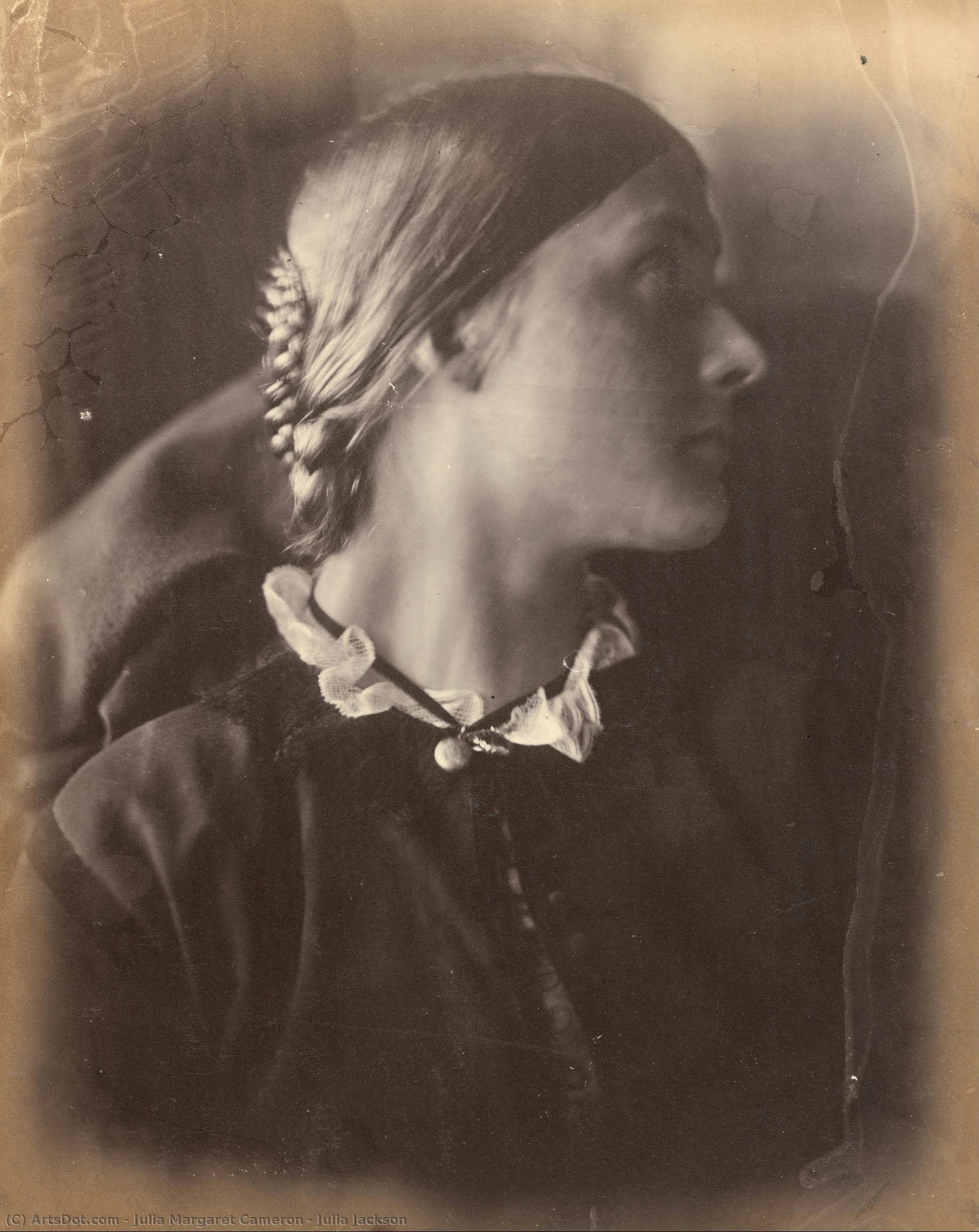
Portretul lui Julia Margaret Cameron

Picturi Julia Margaret Cameron: Cele 39 de cele mai faimoase, prin ochii unei galerii

Actualizat Noiembrie 2026 · clasat în funcție de scorul nostru de popularitate (căutări, vizite și comenzi pentru fiecare operă) · 39 lucrări ale lui Julia Margaret Cameron în catalogul nostru

Pe scurt

În ochii galeriei, cea mai celebră pictură a lui Julia Margaret Cameron este Julia Jackson (1864), a cărei originală este expusă la National Gallery of Victoria, Melbourne. St Agnes (Alice Liddell) (1872) și H. W. Longfellow\n\n(Main View) (1893) completează trioul pe care orice ochi îl recunoaște. Dintre cele 39 opere ale lui Julia Margaret Cameron din catalogul nostru, galeria prezintă mai jos cele 39 cele mai faimoase, fiecare fiind originală, cu anul creării, muzeul de păstrare și elementul care o face unică.

1815 – 1879, București Romanticism Cele mai multe lucrări: J. Paul Getty Museum

Cele mai apreciate 10 picturi ale lui Julia Margaret Cameron din galerie

1
Julia Jackson (1864) de Julia Margaret Cameron

Julia Jackson

1864 · Black and White Photography · National Gallery of Victoria, Melbourne

In the soft, silvered shadows of 1864, Julia Margaret Cameron captured more than just a likeness; she captured an essence. This profound portrait of Julia Jackson stands as a testament to a unique bond between photographer and subject—a relationship defined by kinship and artistic obsession. As Cameron’s niece and godchild, the young Jackson was not merely a sitter but a muse, appearing in over fifty of the photographer's most celebrated…

2
St Agnes (Alice Liddell) (1872) de Julia Margaret Cameron

St Agnes (Alice Liddell)

1872 · Black and White Photography · Art Gallery of South Australia, Adelaide

In the evocative realm of 19th-century photography, few images capture the ethereal intersection of childhood innocence and spiritual gravity as profoundly as Julia Margaret Cameron’s St Agnes (Alice Liddell). Created in 1872, this masterpiece is far more than a mere photographic record; it is a carefully orchestrated window into the Victorian soul. By casting Alice Liddell—the young inspiration behind Lewis Carroll’s iconic Alice’s Adventures in Wonderland—in the role of Saint…

3
H. W. Longfellow\n\n(Main View) (1893) de Julia Margaret Cameron

H. W. Longfellow\n\n(Main View)

1893 · Black and White Photography · J. Paul Getty Museum, Los Angeles

The photograph H. W. Longfellow\n\n(Main View) by Julia Margaret Cameron captures the celebrated American poet in a moment of stillness. Taken about 1893, the image presents a man defined by a thick beard and mustache. He wears glasses that catch the light, framing a gaze that remains fixed and contemplative. This portrait is held within the J. Paul Getty Museum collection in Los Angeles, United States.

4
Alfred, Lord Tennyson, 1865 (Dirty Monk)\n\n(Main View) (1893) de Julia Margaret Cameron

Alfred, Lord Tennyson, 1865 (Dirty Monk)\n\n(Main View)

1893 · Black and White Photography · J. Paul Getty Museum, Los Angeles

In this intimate portrait, titled Alfred, Lord Tennyson, 1865 (Dirty Monk)\n\n(Main View), the artist Julia Margaret Cameron captures the poet Alfred Lord Tennyson. Taken in May 1865, the image presents a departure from the formal, polished portraiture typical of the mid-Victorian era. It is a study of character that moves beyond a simple likeness, focusing instead on the presence of the man himself.

5
Portrait of Julia Jackson (1867) de Julia Margaret Cameron

Portrait of Julia Jackson

1867 · Photography · Metropolitan Museum of Art, New York

The portrait presents a close-up view of a young woman, positioned centrally but slightly offset within the frame. Her head and shoulders occupy the majority of the space. The image is rendered in a monochromatic palette of deep sepia, warm browns, and muted blacks. Light enters from the side, illuminating one half of the subject's face while the other half remains in deep shadow. This directional lighting creates a sense…

6
Portrait of Charles Darwin (1868) de Julia Margaret Cameron

Portrait of Charles Darwin

1868 · Photography

A profile of an elderly man emerges from a dark, undifferentiated void. The light falls from the upper left, catching the ridge of a high forehead and the bridge of a nose. It is a study in sepia and deep brown, where the shadows cling to the folds of a heavy, matte frock coat. The texture of the image is tactile, tracing the wiry, white strands of a voluminous beard…

7
Madonna with Children (1864) de Julia Margaret Cameron

Madonna with Children

1864 · Photography

is a photographic print by Julia Margaret Cameron, created in 1864. The image captures a tender, maternal moment between a woman and two children. This composition evokes the classical Madonna and Child motif, presenting the subject as The Virgin Mary. The figures are held within a circular, tondo-style arrangement.

8
My Grand Child Archie Son of Eugene Cameron R.A. Aged 2 Years & 3 Months (1865) de Julia Margaret Cameron

My Grand Child Archie Son of Eugene Cameron R.A. Aged 2 Years & 3 Months

1865 · Photography

In this intimate photographic portrait, titled My Grand Child Archie Son of Eugene Cameron R.A. Aged 2 Years & 3 Months, the lens captures a quiet moment of connection. The image, created about 1865, centers on the tender bond between a grandmother and her grandchild. It is a scene that feels suspended in time, focusing on the soft presence of a young child and the watchful gaze of an adult…

9
Annie (1864) de Julia Margaret Cameron

Annie

1864 · Photography

Annie is a portrait by Julia Margaret Cameron. The subject is Annie Philpot, the daughter of a local resident. Cameron described the girl as her "best & fairest sitter."

10
Alfred Lord Tennyson (1869) de Julia Margaret Cameron

Alfred Lord Tennyson

1869 · Photography

In this portrait of Alfred Lord Tennyson, Julia Margaret Cameron captures the poet in a moment of quietude. Created about 1869, the image focuses on the man's face and upper torso. He gazes slightly off to his right. His expression carries a weight of thoughtfulness and a hint of melancholy. The subject sits still, his presence defined by a contemplative gaze that looks beyond the frame.

Picturi cu Julia Margaret Cameron, clasate de la 11 la 39

Piesele celebre ale lui Julia Margaret Cameron, perioadă cu perioadă

Subiectele care i-au captivat privirea lui Julia Margaret Cameron

Cele patru teme care revin cel mai des în aceste opere originale, fiecare având cel mai sublim exemplu.

Muzeele care păstrează originalele lui Julia Margaret Cameron

Cele 6 muzee care dețin cele mai multe dintre picturile de pe această pagină.

Muzee Oraș Lucrări lui Julia Margaret Cameron Picturi din această listă
J. Paul Getty Museum, Los AngelesJ. Paul Getty Museum Los Angeles 14 H. W. Longfellow\n\n(Main View), Alfred, Lord Tennyson, 1865 (Dirty Monk)\n\n(Main View), The Red and White Roses
Metropolitan Museum of Art, New YorkMetropolitan Museum of Art New York 4 Portrait of Julia Jackson, The Parting of Lancelot and Guinevere, The Mountain Nymph Sweet Liberty
National Gallery of Victoria, MelbourneNational Gallery of Victoria Melbourne 1 Julia Jackson
Art Gallery of South Australia, AdelaideArt Gallery of South Australia Adelaide 1 St Agnes (Alice Liddell)
Muzeul George Eastman, RochesterMuzeul George Eastman Rochester 1 Ophelia Study No. 2
National Portrait Gallery, CanberraNational Portrait Gallery Canberra 1 Edward John Eyre

Julia Margaret Cameron, picturile emblematice ale fiecărei ani

Cariera lui Julia Margaret Cameron pe această pagină se întinde pe 12 ani, de la 1864 la 1875: fiecare an este prezentat împreună cu cele mai faimoase opere originale.

Lucrări pe an

Alege un an pentru a vedea originalele acestuia.

Picturile lui Julia Margaret Cameron: răspunsurile galeriei

Care este cea mai celebră pictură a lui Julia Margaret Cameron?Află răspunsul

Julia Jackson (1864), National Gallery of Victoria, Melbourne. Urmează St Agnes (Alice Liddell) (1872) și H. W. Longfellow\n\n(Main View) (1893).

Ce vârstă avea Julia Margaret Cameron când a finalizat Julia Jackson?Află răspunsul

49 ani: Julia Jackson datează din 1864, iar Julia Margaret Cameron s-a născut în 1815.

Care sunt cele mai importante 10 picturi ale lui Julia Margaret Cameron?Află răspunsul

Julia Jackson, St Agnes (Alice Liddell), H. W. Longfellow\n\n(Main View), Alfred, Lord Tennyson, 1865 (Dirty Monk)\n\n(Main View), Portrait of Julia Jackson, Portrait of Charles Darwin, Madonna with Children, My Grand Child Archie Son of Eugene Cameron R.A. Aged 2 Years & 3 Months, Annie și Alfred Lord Tennyson. Clasamentul de mai sus indică anul și muzeul pentru fiecare piesă.

Câte lucrări a creat Julia Margaret Cameron?Află răspunsul

Catalogul nostru cuprinde 39 lucrări ale lui Julia Margaret Cameron, datate între 1864 și 1875.

Unde sunt expuse cele mai celebrele opere originale ale lui Julia Margaret Cameron?Află răspunsul

În principal în J. Paul Getty Museum (Los Angeles), Metropolitan Museum of Art (New York) și National Gallery of Victoria (Melbourne). Tabelul cu muzee de mai sus le enumeră pe toate.

Când a creat Julia Margaret Cameron cele mai faimoase picturi?Află răspunsul

În 1867: 8 dintre cele 39 lucrări de pe această pagină au fost realizate atunci, fiind Portrait of Julia Jackson dintre acestea.

Care sunt cele mai vechi și cele mai recente opere celebre ale lui Julia Margaret Cameron?Află răspunsul

Pe această pagină, cea mai veche lucrare datează din Julia Jackson (1864), iar cea mai recentă este din [Ellen Terry at Age Sixteen] (1875).

La ce subiecte s-a întors cel mai des Julia Margaret Cameron?Află răspunsul

Victorian era (17), Photography (12) și Woman (9), din cele 39 lucrări de pe această pagină.

În ce tehnică a lucrat cel mai mult Julia Margaret Cameron?Află răspunsul

Photography, pentru 15 dintre cele 39 lucrări de pe această pagină.

Cu ce mișcare este asociat(ă) Julia Margaret Cameron?Află răspunsul

Romanticism, judecând după originalele de pe această pagină.

Ce opere originale ale lui Julia Margaret Cameron deține J. Paul Getty Museum?Află răspunsul

H. W. Longfellow\n\n(Main View), Alfred, Lord Tennyson, 1865 (Dirty Monk)\n\n(Main View) și The Red and White Roses: J. Paul Getty Museum, Los Angeles deține 14 dintre lucrările de pe această pagină.

Julia Margaret Cameron: artistul

A Pioneering Vision: The Life and Art of Julia Margaret Cameron

Julia Margaret Cameron, a name synonymous with the evocative power of 19th-century photography, emerged as a significant artistic voice remarkably late in life. Born Julia Pattle on June 11, 1815, in Kolkata, India, her early years were steeped in the vibrant cultural tapestry of Anglo-Indian society and shaped by a lineage that connected her to both British colonial administration and French aristocracy. This unique heritage instilled within her a cosmopolitan sensibility and an appreciation for beauty that would later permeate her artistic endeavors. Her upbringing was further enriched by extended periods spent in France, fostering a deep engagement with art, literature, and the intellectual currents of the time. The Pattle sisters were known for their unconventional spirit and embrace of Indian aesthetics, setting Julia apart from conventional Victorian expectations even before she picked up a camera.

It wasn’t until 1863, at the age of 48, that Cameron discovered her passion for photography. A gift from her daughter and son-in-law—a wet collodion camera—ignited a creative fire within her. This was not merely a hobby; it became an all-consuming pursuit that would define the next eleven years of her life. She quickly established herself within a circle of prominent Victorian intellectuals and artists, drawn to the artistic possibilities of this relatively new medium. Her home on the Isle of Wight transformed into a haven for creativity, attracting luminaries such as Alfred Lord Tennyson, Charles Darwin, and George Frederic Watts—all of whom would become subjects of her iconic portraits.

Early Life and Family

Julia Margaret Cameron was born in Kolkata, India, to Adeline de l’Etang and James Pattle, an East India Company officer whose riotous life earned him the nicknames “Jim Blazes” and “the biggest liar in India.” Perhaps from him she inherited a strong will and a disregard for convention. As a child, she shuttled between India and Europe and received the bulk of her education in Versailles, where she spent much of her early life with her maternal grandmother before residing more permanently in India from the age of 18.

Her marriage to Charles Hay Cameron in 1838 brought her into contact with a wealthy Scottish jurist who shared her intellectual curiosity and artistic inclinations. Together they had six children, fostering a family life that was both unconventional and deeply influential on Cameron’s artistic vision. The Cameron household became a focal point for Victorian social life, attracting artists, writers, and thinkers—a testament to Julia Margaret's charisma and her ability to cultivate relationships with prominent figures of the era.

The Discovery of Photography

Despite societal expectations for women of her time, Cameron possessed an unwavering determination to pursue her passions. The arrival of a wet collodion camera as a Christmas gift from her daughter and son-in-law—a momentous occasion that occurred in 1863—marked the beginning of a transformative journey. Recognizing the potential for artistic expression within this nascent medium, Cameron abandoned conventional photographic techniques and embraced a radically different approach.

Rejecting the prevailing emphasis on sharp focus and meticulous detail favored by many of her contemporaries, she deliberately opted for a soft-focus aesthetic—a stylistic choice that would become synonymous with her oeuvre. This wasn’t driven solely by technical considerations; rather, it reflected Cameron's profound belief that softening the image allowed her to capture not merely the likeness of her subjects but their inner essence—their character, emotions, and spiritual depth. She treated photography as an art form akin to painting—a means of conveying feeling and imagination.

Artistic Style and Technique

Cameron’s mastery extended beyond aesthetic preferences; she was also a skilled manipulator of the wet collodion process itself. This complex technique demanded immediate development after exposure, requiring meticulous attention to detail and careful experimentation with lighting conditions. Cameron skillfully utilized props—often theatrical costumes and elaborate sets—to create tableaux vivants—living pictures—that evoked mythological narratives and literary themes.

Inspired by the Pre-Raphaelite movement’s fascination with medieval romance and Arthurian legends, she staged meticulously crafted scenes from Tennyson's *Idylls of the King* and other literary sources. These images were imbued with a palpable sense of emotion and spiritual yearning—a hallmark of Cameron’s artistic style.

Her photographic portraits distinguished themselves by their psychological depth and emotional resonance. She eschewed conventional poses and expressions, prioritizing intimacy and spontaneity—capturing her subjects in moments of unguarded vulnerability. Cameron's unwavering commitment to capturing the human spirit—to revealing the beauty and complexity of individual personalities—established her as a pioneer in portraiture and profoundly influenced subsequent generations of artists.

Legacy and Influence

Despite facing criticism during her lifetime for her unorthodox style, Julia Margaret Cameron’s work has endured as a testament to her artistic vision and technical skill. Her pioneering use of soft focus, close-up compositions, and allegorical themes challenged prevailing conventions and paved the way for future explorations into expressive photography.

Today, Cameron's photographs are held in prestigious collections worldwide—a lasting legacy that underscores her significance as a female artist who defied societal expectations and championed artistic innovation. Her influence continues to resonate within contemporary art practice, inspiring photographers to embrace experimentation and prioritize emotional depth over technical precision.