Portretul lui Joseph Barnard Davis

Cele 19 cele mai faimoase picturi ale lui Joseph Barnard Davis, fiecare unică în felul ei

Actualizat Noiembrie 2026 · clasat în funcție de scorul nostru de popularitate (căutări, vizite și comenzi pentru fiecare operă) · 22 lucrări ale lui Joseph Barnard Davis în catalogul nostru

Pe scurt

The Barnyard (1938) este pictura lui Joseph Barnard Davis care atrage cele mai multe priviri; originalul aparține Walker Art Gallery, Liverpool. După aceasta, privirea se îndreaptă către The Kennet and Avon Canal at Honeystreet Wharf, Woodborough, Wiltshire (1879) și Forge, Chedworth. Dintre cele 22 opere ale lui Joseph Barnard Davis din catalogul nostru, acestea 19 sunt cele mai celebre, fiecare fiind o piesă unică, prezentată împreună cu anul creării, muzeul deținător și motivul pentru care aceasta rămâne memorabilă.

1861 – 1943 Cele mai multe lucrări: Ferens Art Gallery

Cele mai importante 10 picturi ale lui Joseph Barnard Davis, prin ochii galeriei

1
The Barnyard (1938) de Joseph Barnard Davis

The Barnyard

1938 · Oil On Canvas · Walker Art Gallery, Liverpool

In The Barnyard, Joseph Barnard Davis establishes a tranquil rural setting through a carefully balanced arrangement of pastoral elements. A large barn serves as the central focus of the composition, anchored by the surrounding presence of trees that frame the structure. Near the center of the image, a horse is prominently displayed, providing a focal point that reinforces the agricultural theme. Several people are scattered throughout the scene, positioned at…

Păiți celebrele picturi ale lui Joseph Barnard Davis, de la numărul 11 la 19

Muzeele care păstrează originalele lui Joseph Barnard Davis

Cele 5 muzee care dețin cele mai multe dintre picturile de pe această pagină.

Muzee Oraș Lucrări lui Joseph Barnard Davis Picturi din această listă
Ferens Art Gallery, HullFerens Art Gallery Hull 4 Weighing the Sacks (The Tithe Barn), Chalfont, Cotswold River Scene
Bristol Museum - Art Gallery, BristolBristol Museum - Art Gallery Bristol 2 Bibury, Fishponds, Bibury, Cotswold Hills
Walker Art Gallery, LiverpoolWalker Art Gallery Liverpool 1 The Barnyard
Doncaster Museum And Art Gallery, DoncasterDoncaster Museum And Art Gallery Doncaster 1 Chedworth, Gloucestershire
Atkinson Art Gallery Collection, SouthportAtkinson Art Gallery Collection Southport 1 Mill Stream

Joseph Barnard Davis de-a lungul anilor: originalele unice ale fiecăruia

O carieră de 60 ani, de la 1879 la 1938: cele mai faimoase originale ale lui Joseph Barnard Davis, prezentate an de an.

Lucrări pe an

Alege un an pentru a vedea originalele acestuia.

Picturile lui Joseph Barnard Davis: întrebări pentru galerie

Care este cea mai celebră operă a lui Joseph Barnard Davis?Află răspunsul

The Barnyard (1938), Walker Art Gallery, Liverpool. Urmează The Kennet and Avon Canal at Honeystreet Wharf, Woodborough, Wiltshire (1879) și Forge, Chedworth.

La ce vârstă a creat Joseph Barnard Davis The Barnyard?Află răspunsul

77 ani: The Barnyard datează din 1938, iar Joseph Barnard Davis s-a născut în 1861.

Care sunt cele mai celebre zece picturi ale lui Joseph Barnard Davis?Află răspunsul

The Barnyard, The Kennet and Avon Canal at Honeystreet Wharf, Woodborough, Wiltshire, Forge, Chedworth, Weighing the Sacks (The Tithe Barn), Millstream, Cotswolds, A Cotswold Farm, Richmond Castle, North Yorkshire, Chedworth, Gloucestershire, Fallen Giant și Chalfont. Clasamentul de mai sus indică anul și muzeul pentru fiecare piesă.

Câte lucrări ale lui Joseph Barnard Davis sunt cunoscute?Află răspunsul

Catalogul nostru cuprinde 22 lucrări ale lui Joseph Barnard Davis, datate între 1879 și 1938.

Unde pot fi vizualizate originalele celor mai faimoși Joseph Barnard Davis?Află răspunsul

În principal în Ferens Art Gallery (Hull), Bristol Museum - Art Gallery (Bristol) și Walker Art Gallery (Liverpool). Tabelul cu muzee de mai sus le enumeră pe toate.

Care este cea mai veche și care este cea mai recentă pictură a lui Joseph Barnard Davis?Află răspunsul

Pe această pagină, cea mai veche lucrare datează din The Kennet and Avon Canal at Honeystreet Wharf, Woodborough, Wiltshire (1879), iar cea mai recentă este din The Barnyard (1938).

Ce originale de Joseph Barnard Davis pot vedea la Ferens Art Gallery?Află răspunsul

Weighing the Sacks (The Tithe Barn), Chalfont și Cotswold River Scene: Ferens Art Gallery, Hull deține 4 dintre lucrările de pe această pagină.

Joseph Barnard Davis: un portret al artistului

The Dual Legacy of Joseph Barnard Davis: Science and Sentiment

In the annals of the Victorian era, few figures embody the period's profound tension between empirical discovery and romantic observation as poignantly as Joseph Barnard Davis. A man whose life was defined by a remarkable duality, Davis navigated the cold, analytical realms of craniology and medicine while simultaneously capturing the soft, nostalgic light of the English countryside through his art. Born in York on June 13, 1801, his early years were shaped by a rigorous apprenticeship in surgery and apothecary, yet the seeds of a much broader intellectual curiosity were sown during his transformative voyage as a surgeon aboard a whaling vessel to the Arctic seas in 1820. This exposure to the vast, untamed reaches of the world instilled in him a lifelong fascination with the diversity of human anatomy and the quiet majesty of the natural landscape.

Davis’s professional trajectory was one of relentless scholarly pursuit. After qualifying through the Society of Apothecaries and eventually earning his medical doctorate from the University of St Andrews in 1862, he established a prominent practice in Hanley, Staffordshire. However, it was his role as a collector that would cement his place in scientific history. Driven by an almost obsessive passion for human osteology, Davis meticulously amassed a collection of over 1,474 skulls and skeletons. This extraordinary assemblage, which at its peak surpassed the holdings of most British public museums, served as a monumental study of racial lineages and human variation. His work as a craniologist was not merely a hobby but a significant contribution to the scientific discourse of his time, earning him the prestigious distinction of being elected a Fellow of the Royal Society in 1868.

A Visionary Eye: From Anatomy to Landscape

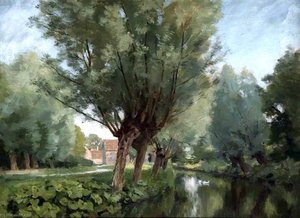
While the world recognized him for the meticulous documentation of bone and sinew, Davis possessed an artist's soul that sought refuge in the pastoral. His paintings offer a striking contrast to the clinical precision of his scientific endeavors. In his landscapes, one finds an atmospheric quality reminiscent of the Impressionist movement, where the focus shifts from the structural rigidity of anatomy to the fluid, ephemeral beauty of light and atmosphere. He had a particular talent for rendering the serene English countryside, imbuing scenes such as his Cotswold River Scene with a sense of profound tranquility and a palpable nostalgia for a vanishing rural way of life.

The technique employed in his works suggests a deep appreciation for the textures of nature—the lushness of riverbanks, the soft haze over distant hills, and the play of light upon water. This artistic development can be viewed as an emotional counterbalance to his scientific life; where craniology sought to categorize and define the permanent structures of humanity, his art celebrated the transient and the beautiful. Through his brush, the landscapes of England became more than mere topographical records; they became emotive vessels for the Victorian sentimentality that valued the spiritual connection between man and his environment.

Historical Significance and Lasting Impression

The historical significance of Joseph Barnard Davis lies in his ability to bridge two seemingly disparate worlds. He was a pivotal figure in the civic and intellectual life of Stoke-on-Trent, playing a foundational role in the establishment of the Museum of Natural History, Pottery and Antiquities. His commitment to disseminating knowledge ensured that his scientific passions contributed to the broader cultural heritage of his community. Even as he pursued the complexities of human physiognomy, he remained deeply rooted in the local landscape, both as a resident physician and an observer of nature.

Ultimately, Davis remains a captivating subject for historians and art enthusiasts alike. His life serves as a testament to the Victorian spirit of inquiry—a period when the boundaries between science, medicine, and art were often porous and interconnected. To study his work is to encounter a man who looked deeply into the very structure of human existence through the lens of a microscope, yet never lost the ability to look upward at the shifting clouds with the wonder of a poet. His legacy endures in the dual echoes of his scientific contributions and his evocative, enduring landscapes.