A Victorian Chronicler: The Life and Art of John Seymour Lucas
John Seymour Lucas, born in London in 1849, occupies a unique position within the landscape of Victorian art. He wasn’t simply a painter of historical scenes; he was a meticulous re-creator of moments past, a visual storyteller dedicated to immortalizing pivotal episodes from Britain's often turbulent history. While perhaps not as widely celebrated today as some of his contemporaries, Lucas enjoyed considerable acclaim during his lifetime, culminating in his election as a Royal Academician and establishing him as a sought-after portraitist and costume designer. His journey began unconventionally – an apprenticeship as a woodcarver preceded his embrace of the canvas – a grounding in three-dimensional form that would profoundly influence the remarkable realism for which he became known. This early training instilled within him a deep appreciation for detail, texture, and the tangible qualities of materials, elements that permeate his historical compositions. Formal education at St. Martin's Lane Art School and the Royal Academy Schools provided a solid technical foundation, but it was travels through Europe – particularly to Holland and Spain – that truly ignited his artistic vision.
Early Life and Artistic Beginnings
Lucas’s formative years were marked by an unexpected path toward artistic expression. Unlike many artists of his era who pursued formal training from a young age, he initially apprenticed as a woodcarver, gaining invaluable experience in manipulating materials and achieving precise craftsmanship. This practical grounding would prove crucial to his later success as a painter, informing his meticulous attention to detail and fostering an understanding of how to convey texture and form effectively. His family’s artistic heritage – notably his uncle, John Lucas, also a painter – undoubtedly instilled within him a predisposition for creative pursuits and nurtured his burgeoning talent. Recognizing the potential for greater artistic fulfillment, he enrolled at St. Martin's Lane Art School and subsequently pursued studies at the Royal Academy Schools, where he honed his skills in draughtsmanship and composition under the tutelage of prominent instructors. It was during these formative years that Lucas encountered Marie Cornelissen from France, whom he married in 1877 – a union that would provide him with a supportive partner and enrich his artistic life immeasurably.
Influences and Artistic Development
Lucas’s artistic sensibilities were profoundly shaped by the masters of Northern Renaissance painting, particularly Van Dyck, whose portraits captured an unparalleled level of psychological insight and technical virtuosity. Equally influential was Diego Velázquez, whose groundbreaking realism—characterized by subtle shading, atmospheric perspective, and a masterful depiction of human emotion—served as a guiding inspiration for Lucas’s own artistic endeavors. He wasn't merely imitating their styles; he was absorbing their techniques and philosophies, striving to emulate their ability to convey the essence of his subjects with breathtaking accuracy. Velázquez’s approach to capturing light and shadow – particularly in *Las Meninas*—became a cornerstone of Lucas’s artistic method, informing his meticulous rendering of textures and surfaces in his historical paintings. This dedication to realism extended beyond mere visual representation; it encompassed an intellectual engagement with the subject matter itself, prompting him to consider not just *what* happened but *how* it felt – the tension, the drama, the human cost of historical events. He sought to recreate scenes as authentically as possible, immersing himself in research and painstakingly documenting every aspect of the environment and costumes involved.
Major Achievements: Historical Painting and Costume Design
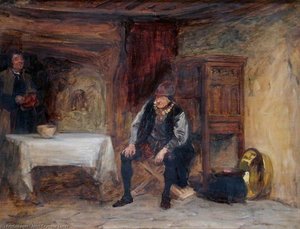
Lucas achieved considerable renown during his lifetime primarily through his prolific output of historical paintings—scenes meticulously researched and rendered with astonishing realism. His most celebrated works include *Rebel Hunting after Culloden*, a dramatic portrayal of the aftermath of the Jacobite uprising, capturing the palpable tension between British soldiers and local blacksmiths suspected of harboring rebel sympathies. The painting’s masterful use of light and shadow—echoing Velázquez's techniques—effectively conveys the atmosphere of confrontation and underscores Lucas’s commitment to psychological depth. Equally impressive was *The Flight of the Five Members*, commissioned for the Houses of Parliament, which depicts a pivotal moment in parliamentary history with remarkable precision and grandeur. His skill as a costume designer further cemented his reputation as a versatile artist, earning him acclaim for creating elaborate costumes for theatrical productions—most notably *The Duke of Normandy* for Prince Alfred’s debut ball—demonstrating his profound understanding of period detail and stylistic conventions. Lucas's legacy resides not only in the enduring beauty of his paintings but also in his contribution to Victorian culture as a whole, shaping aesthetic sensibilities and influencing artistic trends.
Legacy and Recognition
John Seymour Lucas died peacefully in Blythburgh, Suffolk, in 1923, leaving behind a substantial body of work that continues to fascinate scholars and art enthusiasts alike. He was elected an Associate Member of the Royal Academy in 1886 and subsequently ascended to Full Academician status in 1899—honors bestowed upon him by his peers for his exceptional artistic talent and unwavering dedication to craft. His portrait by John Singer Sargent, now housed at Tate Britain, stands as a testament to their mutual respect and artistic camaraderie—a poignant reminder of Lucas’s enduring influence on the Victorian art world. Beyond his professional accomplishments, Lucas was remembered as a thoughtful humanist who embraced intellectual pursuits alongside artistic endeavors—a figure whose life embodies the spirit of Victorian creativity and scholarship. His son, Sydney Seymour Lucas, followed in his footsteps, continuing the family tradition of artistic excellence and upholding Lucas’s legacy as one of Britain's most distinguished historical painters.