Portretul lui John Gilbert

Cele 100 cele mai faimoase picturi ale lui John Gilbert, o selecție de galerie

Actualizat Noiembrie 2026 · clasat în funcție de scorul nostru de popularitate (căutări, vizite și comenzi pentru fiecare operă) · 204 lucrări ale lui John Gilbert în catalogul nostru

Pe scurt

Dintre toate originalele lăsate de John Gilbert, cea mai faimoasă este Fair Saint George (1881), din colecția Guildhall Art Gallery, Londra. Imediat după acestea urmează The Taming of the Shrew (1860) și Sir John Falstaff Reviewing His Ragged Regiment (1858). Catalogul nostru cuprinde 204 lucrări ale lui John Gilbert; galeria a păstrat cele 100 pe care lumea le admiră cel mai mult, fiecare fiind prezentată împreună cu data, muzeul și povestea sa.

1817 – 1897, Surrey Victorian romanticism Cele mai multe lucrări: Guildhall Art Gallery

Cele mai importante 10 picturi ale lui John Gilbert: selecția galeriei

1
Fair Saint George (1881) de John Gilbert

Fair Saint George

1881 · Oil On Canvas · Guildhall Art Gallery, Londra

The air feels heavy with the scent of damp earth and the metallic tang of polished steel. In this frozen moment, a knight stands as a pillar of strength against a backdrop of rolling hills and a restless, cloudy sky. He holds his lance upright, his hands gripping the shaft with a steady, practiced ease that suggests a pause in a much longer, more perilous trek. His armor catches the…

2
The Taming of the Shrew (1860) de John Gilbert

The Taming of the Shrew

1860 · Oil On Canvas · Birmingham Museum and Art Gallery, Birmingham

The Taming of the Shrew is a dramatic scene rendered by the English artist John Gilbert. This work captures a moment of friction from a comedy written by William Shakespeare between 1590 and 1592. The image functions as an illustration for the publication of Tales from Shakespeare by Charles Lamb. George Routledge released this specific version of the work.

3
Sir John Falstaff Reviewing His Ragged Regiment (1858) de John Gilbert

Sir John Falstaff Reviewing His Ragged Regiment

1858 · Oil · Birmingham Museum and Art Gallery, Birmingham

In this 1858 work, we find ourselves drawn into a dense, theatrical scene that feels less like a static image and more like a captured moment from a stage play. The composition centers on Sir John Falstaff, draped in heavy red robes, as he conducts a meticulous review of his ragged regiment. Around him, a crowd of rustic characters gathers, their presence creating a sense of bustling, lived-in energy. The…
4
Scene From Shakespeare's The Merchant Of Venice (1864) de John Gilbert

Scene From Shakespeare's The Merchant Of Venice

1864 · Watercolor · Birmingham Museum and Art Gallery, Birmingham

Scene From Shakespeare's The Merchant Of Venice by John Gilbert, a 19th-century watercolor painting, captures a dramatic moment from the play. Created about 1864, the work reflects the artist's deep engagement with literary narratives and the theatricality of the era. Gilbert, a prominent figure in British art, utilized the medium of watercolor to translate dramatic tension into a visual format.

5
The Return Of The Victors (1878) de John Gilbert

The Return Of The Victors

1878 · Oil On Canvas · Birmingham Museum and Art Gallery, Birmingham

The air thickens with the dust of a thousand marching feet in The Return Of The Victors. This grand scene, painted in 1878, captures a moment of triumphant movement as a victorious army sweeps through the landscape. The scale of the work suggests a panoramic view of history in motion, where the weight of victory meets the chaotic energy of a returning crowd. Every figure contributes to a sense of…

6
Margaret of Anjou Taken Prisoner after the Battle of Tewkesbury (1875) de John Gilbert

Margaret of Anjou Taken Prisoner after the Battle of Tewkesbury

1875 · Oil On Canvas · Guildhall Art Gallery, Londra

The oil painting titled Margaret of Anjou Taken Prisoner after the Battle of Tewkesbury was executed by the British artist John Gilbert in 1875. This work depicts a specific historical event centered on the aftermath of the Battle of Tewkesbury. The subject matter focuses on the immediate consequences of the conflict, specifically capturing the brutality and the state of the battlefield following the engagement.

7
Don Quixote and Sancho at the Castle of the Duke (1883) de John Gilbert

Don Quixote and Sancho at the Castle of the Duke

1883 · Oil On Canvas

The scene unfolds within a stone courtyard, where the heavy architecture of a castle provides a rigid backdrop to a moment of profound human interaction. Two figures dominate the composition, their physical presence defined by a stark contrast in stature and temperament. One figure, clad in the metallic sheen of armor, reaches upward with an air of lofty idealism, his posture embodying the very essence of knightly fantasy. Beside him,…

8
Landscape with a Gypsy Encampment (1888) de John Gilbert

Landscape with a Gypsy Encampment

1888 · Oil On Canvas

A steep hillside descends toward a valley, where the earth meets a turbulent sky. Beneath a canopy of dark, heavy clouds, a small fire flickers, casting a warm glow against the encroaching gloom. Figures huddle near the flames, surrounded by the quiet presence of horses, camels, and sheep. The air feels thick with the scent of woodsmoke and the weight of an approaching storm. Light breaks through the darkness in…

9
Lancelot du Lac (1886) de John Gilbert

Lancelot du Lac

1886 · Oil On Canvas · Guildhall Art Gallery, Londra

The river churns with a heavy, white froth, swallowing the light beneath the weight of armored horses. Two knights collide in the center of the surge, their swords and shields cutting through the spray. A tree leans precariously over the bank, its branches heavy with the threat of falling into the chaos below. In the foreground, a woman watches. Her face is a pale study in melancholy, a quiet stillness…

10
Ego et Rex Meus (1888) de John Gilbert

Ego et Rex Meus

1888 · Oil · Guildhall Art Gallery, Londra

In this 1888 oil painting, two men are positioned in a close, vertical composition against the architectural backdrop of a stone building. The figure on the left wears a crown and is draped in heavy red robes accented with gold. He is turned toward the second man, his posture suggesting he is in the middle of speaking. The second man, characterized by a beard, is dressed in similar red and…

Selecția pentru John Gilbert continuă, de la 11 la 100

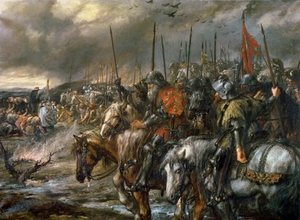
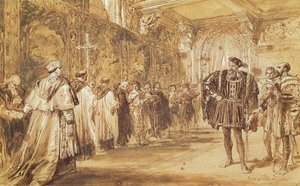
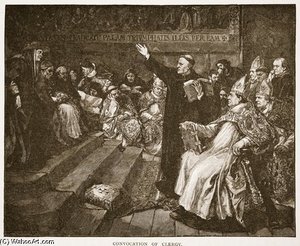
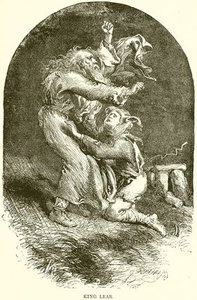
11The Ford (1891) de John GilbertThe Ford1891 · Guildhall Art Gallery 12Don Quixote and Sancho Panza (1840) de John GilbertDon Quixote and Sancho Panza1840 13Don Quixote Disputing with the Priest and the Barber (1844) de John GilbertDon Quixote Disputing with the Priest and the Barber1844 14Her Majesty the Queen Holding a Drawing Room at St James's Palace (1851) de John GilbertHer Majesty the Queen Holding a Drawing Room at St James's Palace1851 15'Henry VIII', Act I, Scene 1, Cardinal Wolsey and Buckingham (1861) de John Gilbert'Henry VIII', Act I, Scene 1, Cardinal Wolsey and Buckingham1861 · Colecția Royal Shakespeare Company 16Keston Common, Kent (1856) de John GilbertKeston Common, Kent1856 17Study Of Trees (1874) de John GilbertStudy Of Trees1874 · Birmingham Museum and Art Gallery 18Old Cottages At Lewisham (1876) de John GilbertOld Cottages At Lewisham1876 · Birmingham Museum and Art Gallery 19Preparing For The Charge (1873) de John GilbertPreparing For The Charge1873 · Birmingham Museum and Art Gallery 20Landscape Sketch (1877) de John GilbertLandscape Sketch1877 · Birmingham Museums And Art Gallery 21Don Sancho Panza, Governor of Barataria (1875) de John GilbertDon Sancho Panza, Governor of Barataria1875 · Muzeul de Artă Manchester 22The Baggage Wagon (1884) de John GilbertThe Baggage Wagon1884 · Birmingham Museum and Art Gallery 23A Windy Day (1885) de John GilbertA Windy Day1885 · Birmingham Museum and Art Gallery 24The Horse Pond at Tarring, Sussex (1882) de John GilbertThe Horse Pond at Tarring, Sussex1882 25The Morning of the Battle of Agincourt (1884) de John GilbertThe Morning of the Battle of Agincourt1884 · Guildhall Art Gallery 26Don Quixote's Niece and Housekeeper (1891) de John GilbertDon Quixote's Niece and Housekeeper1891 · Guildhall Art Gallery 27Stock exchange de John GilbertStock exchange 28The aberdeen cabinet de John GilbertThe aberdeen cabinet 29King John de John GilbertKing John 30King Henry's Forces At The Siege Of Harfleur, de John GilbertKing Henry's Forces At The Siege Of Harfleur, 31Richard Ii de John GilbertRichard Ii 32Henry Iv, Part I de John GilbertHenry Iv, Part I 33War - After The Battle de John GilbertWar - After The Battle 34Marmion's Defence to Douglas de John GilbertMarmion's Defence to Douglas 35Queen Elizabeth I Knighting Francis Drake de John GilbertQueen Elizabeth I Knighting Francis Drake 36Coriolanus, de John GilbertCoriolanus, 37As You Like It de John GilbertAs You Like It 38King Lear de John GilbertKing Lear 39King Lear de John GilbertKing Lear 40The Battle Of The Standard de John GilbertThe Battle Of The Standard 41Morning Of The Battle Of Agincourt de John GilbertMorning Of The Battle Of Agincourt 42Titus Andronicus de John GilbertTitus Andronicus 43The Heir Of Linne de John GilbertThe Heir Of Linne 44Guy Fawkes Before King James de John GilbertGuy Fawkes Before King James 45Much Ado About Nothing de John GilbertMuch Ado About Nothing 46King Henry Vi de John GilbertKing Henry Vi 47The Merchant Of Venice de John GilbertThe Merchant Of Venice 48The Merchant Of Venice de John GilbertThe Merchant Of Venice 49Battle of the Standard, de John GilbertBattle of the Standard, 50Henry Viii And Cardinal Thomas Wolsey de John GilbertHenry Viii And Cardinal Thomas Wolsey 51Cordelia de John GilbertCordelia 52Convocation Of Clergy de John GilbertConvocation Of Clergy 53What Shall He Have That Killed The Deer de John GilbertWhat Shall He Have That Killed The Deer 54Wolsey de John GilbertWolsey 55King Henry VI, Part I de John GilbertKing Henry VI, Part I 56Cardinal Wolsey On His Way To Westminster Hall, de John GilbertCardinal Wolsey On His Way To Westminster Hall, 57The Brave Lord Willoughby de John GilbertThe Brave Lord Willoughby 58Valentine And Ursine de John GilbertValentine And Ursine 59Under The Greenwood Tree de John GilbertUnder The Greenwood Tree 60Rembrandt in his Studio de John GilbertRembrandt in his Studio 61Fairies In A Bird's Nest de John GilbertFairies In A Bird's Nest 62A Girl with Fruit (1882) de John GilbertA Girl with Fruit1882 · Guildhall Art Gallery 63Landscape with Hunting Party (1893) de John GilbertLandscape with Hunting Party1893 · Guildhall Art Gallery 64King Henry's Fleet Sails For France, de John GilbertKing Henry's Fleet Sails For France, 65Malvolio de John GilbertMalvolio 66Measure For Measure, de John GilbertMeasure For Measure, 67The Tempest de John GilbertThe Tempest 68Julius Caesar de John GilbertJulius Caesar 69Henry Iv, Part Ii de John GilbertHenry Iv, Part Ii 70Henry Vi, Part I, de John GilbertHenry Vi, Part I, 71Come Away, Come Away, Death de John GilbertCome Away, Come Away, Death 72The Merchant Of Venice, de John GilbertThe Merchant Of Venice, 73The Two Gentlemen Of Verona de John GilbertThe Two Gentlemen Of Verona 74Romeo And Juliet, de John GilbertRomeo And Juliet, 75Othello de John GilbertOthello 76Henry Vi, Part Iii, de John GilbertHenry Vi, Part Iii, 77After The Battle Of Naseby de John GilbertAfter The Battle Of Naseby 78Twelfth Night de John GilbertTwelfth Night 79The Merry Wives Of Windsor de John GilbertThe Merry Wives Of Windsor 80Joan La Pucelle Abandoned de John GilbertJoan La Pucelle Abandoned 81Valentine And Ursine de John GilbertValentine And Ursine 82As You Like It de John GilbertAs You Like It 83The Yellow Dwarf, de John GilbertThe Yellow Dwarf, 84Investiture Of A Knight Of The Garter de John GilbertInvestiture Of A Knight Of The Garter 85Andrew Barton de John GilbertAndrew Barton 86Macbeth de John GilbertMacbeth 87Henry Viii de John GilbertHenry Viii 88Hamlet de John GilbertHamlet 89Tempest de John GilbertTempest 90Taming Of The Shrew de John GilbertTaming Of The Shrew 91Othello de John GilbertOthello 92A Midsummer Night's Dream de John GilbertA Midsummer Night's Dream 93King Richard Ii de John GilbertKing Richard Ii 94Henry V de John GilbertHenry VMuzeul de Artă Plastică din Boston 95Timon Of Athens de John GilbertTimon Of Athens 96Joan Of Arc de John GilbertJoan Of Arc 97Apotheosis Of Shakespeare's Characters de John GilbertApotheosis Of Shakespeare's Characters 98Guy Fawkes Brought Before James I And His Council de John GilbertGuy Fawkes Brought Before James I And His Council 99Come Away Death de John GilbertCome Away Death 100The Merchant Of Venice de John GilbertThe Merchant Of Venice

Piesele celebre ale lui John Gilbert, perioadă cu perioadă

Subiectele care i-au captivat privirea lui John Gilbert

Cele patru teme care revin cel mai des în aceste opere originale, fiecare având cel mai sublim exemplu.

Muzeele care păstrează originalele lui John Gilbert

Cele 6 muzee care dețin cele mai multe dintre picturile de pe această pagină.

Muzee Oraș Lucrări lui John Gilbert Picturi din această listă
Guildhall Art Gallery, LondraGuildhall Art Gallery Londra 9 Fair Saint George, Margaret of Anjou Taken Prisoner after the Battle of Tewkesbury, Lancelot du Lac
Birmingham Museum and Art Gallery, BirminghamBirmingham Museum and Art Gallery Birmingham 9 The Taming of the Shrew, Sir John Falstaff Reviewing His Ragged Regiment, Scene From Shakespeare's The Merchant Of Venice
Muzeul de Artă Manchester, ManchesterMuzeul de Artă Manchester Manchester 2 Don Sancho Panza, Governor of Barataria
Colecția Royal Shakespeare Company, AvonColecția Royal Shakespeare Company Avon 1 'Henry VIII', Act I, Scene 1, Cardinal Wolsey and Buckingham
Birmingham Museums And Art Gallery, BirminghamBirmingham Museums And Art Gallery Birmingham 1 Landscape Sketch
Muzeul de Artă Plastică din Boston, BostonMuzeul de Artă Plastică din Boston Boston 1 Henry V

John Gilbert deceniu cu deceniu: originalul care definește fiecare

Lucrări pe deceniu

Alege o deceniu pentru a descoperi opera originală care îl definește.

Întrebări ale colecționarilor despre picturile lui John Gilbert

Pentru ce operă este cel mai cunoscut John Gilbert?Află răspunsul

Fair Saint George (1881), Guildhall Art Gallery, Londra. Urmează The Taming of the Shrew (1860) și Sir John Falstaff Reviewing His Ragged Regiment (1858).

Ce vârstă avea John Gilbert când a fost creată Fair Saint George?Află răspunsul

64 ani: Fair Saint George datează din 1881, iar John Gilbert s-a născut în 1817.

Care sunt cele mai celebre zece picturi ale lui John Gilbert?Află răspunsul

Fair Saint George, The Taming of the Shrew, Sir John Falstaff Reviewing His Ragged Regiment, Scene From Shakespeare's The Merchant Of Venice, The Return Of The Victors, Margaret of Anjou Taken Prisoner after the Battle of Tewkesbury, Don Quixote and Sancho at the Castle of the Duke, Landscape with a Gypsy Encampment, Lancelot du Lac și Ego et Rex Meus. Clasamentul de mai sus indică anul și muzeul pentru fiecare piesă.

Câte picturi a lăsat John Gilbert?Află răspunsul

Catalogul nostru cuprinde 204 lucrări ale lui John Gilbert, datate între 1840 și 1893.

În ce muzee sunt expuse capodoperele lui John Gilbert?Află răspunsul

În principal în Guildhall Art Gallery (Londra), Birmingham Museum and Art Gallery (Birmingham) și Muzeul de Artă Manchester (Manchester). Tabelul cu muzee de mai sus le enumeră pe toate.

În ce ani a pictat John Gilbert cele mai cunoscute opere?Află răspunsul

În 1880s: 10 dintre cele 100 lucrări de pe această pagină au fost realizate atunci, fiind Fair Saint George dintre acestea.

Care sunt prima și ultima pictură originală celebră a lui John Gilbert?Află răspunsul

Pe această pagină, cea mai veche lucrare datează din Don Quixote and Sancho Panza (1840), iar cea mai recentă este din Landscape with Hunting Party (1893).

Ce subiecte a ales cel mai des John Gilbert?Află răspunsul

Battle scene (6), Dramatic lighting (5) și Royalty (4), din cele 100 lucrări de pe această pagină.

Ce tehnică a folosit cel mai des John Gilbert?Află răspunsul

Oil On Canvas, pentru 8 dintre cele 100 lucrări de pe această pagină.

Din ce mișcare artistică face parte John Gilbert?Află răspunsul

Victorian romanticism, judecând după originalele de pe această pagină.

Ce lucrări ale lui John Gilbert sunt expuse la Guildhall Art Gallery?Află răspunsul

Fair Saint George, Margaret of Anjou Taken Prisoner after the Battle of Tewkesbury și Lancelot du Lac: Guildhall Art Gallery, Londra deține 9 dintre lucrările de pe această pagină.

John Gilbert: viață și operă

Sir John Gilbert RA: Sculptorul Imaginației Victoriane

John Gilbert (21 iulie 1817 – 5 octombrie 1897), născut în Blackheath, Surrey, a fost un artist britanic a cărui producție prolifică i-a consolidat reputația de „Scott al picturii”, o distincție care reflectă abilitatea sa fără egal de a surprinde spiritul și măreția clasicelor literare. Spre deosebire de mulți artiști din epoca sa care au urmat o instruire formală, Gilbert și-a perfecționat meșteșul prin autodisciplină și observație meticuloasă — copind în principal printuri — consacrându-se ca maestru al acuamelei, al uleiului și, esențial, al gravurii în lemn. Călătoria sa artistică a început cu un ucenicie la o firmă de agenți imobiliari, dar s-a transformat rapid într-o pasiune pentru povestirea vizuală care avea să îi definească întreaga carieră.

Anii de formare și începuturile artistice

Anii formativi ai lui Gilbert i-au însușit o apreciere profundă pentru detaliu și precizie — calități pe care le va traduce ulterior în ilustrații uimitoare. George Lance, singurul său instructor, i-a hrănit talentul, încurajându-l să experimenteze cu diverse medii și cultivându-i o dedicare neclintită către excelența artistică. În ciuda faptului că i s-a refuzat admiterea la Școlile Academiei Regale, determinarea lui Gilbert l-a propulsat înainte, stăpânind tehnici care i-au permis să creeze opere de o frumusețe și complexitate remarcabile. Prima sa expunere la artă a venit prin printul grafic, o practică pe care a îmbrățișat-o cu tot sufletul, recunoscând capacitatea acesteia de a transmite emoția și narațiunea cu o eficacitate uluitoare.

The Illustrated London News și Shakespeare

Momentul decisiv în cariera lui Gilbert a sosit în 1856, când a acceptat invitația lui William Mulready și Thomas Sheepshanks de a contribui cu xilografii pentru The Illustrated London News. Această colaborare a marcat începutul unei parteneriate prolifice care avea să genereze peste 2000 de gravuri — o realizare uluitoare pentru acea vreme — demonstrând măiestria lui Gilbert în acest mediu solicitant. Totuși, cea mai durabilă moștenire a sa rezidă în proiectul său monumental: foliole ilustrate ale lui Shakespeare (1862–63). Cu aproape 750 de desene realizate cu o meticulozitate extremă pentru a surprinde esența pieselor lui Shakespeare, Gilbert a realizat o proză considerată imposibilă de mulți contemporani și s-a impus drept cel mai important interpret al viziunii dramatice a lui Shakespeare. Amploarea și ambiția acestui proiect au subliniat credința sa în puterea transformatoare a artei — în special în capacitatea acesteia de a lumina condiția umană. Tehnică și stil Stilul artistic al lui Gilbert era caracterizat printr-un control magistral al chiascurii, utilizând contrastul dramatic între lumină și umbră pentru a intensifica impactul emoțional și pentru a transmite profunzimea sentimentelor. El a privilegiat detaliul minucios, redând cu o acuratețe remarcabilă texturi și suprafețe — o trăsătură distinctivă a operei sale care îl separă de mulți alți artiști din perioada victoriană. Picturile sale încadrau adesea peisaje îmbibate cu o măreție atmosferică, reflectând o fascinație pentru idealurile romantice și un angajament neclintit de a surprinde frumusețea sublimă. Mai mult, explorările artistice ale lui Gilbert s-au extins dincolo de pictură și în sculptură, unde a creat figuri evocate care întruchipau atât forța, cât și grația.

Moștenire și recunoaștere

Influența lui Gilbert asupra artei și ilustrației victoriane este incontestabilă. A servit ca președinte al Royal Watercolour Society din 1871, consolidându-și poziția de figură de prim-plan în cercurile artistice britanice. În semn de recunoaștere a contribuțiilor sale la artele vizuale, a fost izbit cu titlul de cavaler în 1872 și ulterior ales în Academia Regală în 1876 — o dovadă a reputației sale durabile de excelență și inovație. Opera sa continuă să inspire artiștii de astăzi, servind drept exemplu de disciplină artistică, virtuozitate tehnică și narativ imaginar. Competiția Gilbert-Garret pentru cluburile de schiță, înființată în 1870 la St. Martins School of Art, rămâne un omagiu durabil adus spiritului său pionier și credinței sale neclintite în importanța educației artistice. Moștenirea lui John Gilbert depășește realizările sale artistice; el este reamintit ca un apărător al valorilor umaniste — un om care a căutat să înălțe spiritul uman prin frumusețe și contemplare. Odihnește în liniște în cimitirele Brockley și Ladywell, Surrey.