A Legacy Rooted in Dutch Soil: The Life and Art of Johannes Hermanus Koekkoek
Johannes Hermanus Koekkoek, born in the tranquil village of Vierslag in 1778, wasn’t merely a painter; he was the cornerstone of an artistic dynasty, a lineage inextricably linked to the vibrant heart of Dutch painting. His life and work represent a pivotal moment – a graceful transition from the dramatic intensity of Romanticism towards the grounded realism that would define much of the 19th century in the Netherlands. From his earliest days, Koekkoek was immersed within a creative crucible; his father, Hermanus Koekkoek, himself a respected artist, instilled in him not just technical skills but also an unwavering passion for capturing the essence of the world around them. This familial legacy extended beyond simply inheriting brushes and pigments – it fostered an environment of constant critique, shared inspiration, and a deep-seated commitment to artistic excellence. Initially trained under his father’s watchful eye and later honing his craft at the prestigious Drawing Academy in Middelburg, Koekkoek began his career firmly rooted in the Romantic tradition, producing idealized landscapes brimming with tempestuous skies and evocative scenes designed to stir the soul. However, this was merely a stepping stone on a remarkable artistic journey.From Romantic Visions to Realistic Depictions
Koekkoek’s artistic evolution wasn't a sudden rupture but rather a gradual refinement, profoundly influenced by the burgeoning Hague School – a movement that prioritized direct observation and an honest portrayal of everyday life. Around 1864 (though scholarly sources offer slight variations on this precise timeline), Koekkoek began to subtly shift his approach, moving away from the often-exaggerated emotionalism characteristic of Romanticism towards a more nuanced and realistic style. This transformation wasn’t abrupt; it was a delicate process of observation and adaptation, mirroring the changing artistic landscape of the Netherlands. The Hague School's core philosophy – *plein air* painting, or working directly outdoors to capture the fleeting effects of light and atmosphere – resonated deeply with Koekkoek’s sensibilities. He began to prioritize capturing the subtle beauty of Dutch rural life, the raw power of the sea, and the quiet dignity of those who inhabited these landscapes. This shift is vividly illustrated in his later works, which moved away from purely idealized scenes towards depictions imbued with a palpable sense of reality – a testament to his growing commitment to authenticity. He sought not just to represent a scene but to capture its very spirit, its unique character and atmosphere.A Diverse Oeuvre: Seascapes, Landscapes, and Daily Life
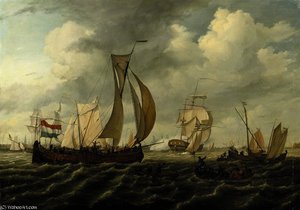
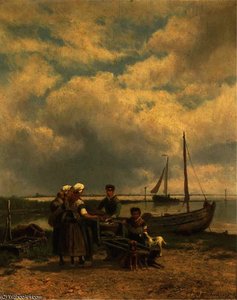
The breadth of Koekkoek’s artistic output reflects both his exceptional technical skill and his evolving interests. He became particularly renowned for his captivating seascapes – dramatic portrayals of ships battling ferocious storms, serene coastal vistas bathed in the golden light of dawn, and the untamed power of the ocean itself. These weren't simply depictions of maritime activity; they were profound explorations of humanity’s relationship with nature, showcasing both its breathtaking beauty and its formidable force. Alongside these tempestuous marine paintings, Koekkoek produced a wealth of Dutch rural landscapes – idyllic scenes of farms nestled amongst rolling fields, quaint villages bathed in the warm glow of sunset, and expansive skies that seemed to stretch endlessly towards the horizon. He possessed an extraordinary ability to capture the distinctive character of the Dutch countryside, imbuing his scenes with a sense of tranquility and timelessness. However, Koekkoek’s artistic vision wasn't limited to landscapes; he also turned his attention to scenes of daily life – depicting farmers diligently working in their fields, travelers traversing country roads, and the everyday activities that defined 19th-century Dutch society. Works such as “Vessels on a Lee Shore in a Gale of Wind” (1844) exemplify his mastery of dramatic composition and atmospheric perspective, while pieces like "On the Beach" showcase his remarkable ability to capture the subtle nuances of coastal life.Technique, Legacy, and Historical Significance
Koekkoek’s artistic style is characterized by an unwavering attention to detail, particularly in his rendering of natural elements and everyday objects. He possessed a keen eye for light and shadow, skillfully employing these tools to create depth, atmosphere, and a profound sense of realism within his compositions. His commitment to portraying scenes as they appeared before the viewer’s eyes – especially during his later period – distinguished him from many of his contemporaries. This dedication to authenticity, combined with his exceptional technical prowess, cemented his place as an important figure in the transition from Romanticism to Realism in Dutch painting. While perhaps not as widely celebrated as some of the more prominent members of the Hague School, Johannes Hermanus Koekkoek played a crucial role in shaping the artistic landscape of 19th-century Netherlands. His work provides invaluable insights into Dutch life and culture during this period, offering a poignant glimpse into the everyday realities of a nation undergoing significant social and economic transformation. Moreover, his influence extended far beyond his own lifetime, inspiring generations of Dutch artists who continued to explore themes of realism, naturalism, and the enduring beauty of their homeland. The Koekkoek name itself became synonymous with artistic excellence, ensuring that his legacy would continue to flourish through the work of his sons, grandsons, and great-grandsons – a powerful testament to the enduring power of family, tradition, and an unwavering dedication to the art of painting.Family Ties and Artistic Dynasty
It’s important to acknowledge the profound influence of Koekkoek's familial lineage on his artistic development. His father, Hermanus Koekkoek, was a respected artist in his own right, providing Johannes with a foundational understanding of artistic principles and techniques. Furthermore, his brothers, Willem and Barend Cornelis, continued the family tradition, each contributing to the rich tapestry of Dutch artistic heritage. This familial environment fostered a culture of constant learning, critique, and shared passion – shaping young Johannes’s artistic sensibilities from an early age. The Koekkoek name became inextricably linked with artistic excellence, creating a legacy that extended far beyond any single individual.Întrebări și răspunsuri
Cum pot găsi lucrările lui Johannes Hermanus Koekkoek dintr-o anumită paletă de culori?
Operele lui Johannes Hermanus Koekkoek pot fi explorate pe baza paletei cromatice în pagina de După paletă de culori a artistului.
Ce stări exprimă operele lui Johannes Hermanus Koekkoek?
Lucrările lui Johannes Hermanus Koekkoek pot fi explorate în funcție de starea de spirit pe pagina Galerie pe stări de spirit a artistului, unde operele sunt organizate după stările lor de spirit.
Unde pot fi explorate operele lui Johannes Hermanus Koekkoek organizate pe culori?
Operele lui Johannes Hermanus Koekkoek pot fi explorate pe criterii de culoare în pagina Indice Spectral a artistului.