Portretul lui Jan Baptist Weenix

Cele 78 cele mai faimoase picturi ale lui Jan Baptist Weenix, o selecție de galerie

Actualizat Noiembrie 2026 · clasat în funcție de scorul nostru de popularitate (căutări, vizite și comenzi pentru fiecare operă) · 86 lucrări ale lui Jan Baptist Weenix în catalogul nostru

Pe scurt

Dintre toate originalele lăsate de Jan Baptist Weenix, cea mai faimoasă este Tobit, asleep under a vine, is blinded (1642), din colecția Museum Boijmans Van Beuningen, Rotterdam. Imediat după acestea urmează Italian landscape with shelter and antiques ruins (1658) și Still Life with a Dead Swan (1651). Catalogul nostru cuprinde 86 lucrări ale lui Jan Baptist Weenix; galeria a păstrat cele 78 pe care lumea le admiră cel mai mult, fiecare fiind prezentată împreună cu data, muzeul și povestea sa.

1621 – 1659, Amsterdam Dutch golden age Cele mai multe lucrări: Colecțiile Statale de Pictură din Bavaria

Cele mai importante 10 picturi ale lui Jan Baptist Weenix: selecția galeriei

1
Tobit, asleep under a vine, is blinded (1642) de Jan Baptist Weenix

Tobit, asleep under a vine, is blinded

1642 · Oil On Canvas · Museum Boijmans Van Beuningen, Rotterdam

A single man reclines in the heavy shade of a vine. He is Tobit, lost to a deep, unsuspecting sleep. The air around him feels thick, weighted by the muted tones of ochre and forest green. Sunlight does not flood this scene; instead, it pierces through the foliage in sharp, controlled beams, illuminating the textures of his slumped posture and the coarse fabric of his clothing. He rests amidst a…

2
Italian landscape with shelter and antiques ruins (1658) de Jan Baptist Weenix

Italian landscape with shelter and antiques ruins

1658 · Oil On Panel · Mauritshuis, Haag

The oil on panel painting titled Italian landscape with shelter and antiques ruins was executed by the artist Jan Baptist Weenix in 1658. This landscape painting depicts a specific pastoral setting within an Italianate environment. The scene is populated by a group of peasants and various livestock, including sheep and goats. These figures are situated near a rustic cottage and several ancient architectural ruins that occupy the landscape.

3
Still Life with a Dead Swan (1651) de Jan Baptist Weenix

Still Life with a Dead Swan

1651 · Oil On Canvas · Detroit Institute of Arts, Detroit

The painting Still Life with a Dead Swan by Jan Baptist Weenix captures a heavy, silent moment of the hunt. Created about 1651, the work presents a collection of fallen game as a trophy of the chase. A white swan rests at the center, its pale plumage a stark contrast to the darker forms surrounding it. This central figure is accompanied by a turkey, two partridges, and a small finch,…

4
Tobit Sleeping Under the Vine (1641) de Jan Baptist Weenix

Tobit Sleeping Under the Vine

1641 · Oil · Museum Catharijneconvent, Utrecht

In this work, titled Tobit Sleeping Under the Vine, we encounter a significant piece by the Dutch Golden Age painter Jan Baptist Weenix. Created around 1642, the painting belongs to the Baroque period, a time when the interplay of light and shadow began to define the dramatic tension of Northern European art. Weenix, born in Amsterdam, Netherlands, brought a disciplined approach to his subjects, often blending meticulous observation with a…

5
The Scissors Grinder (1641) de Jan Baptist Weenix

The Scissors Grinder

The air feels heavy with the scent of damp stone and the rhythmic, metallic scrape of steel against stone. Under a vast, expansive sky, a group of figures gathers within the skeletal remains of a classical ruin. A man leans into his work, operating a grinding wheel that cuts through the quietude of the scene. Beside him, a woman sits in repose, while a small child stands close by, watching…

7
Portrait of René Descartes (1647) de Jan Baptist Weenix

Portrait of René Descartes

1647 · Oil · Centraal Museum, Utrecht

In this 1647 oil painting, Jan Baptist Weenix captures the French philosopher René Descartes. The subject appears in a medium close-up, his presence defined by a heavy, somber stillness. He is an elderly man, his face marked by the weight of thought and the passage of years. A bright white collar cuts through the darkness of his attire, framing a pale countenance that emerges from a deep, umber shadow.

8
Monument at a Harbour (1648) de Jan Baptist Weenix

Monument at a Harbour

1648 · Oil · Statens Museum For Kunst, Copenhaga

The composition relies on strong vertical elements, primarily through imposing columns and a central, highly ornate pedestal topped with a large urn. These structures anchor the scene, providing a sense of scale against the scattered human figures in the foreground and middle ground. Through a use of deep recession, the perspective draws the eye past a colonnade toward a distant, hazy horizon where the masts of ships are visible.

9
Harbour with Antique Ruins (1648) de Jan Baptist Weenix

Harbour with Antique Ruins

1648 · Oil On Canvas · Nationalmuseum, Stockholm

The scene unfolds in 1648, a moment captured in the oil on canvas known as Harbour with Antique Ruins. This work belongs to the hand of Jan Baptist Weenix, an artist who brings the weight of history into a living, breathing maritime setting. The painting presents a world where the weathered stone of classical antiquity meets the constant, rhythmic movement of a working harbor. It is a vision of a…

10
The Angel Raphael Leaving Tobias's Family (1648) de Jan Baptist Weenix

The Angel Raphael Leaving Tobias's Family

1648 · Oil · Nationalmuseum, Stockholm

In "The Angel Raphael Leaving Tobias's Family" by Jan Baptist Weenix, a divine departure unfolds with sudden, celestial energy. The scene captures the exact moment the Angel Raphael ascends toward the heavens, leaving the family below in a state of profound awe and reverence. A powerful diagonal movement pulls the eye from the lower left foreground upward toward the upper left, where the angelic figure climbs into a swirling formation…

Selecția pentru Jan Baptist Weenix continuă, de la 11 la 78

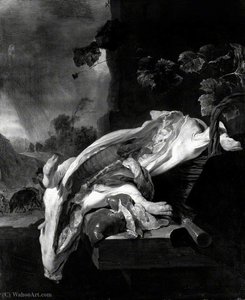
11vegetable-sellers at the house-door, 5 figures (1646) de Jan Baptist Weenixvegetable-sellers at the house-door, 5 figures1646 12caravane near the shore (1646) de Jan Baptist Weenixcaravane near the shore1646 13Mother and Child (1647) de Jan Baptist WeenixMother and Child1647 14Circumcision of Moses' son (1640) de Jan Baptist WeenixCircumcision of Moses' son1640 · Muzeul Național din Varșovia 15Still Life with Game, Hunter and Two Dogs (1652) de Jan Baptist WeenixStill Life with Game, Hunter and Two Dogs1652 · Colecțiile Statale de Pictură din Bavaria 16Butterfly Dog and Dead Bird (1649) de Jan Baptist WeenixButterfly Dog and Dead Bird1649 · Museum Mayer van den Bergh 17Pleasure boating (1650) de Jan Baptist WeenixPleasure boating1650 18The Sleeping Shepherdess (1658) de Jan Baptist WeenixThe Sleeping Shepherdess1658 · National Gallery of Ireland 19Roman Tinker (1656) de Jan Baptist WeenixRoman Tinker1656 · Städel Museum 20The love letter (1650) de Jan Baptist WeenixThe love letter1650 · Muzeul Național de Artă, Arhitectură și Design 21Italian Harbour (1651) de Jan Baptist WeenixItalian Harbour1651 · Muzeul Ermitaj 22Italian Peasants among Ruins (1650) de Jan Baptist WeenixItalian Peasants among Ruins1650 · Detroit Institute of Arts 23Sleeping girl (1656) de Jan Baptist WeenixSleeping girl1656 · Colecțiile Statale de Pictură din Bavaria 24Rest on the Flight into Egypt (1657) de Jan Baptist WeenixRest on the Flight into Egypt1657 · Museum Boijmans Van Beuningen 25Merry Company on a Ferry (1649) de Jan Baptist WeenixMerry Company on a Ferry1649 · Museum Gouda 26Battle at the foot of the mountain. (1650) de Jan Baptist WeenixBattle at the foot of the mountain.1650 · Muzeul Național din Varșovia 27Christina Lepper de Kempenaer and Her Children (1653) de Jan Baptist WeenixChristina Lepper de Kempenaer and Her Children1653 28Italian port scene, 1649 (1649) de Jan Baptist WeenixItalian port scene, 16491649 · Centraal Museum 29Italian Landscape with Horsemen by a Spring (1657) de Jan Baptist WeenixItalian Landscape with Horsemen by a Spring1657 · Centraal Museum 30Before the walls of Rome (1650) de Jan Baptist WeenixBefore the walls of Rome1650 · National Museum in Wrocław 31Portrait of a man with a letter (1650) de Jan Baptist WeenixPortrait of a man with a letter1650 · Agnes Etherington Art Center 32A Landscape with a Ford (1660) de Jan Baptist WeenixA Landscape with a Ford1660 · Regional Gallery in Liberec 33In the Campagna (1669) de Jan Baptist WeenixIn the Campagna1669 · National Gallery of Ireland 34Dead Fowl Being Eaten by a Cat (1653) de Jan Baptist WeenixDead Fowl Being Eaten by a Cat1653 · Städel Museum 35Departure of an Oriental Entourage (1647) de Jan Baptist WeenixDeparture of an Oriental Entourage1647 · Muzeul Luvru 36Display of Dead Game (1641) de Jan Baptist WeenixDisplay of Dead Game1641 · Petit Palais 37Dead Game (1641) de Jan Baptist WeenixDead Game1641 38River Landscape with a Ferry (1650) de Jan Baptist WeenixRiver Landscape with a Ferry1650 · Muzeul de Arte Frumoase din Montreal 39Still Life with Dead Game and Poultry (1656) de Jan Baptist WeenixStill Life with Dead Game and Poultry1656 · Centraal Museum 40Still Life with Fowl (1650) de Jan Baptist WeenixStill Life with Fowl1650 · Museum of Fine Arts Ghent (MSK) 41Marine with a Venetian Bucintoro (1650) de Jan Baptist WeenixMarine with a Venetian Bucintoro1650 · Staatliche Kunsthalle Karlsruhe 42The Dutch Ambassador on his Way to Isfahan, Jan Baptist Weenix, 1653 - 1659 (1659) de Jan Baptist WeenixThe Dutch Ambassador on his Way to Isfahan, Jan Baptist Weenix, 1653 - 16591659 · Rijksmuseum 43After the Hunt, Jan Baptist Weenix, c. 1656 (1656) de Jan Baptist WeenixAfter the Hunt, Jan Baptist Weenix, c. 16561656 · Rijksmuseum 44Still Life with White Mouse (1680) de Jan Baptist WeenixStill Life with White Mouse1680 · Ernest Zmeták Art Gallery 45Still Life with Game de Jan Baptist WeenixStill Life with GameHarvard Art Museums 46The Ford in the River (1647) de Jan Baptist WeenixThe Ford in the River1647 · Muzeul Ermitaj 47Harbor View with Rider in Oriental Dress, de Jan Baptist WeenixHarbor View with Rider in Oriental Dress,Groninger Museum 48The Holy Women at the Tomb de Jan Baptist WeenixThe Holy Women at the TombNational Gallery of Ireland 49An Italian Seaport de Jan Baptist WeenixAn Italian SeaportMuzeul Regal de Arte Frumoase din Anvers 50Architectural interior with foreign shippers, ruins and a shipyard beyond de Jan Baptist WeenixArchitectural interior with foreign shippers, ruins and a shipyard beyond 51Study of a sheep de Jan Baptist WeenixStudy of a sheep 52A pig's carcase de Jan Baptist WeenixA pig's carcase 53The Tinker and His Dog de Jan Baptist WeenixThe Tinker and His Dog 54Landscape with Peasants and Animals de Jan Baptist WeenixLandscape with Peasants and Animals 55Dead Partridge (1650) de Jan Baptist WeenixDead Partridge1650 · Mauritshuis 56Goat Lying Down, Jan Baptist Weenix, 1645 - 1660 (1660) de Jan Baptist WeenixGoat Lying Down, Jan Baptist Weenix, 1645 - 16601660 · Rijksmuseum 57A Dog and a Cat near a partially disembowelled Deer, Jan Baptist Weenix, 1645 - 1660 (1660) de Jan Baptist WeenixA Dog and a Cat near a partially disembowelled Deer, Jan Baptist Weenix, 1645 - 16601660 · Rijksmuseum 58Still Life with Dead Poultry, Lidded Pitcher and Passglas de Jan Baptist WeenixStill Life with Dead Poultry, Lidded Pitcher and PassglasColecțiile Statale de Pictură din Bavaria 59Game-piece de Jan Baptist WeenixGame-pieceNational Gallery of Ireland 60Dead game and hunting tackle in landscape de Jan Baptist WeenixDead game and hunting tackle in landscape 61Hound with a Joint of Meat and a Cat Looking on de Jan Baptist WeenixHound with a Joint of Meat and a Cat Looking on 62Bouquet of flowers de Jan Baptist WeenixBouquet of flowersGemäldegalerie 63Shipping in Harbour de Jan Baptist WeenixShipping in Harbour 64Herons and Lapwings de Jan Baptist WeenixHerons and Lapwings 65Still Life of Dead Game in a Landscape with a Huntsman de Jan Baptist WeenixStill Life of Dead Game in a Landscape with a Huntsman 66An italian port scene de Jan Baptist WeenixAn italian port scene 67Shepherds and Flocks among Classical Ruins de Jan Baptist WeenixShepherds and Flocks among Classical Ruins 68A Coast Scene with Classical Ruins de Jan Baptist WeenixA Coast Scene with Classical RuinsWallace Collection 69Still Life with Dead Game de Jan Baptist WeenixStill Life with Dead Game 70Hounds and an Owl with Dead Birds and Sculptures in a Landscape de Jan Baptist WeenixHounds and an Owl with Dead Birds and Sculptures in a Landscape 71Still Life with Dead Birds de Jan Baptist WeenixStill Life with Dead Birds 72Family in a Mediterranean Seaport de Jan Baptist WeenixFamily in a Mediterranean Seaport 73Figures near a Seaport de Jan Baptist WeenixFigures near a SeaportScottish National Gallery 74A Huntsman cutting up a Dead Deer, with Two Deerhounds de Jan Baptist WeenixA Huntsman cutting up a Dead Deer, with Two DeerhoundsNational Gallery 75Ancient Ruins de Jan Baptist WeenixAncient RuinsMuzeul de Artă Fine din Budapesta 76Figures among ruins de Jan Baptist WeenixFigures among ruinsThe Kremer Collection 77Ancient Ruins (detail) de Jan Baptist WeenixAncient Ruins (detail)Muzeul de Artă Fine din Budapesta 78Girl as Shepherdess (1650) de Jan Baptist WeenixGirl as Shepherdess1650 · Musée de Picardie

Piesele celebre ale lui Jan Baptist Weenix, perioadă cu perioadă

Subiectele care i-au captivat privirea lui Jan Baptist Weenix

Cele patru teme care revin cel mai des în aceste opere originale, fiecare având cel mai sublim exemplu.

Muzeele care păstrează originalele lui Jan Baptist Weenix

Cele 8 muzee care dețin cele mai multe dintre picturile de pe această pagină.

Muzee Oraș Lucrări lui Jan Baptist Weenix Picturi din această listă
Colecțiile Statale de Pictură din Bavaria, MunchenColecțiile Statale de Pictură din Bavaria Munchen 4 The Scissors Grinder, Still Life with Game, Hunter and Two Dogs, Sleeping girl
Centraal Museum, UtrechtCentraal Museum Utrecht 4 Portrait of René Descartes, Italian port scene, 1649, Italian Landscape with Horsemen by a Spring
National Gallery of Ireland, DublinNational Gallery of Ireland Dublin 4 The Sleeping Shepherdess, In the Campagna, The Holy Women at the Tomb
Rijksmuseum, AmsterdamRijksmuseum Amsterdam 4 The Dutch Ambassador on his Way to Isfahan, Jan Baptist Weenix, 1653 - 1659, After the Hunt, Jan Baptist Weenix, c. 1656, Goat Lying Down, Jan Baptist Weenix, 1645 - 1660
Museum Boijmans Van Beuningen, RotterdamMuseum Boijmans Van Beuningen Rotterdam 2 Tobit, asleep under a vine, is blinded, Rest on the Flight into Egypt
Mauritshuis, HaagMauritshuis Haag 2 Italian landscape with shelter and antiques ruins, Dead Partridge
Detroit Institute of Arts, DetroitDetroit Institute of Arts Detroit 2 Still Life with a Dead Swan, Italian Peasants among Ruins
Nationalmuseum, StockholmNationalmuseum Stockholm 2 Harbour with Antique Ruins, The Angel Raphael Leaving Tobias's Family

Jan Baptist Weenix an de an: originalele care definesc fiecare perioadă

De la 1640 la 1659, Jan Baptist Weenix a activat timp de 20 ani: selecția urmărește această lungă carieră an de an, prin cele mai deosebite opere originale.

Lucrări pe an

Alege un an pentru a vedea originalele acestuia.

Întrebări ale colecționarilor despre picturile lui Jan Baptist Weenix

Pentru ce operă este cel mai cunoscut Jan Baptist Weenix?Află răspunsul

Tobit, asleep under a vine, is blinded (1642), Museum Boijmans Van Beuningen, Rotterdam. Urmează Italian landscape with shelter and antiques ruins (1658) și Still Life with a Dead Swan (1651).

Ce vârstă avea Jan Baptist Weenix când a fost creată Tobit, asleep under a vine, is blinded?Află răspunsul

21 ani: Tobit, asleep under a vine, is blinded datează din 1642, iar Jan Baptist Weenix s-a născut în 1621.

Care sunt cele mai celebre zece picturi ale lui Jan Baptist Weenix?Află răspunsul

Tobit, asleep under a vine, is blinded, Italian landscape with shelter and antiques ruins, Still Life with a Dead Swan, Tobit Sleeping Under the Vine, The Scissors Grinder, Hunters Near Ruins, Portrait of René Descartes, Monument at a Harbour, Harbour with Antique Ruins și The Angel Raphael Leaving Tobias's Family. Clasamentul de mai sus indică anul și muzeul pentru fiecare piesă.

Câte picturi a lăsat Jan Baptist Weenix?Află răspunsul

Catalogul nostru cuprinde 86 lucrări ale lui Jan Baptist Weenix, datate între 1640 și 1659.

În ce muzee sunt expuse capodoperele lui Jan Baptist Weenix?Află răspunsul

În principal în Colecțiile Statale de Pictură din Bavaria (Munchen), Centraal Museum (Utrecht) și National Gallery of Ireland (Dublin). Tabelul cu muzee de mai sus le enumeră pe toate.

În ce ani a pictat Jan Baptist Weenix cele mai cunoscute opere?Află răspunsul

În 1650: 11 dintre cele 78 lucrări de pe această pagină au fost realizate atunci, fiind Pleasure boating dintre acestea.

Care sunt prima și ultima pictură originală celebră a lui Jan Baptist Weenix?Află răspunsul

Pe această pagină, cea mai veche lucrare datează din Circumcision of Moses' son (1640), iar cea mai recentă este din The Dutch Ambassador on his Way to Isfahan, Jan Baptist Weenix, 1653 - 1659 (1659).

Ce subiecte a ales cel mai des Jan Baptist Weenix?Află răspunsul

Landscape (18), Ruins (17) și Sky (13), din cele 78 lucrări de pe această pagină.

Ce tehnică a folosit cel mai des Jan Baptist Weenix?Află răspunsul

Oil On Canvas, pentru 30 dintre cele 78 lucrări de pe această pagină.

Din ce mișcare artistică face parte Jan Baptist Weenix?Află răspunsul

Dutch golden age și Baroque, judecând după originalele de pe această pagină.

Ce lucrări ale lui Jan Baptist Weenix sunt expuse la Colecțiile Statale de Pictură din Bavaria?Află răspunsul

The Scissors Grinder, Still Life with Game, Hunter and Two Dogs și Sleeping girl: Colecțiile Statale de Pictură din Bavaria, Munchen deține 4 dintre lucrările de pe această pagină.

Jan Baptist Weenix: viață și operă

Vizionarul Epocii de Aur Olandeze

Jan Baptist Weenix se impune ca o figură singulară în cadrul Epocii de Aur olandeze, fiind celebrat pentru amestecul său distinctiv de observație meticuloasă și viziune imaginară. Deși producția sa artistică a fost relativ modestă comparativ cu contemporanii săi, precum Rembrandt sau Vermeer, contribuția lui Weenix la istoria artei olandeze este incontestabilă — în special explorarea sa revoluționară a peisajelor italiene animate de figuri umane, stabilind un precedent stilistic ce avea să rezoneze în generațiile următoare. Născut în Amsterdam, în apropierea portului aglomerat, în anul 1621, Weenix a descins dintr-o familie de arhitecți, o ascendență care, cel mai probabil, i-a modelat anii formativi în mijlocul fermentului intelectual și structural al epocii.

În ciuda provocărilor personale — relatările sugerează că s-a confruntat cu dificultăți de vorbire din cauza unei afecțiuni medicale — Weenix a posedat o pasiune ardorantă pentru literatură și artă, o dorință cultivată de o mamă care a organizat cu prevedere ucenicia sa sub îndrumarea lui Jan Micker, cumnatul lui Rembrandt. Această instruire timpurie i-a insuflat o abordare disciplinată a desenului și a observației, elemente ce avea să devină embleme ale întregii sale opere. Și-a perfecționat ulterior abilitățile la Utrecht, sub îndrumarea lui Abraham Bloemaert, și s-a întors în Amsterdam pentru a studia cu Claes Corneliszoon Moeyaert, consolidându-și astfel temeliile în cadrul curentelor artistice dominante din Țările de Jos.

O călătorie prin lumină și peisaj

Traiectoria carierei lui Weenix a fost profund modificată de călătoriile sale, cel mai notabil fiind drumul către Roma în 1643, alături de Nicolaes Pieterszoon Berchem. Această excursie i-a permis să întâlnească mediul vibrant, intelectual și artistic al breaslei Bentvueghels, o experiență care l-a propulsat către un spectru stilistic mult mai vast. În Roma, el a îmbrățișat stilul italian, caracterizat prin lumina caldă, aurie, și peisaje clasice care contrastau superb cu tonurile mai reci și mai sobre ale picturii tradiționale olandeze. Această perioadă de influență romană i-a permis să stăpânească arta „peisajului italianizat”, unde frumusețea aspră a Europei de Sud era reimaginată printr-o perspectivă nord-europeană.

Muncă sa din această eră a împletit adesea măreția decorurilor clasice cu elemente umane intime. Fie că înscena porturi care șoptiau despre comerțul maritim, fie că picta văzuri întinse ce evocau un sentiment de eternitate, Weenix poseda o capacitate unică de a surprinde atmosfera unui loc. Măiestria sa nu era limitată la orizonturi vaste; era la fel de abil în capturarea realității tăcute și adesea viscerale a vieții prin intermediul naturelor moarte. Reprezentările sale ale vânatului și animalelor erau marcate de un realism uimitor, unde fiecare textură — de la blana asprază a unui câine de vânătoare până la strălucirea delicată a penelor — era redată cu o precizie care taie respirație.

Moștenirea realismului și a măiestriei

Semnificația lui Jan Baptist Weenix rezidă în capacitatea sa de a crea o punte între realismul dur al tradiției olandeze și frumusețea idealizată a mișcării italianizante. Versatilitatea sa i-a permis să navigheze printre subiecte diverse, de la tensiunea dramatică găsită în lucrări precum După vânătoare, până la intensitatea liniștită, aproape sumbră, a studiilor sale asupra animalelor. Prin pensula sa, privitorul este invitat într-o lume în care granițele dintre lumea naturală observată și trecutul clasic imaginat sunt frumos estompate.

Reflectând asupra vieții și operei sale, câteva elemente cheie îi definesc importanța durabilă:

  • Inovație stilistică: A fost un pionier în integrarea elementelor de peisaj italianizat în tradiția olandeză, creând un nou limbaj vizual pentru contemporanii săi.
  • Măiestrie tehnică: Instruirea sa disciplinată a permis un nivel extraordinar de detaliu atât în peisajele de mari dimensiuni, cât și în naturile moarte intime.
  • Versatilitate: Capacitatea sa de a trece fără efort de la scene portuare și motive de vânătoare la portrete de animale demonstrează o lărgime de talent rară.
  • Impact istoric: Ca membru al Bentvueghels, a contribuit la promovarea schimbului internațional de idei artistice care au definit lumea artei secolului al XVII-lea.

Deși viața sa a fost relativ scurtă, încheindu-se în 1661, amprenta lăsată de Jan Baptist Weenix rămâne vizibilă în evoluția picturii de peisaj. El i-a învățat generațiilor viitoare cum să privească orizontul nu doar ca pe o limită, ci ca pe o pânză pentru lumină, istorie și emoție umană.