Portretul lui Heinrich Zille

Picturi Heinrich Zille: Cele 53 de cele mai faimoase, prin ochii unei galerii

Actualizat Noiembrie 2026 · clasat în funcție de scorul nostru de popularitate (căutări, vizite și comenzi pentru fiecare operă) · 53 lucrări ale lui Heinrich Zille în catalogul nostru

Pe scurt

În ochii galeriei, cea mai celebră pictură a lui Heinrich Zille este Restoration (1910). Untitled (AQREDC) (1909) și Untitled (AQRECJ) (1919) completează trioul pe care orice ochi îl recunoaște. Dintre cele 53 opere ale lui Heinrich Zille din catalogul nostru, galeria prezintă mai jos cele 53 cele mai faimoase, fiecare fiind originală, cu anul creării, muzeul de păstrare și elementul care o face unică.

1859 – 1933, Kassel Contemporary realism Cele mai multe lucrări: Augustiner Museum

Cele mai apreciate 10 picturi ale lui Heinrich Zille din galerie

1
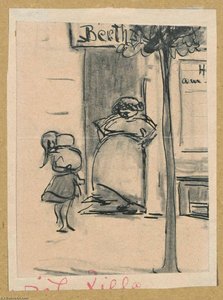
Restoration (1910) de Heinrich Zille

Restoration

1910 · Ink On Paper

Restoration is a black and white illustration created by Heinrich Hoffmann. The work dates to about 1910 and presents a monochromatic view of an urban environment. The scene focuses on a bustling city street, capturing a specific moment of daily activity within a metropolitan setting. The central subject involves a restaurant that is currently undergoing restoration work, providing a focal point for the surrounding movement.

2
Untitled (AQREDC) (1909) de Heinrich Zille

Untitled (AQREDC)

1909 · Etching

Untitled (AQREDC) by Heinrich Hoffmann depicts a bustling scene within a modest, crowded living space. The composition is dynamic and somewhat chaotic, with figures clustered together to fill most of the frame. A central grouping of people is arranged around a table, while other individuals are scattered throughout the room. Some figures are standing, while others are seated or lying down. In the background, a window provides a glimpse of…

3
Untitled (AQRECJ) (1919) de Heinrich Zille

Untitled (AQRECJ)

1919 · Drawing

This black and white drawing, dated 1919, depicts a group of at least twelve children positioned in a shared space. The figures are arranged in layers, with several children standing in the immediate foreground while others are situated further back in the composition. These children appear to be engaged in conversation or play. Two teddy bears are placed within the scene: one is located near the center, and the other…

4
Untitled (AQREBC) (1917) de Heinrich Zille

Untitled (AQREBC)

1917 · Drawing

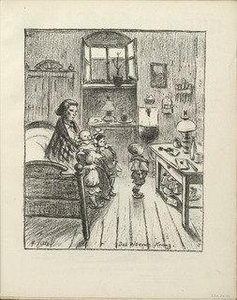
In this black and white drawing, Untitled (AQREBC) by Heinrich Hoffmann presents a quiet, domestic scene from about 1917. The composition centers on a woman seated in a chair, surrounded by her children. She holds a baby in her arms, while the other children settle onto her lap or gather closely around her. There is a palpable sense of intimacy in the way the figures are clustered together, creating a…

5
Untitled (AQREDE) (1884) de Heinrich Zille

Untitled (AQREDE)

1884 · Pencil

In this work from 1884, Heinrich Hoffmann invites us into the quiet, lived-in atmosphere of a traditional German tavern or beer hall. The scene captures a specific moment of social interaction and conviviality, focusing on a group of figures gathered around a long table. There is a sense of shared experience here, as patrons engage in conversation and drink within the interior space. It is a glimpse into a communal…

6
Going to Church in the Black Forest (1905) de Heinrich Zille

Going to Church in the Black Forest

1905 · Oil On Canvas · Augustiner Museum, Freiburg

In "Going to Church in the Black Forest" by Heinrich Hoffmann, we find ourselves observing a quiet moment of communal devotion. The scene, painted about 1905, centers on a group of women gathered at the entrance of a rustic stone church. They are dressed in traditional German folk costume, their attire providing a focal point of deep blues, blacks, and intricate patterns. This central gathering is framed by the environment:…

7
Untitled (AQREC6) (1900) de Heinrich Zille

Untitled (AQREC6)

1900 · Black and White Photography

Untitled (AQREC6) by Heinrich Hoffmann features a monochrome photographic study of a nude female figure. The composition is centered on the human subject, who is positioned in the foreground within an indoor studio setting. To the left of the central figure, a marble statue of a draped woman is placed, creating a juxtaposition between the living model and the carved stone. The background is composed of dark fabric draped over…

8
Untitled (AQREDJ) (1905) de Heinrich Zille

Untitled (AQREDJ)

1905 · Pencil

This 1905 pencil drawing on paper presents a spontaneous, quick sketch of two figures, appearing to be women, within a garden setting. The composition is asymmetrical and dynamic, with the figures positioned diagonally across the frame; one figure is taller than the other, and they seem to be engaged in conversation or a shared activity. The artwork is characterized by a loose, energetic quality, utilizing expressive lines, hatching, and cross-hatching…

9
Untitled (AQRECN) (1903) de Heinrich Zille

Untitled (AQRECN)

1903 · Etching

The scene unfolds within the lines of Untitled (AQRECN), an etching created by Heinrich Hoffmann. This work captures a specific, unvarnished moment from 1903, freezing a wrestling match in a state of constant motion. The figures strain against one another, caught in a struggle that feels immediate and raw. Onlookers gather around, their presence adding a layer of communal energy to the central conflict.

10
Untitled (AQREBN) (1905) de Heinrich Zille

Untitled (AQREBN)

1905 · Woodcut

This monochrome woodcut print, created in 1905, presents a densely packed and realistic portrayal of a crowded marketplace. The scene is set within an indoor environment, appearing to be a covered bazaar or market, where a multitude of figures are engaged in various activities such as buying, selling, and observing. The composition is tightly structured, utilizing strong, directional lines to define both the individual forms of the people and the…

Picturi cu Heinrich Zille, clasate de la 11 la 53

11Untitled (AQRECC) (1900) de Heinrich ZilleUntitled (AQRECC)1900 12Untitled (AQRECL) (1910) de Heinrich ZilleUntitled (AQRECL)1910 13Untitled (AQRECY) (1910) de Heinrich ZilleUntitled (AQRECY)1910 14Untitled (AQRECE) (1910) de Heinrich ZilleUntitled (AQRECE)1910 15The Iron Cross (Das eiserne Kreuz) (plate, folio 17) from the periodical Der Bildermann, vol. 1, no. 8 (June 1916) (1916) de Heinrich ZilleThe Iron Cross (Das eiserne Kreuz) (plate, folio 17) from the periodical Der Bildermann, vol. 1, no. 8 (June 1916)1916 16Standing in Line for Potatoes (Kartoffelstehen) (plate, folio 25) from the periodical Der Bildermann, vol. 1, no. 12 (September 1916) (1916) de Heinrich ZilleStanding in Line for Potatoes (Kartoffelstehen) (plate, folio 25) from the periodical Der Bildermann, vol. 1, no. 12 (September 1916)1916 17Untitled (AQREBW) (1919) de Heinrich ZilleUntitled (AQREBW)1919 18Untitled (AQRECA) (1919) de Heinrich ZilleUntitled (AQRECA)1919 19Untitled (AQREBE) (1930) de Heinrich ZilleUntitled (AQREBE)1930 20Untitled (AQREB6) (1898) de Heinrich ZilleUntitled (AQREB6)1898 21Untitled (AQREBL) (1905) de Heinrich ZilleUntitled (AQREBL)1905 22Untitled (AQRECU) (1902) de Heinrich ZilleUntitled (AQRECU)1902 23Untitled (AQRED4) (1903) de Heinrich ZilleUntitled (AQRED4)1903 24Untitled (AQREC4) (1901) de Heinrich ZilleUntitled (AQREC4)1901 25Spinning Room in the Black Forest de Heinrich ZilleSpinning Room in the Black ForestAugustiner Museum 26Untitled (AQREAU) (1910) de Heinrich ZilleUntitled (AQREAU)1910 27Untitled (AQREC2) (1909) de Heinrich ZilleUntitled (AQREC2)1909 28Untitled (AQREB2) (1910) de Heinrich ZilleUntitled (AQREB2)1910 29Untitled (AQRECS) (1911) de Heinrich ZilleUntitled (AQRECS)1911 30Untitled (AQREC8) (1910) de Heinrich ZilleUntitled (AQREC8)1910 31Untitled (AQREAS) (1910) de Heinrich ZilleUntitled (AQREAS)1910 32Untitled (AQRED2) (1916) de Heinrich ZilleUntitled (AQRED2)1916 33Untitled (AQRED6) (1913) de Heinrich ZilleUntitled (AQRED6)1913 34Untitled (AQREBA) (1914) de Heinrich ZilleUntitled (AQREBA)1914 35Untitled (AQRECW) (1916) de Heinrich ZilleUntitled (AQRECW)1916 36Untitled (AQREBJ) (1915) de Heinrich ZilleUntitled (AQREBJ)1915 37Untitled (AQREB4) (1915) de Heinrich ZilleUntitled (AQREB4)1915 38On Vacation (Auf Urlaub) (front cover, folio 26) from the periodical Der Bildermann, vol. 1, no. 13 (October 1916) (1916) de Heinrich ZilleOn Vacation (Auf Urlaub) (front cover, folio 26) from the periodical Der Bildermann, vol. 1, no. 13 (October 1916)1916 39Schnapps Saloon (Schnapsdestille) (plate, folio 33) from the periodical Der Bildermann, vol. 1, no. 16 (November 1916) (1916) de Heinrich ZilleSchnapps Saloon (Schnapsdestille) (plate, folio 33) from the periodical Der Bildermann, vol. 1, no. 16 (November 1916)1916 40Study with Singing Children (Studienblatt mit singenden Kindern) (plate, folio 11) from the periodical Der Bildermann, vol. 1, no. 5 (June 1916) (1916) de Heinrich ZilleStudy with Singing Children (Studienblatt mit singenden Kindern) (plate, folio 11) from the periodical Der Bildermann, vol. 1, no. 5 (June 1916)1916 41Untitled (AQREBU) (1919) de Heinrich ZilleUntitled (AQREBU)1919 42Untitled (AQREBQ) (1919) de Heinrich ZilleUntitled (AQREBQ)1919 43Untitled (AQRECG) (1919) de Heinrich ZilleUntitled (AQRECG)1919 44Untitled (AQREAW) (1919) de Heinrich ZilleUntitled (AQREAW)1919 45Untitled (AQREDA) (1919) de Heinrich ZilleUntitled (AQREDA)1919 46Untitled (AQRED8) (1919) de Heinrich ZilleUntitled (AQRED8)1919 47Untitled (AQRECQ) (1920) de Heinrich ZilleUntitled (AQRECQ)1920 48Untitled (AQREB8) (1919) de Heinrich ZilleUntitled (AQREB8)1919 49Untitled (AQREAY) (1924) de Heinrich ZilleUntitled (AQREAY)1924 50Untitled (AQREAQ) (1960) de Heinrich ZilleUntitled (AQREAQ)1960 51Alte Frau mit Hundefuhrwerk (1910) de Heinrich ZilleAlte Frau mit Hundefuhrwerk1910 52Untitled (AQREBY) de Heinrich ZilleUntitled (AQREBY) 53Untitled (AQREDG) de Heinrich ZilleUntitled (AQREDG)

Subiectele care i-au captivat privirea lui Heinrich Zille

Cele patru teme care revin cel mai des în aceste opere originale, fiecare având cel mai sublim exemplu.

Muzeele care păstrează originalele lui Heinrich Zille

Muzeul care deține cele mai multe dintre picturile prezentate pe această pagină.

Muzee Oraș Lucrări lui Heinrich Zille Picturi din această listă
Augustiner Museum, FreiburgAugustiner Museum Freiburg 2 Going to Church in the Black Forest, Spinning Room in the Black Forest

Heinrich Zille, o pictură emblematică pe deceniu

Lucrări pe deceniu

Alege o deceniu pentru a descoperi opera originală care îl definește.

Picturile lui Heinrich Zille: răspunsurile galeriei

Care este cea mai celebră pictură a lui Heinrich Zille?Află răspunsul

Restoration (1910). Urmează Untitled (AQREDC) (1909) și Untitled (AQRECJ) (1919).

Ce vârstă avea Heinrich Zille când a finalizat Restoration?Află răspunsul

51 ani: Restoration datează din 1910, iar Heinrich Zille s-a născut în 1859.

Care sunt cele mai importante 10 picturi ale lui Heinrich Zille?Află răspunsul

Restoration, Untitled (AQREDC), Untitled (AQRECJ), Untitled (AQREBC), Untitled (AQREDE), Going to Church in the Black Forest, Untitled (AQREC6), Untitled (AQREDJ), Untitled (AQRECN) și Untitled (AQREBN). Clasamentul de mai sus indică anul și muzeul pentru fiecare piesă.

Câte lucrări a creat Heinrich Zille?Află răspunsul

Catalogul nostru cuprinde 53 lucrări ale lui Heinrich Zille, datate între 1884 și 1930.

Unde sunt expuse cele mai celebrele opere originale ale lui Heinrich Zille?Află răspunsul

În principal în Augustiner Museum (Freiburg). Tabelul cu muzee de mai sus le enumeră pe toate.

Când a creat Heinrich Zille cele mai faimoase picturi?Află răspunsul

În 1910s: 32 dintre cele 53 lucrări de pe această pagină au fost realizate atunci, fiind Restoration dintre acestea.

Care sunt cele mai vechi și cele mai recente opere celebre ale lui Heinrich Zille?Află răspunsul

Pe această pagină, cea mai veche lucrare datează din Untitled (AQREDE) (1884), iar cea mai recentă este din Untitled (AQREBE) (1930).

La ce subiecte s-a întors cel mai des Heinrich Zille?Află răspunsul

People (7), Social commentary (6) și Figures (5), din cele 53 lucrări de pe această pagină.

În ce tehnică a lucrat cel mai mult Heinrich Zille?Află răspunsul

Ink On Paper, pentru 3 dintre cele 53 lucrări de pe această pagină.

Cu ce mișcare este asociat(ă) Heinrich Zille?Află răspunsul

Contemporary realism, judecând după originalele de pe această pagină.

Ce opere originale ale lui Heinrich Zille deține Augustiner Museum?Află răspunsul

Going to Church in the Black Forest și Spinning Room in the Black Forest: Augustiner Museum, Freiburg deține 2 dintre lucrările de pe această pagină.

Heinrich Zille: artistul

A Chronicler of Berlin’s Soul: The Life and Art of Heinrich Zille

Rudolf Heinrich Zille, affectionately known as “Pinselheinrich” – Brush Heinrich – to the people of Berlin, wasn't merely an artist; he was a visual historian, a compassionate observer, and a satirical chronicler of a city undergoing seismic change. Born in 1858 in Radeburg, Germany, Zille’s life mirrored the burgeoning industrialization and social upheaval that defined late 19th and early 20th-century Berlin. His family's relocation to the capital in 1867 proved pivotal, immersing him in a world of stark contrasts – opulent growth alongside grinding poverty. This duality would become the defining characteristic of his artistic vision, shaping not only his subject matter but also his unique approach to depicting urban life. Initially apprenticed as a lithographer in 1872, Zille’s early training instilled in him a mastery of line and form that would serve as the foundation for his later work; he learned to capture detail with remarkable precision, using precise hatching and cross-hatching techniques to create texture and depth on paper. Though his father envisioned a more conventional trade – perhaps butchery – young Heinrich’s passion for draughtsmanship was undeniable, nurtured by an encouraging teacher who recognized his burgeoning talent. This dedication to art, however, wasn't immediate; it evolved from necessity after losing his job in 1910, with the encouragement of Max Liebermann, allowing him to fully embrace his artistic calling and establish himself as a respected chronicler of Berlin’s streets.

The “Milljöh” and a City Revealed

Zille's enduring legacy rests upon his ability to capture the essence of Berlin’s “Milljöh” – a uniquely German term encompassing the everyday life, atmosphere, and social fabric of the city, particularly within its working-class neighborhoods. This word, coined by Zille himself, perfectly describes the vibrant yet often chaotic reality he sought to portray. He didn't romanticize or idealize; instead, he presented an unvarnished portrayal of tenement buildings (“Mietskaserne”), crowded streets teeming with humanity, and the lives of those struggling to survive within them. His drawings weren’t simply depictions of poverty; they were empathetic studies of human resilience, humor, and dignity in the face of hardship. Beggars, prostitutes, laborers, children working long hours – all populated his world, rendered with a keen eye for detail and an often-biting wit. He captured not just their misery but also their moments of joy, their shared laughter, and their quiet acts of kindness. Zille’s masterful use of light and shadow, combined with his ability to convey emotion through subtle gestures and expressions, created images that were both poignant and unforgettable. He avoided caricature, opting instead for a nuanced portrayal of individuals within the context of their environment, revealing the complexities of their lives rather than simply judging them.

Influences and Artistic Development

Zille’s artistic journey was shaped by several key influences. His early training as a lithographer provided him with technical skills and an appreciation for graphic design. The photographs he studied during his apprenticeship at the *Photographische Gesellschaft* Berlin – a position he held for thirty consecutive years – served as invaluable references, informing his understanding of composition, perspective, and detail. However, Zille’s artistic voice was distinctly his own, blending realism with elements of caricature and social commentary. He drew inspiration from the works of Gustave Courbet and Honoré Daumier, both masters of depicting working-class life with unflinching honesty. Furthermore, he absorbed the spirit of German Realism, particularly the work of artists like Caspar David Friedrich, though he translated this Romantic sensibility into a distinctly urban context. His style evolved over time, becoming increasingly bold and expressive as he gained confidence and experience. The encouragement of Max Liebermann proved crucial, providing Zille with validation and access to artistic circles that helped him refine his technique and expand his audience.

Recognition and Legacy

For years, Zille’s work found its audience primarily through publications like *Simplicissimus*, a prestigious German satirical weekly known for its progressive social commentary. This exposure gradually brought him wider recognition, culminating in an invitation from Max Liebermann to join the Berlin Secession in 1903 – a watershed moment that aligned him with a group of artists challenging traditional artistic norms and embracing new forms of expression. The Secession provided a platform for Zille’s work and solidified his position within the avant-garde art scene. In 1921, the National Gallery purchased several of his drawings, a significant validation of his artistic merit and a testament to the growing appreciation for his unique vision. This recognition continued with a professorship at the Academy of the Arts in 1924, cementing his status as a respected figure within the German art world. Even popular culture embraced Zille’s characters and stories; *Die Verrufenen* (The Disreputable), a film adaptation of his work, was released in 1925, further extending his reach beyond the confines of galleries and museums. Following his death in 1929, Berlin honored Zille’s memory through the creation of parks, statues, and ultimately, a museum dedicated to his life and work – ensuring that his legacy continues to resonate with generations to come.

Beyond the Surface: A Complex Legacy

While primarily known for his depictions of Berlin's working class, Zille also explored other themes in his art. He produced a series of erotic drawings depicting everyday life, offering a glimpse into a more private and playful side of the artist. These works, now housed in the Beate Uhse Erotic Museum in Berlin, demonstrate his willingness to explore the full spectrum of human experience and challenge conventional notions of artistic propriety. However, it is his broader body of work – his unflinching portrayal of urban poverty, social injustice, and the resilience of the human spirit – that secures his place as one of Germany’s most important visual chroniclers. His art remains a powerful testament to the enduring human spirit and a vital record of a city on the cusp of modernity.
  • Social Commentary: Zille’s work served as a potent form of social commentary, exposing the harsh realities of urban poverty and inequality.
  • Artistic Influence: His distinctive style influenced subsequent generations of artists interested in depicting everyday life and social issues.
  • Historical Documentation: Zille’s drawings provide invaluable historical documentation of Berlin during a period of rapid transformation.
  • Cultural Icon: He remains a beloved cultural icon in Berlin, celebrated for his ability to capture the city's unique character and spirit.