A Wanderer of Light and Shadow
The life of Harry van der Weyden was a remarkable journey that spanned continents, bridging the gap between the traditional roots of his American birth and the sophisticated artistic circles of Europe. Born on September 8, 1868, in Boston, Massachusetts, Van der Weyden’s early years were far removed from the misty coasts of France or the bustling studios of London that would later define his career. Despite his New England origins, he was never a product of the Boston School; instead, his artistic destiny was shaped by a profound pull toward the European avant-garde. At the tender age of nineteen, his talent earned him a prestigious scholarship to the Slade School in London, an opportunity that would set him on a path of rigorous classical training and eventual mastery over the atmospheric nuances of landscape painting.
As he matured, Van der Weyden sought the heart of the art world, moving to Paris during the pivotal years of 1890-1891. Under the tutelage of masters such as Jean-Paul Laurens, Benjamin Constant, and Jules-Joseph Lefebvre at the Académie Julian, he refined a technique that balanced academic precision with an emerging sensitivity to light. This period of intense study allowed him to absorb the evolving currents of French art, preparing him for a life spent capturing the ephemeral beauty of the natural world. His work during this era began to reflect a deep connection to the landscape, often finding inspiration in the coastal regions of France, particularly near Étaples, where he lived for many years before the tides of history changed his life forever.
The Mastery of Tonalism and Sea
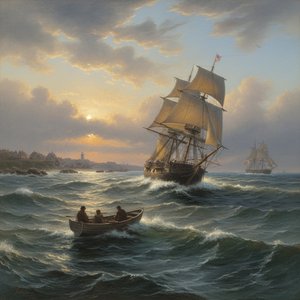
Van der Weyden’s artistic legacy is most vibrantly felt in his ability to evoke mood through Tonalism—a style characterized by a limited palette and an emphasis on atmosphere. He possessed a rare gift for translating the subtle shifts of twilight, the heavy mist of a harbor, and the dramatic tension of coastal cliffs into oil on canvas. His paintings often feel less like static images and more like captured breaths of air. In works such as Night Fishing at Étaples, one can witness his masterful use of light to create a sense of profound tranquility, where Impressionistic brushstrokes dance across the surface to suggest the movement of water and the soft glow of distant lanterns.
His fascination with the sea and coastal landscapes led him to capture some of the most evocative scenes of his era. Whether depicting the rugged majesty of Cliff End, Studland in Dorset or the serene, monochromatic effects of a sunset over a bay, his work remains anchored in a deep emotional realism. There is an inherent poetry in his approach; he did not merely paint what he saw, but rather how the light felt against the skin and how the salt air shaped the horizon. This ability to merge the physical reality of a landscape with a subjective, emotional atmosphere allowed him to stand alongside great Tonalist figures like James McNeill Whistler.
A Life Shaped by History
The trajectory of Van der Weyden’s life was irrevocably altered by the onset of the Great War. The very landscapes he loved became theaters of conflict. From 1916 to 1918, his artistic eye was pressed into service for a different kind of observation; serving as a camouflage officer with the British Royal Engineers, he utilized his understanding of color, texture, and light to aid in the concealment of military movements. This period of intense, practical application of his artistic skills added a layer of gravity and complexity to his perspective on the natural world.
In the twilight of his life, Van der Weyden remained a figure of quiet significance within the international art community. Though much of his work resides in private collections today, his contribution to the evolution of landscape painting—specifically the bridge between late 19th-century realism and the atmospheric depth of Tonalism—remains undeniable. He passed away in London in 1952, leaving behind a body of work that continues to invite viewers into a world of serene coastal vistas and timeless, luminous beauty. His life stands as a testament to the wandering spirit of an artist who found his true home not in the city of his birth, but in the shifting lights of the European coast.