Portretul lui Franz Ritter von Stuck

Cele 100 cele mai faimoase picturi ale lui Franz Ritter von Stuck, o selecție de galerie

Actualizat Noiembrie 2026 · clasat în funcție de scorul nostru de popularitate (căutări, vizite și comenzi pentru fiecare operă) · 259 lucrări ale lui Franz Ritter von Stuck în catalogul nostru

Pe scurt

Dintre toate originalele lăsate de Franz Ritter von Stuck, cea mai faimoasă este Păcatul (1893), din colecția Colecțiile Statale de Pictură din Bavaria, Munchen. Imediat după acestea urmează Lucifer (1890) și Amazona rănită (1904). Catalogul nostru cuprinde 259 lucrări ale lui Franz Ritter von Stuck; galeria a păstrat cele 100 pe care lumea le admiră cel mai mult, fiecare fiind prezentată împreună cu data, muzeul și povestea sa.

1863 – 1928, Tettenweis Simbolismul Cele mai multe lucrări: Colecțiile Statale de Pictură din Bavaria

Cele mai importante 10 picturi ale lui Franz Ritter von Stuck: selecția galeriei

1
Păcatul (1893) de Franz Ritter von Stuck

Păcatul

1893 · Ulei pe pânză · Colecțiile Statale de Pictură din Bavaria, Munchen

Păcatul este o pictură din anul 1893 realizată de artistul german Franz von Stuck. În această operă, artistul prezintă figura Evei, reprezentată nudă și împletuită cu un șarpe uriaș care îi înfășoară corpul. Acest motív specific a apărut din explorări anterioare ale temelor picturale, dezvoltându-se în mod particular din pictura din 1889 a lui Stuck, intitulată Sensualitate (Die Sinnlichkeit).

2
Lucifer (1890) de Franz Ritter von Stuck

Lucifer

1890 · Ulei pe pânză · National Gallery of Bulgaria, Sofia

În anul 1890, Franz von Stuck a dat viață picturii Lucifer ca o operă realizată în ulei pe pânză, o creație ce marchează profund perioada sa „monumentală întunecată”. Figura emerge dintr-un vid absolut, un om-demon așezat, capturat într-un moment de o liniște grea și melancolică. Este o creatură compusă din mușchi și umbră, forma sa fiind definită de tensiunea unui corp care este, în același timp, uman și ceva mult…

3
Amazona rănită (1904) de Franz Ritter von Stuck

Amazona rănită

1904 · Ulei pe pânză

În piesa tulburătoare și plină de evocare Amazona rănită, creată în 1904, Franz Ritter von Stuck ne invită într-un moment de vulnerabilitate profundă și conflict brut. Tabloul prezintă o figură feminină nudă, o Amazonă, surprinsă într-o stare de suferință intensă. Aceasta este poziționată în genunchi pe pământ, corpul său purtând semnul luptei prin rana vizibilă de sub sân, în timp ce își ridică brațele spre față pentru a se proteja…

4
Sin (1893) de Franz Ritter von Stuck

Sin

1893 · Oil On Canvas · Neue Pinakothek, Munchen

Franz Ritter von Stuck: The Sin The dark, decadent art of Franz Ritter von Stuck is ushered into the light for its first American retrospective. Jo-Ann Birnie Danzker, curator at the Frye Art Museum, hopes that it will lead to a reevaluation of Stuck’s importance as an artist in his own right – his work seemed old-fashioned and irrelevant to a generation that had endured World War I. Stuck's reputation…

5
Lucifer de Franz Ritter von Stuck

Lucifer

Oil On Canvas

Franz von Stuck presents the fallen angel in Lucifer, an oil on canvas executed between 1890 and 1891. The figure is rendered as a seated, naked, and brooding presence within an undefined dark space. This depiction of a central figure from Christian mythology emphasizes an intense, muscular physicality. The subject's posture is heavy, conveying a sense of profound melancholy and internal struggle.

6
Wine (1889) de Franz Ritter von Stuck

Wine

1889 · Oil On Canvas · Kunsthaus Zürich, Zurich

To stand before Franz Ritter von Stuck’s Wine is to step directly into the charged, evocative atmosphere of late 19th-century German Symbolism. This piece from 1889 is far more than a mere depiction; it is an emotional tableau, a meditation on human connection, nature's embrace, and perhaps, the intoxicating mystery of desire itself. The composition immediately draws the eye to the central drama: a nude male figure clinging with desperate…

7
The Sin (1912) de Franz Ritter von Stuck

The Sin

1912 · Oil On Canvas · Alte Nationalgalerie, Berlin

, also known as Die Sünde, is an oil on canvas work by the German artist Franz von Stuck. Created in 1912, this piece represents one of several versions of this specific theme developed by the artist. The work is a significant example of the Symbolist movement, focusing on psychological depth and dramatic tension.

8
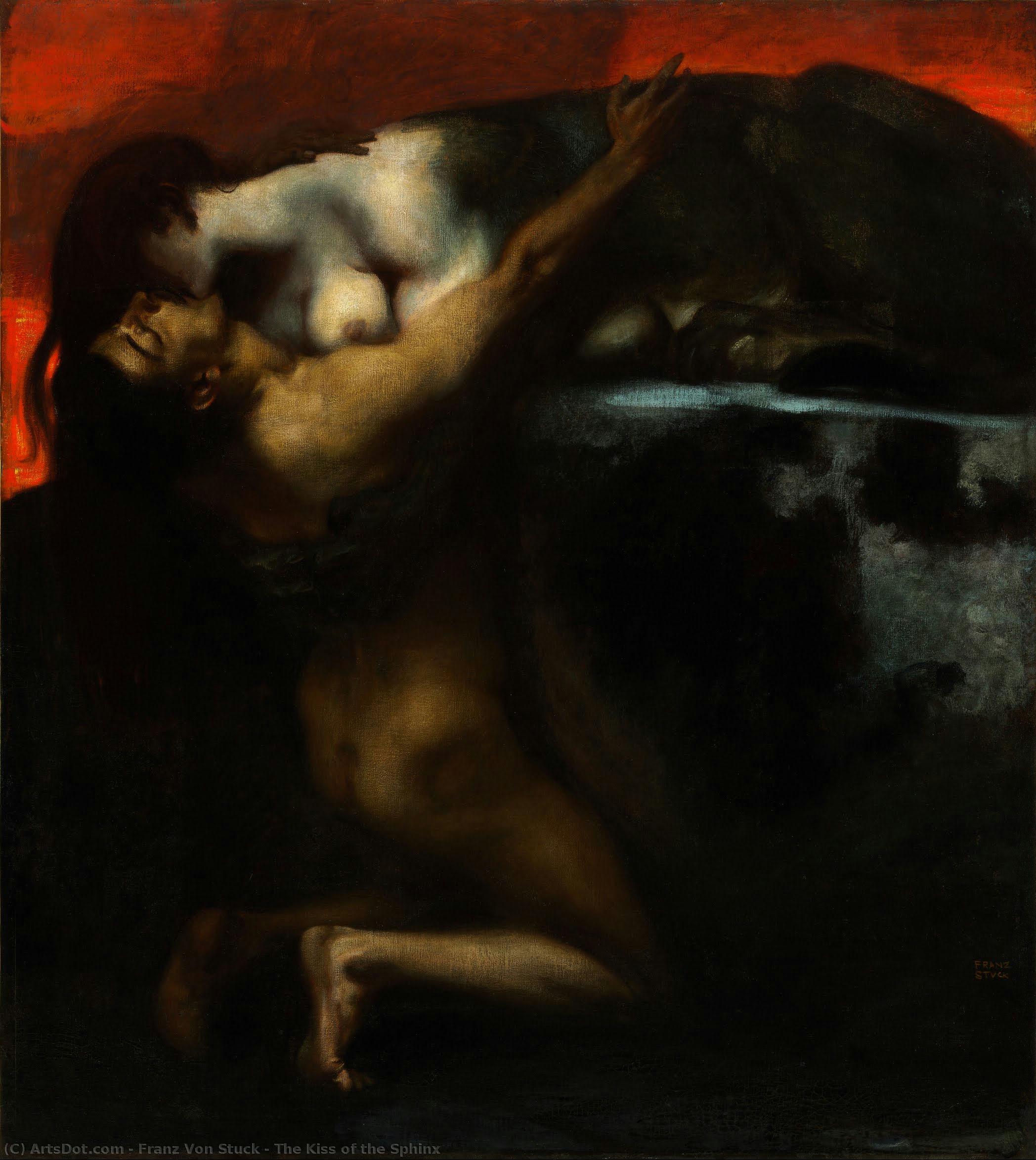
The Kiss of the Sphinx (1895) de Franz Ritter von Stuck

The Kiss of the Sphinx

1895 · Oil On Canvas · Muzeul de Artă Fine din Budapesta, Budapesta

In the twilight of the nineteenth century, few images captured the psychological tremors of the era as profoundly as Franz Ritter von Stuck’s "The Kiss of the Sphinx." Completed in 1895, this masterpiece serves as a haunting cornerstone of German Symbolism, inviting the viewer into a realm where the boundaries between the physical and the metaphysical dissolve. The painting presents a dramatic tableau of a sensual encounter, set against the…

9
Sisyphus (1920) de Franz Ritter von Stuck

Sisyphus

1920 · Oil

In the 1920 painting titled Sisyphus, the artist Franz von Stuck depicts a man engaged in a repetitive physical struggle. The subject is shown in the process of pushing a large boulder up a steep incline. The man is positioned with the weight of the rock resting directly upon his back. He wears a simple loincloth, leaving his muscular form exposed as he labors against the terrain. One hand is…

10
Glow Worms (1898) de Franz Ritter von Stuck

Glow Worms

1898 · Oil On Canvas

In this work, titled Glow Worms, we encounter a piece from 1898 by the German artist Franz von Stuck. It is a quiet moment captured in oil on canvas, reflecting the specific sensibilities of the late nineteenth century. The artist, who was born in Tettenweis, Germany, brings a particular sense of atmosphere to this nocturnal scene, moving away from the rigid academicism of his era toward something more personal and…

Selecția pentru Franz Ritter von Stuck continuă, de la 11 la 100

11Wild Chase (1889) de Franz Ritter von StuckWild Chase1889 · Lenbachhaus 12Inferno (1908) de Franz Ritter von StuckInferno1908 · Metropolitan Museum of Art 13Portrait of Frau Feez de Franz Ritter von StuckPortrait of Frau Feez 14The Guardian of Paradise (1889) de Franz Ritter von StuckThe Guardian of Paradise1889 · Museum Villa Stuck 15von Lucifer de Franz Ritter von Stuckvon Lucifer 16Gertrud Littmann (1911) de Franz Ritter von StuckGertrud Littmann1911 · Colecțiile Statale de Pictură din Bavaria 17Amazon and Centaur de Franz Ritter von StuckAmazon and Centaur 18Faun and Nymph (Teasing) (1892) de Franz Ritter von StuckFaun and Nymph (Teasing)1892 · National Gallery Prague 19Florentine Lady (1901) de Franz Ritter von StuckFlorentine Lady1901 20Professor Lujo Brentano (1914) de Franz Ritter von StuckProfessor Lujo Brentano1914 · Colecțiile Statale de Pictură din Bavaria 21The Murderer (1891) de Franz Ritter von StuckThe Murderer1891 22Sin (1893) de Franz Ritter von StuckSin1893 23Junge de Franz Ritter von StuckJunge 24Crucifixion (1913) de Franz Ritter von StuckCrucifixion1913 · Museum der bildenden Künste 25Salome (1906) de Franz Ritter von StuckSalome1906 · Lenbachhaus 26The Architect Max Littmann (1903) de Franz Ritter von StuckThe Architect Max Littmann1903 · Colecțiile Statale de Pictură din Bavaria 27Young Girl with Wreath (Bust, octagonal) (1862) de Franz Ritter von StuckYoung Girl with Wreath (Bust, octagonal)1862 28a Lady Monna Vanna (1879) de Franz Ritter von Stucka Lady Monna Vanna1879 · Stadtisches Museum 29Portrait of the Artist's Wife (1888) de Franz Ritter von StuckPortrait of the Artist's Wife1888 30Children Sledding (1888) de Franz Ritter von StuckChildren Sledding1888 31Double Portrait of Two Girls (1888) de Franz Ritter von StuckDouble Portrait of Two Girls1888 32Portrait of a Lady in Profile (1888) de Franz Ritter von StuckPortrait of a Lady in Profile1888 33Female Portrait (Back View and Profile) (1888) de Franz Ritter von StuckFemale Portrait (Back View and Profile)1888 34Female Portrait (1888) de Franz Ritter von StuckFemale Portrait1888 35Female Nude, Venus (1888) de Franz Ritter von StuckFemale Nude, Venus1888 36Self-Portrait in Profile (1888) de Franz Ritter von StuckSelf-Portrait in Profile1888 · Stadtisches Museum 37Sphinx (1892) de Franz Ritter von StuckSphinx1892 38Lost (1891) de Franz Ritter von StuckLost1891 39bathing nymph + looking Satyr (1888) de Franz Ritter von Stuckbathing nymph + looking Satyr1888 40portrait of Tilla Durieux as line (1888) de Franz Ritter von Stuckportrait of Tilla Durieux as line1888 41Susanna and the two eldermen (1888) de Franz Ritter von StuckSusanna and the two eldermen1888 42Helios (1888) de Franz Ritter von StuckHelios1888 43girl with wreath of violets (1888) de Franz Ritter von Stuckgirl with wreath of violets1888 44Portrait of a man (1888) de Franz Ritter von StuckPortrait of a man1888 45Female head (1888) de Franz Ritter von StuckFemale head1888 46A crying nix - woman (1888) de Franz Ritter von StuckA crying nix - woman1888 47Head of Medusa (1892) de Franz Ritter von StuckHead of Medusa1892 48Portrait of Beethoven de Franz Ritter von StuckPortrait of Beethoven 49Drunken Cantaur (1889) de Franz Ritter von StuckDrunken Cantaur1889 50Boy Bacchus Riding on a Panther de Franz Ritter von StuckBoy Bacchus Riding on a Panther 51Innocentia (1889) de Franz Ritter von StuckInnocentia1889 52Sensuality (1897) de Franz Ritter von StuckSensuality1897 53Franz and Mary Stock in the Studio (1902) de Franz Ritter von StuckFranz and Mary Stock in the Studio1902 54Portrait of a Girl (1899) de Franz Ritter von StuckPortrait of a Girl1899 55Portrait of the Artist's Daughter (1903) de Franz Ritter von StuckPortrait of the Artist's Daughter1903 56Portrait of His Wife (1903) de Franz Ritter von StuckPortrait of His Wife1903 57Portrait of a Woman (Wife of the Artist) (1903) de Franz Ritter von StuckPortrait of a Woman (Wife of the Artist)1903 58Runner (1903) de Franz Ritter von StuckRunner1903 59Portrait of a Woman (his wife) (Lady's Portrait) (1903) de Franz Ritter von StuckPortrait of a Woman (his wife) (Lady's Portrait)1903 60Portrait of a lady (1902) de Franz Ritter von StuckPortrait of a lady1902 61Head of a girl (1903) de Franz Ritter von StuckHead of a girl1903 62Portr. of a lady (1903) de Franz Ritter von StuckPortr. of a lady1903 63Half-length. ............ (1903) de Franz Ritter von StuckHalf-length. ............1903 64dancers (1903) de Franz Ritter von Stuckdancers1903 65Lady with head-dress (1903) de Franz Ritter von StuckLady with head-dress1903 66Wind + wave (1903) de Franz Ritter von StuckWind + wave1903 67The see - saw (1903) de Franz Ritter von StuckThe see - saw1903 68Rape of a maremaid (1902) de Franz Ritter von StuckRape of a maremaid1902 69head of a girl (1903) de Franz Ritter von Stuckhead of a girl1903 70Susanna in the bath (1904) de Franz Ritter von StuckSusanna in the bath1904 · Kunstmuseum 71Bacchanal (1905) de Franz Ritter von StuckBacchanal1905 72The Ride (1903) de Franz Ritter von StuckThe Ride1903 73The Kiss of the Sphinx (1905) de Franz Ritter von StuckThe Kiss of the Sphinx1905 74The Artist's Daughter with Cornflowers in Her Hair (1909) de Franz Ritter von StuckThe Artist's Daughter with Cornflowers in Her Hair1909 · Westfälisches Landesmuseum 75"The swing of love" (1909) de Franz Ritter von Stuck"The swing of love"1909 76Portrait of a girl (1907) de Franz Ritter von StuckPortrait of a girl1907 77Portrait of lady between Doric columns (1906) de Franz Ritter von StuckPortrait of lady between Doric columns1906 78Bathsheba (1912) de Franz Ritter von StuckBathsheba1912 · Muzeul Național de Arte Fine din Buenos Aires 79Phryne (1917) de Franz Ritter von StuckPhryne1917 · Portland Art Museum 80Spanish duel "the deal" (1917) de Franz Ritter von StuckSpanish duel "the deal"1917 81Pygmalion (1926) de Franz Ritter von StuckPygmalion1926 82Wind and Waves (unfinished) (1928) de Franz Ritter von StuckWind and Waves (unfinished)1928 83The Struggle for Woman de Franz Ritter von StuckThe Struggle for Woman 84Pietà (1891) de Franz Ritter von StuckPietà1891 · Städelsche Kunstinstitut Und Städtische Galerie 85Fighting Centaurs (1894) de Franz Ritter von StuckFighting Centaurs1894 · Städelsche Kunstinstitut Und Städtische Galerie 86Fighting Fauns (1889) de Franz Ritter von StuckFighting Fauns1889 · Bayerische Staatsgemaldesammlungen 87Encounter (1921) de Franz Ritter von StuckEncounter1921 · Colecțiile Statale de Pictură din Bavaria 88The Spring (1902) de Franz Ritter von StuckThe Spring1902 · Muzeul de Artă Fine din Budapesta 89Mary with a red hat (1902) de Franz Ritter von StuckMary with a red hat1902 90War (1894) de Franz Ritter von StuckWar1894 · Colecțiile Statale de Pictură din Bavaria 91Ostrich Hunt (1919) de Franz Ritter von StuckOstrich Hunt1919 · Colecțiile Statale de Pictură din Bavaria 92The Diner de Franz Ritter von StuckThe DinerColecțiile Statale de Pictură din Bavaria 93Evening Star de Franz Ritter von StuckEvening Star 94Portrait of Marie Stuck de Franz Ritter von StuckPortrait of Marie Stuck 95The Wild Hunt (1899) de Franz Ritter von StuckThe Wild Hunt1899 · Musée d'Orsay 96Pallas Athene (1898) de Franz Ritter von StuckPallas Athene1898 97children on sledges (1888) de Franz Ritter von Stuckchildren on sledges1888 98Landscape with Waterfall (1896) de Franz Ritter von StuckLandscape with Waterfall1896 · Colecțiile Statale de Pictură din Bavaria 99Dancers (1896) de Franz Ritter von StuckDancers1896 100Fighting Amazon (1897) de Franz Ritter von StuckFighting Amazon1897 · Lenbachhaus

Piesele celebre ale lui Franz Ritter von Stuck, perioadă cu perioadă

Subiectele care i-au captivat privirea lui Franz Ritter von Stuck

Cele patru teme care revin cel mai des în aceste opere originale, fiecare având cel mai sublim exemplu.

Muzeele care păstrează originalele lui Franz Ritter von Stuck

Cele 8 muzee care dețin cele mai multe dintre picturile de pe această pagină.

Muzee Oraș Lucrări lui Franz Ritter von Stuck Picturi din această listă
Colecțiile Statale de Pictură din Bavaria, MunchenColecțiile Statale de Pictură din Bavaria Munchen 9 Păcatul, Gertrud Littmann, Professor Lujo Brentano
Lenbachhaus, MunchenLenbachhaus Munchen 4 Wild Chase, Salome, Fighting Amazon
Muzeul de Artă Fine din Budapesta, BudapestaMuzeul de Artă Fine din Budapesta Budapesta 2 The Kiss of the Sphinx, The Spring
Stadtisches Museum, GelsenkirchenStadtisches Museum Gelsenkirchen 2 a Lady Monna Vanna, Self-Portrait in Profile
Städelsche Kunstinstitut Und Städtische Galerie, FrankfurtStädelsche Kunstinstitut Und Städtische Galerie Frankfurt 2 Pietà, Fighting Centaurs
Alte Nationalgalerie, BerlinAlte Nationalgalerie Berlin 4 The Sin
Museum Villa Stuck, MunchenMuseum Villa Stuck Munchen 3 The Guardian of Paradise
National Gallery of Bulgaria, SofiaNational Gallery of Bulgaria Sofia 1 Lucifer

Franz Ritter von Stuck deceniu cu deceniu: originalul care definește fiecare

Lucrări pe deceniu

Alege o deceniu pentru a descoperi opera originală care îl definește.

Întrebări ale colecționarilor despre picturile lui Franz Ritter von Stuck

Pentru ce operă este cel mai cunoscut Franz Ritter von Stuck?Află răspunsul

Păcatul (1893), Colecțiile Statale de Pictură din Bavaria, Munchen. Urmează Lucifer (1890) și Amazona rănită (1904).

Ce vârstă avea Franz Ritter von Stuck când a fost creată Păcatul?Află răspunsul

30 ani: Păcatul datează din 1893, iar Franz Ritter von Stuck s-a născut în 1863.

Care sunt cele mai celebre zece picturi ale lui Franz Ritter von Stuck?Află răspunsul

Păcatul, Lucifer, Amazona rănită, Sin, Lucifer, Wine, The Sin, The Kiss of the Sphinx, Sisyphus și Glow Worms. Clasamentul de mai sus indică anul și muzeul pentru fiecare piesă.

Câte picturi a lăsat Franz Ritter von Stuck?Află răspunsul

Catalogul nostru cuprinde 259 lucrări ale lui Franz Ritter von Stuck, datate între 1879 și 1928.

În ce muzee sunt expuse capodoperele lui Franz Ritter von Stuck?Află răspunsul

În principal în Colecțiile Statale de Pictură din Bavaria (Munchen), Lenbachhaus (Munchen) și Muzeul de Artă Fine din Budapesta (Budapesta). Tabelul cu muzee de mai sus le enumeră pe toate.

În ce ani a pictat Franz Ritter von Stuck cele mai cunoscute opere?Află răspunsul

În 1900s: 31 dintre cele 100 lucrări de pe această pagină au fost realizate atunci, fiind Amazona rănită dintre acestea.

Care sunt prima și ultima pictură originală celebră a lui Franz Ritter von Stuck?Află răspunsul

Pe această pagină, cea mai veche lucrare datează din a Lady Monna Vanna (1879), iar cea mai recentă este din Wind and Waves (unfinished) (1928).

Ce subiecte a ales cel mai des Franz Ritter von Stuck?Află răspunsul

Woman (52), Man (23) și Portrait (19), din cele 100 lucrări de pe această pagină.

Ce tehnică a folosit cel mai des Franz Ritter von Stuck?Află răspunsul

Oil On Canvas, pentru 54 dintre cele 100 lucrări de pe această pagină.

Din ce mișcare artistică face parte Franz Ritter von Stuck?Află răspunsul

Simbolismul, judecând după originalele de pe această pagină.

Ce lucrări ale lui Franz Ritter von Stuck sunt expuse la Colecțiile Statale de Pictură din Bavaria?Află răspunsul

Păcatul, Gertrud Littmann și Professor Lujo Brentano: Colecțiile Statale de Pictură din Bavaria, Munchen deține 9 dintre lucrările de pe această pagină.

Franz Ritter von Stuck: viață și operă

A Life Steeped in Myth and Symbol

Franz Ritter von Stuck, a name that echoes through the halls of German art history, was more than just an artist; he was a cultural phenomenon, a “Prince of Art” as he was affectionately known during his lifetime. Born in 1863 in the tranquil village of Tettenweis, nestled amidst the rolling hills of Bavaria, Stuck’s journey began far from the bustling studios of Munich, destined instead for a life intertwined with the ancient myths and symbolic landscapes that would ultimately define his artistic vision. Initially slated to follow in his father's footsteps as a forester – a path of quiet rural existence – young Franz quickly revealed an undeniable passion for drawing and caricature, a nascent talent that defied the expectations of his family and set him on a radically different course. This early aptitude led him inexorably to Munich, first to the School of Applied Arts in 1878 and then to the prestigious Academy of Fine Arts from 1882-1884, where he became utterly captivated by the hauntingly beautiful mythological scenes crafted by Arnold Böcklin – a formative influence that would profoundly shape his artistic sensibilities. Stuck’s story isn't simply one of an artist’s development; it’s a testament to the power of defying convention and forging one’s own path, ultimately establishing him as a pivotal figure in bridging the gap between 19th-century academic tradition and the burgeoning currents of modernism.

The Rise of a Symbolist Master

Stuck's ascent to prominence was remarkably swift and dramatic. His breakthrough arrived in 1889 with *The Guardian of Paradise*, an arresting painting exhibited at the Munich Glass Palace, instantly captivating critics and securing him a gold medal – a recognition that catapulted him into the heart of the art world’s spotlight. This wasn't merely a display of technical skill; it was a bold declaration of a new artistic voice—one infused with classical precision yet imbued with the enigmatic allure of Symbolism. He quickly became a central figure in challenging established norms, playing a crucial role in co-founding the Munich Secession in 1892 alongside like-minded artists determined to break free from the stifling constraints of conservative academic circles and champion the innovative spirit of modern art. This act of artistic rebellion coincided with his exploration into sculpture, debuting with *Athlete* (1892), a dynamic bronze figure that demonstrated an impressive versatility and foreshadowed his future explorations in three-dimensional form. However, it was *The Sin* (1893) – a painting depicting a scene of intense drama and psychological complexity – that truly cemented his reputation as a master of Symbolist painting, captivating audiences with its dramatic intensity and profound exploration of the human psyche. This period marked the full flowering of Stuck’s unique style—a potent blend of sensuality, classical form, and symbolic resonance, a signature that would distinguish him for decades to come.

Themes and Influences: A World of Desire and Myth

The artistic universe of Franz von Stuck is profoundly shaped by recurring motifs that reveal his deep engagement with timeless themes. Mythology served as an inexhaustible source of inspiration, drawing from the rich narratives of Greek, Roman, and biblical stories – tales he reimagined through a distinctly personal lens, imbuing them with a potent blend of sensuality, drama, and psychological depth. These weren’t mere retellings; they were explorations of the human condition filtered through the prism of ancient myths, offering profound insights into our desires, fears, and moral dilemmas. Equally prominent was his fascination with *la femme fatale* – the alluring yet dangerous woman—powerfully embodied in his numerous depictions of Salome, a figure representing desire, danger, and moral ambiguity. These paintings weren’t simply about physical beauty; they delved into the complex psychological landscapes of female power, its potential for both irresistible allure and destructive consequences. Underlying all this was a deep reverence for classical art, evident in his meticulous technique, anatomical accuracy, and masterful compositional rigor—a testament to his rigorous training and unwavering dedication to artistic excellence. Beyond Böcklin’s influence, Stuck acknowledged the contributions of Pre-Raphaelites and Gustave Moreau, but he wasn't merely an imitator; he synthesized these diverse influences into something uniquely his own, forging a distinctive style that profoundly impacted subsequent generations of artists.

Major Achievements and Recognition

Throughout his career, Franz von Stuck achieved remarkable recognition for his artistic talent and unwavering commitment to innovation. In 1895, he took on another crucial role – that of teacher at the Munich Academy, where he became a highly respected instructor, not only imparting technical skills but also encouraging his students to explore their individual artistic visions. Among those who benefited from his guidance were luminaries such as Paul Klee, Hans Purrmann, and Josef Albers, demonstrating the breadth of his influence and the lasting legacy of his teaching. In 1897, he married American widow Mary Lindpainter and began designing his own residence and studio, the Villa Stuck in Munich – a stunning architectural masterpiece that reflected his artistic vision from every detail, including layout, interior decorations, and furniture design. The Villa Stuck earned him yet another gold medal at the 1900 Paris World Exposition, solidifying his reputation as a multifaceted artist with exceptional talent. His dedication to art was further recognized in 1905 when he was ennobled, becoming “Ritter von Stuck” – a testament to his growing prestige and contribution to German culture. He continued to receive accolades throughout Europe during the remainder of his life, cementing his position as one of the leading artists of his time.

Legacy and Enduring Significance

Franz Ritter von Stuck’s contributions to art history are undeniable. He played a pivotal role in shaping the Symbolist movement in Germany, bridging the gap between academic tradition and modern artistic experimentation. His work continues to captivate audiences with its dramatic intensity, mythological richness, and psychological depth. He remains a vital figure for understanding the transition from 19th-century historicism to the innovative spirit of the 20th century, an artist whose influence can still be felt in contemporary art today. His legacy is not only reflected in his paintings and sculptures but also in the countless artists he inspired—a testament to his enduring vision and profound impact on the world of art.