Portretul lui Frank Bowling

Cele 8 cele mai faimoase picturi ale lui Frank Bowling, o selecție de galerie

Actualizat Noiembrie 2026 · clasat în funcție de scorul nostru de popularitate (căutări, vizite și comenzi pentru fiecare operă) · 9 lucrări ale lui Frank Bowling în catalogul nostru

Pe scurt

Dintre toate originalele lăsate de Frank Bowling, cea mai faimoasă este Night Journey (1969). Imediat după acestea urmează Who's Afraid of Barney Newman (1968) și Clem's No. I (1972). Catalogul nostru cuprinde 9 lucrări ale lui Frank Bowling; galeria a păstrat cele 8 pe care lumea le admiră cel mai mult, fiecare fiind prezentată împreună cu data, muzeul și povestea sa.

născut în 1934, Bartica Cele mai multe lucrări: Tate Modern

Cele mai importante 10 picturi ale lui Frank Bowling: selecția galeriei

1
Night Journey (1969) de Frank Bowling

Night Journey

1969

Night Journey belongs to Bowling’s Map series, a group of mostly abstract paintings composed of broad fields of color into which the artist placed the continents of Australia, South America, and Africa. Here, the barely discernible shapes of South America, in red at center left, and Africa, in blue and pink at center right, hover in a luminous but moody composition, which he created primarily by pouring various layers of…

8
Wintergreens (1986) de Frank Bowling

Wintergreens

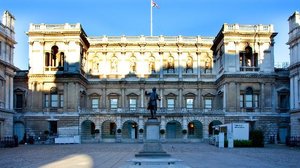
1986 · Royal Academy of Arts, Londra

One of the modern masterpieces in the RA Collection, Wintergreens was made in 1986, the year Frank Bowling moved to a studio with a view of the Thames in Limehouse, London. He’s referred to the city as “Turner’s town” and the scale of this painting has attracted comparisons with the ambitious landscapes of past artists such as Turner and Constable.The title refers to plants that keep their leaves throughout winter,…

Muzeele care păstrează originalele lui Frank Bowling

Cele 3 muzee care dețin cele mai multe dintre picturile de pe această pagină.

Muzee Oraș Lucrări lui Frank Bowling Picturi din această listă
Tate Modern, LondraTate Modern Londra 2 Who's Afraid of Barney Newman, Sacha Jason Guyana Dreams
Muzeul de Artă Plastică din Boston, BostonMuzeul de Artă Plastică din Boston Boston 1 Suncrush
Royal Academy of Arts, LondraRoyal Academy of Arts Londra 1 Wintergreens

Frank Bowling deceniu cu deceniu: originalul care definește fiecare

Lucrări pe deceniu

Alege o deceniu pentru a descoperi opera originală care îl definește.

Întrebări ale colecționarilor despre picturile lui Frank Bowling

Pentru ce operă este cel mai cunoscut Frank Bowling?Află răspunsul

Night Journey (1969). Urmează Who's Afraid of Barney Newman (1968) și Clem's No. I (1972).

Ce vârstă avea Frank Bowling când a fost creată Night Journey?Află răspunsul

35 ani: Night Journey datează din 1969, iar Frank Bowling s-a născut în 1934.

Câte picturi a lăsat Frank Bowling?Află răspunsul

Catalogul nostru cuprinde 9 lucrări ale lui Frank Bowling, datate între 1968 și 1989.

În ce muzee sunt expuse capodoperele lui Frank Bowling?Află răspunsul

În principal în Tate Modern (Londra), Muzeul de Artă Plastică din Boston (Boston) și Royal Academy of Arts (Londra). Tabelul cu muzee de mai sus le enumeră pe toate.

În ce ani a pictat Frank Bowling cele mai cunoscute opere?Află răspunsul

În 1970s: 3 dintre cele 8 lucrări de pe această pagină au fost realizate atunci, fiind Clem's No. I dintre acestea.

Care sunt prima și ultima pictură originală celebră a lui Frank Bowling?Află răspunsul

Pe această pagină, cea mai veche lucrare datează din Who's Afraid of Barney Newman (1968), iar cea mai recentă este din Sacha Jason Guyana Dreams (1989).

Ce lucrări ale lui Frank Bowling sunt expuse la Tate Modern?Află răspunsul

Who's Afraid of Barney Newman și Sacha Jason Guyana Dreams: Tate Modern, Londra deține 2 dintre lucrările de pe această pagină.

Frank Bowling: viață și operă

The Architect of Abstraction: The Life and Legacy of Frank Bowling

In the vast, textured landscapes of contemporary abstraction, few names resonate with as much profound authority as Frank Bowling. Born in 1934 in the riverside town of Bartica, British Guiana, Bowling’s journey is one of remarkable movement—not just across continents, but through the very layers of paint and medium itself. His arrival in Britain as a young man marked the beginning of a career that would fundamentally reshape the trajectory of post-war British art. As a pioneer of color field painting and lyrical abstraction, Bowling did not merely paint surfaces; he constructed worlds that evoke the geological, the cartographic, and the deeply psychological.

Bowling’s formative years in the United Kingdom saw him immersed in the rigorous creative environments of the Regent Street Polytechnic and the Chelsea School of Art. By 1959, his talent earned him a prestigious scholarship to the Royal College of Art, placing him at the heart of a revolutionary generation. Alongside luminaries such as David Hockney and R.B. Kitaj, Bowling was part of a cohort that challenged the boundaries of British experimentalism. It was during this period that the echoes of American Abstract Expressionism—the monumental legacies of Mark Rothko and Barnative Newman—began to resonate within his work, inspiring a fascination with vast, immersive canvases that prioritize emotional resonance over representational clarity.

The Cartography of Color and Materiality

The mid-1960s heralded the emergence of Bowling’s most iconic contribution to the art world: the 'Map' series. These groundbreaking works eschewed traditional imagery in favor of a complex, fluid language of color and texture. In these paintings, the artist utilized the technique of pouring diluted paint onto canvas, allowing pigments to bleed, stain, and coalesce into shapes that suggest continents, oceans, and shifting borders. This approach transformed the canvas into a living topography, where the boundaries between land and sea, or self and other, become beautifully blurred.

What truly distinguishes Bowling’s technique is his daring exploration of materiality. He famously incorporated industrial substances such as asphalt and resin into his compositions, creating heavy, tactile surfaces that possess a physical weight and geological presence. This use of non-traditional media was more than a stylistic choice; it was a deliberate gesture against the polished aesthetic conventions of his era. Through these rugged textures, Bowling explored themes of globalization, cultural displacement, and the anxieties of a post-colonial world, making his work as much about political identity as it is about formal beauty.

A Modern Master on the Global Stage

The historical significance of Frank Bowling extends far beyond the aesthetic realm. As one of the most distinguished Black artists to emerge from the post-war British art school system, his success represents a pivotal moment in the diversification of the British canon. His career has been defined by a series of monumental achievements that have cemented his status as a modern master:

Today, Frank Bowling remains a singular figure whose work continues to breathe and evolve. Whether through the vibrant energy of pieces like 'Who’s Afraid of Barney Newman' or the atmospheric depth of 'Wintergreens', he invites the viewer into a space where color is not just seen, but felt. His legacy is etched into the very fabric of modern art—a testament to the power of abstraction to navigate the complexities of the human experience.