Portretul lui Felicien Rops

Cele 46 cele mai faimoase picturi ale lui Felicien Rops, o selecție de galerie

Actualizat Noiembrie 2026 · clasat în funcție de scorul nostru de popularitate (căutări, vizite și comenzi pentru fiecare operă) · 46 lucrări ale lui Felicien Rops în catalogul nostru

Pe scurt

Dintre toate originalele lăsate de Felicien Rops, cea mai faimoasă este The Entrance to the Ball (1858), din colecția musée provincial Félicien Rops, Namur. Imediat după acestea urmează Satanic Self-Portrait (1860) și Head of an Old Antwerp Woman (1873). Catalogul nostru cuprinde 46 lucrări ale lui Felicien Rops; galeria a păstrat cele 46 pe care lumea le admiră cel mai mult, fiecare fiind prezentată împreună cu data, muzeul și povestea sa.

1833 – 1898, Namur Symbolism Cele mai multe lucrări: musée provincial Félicien Rops

Cele mai importante 10 picturi ale lui Felicien Rops: selecția galeriei

1
The Entrance to the Ball (1858) de Felicien Rops

The Entrance to the Ball

1858 · Oil · musée provincial Félicien Rops, Namur

In "The Entrance to the Ball" by Félicien Rops, the composition is vertically oriented, drawing the eye upward through a narrow, compressed space. The perspective is set at eye level, adopting a side view that places us directly alongside the central figure. This man, perhaps a guest or a servant, is positioned in the foreground near a doorway. The entrance itself is marked by text, providing a specific point of…

2
Satanic Self-Portrait (1860) de Felicien Rops

Satanic Self-Portrait

1860 · Charcoal

Created about 1860, Satanic Self-Portrait by Félicien Rops presents a monochromatic study of the artist himself. The work captures a somber and introspective image of Félicien Rops, rendered in a limited palette of grayscale tones and subtle browns. He is depicted from the waist up, his head slightly bowed in a gesture of melancholy or deep thought. A large, draped garment covers his shoulders, adding a sense of weight to…

3
Head of an Old Antwerp Woman (1873) de Felicien Rops

Head of an Old Antwerp Woman

1873 · Oil On Canvas · musée provincial Félicien Rops, Namur

In the work Head of an Old Antwerp Woman by Félicien Rops, the composition is a medium close-up that focuses on the subject's head and upper torso. The subject is an aged woman positioned slightly off-center within the frame. She is depicted from a direct, eye-level view, creating an intimate proximity between the viewer and the subject. The background remains dark and indistinct, providing no specific details of a domestic…

4
The Lady with the Puppet and the Fan (1873) de Felicien Rops

The Lady with the Puppet and the Fan

1873 · Pastel · musée provincial Félicien Rops, Namur

In "The Lady with the Puppet and the Fan" by Félicien Rops, a vertical portrait captures a woman in profile. She occupies the left and center of the frame, her gaze fixed upon a small, colorful jester-like puppet held in her hand. The scene is set against a background of ochre, gold, and yellow. This warm backdrop provides a sharp contrast to the cool blues and teals of her attire.…

5
In the Wings (1878) de Felicien Rops

In the Wings

1878 · Oil

In the Wings by Félicien Rops presents a vertical, figurative scene executed in a Symbolist style. Created about 1878, the work captures a backstage or theatrical setting defined by a palpable sense of tension and voyeurism. The composition centers on two primary figures positioned within a dark, draped environment.

7
The Lady with the Puppet (1884) de Felicien Rops

The Lady with the Puppet

1884 · Mixed Media

The Lady with the Puppet emerges from the creative mind of Félicien Rops, a Belgian artist who navigates the shadowy realms of Symbolism and Decadence. This specific piece exists as part of a small series of variations on a theme, where the artist explores recurring motifs through a lens of psychological depth. Within this collection, the work captures a singular, suspended moment of interaction between a woman and a miniature…

8
Eggnog (1879) de Felicien Rops

Eggnog

1879 · Pastel · musée provincial Félicien Rops, Namur

Eggnog by Félicien Rops is a small-scale, intimate figurative work created in 1879. The scene captures a private, domestic moment between two figures within an interior setting. A woman stands as a central vertical axis, dressed in light, possibly intimate, undergarments. She holds a small dish or cup, positioned as if in the act of serving. Opposite her, a man is seated in the foreground, providing a diagonal counterweight to…

9
The Farewells of Madness - Better to Bear Laughter Than Tears (1879) de Felicien Rops

The Farewells of Madness - Better to Bear Laughter Than Tears

1879 · Lithograph · musée provincial Félicien Rops, Namur

We are looking at The Farewells of Madness - Better to Bear Laughter Than Tears, a work produced by Félicien Rops around 1879. This piece emerged from the creative period of an artist who was born in 1833 in Namur, Belgium. Rops spent much of his life navigating the shifting intellectual currents of the late nineteenth century until his death in 1898.

Selecția pentru Felicien Rops continuă, de la 11 la 46

Subiectele care i-au captivat privirea lui Felicien Rops

Cele patru teme care revin cel mai des în aceste opere originale, fiecare având cel mai sublim exemplu.

Muzeele care păstrează originalele lui Felicien Rops

Cele 5 muzee care dețin cele mai multe dintre picturile de pe această pagină.

Muzee Oraș Lucrări lui Felicien Rops Picturi din această listă
musée provincial Félicien Rops, Namurmusée provincial Félicien Rops Namur 11 The Entrance to the Ball, Head of an Old Antwerp Woman, The Lady with the Puppet and the Fan
Muzeul Regal de Arte Frumoase din Anvers, AntwerpenMuzeul Regal de Arte Frumoase din Anvers Antwerpen 5 Landscape in the Ardennes, Beach, Bridge over the River Lesse
Kröller-Müller Museum, OtterloKröller-Müller Museum Otterlo 1 Death at the Ball
Museum of Fine Arts Ghent (MSK), GhentMuseum of Fine Arts Ghent (MSK) Ghent 1 Landscape in Sweden
Hammer Museum, Los AngelesHammer Museum Los Angeles 1 Cupid with a Tambourine

Felicien Rops deceniu cu deceniu: originalul care definește fiecare

Lucrări pe deceniu

Alege o deceniu pentru a descoperi opera originală care îl definește.

Întrebări ale colecționarilor despre picturile lui Felicien Rops

Pentru ce operă este cel mai cunoscut Felicien Rops?Află răspunsul

The Entrance to the Ball (1858), musée provincial Félicien Rops, Namur. Urmează Satanic Self-Portrait (1860) și Head of an Old Antwerp Woman (1873).

Ce vârstă avea Felicien Rops când a fost creată The Entrance to the Ball?Află răspunsul

25 ani: The Entrance to the Ball datează din 1858, iar Felicien Rops s-a născut în 1833.

Care sunt cele mai celebre zece picturi ale lui Felicien Rops?Află răspunsul

The Entrance to the Ball, Satanic Self-Portrait, Head of an Old Antwerp Woman, The Lady with the Puppet and the Fan, In the Wings, The incantation, The Lady with the Puppet, Eggnog, The Farewells of Madness - Better to Bear Laughter Than Tears și Cherubim's Song. Clasamentul de mai sus indică anul și muzeul pentru fiecare piesă.

Câte picturi a lăsat Felicien Rops?Află răspunsul

Catalogul nostru cuprinde 46 lucrări ale lui Felicien Rops, datate între 1858 și 1898.

În ce muzee sunt expuse capodoperele lui Felicien Rops?Află răspunsul

În principal în musée provincial Félicien Rops (Namur), Muzeul Regal de Arte Frumoase din Anvers (Antwerpen) și Kröller-Müller Museum (Otterlo). Tabelul cu muzee de mai sus le enumeră pe toate.

În ce ani a pictat Felicien Rops cele mai cunoscute opere?Află răspunsul

În 1880s: 10 dintre cele 46 lucrări de pe această pagină au fost realizate atunci, fiind The Lady with the Puppet dintre acestea.

Care sunt prima și ultima pictură originală celebră a lui Felicien Rops?Află răspunsul

Pe această pagină, cea mai veche lucrare datează din The Entrance to the Ball (1858), iar cea mai recentă este din Snow at Thozée (1898).

Ce subiecte a ales cel mai des Felicien Rops?Află răspunsul

Woman (10), Man (7) și Portrait (3), din cele 46 lucrări de pe această pagină.

Ce tehnică a folosit cel mai des Felicien Rops?Află răspunsul

Pastel, pentru 3 dintre cele 46 lucrări de pe această pagină.

Din ce mișcare artistică face parte Felicien Rops?Află răspunsul

Symbolism, judecând după originalele de pe această pagină.

Ce lucrări ale lui Felicien Rops sunt expuse la musée provincial Félicien Rops?Află răspunsul

The Entrance to the Ball, Head of an Old Antwerp Woman și The Lady with the Puppet and the Fan: musée provincial Félicien Rops, Namur deține 11 dintre lucrările de pe această pagină.

Felicien Rops: viață și operă

A Shadowy Visionary: The Life and Art of Félicien Rops

Félicien Victor Joseph Rops, born in 1833 in the Belgian town of Namur, emerged as a pivotal figure bridging the gap between Realism, Symbolism, and the burgeoning world of modern graphic storytelling. His life, steeped in both bourgeois comfort – his father was a prosperous textile manufacturer – and a restless artistic spirit, unfolded against a backdrop of rapid social and intellectual change. Early training at local academies provided a foundation, but it was his move to Brussels at twenty that truly ignited his creative trajectory. Though briefly enrolled at the University of Brussels, Rops found himself drawn inexorably towards the Académie de Saint-Luc, where he honed his skills not just in painting and drawing, but also in the art of satire through lithography. His early work quickly gained recognition in student magazines like *Le Crocodile* and *L'Uylenspiegel*, establishing him as a gifted caricaturist with a keen eye for societal foibles. These formative years weren’t merely about developing technical proficiency; they were about finding his voice, a voice that would soon become synonymous with challenging conventions and exploring the darker recesses of the human psyche.

Early Years and Artistic Foundations

Rops's childhood was marked by privilege and intellectual stimulation—his father’s textile business ensured financial stability while fostering an appreciation for craftsmanship and design. From a young age, he demonstrated exceptional talent in drawing and painting, nurtured by private tutors who recognized his innate artistic inclination. Recognizing the importance of formal education, he attended Notre Dame de la Paix de Namur and the Athénée Royal de Namur, immersing himself in humanist studies alongside artistic pursuits. This dual focus shaped his worldview and instilled a lifelong fascination with both beauty and truth—a preoccupation that would permeate his entire oeuvre. His enrollment at the Université Libre de Bruxelles solidified these connections, placing him within a vibrant intellectual milieu where he engaged in spirited debates about art, politics, and philosophy. It was here that he began to develop influential artistic networks, forging friendships with fellow students who shared his passion for innovation and experimentation.

Parisian Encounters and Artistic Transformation

The year 1862 proved transformative when Rops relocated to Paris—a city brimming with artistic fervor and intellectual ferment—seeking inspiration and encountering kindred spirits. Immediately drawn to the ateliers of Henri-Alfred Jacquemart and Félix Bracquemond, he embraced intaglio techniques – etching and aquatint – mastering these methods with meticulous dedication. These encounters profoundly influenced his artistic style, shaping his approach to printmaking and fostering a fascination with tonal gradations and textural nuances. Crucially, it was his meeting with Charles Baudelaire in 1864 that cemented Rops’s artistic identity. Baudelaire's poetic exploration of beauty intertwined with decay—his insistence on confronting the grotesque and unsettling—resonated deeply with Rops’s own burgeoning aesthetic sensibilities. This encounter spurred him to delve into darker themes, investigating psychological complexities and challenging societal norms—a trajectory that would define his subsequent artistic endeavors. The resulting collaboration between Baudelaire and Rops culminated in the iconic illustration for *Les Fleurs du Mal*, establishing a partnership that epitomized the spirit of Symbolism and foreshadowed Rops’s enduring legacy as an artist who dared to confront uncomfortable truths.

The Symbolist Aesthetic and Pioneering Printmaking Techniques

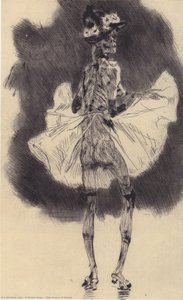
Rops's artistic style is instantly recognizable for its meticulous detail, dramatic chiaroscuro—the masterful manipulation of light and shadow—and a haunting atmosphere that pervades his work. Rejecting the conventions of Realism, he embraced the tenets of Symbolism, prioritizing mood and emotion over literal representation. He skillfully employed soft-ground etching, a technique rarely utilized by his contemporaries, combining it with mezzotint or aquatint to achieve unparalleled tonal richness and textural complexity. This dedication to innovative printmaking techniques—a hallmark of Rops’s artistic vision—established him as one of the foremost masters of the medium. His prints are characterized by an unsettling blend of eroticism and occult imagery, reflecting his fascination with the darker aspects of human psychology and exploring themes of transgression and desire. Works like “Pornokratès” (1878), a psychologically astute depiction of female power and vulnerability, exemplify Rops’s ability to convey profound emotional states through visual language—a feat that continues to captivate audiences today.
Legacy and Influence Beyond His Time

Despite initial obscurity and facing criticism for his provocative subject matter—particularly his erotic prints—Rops was revered by fellow artists as a visionary innovator who championed artistic freedom and challenged societal prejudices. He joined the Société Libre des Beaux-Arts in Brussels (1868–1876), fostering intellectual discourse and collaborating with influential figures of his time. His membership in Les XX ("the twenty"), formed in 1884, solidified his position as a leader of avant-garde artistic circles—a testament to his unwavering commitment to pushing creative boundaries. Rops’s influence extended far beyond the realm of printmaking; he inspired subsequent generations of artists—including Edvard Munch and Max Klinger—who adopted his stylistic innovations and explored similar thematic concerns. His enduring legacy resides not merely in his celebrated artworks but also in his courageous willingness to confront taboo subjects, prompting viewers to contemplate uncomfortable truths about human nature and societal morality. Félicien Rops remains a pivotal figure in the history of Symbolism and a pioneer of both graphic art and comics—a testament to his artistic genius and enduring fascination with the complexities of the human condition.