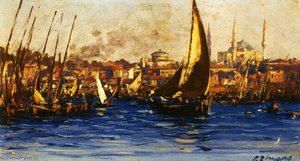
Fausto Zonaro: viață și operă
A Bridge Between Worlds: The Life and Art of Fausto Zonaro
Fausto Zonaro, a name perhaps less familiar than those of his contemporaries, occupies a unique and fascinating position in the annals of 19th-century art. Born in Masi, Padua, in 1854—then part of the Austrian Empire—his life was one of shifting allegiances and cultural immersion, ultimately blossoming into a remarkable artistic career that bridged the gap between Italian Realism and the exotic allure of the Ottoman world. Initially destined to follow his father’s trade as a mason, young Fausto displayed an undeniable talent for drawing, a passion nurtured by supportive parents who allowed him to pursue formal training at the Technical Institute in Lendinara and later at the prestigious Cignaroli Academy in Verona under Napoleone Nani. These formative years instilled in him a solid foundation in technique and observation, skills that would prove invaluable as he navigated an increasingly diverse artistic landscape. Early works showcased scenes of daily life, establishing his reputation as a promising realist painter exhibiting in major Italian cities like Milan, Rome, Turin, and Venice—a testament to his growing skill and the burgeoning demand for genre paintings capturing the essence of everyday existence.
His early canvases captured the bustling marketplaces of Verona and Padua with remarkable accuracy, portraying ordinary people engaged in their daily routines – artisans crafting wares, merchants haggling over prices, families enjoying leisurely afternoons. These scenes weren’t merely depictions; they were imbued with a palpable sense of atmosphere, conveying the sights, sounds, and smells of Italian provincial life with astonishing fidelity. This dedication to observation—a hallmark of his artistic approach—would serve as a cornerstone for his later explorations into grander subjects.
Istanbul and the Sultan’s Painter
A pivotal moment arrived in 1891 when Zonaro met Elisa Pante, a pupil who shared his fascination with the Orient—a fascination fueled by Edmondo de Amicis’ evocative travelogue *Constantinopoli*. Their subsequent marriage marked not only a personal union but also a decisive shift in artistic direction. The couple settled in Istanbul, drawn to the vibrant culture and captivating atmosphere of the Ottoman capital. It was here that Zonaro truly found his voice, depicting Ottoman life with an unprecedented level of realism and detail. His talent quickly garnered attention within aristocratic circles, leading to the extraordinary appointment as court painter (*Ressam-ı Hazret-i Şehriyari*) to Sultan Abdul Hamid II in 1896. This prestigious position, secured through the intervention of the Russian ambassador who presented the sultan with Zonaro’s painting *The Imperial Regiment of Ertuğrul on the Galata Bridge*, opened doors to commissions that would define his artistic legacy. He undertook a series depicting events from the life of Mehmed II, consciously positioning himself as a successor to Gentile Bellini, who had painted the same subject centuries earlier—a bold statement acknowledging both historical precedent and his own artistic ambition. Zonaro’s immersion in Ottoman culture extended beyond official commissions; he was deeply moved by witnessing the Ashura processions, capturing their raw emotional intensity in his renowned painting *10th of Muharram*, a work that stands as a powerful testament to his empathetic observation and masterful technique.
His meticulous attention to detail—evident in every brushstroke—transformed ordinary scenes into immersive experiences for the viewer. He painstakingly recreated architectural grandeur, capturing the intricate mosaics and opulent furnishings of palaces with breathtaking precision. Furthermore, Zonaro’s portraits of Ottoman dignitaries were distinguished by their psychological depth, conveying not merely physical likeness but also character and emotion.
Style and Artistic Legacy
Zonaro’s artistic style is characterized by a compelling blend of Realism, Italian genre painting traditions, and subtle Impressionistic influences. He possessed an exceptional ability to capture light, atmosphere, and intricate detail, bringing the bustling streets of Istanbul, the grandeur of Ottoman palaces, and the nuances of its people to life on canvas. His oeuvre encompassed portraits, landscapes, and historical paintings—each a valuable visual record of the late Ottoman Empire. *Mehmet II Conquering Constantinople*, for example, is a dynamic depiction of a pivotal moment in history, rendered with dramatic flair and meticulous attention to detail. *Le Conquérant* showcases the power and authority of an Ottoman ruler through a striking portrait, while his scenes from daily life offer intimate glimpses into the routines and customs of Istanbul’s inhabitants. His work wasn't merely documentation; it was imbued with a sense of empathy and understanding, avoiding the often-superficial exoticism prevalent in Orientalist painting.
His masterful technique—informed by Bellini’s influence—combined meticulous observation with expressive brushwork, resulting in canvases that resonated with both accuracy and emotional resonance. He skillfully employed chiaroscuro – the dramatic interplay of light and shadow – to heighten the impact of his compositions and convey a sense of immediacy. Zonaro's legacy rests on his ability to transform historical narratives into emotionally compelling artworks—a feat achieved through unwavering dedication to realism combined with an intuitive grasp of artistic expression.
## Major Achievements
Zonaro’s career culminated in numerous prestigious commissions, cementing his reputation as one of the foremost artists of his time. He was awarded the Order of Merit by Sultan Abdul Hamid II for his contributions to Ottoman art and culture—a testament to his unwavering commitment to portraying the splendor and complexity of the Ottoman Empire with unparalleled artistry. Beyond official patronage, Zonaro’s artistic output encompassed a vast array of subjects—from monumental portraits of royal figures to evocative landscapes capturing the beauty of Turkey's diverse regions—establishing him as a prolific and versatile artist who left an indelible mark on the visual arts.
## Historical Significance
Fausto Zonaro’s work stands as a crucial document of the Ottoman Empire during its twilight years, offering invaluable insights into the social, political, and cultural landscape of the era. His paintings serve as powerful reminders of a bygone age—a testament to artistic excellence and cultural understanding—and continue to inspire admiration for their beauty and historical significance. He remains an artist whose work embodies the spirit of his time—a bridge between tradition and innovation—and whose legacy endures as a beacon of artistic accomplishment.