Portretul lui Eva Hesse

Cele 13 cele mai faimoase picturi ale lui Eva Hesse, o selecție de galerie

Actualizat Octombrie 2026 · clasat în funcție de scorul nostru de popularitate (căutări, vizite și comenzi pentru fiecare operă) · 13 lucrări ale lui Eva Hesse în catalogul nostru

Pe scurt

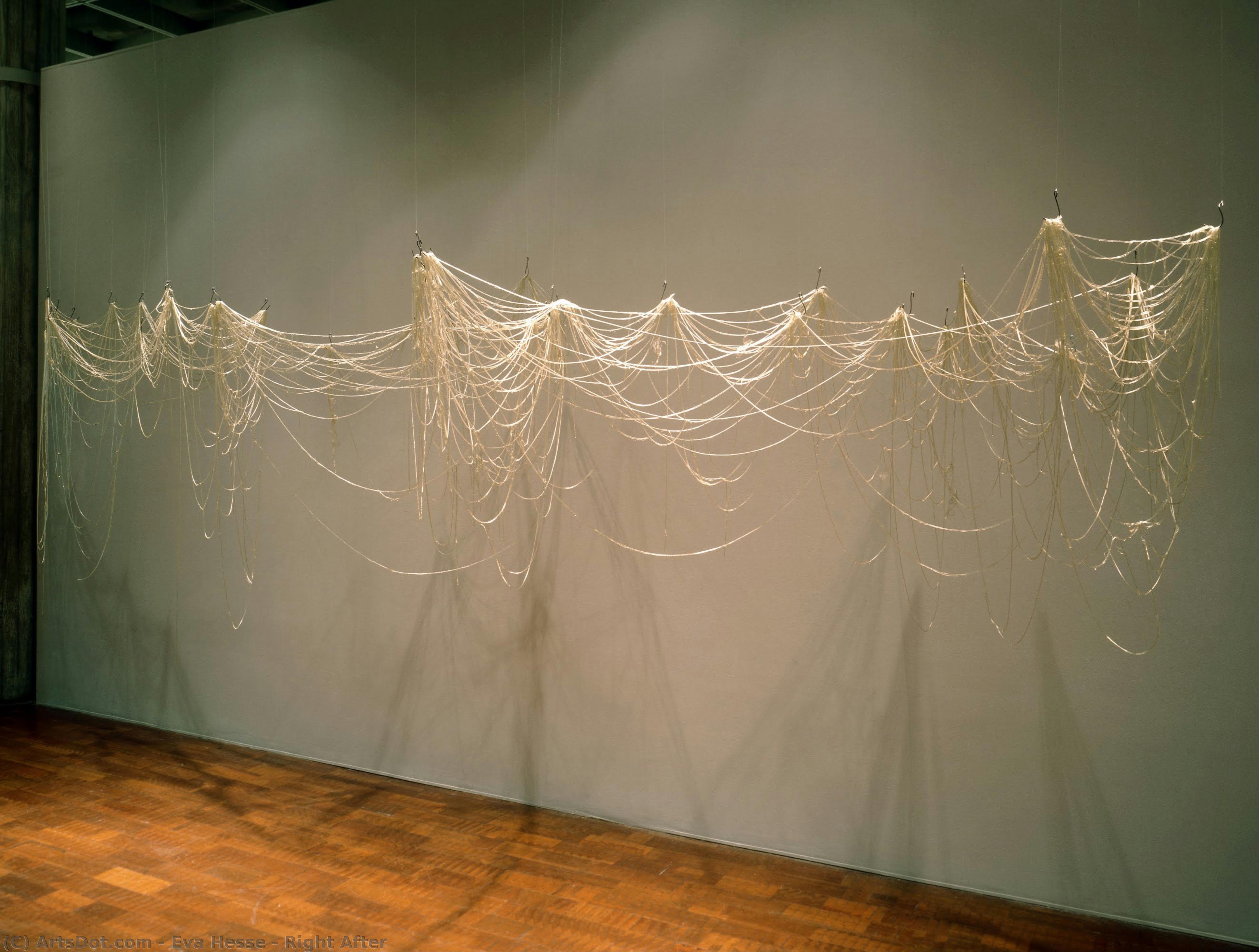
Dintre toate originalele lăsate de Eva Hesse, cea mai faimoasă este Repetition Nineteen III (1968), din colecția MoMA - Museum of Modern Art, New York City. Imediat după acestea urmează Tomorrow's Apples (5 in White) (1965) și Right After (1969). Catalogul nostru cuprinde 13 lucrări ale lui Eva Hesse; galeria a păstrat cele 13 pe care lumea le admiră cel mai mult, fiecare fiind prezentată împreună cu data, muzeul și povestea sa.

1936 – 1970, Hamburg Post-minimalism Cele mai multe lucrări: Tate Modern

Cele mai importante 10 picturi ale lui Eva Hesse: selecția galeriei

1
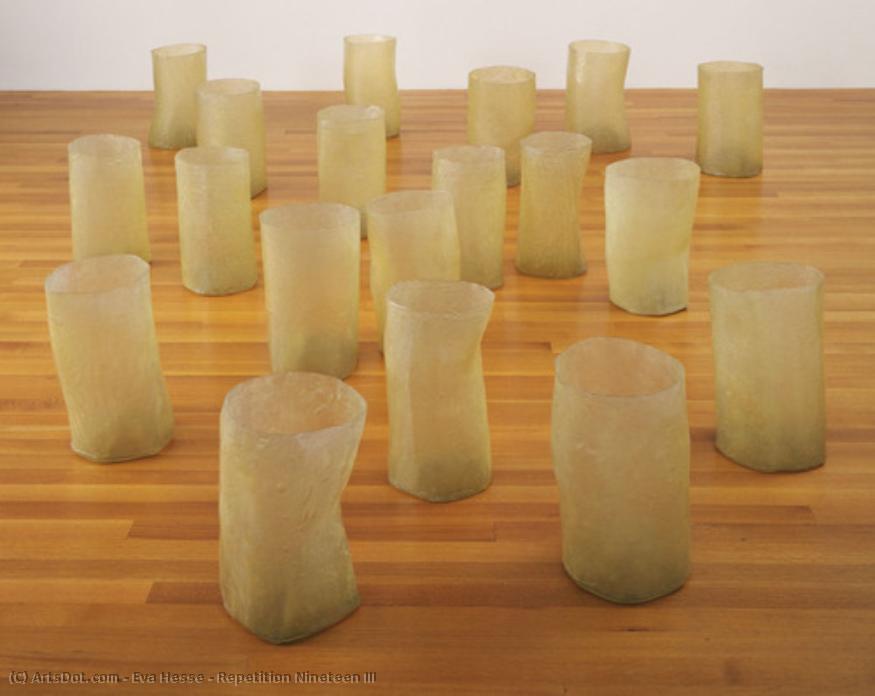
Repetition Nineteen III (1968) de Eva Hesse

Repetition Nineteen III

1968 · Resin · MoMA - Museum of Modern Art, New York City

To stand before Repetition Nineteen III is to encounter not merely an arrangement of objects, but a meditation on persistence and the beautiful imperfection of being. Eva Hesse’s work from this period pulses with a quiet, almost visceral energy. The sculpture presents a constellation of roughly hewn, organic forms resting upon a grounding plane of warm wood. These pieces, cast in a muted, pale green material—perhaps resin or fiberglass—reject the…

2
Tomorrow's Apples (5 in White) (1965) de Eva Hesse

Tomorrow's Apples (5 in White)

1965 · Sculpture · Tate Modern, Londra

In the quiet, evocative realm of Eva Hesse, materiality speaks where words fail. Her 1965 masterpiece, Tomorrow's Apples (5 in White), stands as a profound testament to the beauty found in imperfection and the delicate balance between structure and decay. At first glance, the viewer is met with a minimalist landscape: five vibrant, rope-like forms—hues of blue, red, pink, yellow, and green—casually draped across a stark, textured white expanse. These…

5
Contingent (1968) de Eva Hesse

Contingent

1968 · Mixed Media · National Gallery of Australia, Canberra

Eva Hesse’s 1968 work, “Contingent,” isn't merely a sculpture; it’s an embodied meditation on vulnerability and the precarious nature of existence. Born from the tumultuous backdrop of post-war Germany and Hesse’s deeply personal experiences – displacement, loss, and the lingering shadow of her mother’s suicide – the piece speaks to a profound sense of uncertainty and reliance. Hesse, a pivotal figure in the emergence of Post-Minimalism, deliberately eschewed the rigid…

7
Hang Up (1966) de Eva Hesse

Hang Up

1966 · Art Institute of Chicago, Chicago

Eva Hesse’s “Hang Up,” created in 1966, isn't merely a sculpture; it’s an arresting meditation on the very nature of art and its relationship to space. Captured with remarkable clarity in this photograph, the work immediately commands attention with its stark simplicity – a rectangular frame, painted a subtly grayish-blue, suspended from a thick, black cord that descends dramatically to the floor. This seemingly austere composition belies a profound depth…

Selecția pentru Eva Hesse continuă, de la 11 la 13

Piesele celebre ale lui Eva Hesse, perioadă cu perioadă

Subiectele care i-au captivat privirea lui Eva Hesse

Cele patru teme care revin cel mai des în aceste opere originale, fiecare având cel mai sublim exemplu.

Muzeele care păstrează originalele lui Eva Hesse

Cele 5 muzee care dețin cele mai multe dintre picturile de pe această pagină.

Muzee Oraș Lucrări lui Eva Hesse Picturi din această listă
Tate Modern, LondraTate Modern Londra 2 Tomorrow's Apples (5 in White), Untitled
Detroit Institute of Arts, DetroitDetroit Institute of Arts Detroit 2 Accession II, Accession II
MoMA - Museum of Modern Art, New York CityMoMA - Museum of Modern Art New York City 1 Repetition Nineteen III
National Gallery of Australia, CanberraNational Gallery of Australia Canberra 1 Contingent
Art Institute of Chicago, ChicagoArt Institute of Chicago Chicago 1 Hang Up

Eva Hesse an de an: originalele care definesc fiecare perioadă

Doar într-un deceniu, de la 1960 la 1969, a oferit lumii fiecare lucrare originală datată a lui Eva Hesse din această selecție: iată-le, an de an.

Lucrări pe an

Alege un an pentru a vedea originalele acestuia.

Întrebări ale colecționarilor despre picturile lui Eva Hesse

Pentru ce operă este cel mai cunoscut Eva Hesse?Află răspunsul

Repetition Nineteen III (1968), MoMA - Museum of Modern Art, New York City. Urmează Tomorrow's Apples (5 in White) (1965) și Right After (1969).

Ce vârstă avea Eva Hesse când a fost creată Repetition Nineteen III?Află răspunsul

32 ani: Repetition Nineteen III datează din 1968, iar Eva Hesse s-a născut în 1936.

Care sunt cele mai celebre zece picturi ale lui Eva Hesse?Află răspunsul

Repetition Nineteen III, Tomorrow's Apples (5 in White), Right After, No Title (Spectres series), Contingent, Untitled, Hang Up, Untitled, Expanded Expansion și Addendum. Clasamentul de mai sus indică anul și muzeul pentru fiecare piesă.

Câte picturi a lăsat Eva Hesse?Află răspunsul

Catalogul nostru cuprinde 13 lucrări ale lui Eva Hesse, datate între 1960 și 1969.

În ce muzee sunt expuse capodoperele lui Eva Hesse?Află răspunsul

În principal în Tate Modern (Londra), Detroit Institute of Arts (Detroit) și MoMA - Museum of Modern Art (New York City). Tabelul cu muzee de mai sus le enumeră pe toate.

În ce ani a pictat Eva Hesse cele mai cunoscute opere?Află răspunsul

În 1965: 3 dintre cele 13 lucrări de pe această pagină au fost realizate atunci, fiind Tomorrow's Apples (5 in White) dintre acestea.

Care sunt prima și ultima pictură originală celebră a lui Eva Hesse?Află răspunsul

Pe această pagină, cea mai veche lucrare datează din No Title (Spectres series) (1960), iar cea mai recentă este din Right After (1969).

Ce subiecte a ales cel mai des Eva Hesse?Află răspunsul

Materiality (4), Fragility (4) și Organic forms (2), din cele 13 lucrări de pe această pagină.

Ce tehnică a folosit cel mai des Eva Hesse?Află răspunsul

Sculpture, pentru 2 dintre cele 13 lucrări de pe această pagină.

Din ce mișcare artistică face parte Eva Hesse?Află răspunsul

Post-minimalism și Postminimalism, judecând după originalele de pe această pagină.

Ce lucrări ale lui Eva Hesse sunt expuse la Tate Modern?Află răspunsul

Tomorrow's Apples (5 in White) și Untitled: Tate Modern, Londra deține 2 dintre lucrările de pe această pagină.

Eva Hesse: viață și operă

A Life Interrupted: The Poetic Vulnerability of Eva Hesse

Eva Hesse’s story is one of profound displacement and a relentless pursuit of artistic expression in the face of personal tragedy. Born in 1936 in Hamburg, Germany, her early life was irrevocably altered by the looming shadow of Nazism. Fleeing persecution, her family sought refuge in the United States in 1938, an act that would forever shape Hesse’s identity as a displaced person navigating two worlds. This sense of rootlessness, coupled with the emotional trauma of her parents' separation and her mother’s subsequent suicide when Hesse was just ten years old, became a subtle yet powerful undercurrent in her art—a haunting exploration of fragility, loss, and the ephemeral nature of existence. Her formal artistic training began at Pratt Institute in Brooklyn, followed by studies at Cooper Union and Yale University School of Art and Architecture, where she encountered the rigorous material explorations championed by Josef Albers. However, it was not within the confines of traditional painting that Hesse found her true voice; rather, she embarked on a path of radical experimentation with materials and form, ultimately becoming a pivotal figure in the development of Postminimalism and Eccentric Abstraction.

Early Life and Influences: Displacement and Surrealist Echoes

Eva Hesse’s formative years were marked by upheaval and loss. Her parents divorced shortly after her birth, creating an atmosphere of instability that profoundly impacted her emotional development. The trauma of witnessing her mother’s suicide at the tender age of ten fueled a deep preoccupation with themes of vulnerability and mortality—themes that would permeate her artistic vision throughout her career. Hesse’s exposure to Surrealism during her studies at Yale University School of Art and Architecture proved particularly influential, shaping her fascination with dreamlike imagery and subconscious exploration. Artists like Hans Arp and Jean Dubuffet served as models for her sculptural experimentation, encouraging her to embrace unconventional materials and techniques—materials often associated with industrial production or everyday life. Hesse wasn’t interested in their intended purpose; instead, she manipulated them in unexpected ways, brushing latex like paint to create layered surfaces, allowing materials to sag, droop, and defy conventional notions of form and stability. This initial engagement with Surrealism instilled a desire to confront difficult emotions and explore the complexities of human experience—a characteristic that would define her artistic approach for decades to come.

From Painting to Materiality: A Sculptural Revolution

Initially drawn to abstract painting, Hesse soon felt constrained by its conventional limitations. She yearned for a more direct engagement with materiality—a way to imbue her work with the raw immediacy of feeling and experience. This desire led her to explore a diverse range of artistic influences, from the Surrealist explorations of form and subconscious imagery to the gestural energy of Abstract Expressionism and the biomorphic sculptures of artists like Louise Bourgeois; Bourgeois’s psychologically charged sculptures resonated deeply with Hesse, revealing the potential for art to confront personal trauma and explore the complexities of the human psyche. The encounter with Albers's teachings at Yale solidified Hesse’s commitment to material experimentation—a cornerstone of her artistic practice. She moved to New York in the late 1950s placing herself at the heart of a vibrant artistic community, further fueling her exploration of innovative materials and techniques. By the mid-1960s, Hesse decisively turned towards sculpture, embracing unconventional materials like latex, fiberglass, resin, and rope—materials often associated with industrial production or everyday life. She wasn’t interested in their intended purpose; instead, she manipulated them in unexpected ways, brushing latex like paint to create layered surfaces, allowing materials to sag, droop, and defy conventional notions of form and stability.

Defining Postminimalism: Embracing Imperfection and Organic Form

Hesse’s sculptural breakthroughs occurred during a period of artistic ferment—a reaction against the formalism championed by Minimalism. Rejecting geometric precision and industrial fabrication, Hesse sought to express emotion and experience through organic forms and unconventional materials. Her work embodies a distinctive aesthetic characterized by imperfection, vulnerability, and raw materiality—elements that challenged prevailing artistic conventions. Hesse’s sculptures are often marked by repetitive structures arranged in grid patterns or clustered arrangements, evoking a sense of both order and chaos, control and surrender. The exploration of these contrasting forces became central to her artistic vision. Pieces like “Hang Up” (1966) exemplify this approach—a minimalist wire & wood sculpture embodying Postminimalism. Hesse’s fascination with the body and sexuality also emerged as a significant theme in her oeuvre, reflecting feminist sensibilities of the time. Her willingness to confront difficult emotions and explore the complexities of human existence resonated with artists who sought to break free from traditional artistic boundaries.

Legacy and Influence: A Singular Voice Amidst Artistic Change

Despite her tragically short career—she succumbed to cancer in 1970 at the age of thirty-four—Eva Hesse’s impact on the art world has been profound and enduring. She is now widely recognized as a pivotal figure in Postminimalism and Eccentric Abstraction, challenging the rigid formalism of Minimalism by introducing elements of subjectivity, emotion, and organic form. Her exploration of vulnerability, repetition, and materiality continues to inspire contemporary artists today. Hesse’s sculptures remain a testament to the power of creativity to transcend personal tragedy and offer profound insights into the human condition—a singular voice amidst artistic change that cemented her place in art history.