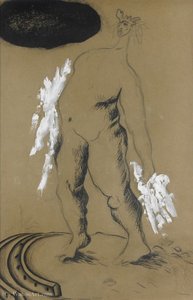
Enzo Cucchi: A Visionary Landscape Painter of the Transavanguardia
Enzo Cucchi (born 1949) stands as a prominent figure in Italian
Neo-Expressionism, inextricably linked to the vibrant Transavanguardia movement that captivated the art world during the 1980s. Originating from Morro d’alba, Province of Ancona, Cucchi's artistic journey began with an initial fascination for poetry—a passion nurtured by his encounters with celebrated poet Mino de Angelis—and solidified through collaborations with influential critic Achille Bonito Oliva and the publishing house La Nuova Foglio di Materadata. It was Oliva who coined the term “Transavanguardia,” encapsulating Cucchi’s generation's artistic spirit: a defiant return to expressive painting after decades dominated by
conceptual art, mirroring similar trends across Europe and America.
- Early Influences & Formation
- The Transavanguardia Movement
- Notable Works & Exhibitions
- Museum Collections & Recognition
- Legacy & Artistic Significance
Early Influences & Formation
Cucchi’s artistic genesis wasn't solely driven by visual stimuli; it was profoundly shaped by intellectual pursuits. His formative years were marked by a deep engagement with poetry, particularly the work of Mino de Angelis, whose philosophical explorations resonated deeply within Cucchi’s creative sensibility. This connection fostered collaborations that would prove crucial to his artistic trajectory, notably through La Nuova Foglio di Materadata, where he encountered Achille Bonito Oliva—a critic who championed Cucchi's burgeoning talent and recognized the potential for a powerful visual language rooted in poetic contemplation. These early influences instilled in him a sensitivity to
symbolism and narrative, elements that would become hallmarks of his distinctive style.
The Transavanguardia Movement
Cucchi’s artistic breakthrough occurred amidst the burgeoning Transavanguardia movement—a collective effort spearheaded by artists like
Francesco Clemente,
Mimmo Paladino, Nicola de Maria, and
Sandro Chia—which emerged in Italy during the 1980s. Rejecting the prevailing conceptual framework of the time, Transavanguardia championed a visceral return to
figurative painting, prioritizing emotion and subjective experience over intellectual abstraction. Cucchi’s involvement with this movement cemented his position as a vanguard artist, aligning him with fellow innovators who sought to express profound psychological states through bold color palettes and evocative imagery—often depicting landscapes imbued with mythological references and spiritual undertones.
Notable Works & Exhibitions
Cucchi's artistic reputation ascended rapidly following his groundbreaking retrospective at the
Solomon R. Guggenheim Museum in
New York City in 1986, establishing him as a leading voice within
contemporary art. His canvases—characterized by monumental scale and arresting compositions—explore themes of nature, memory, and
human vulnerability with uncompromising honesty. Recurring motifs include skulls,
nude figures, and landscapes rendered in luminous hues that convey both beauty and melancholy. Cucchi’s works are held in prestigious museum collections worldwide, including the Museum of
Modern Art New York, Tate London, and The Art Institute of Chicago—testaments to his enduring artistic impact.
Museum Collections & Recognition
The widespread acclaim garnered by Cucchi's oeuvre is reflected in its presence within internationally recognized museums. These institutions acknowledge his contribution to the expressive landscape genre and celebrate his ability to convey complex emotions through visual storytelling. His paintings resonate with viewers on a visceral level, prompting contemplation about mortality, spirituality, and the relationship between humanity and the natural world—themes that underscore Cucchi’s artistic vision.
Legacy & Artistic Significance
Enzo Cucchi's legacy extends beyond his individual artworks; he represents a pivotal moment in
Italian art history—a defiant assertion of
figurative painting against the tide of conceptualism. His unwavering commitment to expressive technique and poetic
symbolism continues to inspire artists today, securing his place as one of the most influential figures of the Transavanguardia movement and cementing his enduring contribution to the broader landscape of
contemporary art.