Portretul lui Edward Lamson Henry

Cele 100 cele mai faimoase picturi ale lui Edward Lamson Henry, o selecție de galerie

Actualizat Noiembrie 2026 · clasat în funcție de scorul nostru de popularitate (căutări, vizite și comenzi pentru fiecare operă) · 106 lucrări ale lui Edward Lamson Henry în catalogul nostru

Pe scurt

Dintre toate originalele lăsate de Edward Lamson Henry, cea mai faimoasă este Sir William Johnson Presenting Medals to the Indian Chiefs of the Six Nations at Johnstown, N.Y. (1903). Imediat după acestea urmează The Camden and Amboy Railroad with the Engine Planet'' in 1834'' (1904) și Saint George's Church, New York (1875). Catalogul nostru cuprinde 106 lucrări ale lui Edward Lamson Henry; galeria a păstrat cele 100 pe care lumea le admiră cel mai mult, fiecare fiind prezentată împreună cu data, muzeul și povestea sa.

1841 – 1919, Charleston Realism Cele mai multe lucrări: Metropolitan Museum of Art

Cele mai importante 10 picturi ale lui Edward Lamson Henry: selecția galeriei

1
Sir William Johnson Presenting Medals to the Indian Chiefs of the Six Nations at Johnstown, N.Y. (1903) de Edward Lamson Henry

Sir William Johnson Presenting Medals to the Indian Chiefs of the Six Nations at Johnstown, N.Y.

1903 · Oil On Canvas

In this 1903 oil on canvas, Edward Lamson Henry captures a specific intersection of colonial diplomacy and indigenous leadership. The work, titled Sir William Johnson Presenting Medals to the Indian Chiefs of the Six Nations at Johnstown, N.Y., reconstructs a gathering from 1772. The scene focuses on a conference held at Johnson Hall, where Sir William Johnson meets with the Iroquois. It is a moment of formal recognition, frozen in…

2
The Camden and Amboy Railroad with the Engine Planet'' in 1834'' (1904) de Edward Lamson Henry

The Camden and Amboy Railroad with the Engine Planet'' in 1834''

1904 · Oil On Canvas

The steam and iron of a transformative era emerge through the brush of Edward Lamson Henry in his work, The Camden and Amboy Railroad with the Engine Planet'' in 1834''. Created in 1904, this piece looks back across the decades to capture a specific, bustling moment in American transit. The scene centers on the Camden and Amboy Railroad, frozen in the year 1834, as the engine known as the "Planet"…

3
Saint George's Church, New York (1875) de Edward Lamson Henry

Saint George's Church, New York

1875 · Lithograph · Metropolitan Museum of Art, New York

To stand before this evocative print is to step directly into the vibrant, yet sepia-toned, heart of New York City circa 1875. Edward Lamson Henry, through his masterful rendering, has gifted us more than just a depiction of architecture; he has captured the very breath of a bygone era. The composition centers unwaveringly on Saint George's Church, its spire piercing the hazy expanse as a beacon against the dense tapestry…

4
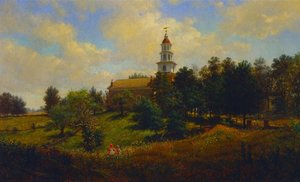
Westover, Virginia (1865) de Edward Lamson Henry

Westover, Virginia

1865 · Oil

The composition centers on a large red brick mansion characterized by white trim and a prominent steeple, which lends the structure the appearance of a church. A layer of white snow covers the ground, establishing a cold, wintry atmosphere across the landscape. In the foreground and middle ground, several horses are positioned near the house; some stand in close proximity to one another, while others are scattered across the snowy…

5
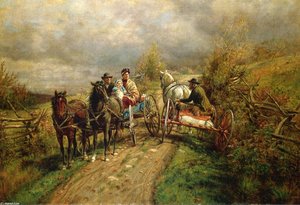
A Summer Day (1890) de Edward Lamson Henry

A Summer Day

1890 · Oil

In this 1890 composition, we find ourselves transported to a tranquil rural landscape, where the pace of life is dictated by the steady rhythm of hoofbeats on a dirt path. The scene captures a group of riders on horseback, moving leisurely through a sun-drenched country setting. There is a certain stillness here, despite the movement of the animals. A wagon rests in the distance, and a solitary chair sits near…

6
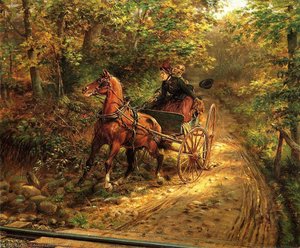
The Departure (1901) de Edward Lamson Henry

The Departure

1901 · Oil

The painting depicts a small town street populated by several figures on horseback. In the foreground, horses and riders move through the thoroughfare, some positioned closer to the viewer while others recede into the background. To the right, a carriage is parked or moving along the edge of the scene. A wooden bench sits in the middle of the composition, offering a stationary point amidst the movement. The architecture and…

8
St. Mark's in the Bowery in the Early Forties (1917) de Edward Lamson Henry

St. Mark's in the Bowery in the Early Forties

1917

The scene captures a moment of urban movement near St. Mark's in the Bowery in New York City. Pedestrians navigate the grounds of the church, their figures scattered across the foreground and middle distance. The composition is anchored by the church's architecture, specifically a prominent clock tower that rises above the street-level activity. Horses and carriages, typical of the era, populate the thoroughfare, suggesting the rhythmic, animal-powered pulse of a…

9
A Philadelphia Doorway (1882) de Edward Lamson Henry

A Philadelphia Doorway

1882 · Ulei pe pânză · Yale University Art Gallery, Hartford

Edward Lamson Henry (1841–1919) reprezintă un punct culminant în pictura americană de sfârșit de secol XIX, fiind cunoscut pentru abilitatea sa extraordinară de a captura esența unei lumi nostalgice și autentice. „A Philadelphia Doorway”, realizată în anul 1882, nu este doar o imagine frumoasă; ea este o mărturie a unei estetici specifice timpului său și a unei sensibilități artistice complexe.

10
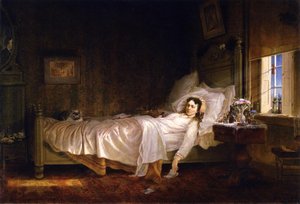
Interior (1870) de Edward Lamson Henry

Interior

1870 · Oil · Smithsonian American Art Museum, Washington, D.C.

In Interior, Edward Lamson Henry invites us into a quiet, historical setting that feels deeply lived-in. The scene captures a subtle moment of interaction between two figures within an ornate room. To the left, a woman sits at a table near a large leaded-glass window, her form catching the bright, directional light that pours into the space. Opposite her, a man stands before a fireplace, his presence grounding the domestic…

Selecția pentru Edward Lamson Henry continuă, de la 11 la 100

11A Carriage Ride (1885) de Edward Lamson HenryA Carriage Ride1885 · Metropolitan Museum of Art 12Country Breakfast (1884) de Edward Lamson HenryCountry Breakfast1884 · New Britain Museum of American Art 13Capital and Labor (1881) de Edward Lamson HenryCapital and Labor1881 · New York Historical Society 14Forty Winks (1880) de Edward Lamson HenryForty Winks1880 15East Hampton Beach (1880) de Edward Lamson HenryEast Hampton Beach1880 16Teatime (1890) de Edward Lamson HenryTeatime1890 · New Britain Museum of American Art 17Carriage Ride (1886) de Edward Lamson HenryCarriage Ride1886 18Stopping for a Chat (1889) de Edward Lamson HenryStopping for a Chat1889 19In The Shenandoah Valley (Off the Main Road) (1897) de Edward Lamson HenryIn The Shenandoah Valley (Off the Main Road)1897 · New Britain Museum of American Art 20The Ferry Crossing at Von Steuben Tavern (1909) de Edward Lamson HenryThe Ferry Crossing at Von Steuben Tavern1909 21Changing Horses (1880) de Edward Lamson HenryChanging Horses1880 22The North Dutch Church, Fulton and William Streets, New York (1869) de Edward Lamson HenryThe North Dutch Church, Fulton and William Streets, New York1869 · Metropolitan Museum of Art 23Village Squire Entertaining the New Minister de Edward Lamson HenryVillage Squire Entertaining the New Minister 24In the Roaring Forties (1884) de Edward Lamson HenryIn the Roaring Forties1884 25Parlor on Brooklyn Heights of Mr. and Mrs. John Ballard (1872) de Edward Lamson HenryParlor on Brooklyn Heights of Mr. and Mrs. John Ballard1872 26Moonlight Landscape with House (1860) de Edward Lamson HenryMoonlight Landscape with House1860 27A Chat after Meeting (1871) de Edward Lamson HenryA Chat after Meeting1871 28Descending the Stairs (1870) de Edward Lamson HenryDescending the Stairs1870 29On the James River, Virginia (1864) de Edward Lamson HenryOn the James River, Virginia1864 30The John Hancock House (1865) de Edward Lamson HenryThe John Hancock House1865 · Yale University Art Gallery 31The Invalid (1868) de Edward Lamson HenryThe Invalid1868 · Fogg Art Museum 32The Old Westover House (1869) de Edward Lamson HenryThe Old Westover House1869 · National Gallery of Art 33Drafting the Letter (1871) de Edward Lamson HenryDrafting the Letter1871 34Station on the Morris and Essex Railroad (1864) de Edward Lamson HenryStation on the Morris and Essex Railroad1864 35The Old Clock on the Stairs (1868) de Edward Lamson HenryThe Old Clock on the Stairs1868 36The Attack on Chew's House during the Battle of Germantown, 1777 (1878) de Edward Lamson HenryThe Attack on Chew's House during the Battle of Germantown, 17771878 · Art Institute of Chicago 37The Widower (1873) de Edward Lamson HenryThe Widower1873 · Smithsonian American Art Museum 38Can They Go Too. (1877) de Edward Lamson HenryCan They Go Too.1877 39Totally Absorbed (1874) de Edward Lamson HenryTotally Absorbed1874 40The Lafayette Reception (1874) de Edward Lamson HenryThe Lafayette Reception1874 41Examining Illustrations by the Fire (1872) de Edward Lamson HenryExamining Illustrations by the Fire1872 42City Point, Virginia, Headquarters of General Grant (1873) de Edward Lamson HenryCity Point, Virginia, Headquarters of General Grant1873 · Addison Gallery of American Art 43Le Paresseuse (also known as The Idle One) (1876) de Edward Lamson HenryLe Paresseuse (also known as The Idle One)1876 44The Old Dutch Church, Bruynswick (1878) de Edward Lamson HenryThe Old Dutch Church, Bruynswick1878 45The Meeting of General Washington and Rochambeau (1873) de Edward Lamson HenryThe Meeting of General Washington and Rochambeau1873 · Virginia Museum of Fine Arts 46Miss X and Sister (1884) de Edward Lamson HenryMiss X and Sister1884 47Still LIfe of Rhododendrons (1885) de Edward Lamson HenryStill LIfe of Rhododendrons1885 48The Little Flower Girl (1880) de Edward Lamson HenryThe Little Flower Girl1880 49Old Enemies (1885) de Edward Lamson HenryOld Enemies1885 50The Conversation (1882) de Edward Lamson HenryThe Conversation1882 51The Latest Village Scandal (1885) de Edward Lamson HenryThe Latest Village Scandal1885 52The King of the Montauks (1880) de Edward Lamson HenryThe King of the Montauks1880 · Detroit Institute of Arts 53Stagecoach (1881) de Edward Lamson HenryStagecoach1881 54The Sunny Hours of Childhood (1879) de Edward Lamson HenryThe Sunny Hours of Childhood1879 55On the Way to Market (1888) de Edward Lamson HenryOn the Way to Market1888 56The New Woman (1892) de Edward Lamson HenryThe New Woman1892 57Interior at Petworth (1886) de Edward Lamson HenryInterior at Petworth1886 58Horse and Buggy on Main Street (1889) de Edward Lamson HenryHorse and Buggy on Main Street1889 59A Country School (1890) de Edward Lamson HenryA Country School1890 · Yale University Art Gallery 60A Lover of Old China (1889) de Edward Lamson HenryA Lover of Old China1889 61A Virginia Wedding (1890) de Edward Lamson HenryA Virginia Wedding1890 62A Moment of Peril (1890) de Edward Lamson HenryA Moment of Peril1890 63Mrs. Lydig and Her Daughter Greeting Their Guest (1891) de Edward Lamson HenryMrs. Lydig and Her Daughter Greeting Their Guest1891 64Visit to the Plantation (1898) de Edward Lamson HenryVisit to the Plantation1898 65Return to the Farm (1895) de Edward Lamson HenryReturn to the Farm1895 66An Informal Call (1895) de Edward Lamson HenryAn Informal Call1895 67A Country Lawyer (1895) de Edward Lamson HenryA Country Lawyer1895 68Waiting for the Ferry, Shelter Island, New York (1895) de Edward Lamson HenryWaiting for the Ferry, Shelter Island, New York1895 69The Pillory and Whipping Post, New Castle, Delaware (1896) de Edward Lamson HenryThe Pillory and Whipping Post, New Castle, Delaware1896 70The Message (1893) de Edward Lamson HenryThe Message1893 · Fogg Art Museum 71Vespers (1898) de Edward Lamson HenryVespers1898 72A Stormy Morning (also known as Leaving in the Early Morn in a Nor’easter) (1899) de Edward Lamson HenryA Stormy Morning (also known as Leaving in the Early Morn in a Nor’easter)1899 73What's That You Say (1905) de Edward Lamson HenryWhat's That You Say1905 74One Sunday Afternoon (1902) de Edward Lamson HenryOne Sunday Afternoon1902 75An October Day (also known as Cragsmoor Post Office) (1903) de Edward Lamson HenryAn October Day (also known as Cragsmoor Post Office)1903 76Waiting for the Stagecoach (1905) de Edward Lamson HenryWaiting for the Stagecoach1905 77Passing the Outposts on the Old Kingsbridge Road (1903) de Edward Lamson HenryPassing the Outposts on the Old Kingsbridge Road1903 78The Homecoming (1899) de Edward Lamson HenryThe Homecoming1899 79Stopping to Water His Horse (1904) de Edward Lamson HenryStopping to Water His Horse1904 80Young Girl with a Parrot de Edward Lamson HenryYoung Girl with a Parrot 81Horse and Buggy de Edward Lamson HenryHorse and Buggy 82Scene along Delaware and Hudson Canal (1907) de Edward Lamson HenryScene along Delaware and Hudson Canal1907 83In East Tennessee (1906) de Edward Lamson HenryIn East Tennessee1906 84What Luck (1910) de Edward Lamson HenryWhat Luck1910 85What's the News. (also known as Stopping for a Chat) (1909) de Edward Lamson HenryWhat's the News. (also known as Stopping for a Chat)1909 86Unexpected Visitors (1909) de Edward Lamson HenryUnexpected Visitors1909 87Colonial Wedding (1911) de Edward Lamson HenryColonial Wedding1911 88St. John's Church, Varick Street, New York (1914) de Edward Lamson HenrySt. John's Church, Varick Street, New York1914 · New York Historical Society 89News of the War of 1812 (1913) de Edward Lamson HenryNews of the War of 18121913 90Gathering Flowers (1913) de Edward Lamson HenryGathering Flowers1913 91The Sitting Room (1883) de Edward Lamson HenryThe Sitting Room1883 92Memories (1873) de Edward Lamson HenryMemories1873 · Yale University Art Gallery 93Later Afternoon on the Old Delaware and Hudson Canal, at Port Ben, Ulster County, New York (1894) de Edward Lamson HenryLater Afternoon on the Old Delaware and Hudson Canal, at Port Ben, Ulster County, New York1894 94Going to Town de Edward Lamson HenryGoing to TownThe Phillips Collection 95Country Landscape de Edward Lamson HenryCountry Landscape 96Leaving Home de Edward Lamson HenryLeaving Home 97Nearing the Bend de Edward Lamson HenryNearing the Bend 98Coming Home de Edward Lamson HenryComing Home 99Early Days of Rapid Transit de Edward Lamson HenryEarly Days of Rapid Transit 100The Village Street de Edward Lamson HenryThe Village Street

Piesele celebre ale lui Edward Lamson Henry, perioadă cu perioadă

Subiectele care i-au captivat privirea lui Edward Lamson Henry

Cele patru teme care revin cel mai des în aceste opere originale, fiecare având cel mai sublim exemplu.

Muzeele care păstrează originalele lui Edward Lamson Henry

Cele 8 muzee care dețin cele mai multe dintre picturile de pe această pagină.

Muzee Oraș Lucrări lui Edward Lamson Henry Picturi din această listă
Metropolitan Museum of Art, New YorkMetropolitan Museum of Art New York 4 Saint George's Church, New York, A Carriage Ride, The North Dutch Church, Fulton and William Streets, New York
New Britain Museum of American Art, New BritainNew Britain Museum of American Art New Britain 3 Country Breakfast, Teatime, In The Shenandoah Valley (Off the Main Road)
Smithsonian American Art Museum, Washington, D.C.Smithsonian American Art Museum Washington, D.C. 4 Interior, The Widower
Yale University Art Gallery, HartfordYale University Art Gallery Hartford 2 A Philadelphia Doorway, Memories
New York Historical Society, New York CityNew York Historical Society New York City 2 Capital and Labor, St. John's Church, Varick Street, New York
Yale University Art Gallery, New HavenYale University Art Gallery New Haven 2 The John Hancock House, A Country School
Fogg Art Museum, CambridgeFogg Art Museum Cambridge 2 The Invalid, The Message
National Gallery of Art, WashingtonNational Gallery of Art Washington 1 The Old Westover House

Edward Lamson Henry deceniu cu deceniu: originalul care definește fiecare

Lucrări pe deceniu

Alege o deceniu pentru a descoperi opera originală care îl definește.

Întrebări ale colecționarilor despre picturile lui Edward Lamson Henry

Pentru ce operă este cel mai cunoscut Edward Lamson Henry?Află răspunsul

Sir William Johnson Presenting Medals to the Indian Chiefs of the Six Nations at Johnstown, N.Y. (1903). Urmează The Camden and Amboy Railroad with the Engine Planet'' in 1834'' (1904) și Saint George's Church, New York (1875).

Ce vârstă avea Edward Lamson Henry când a fost creată Sir William Johnson Presenting Medals to the Indian Chiefs of the Six Nations at Johnstown, N.Y.?Află răspunsul

62 ani: Sir William Johnson Presenting Medals to the Indian Chiefs of the Six Nations at Johnstown, N.Y. datează din 1903, iar Edward Lamson Henry s-a născut în 1841.

Care sunt cele mai celebre zece picturi ale lui Edward Lamson Henry?Află răspunsul

Sir William Johnson Presenting Medals to the Indian Chiefs of the Six Nations at Johnstown, N.Y., The Camden and Amboy Railroad with the Engine Planet'' in 1834'', Saint George's Church, New York, Westover, Virginia, A Summer Day, The Departure, Waiting for the Ferry, St. Mark's in the Bowery in the Early Forties, A Philadelphia Doorway și Interior. Clasamentul de mai sus indică anul și muzeul pentru fiecare piesă.

Câte picturi a lăsat Edward Lamson Henry?Află răspunsul

Catalogul nostru cuprinde 106 lucrări ale lui Edward Lamson Henry, datate între 1860 și 1917.

În ce muzee sunt expuse capodoperele lui Edward Lamson Henry?Află răspunsul

În principal în Metropolitan Museum of Art (New York), New Britain Museum of American Art (New Britain) și Smithsonian American Art Museum (Washington, D.C.). Tabelul cu muzee de mai sus le enumeră pe toate.

În ce ani a pictat Edward Lamson Henry cele mai cunoscute opere?Află răspunsul

În 1880s: 23 dintre cele 100 lucrări de pe această pagină au fost realizate atunci, fiind A Philadelphia Doorway dintre acestea.

Care sunt prima și ultima pictură originală celebră a lui Edward Lamson Henry?Află răspunsul

Pe această pagină, cea mai veche lucrare datează din Moonlight Landscape with House (1860), iar cea mai recentă este din St. Mark's in the Bowery in the Early Forties (1917).

Ce subiecte a ales cel mai des Edward Lamson Henry?Află răspunsul

People (13), Horse (11) și Woman (9), din cele 100 lucrări de pe această pagină.

Ce tehnică a folosit cel mai des Edward Lamson Henry?Află răspunsul

Oil On Canvas, pentru 18 dintre cele 100 lucrări de pe această pagină.

Din ce mișcare artistică face parte Edward Lamson Henry?Află răspunsul

Realism, judecând după originalele de pe această pagină.

Ce lucrări ale lui Edward Lamson Henry sunt expuse la Metropolitan Museum of Art?Află răspunsul

Saint George's Church, New York, A Carriage Ride și The North Dutch Church, Fulton and William Streets, New York: Metropolitan Museum of Art, New York deține 3 dintre lucrările de pe această pagină.

Edward Lamson Henry: viață și operă

O viziune nostalgică asupra Americii: Viața și arta lui Edward Lamson Henry

Edward Lamson Henry, născut în Charleston, Carolina de Sud, în 1841, nu a fost doar un pictor de scene; el a fost un cronicar al unei identități americane în devenire spre dispariție. Canvasurile sale evocă un sentiment profund de nostalgie, reconstruind cu meticulozitate momente din trecutul națiunii — de la energia vibrantă a primelor călătorii cu trenul, până la intimitatea liniștită a vieții domestice și umbrele persistente ale Războiului Civil. Deși tinerețea sa a fost marcată de tragedie — rămânând orfan la vârsta de șapte ani — acest lucru i-a insuflat, probabil, dorința de a păstra amintiri, de a surprinde o lume care se scurgea printre degete cu fiecare an ce trecea. S-a mutat la New York City pentru a locui cu rudele, începându-și călătoria artistică în mijlocul peisajului cultural înflorissant al metropolei și formatându-și ulterior pregătirea la Academia de Arte Fine din Pennsylvania, în Philadelphia.

Influențele pariziene și semințele realismului

Momentul decisiv în dezvoltarea lui Henry a sosit în 1860, odată cu relocarea sa la Paris. Aceasta a fost o perioadă de o fermentare artistică imensă, iar Henry s-a trezit imers în cercul unor pictori revoluționari, printre care Claude Monet, Pierre-Auguste Renoir, Frédéric Bazille și Alfred Sisley — artiști care urmau să redefinească limitele artei. A studiat sub îndrumarea lui Charles Gleyre, absorbind tehnici clasice, însă realismul neînduplecat al lui Gustave Courbet a fost cel care a rezonat cu adevărat în sufletul său. Angajamentul lui Courbet de a depinde viața de zi cu zi fără idealizare i-a influențat profund propria direcție artistică. Deși nu a îmbrățișat pe deplin Impresionismul așa cum au făcut-o contemporanii săi, experiența pariziană i-a întipărit dedicarea de a surprinde momente autentice și o observație ageră a luminii și a atmosferei. Această perioadă a fost formativă, punând bazele stilului său distinctiv — un amestec de detalii meticuloase și o narativă evocatoare.

Serviciul în Războiul Civil și ascensiunea picturii de gen

Izbucnirea Războiului Civil American i-a întrerupt scopurile artistice lui Henry. S-a întors în Statele Unite și a servit ca funcționar pe o navă de transport a Uniunii, o experiență care avea să îi influențeze profund lucrările ulterioare. Consecințele războiului au alimentat o serie de picturi inspirate din observațiile sale — scene nu ale unor bătălii grandioase, ci ale vieții cotidiene atinse de conflict. S-a stabilit în New York City, devenind parte a comunității artistice vibrante centrate în jurul Tenth Street Studio Building, unde a împărțit spațiul cu lumenari precum Winslow Homer. În această perioadă, Henry a îmbrățișat pe deplin pictura de gen — reprezentând scene ale oamenilor obișnuiți și ale vieții lor zilnică. A câștigat rapid recunoaștere pentru capacitatea sa de a recrea momente istorice cu o acuratețe remarcabilă și o notă de umor pitoresc. În 1869, alegerea sa în National Academy of Design i-a consolidat poziția în lumea artei americane.

Un maestru al detaliului: Ficțiune istorică pe pânză

Picturile lui Henry sunt caracterizate printr-o atenție extraordinară la detalii — o reconstrucție meticuloasă a costumelor de epocă, a arhitecturii și a obiectelor de zi cu zi. El nu picta pur și simplu scene; el construia lumi. Subiectele sale se învârteau adesea în jurul temelor coloniale și ale primelor perioade americane, călătoriile cu trenul, traseele cu trăsură și viața pe barca de canal. A devenit renumit pentru randarea acestor scene la o scară minuțioasă, invitând privitorii să se imerg în complexitatea trecutului. Totuși, este important de menționat că opera lui Henry nu era pur documentară. El a recunoscut liber utilizarea licenței artistice, oferind prioritate atmosferei și narațiunii în detrimentul unei acurateții istorice stricte — creând ceea ce contemporanii au numit „ficțiuni istorice”. Această dorință de a îmbogăți realitatea pentru un efect emoțional este un element cheie al atractivității sale; nu era interesat doar de înregistrarea istoriei, ci de evocarea unei anumite stări de spirit și a unui sentiment de nostalgie. Soția sa, Frances Livingston Wells, a jucat un rol crucial în acest proces, asigurând autenticitatea detaliilor prin cercetări extinse utilizând antichități, fotografii vechi și diverse obiecte de Americana.

Moștenire și semnificație istorică

Opera lui Edward Lamson Henry oferă o fereastră unică către cultura americană a secolului al XIX-lea — o viziune romanticizată a unui trecut mai simplu. Picturile sale au rezonat cu un public dornic să adopte un sentiment de identitate națională și nostalgie pentru o eră trecută. A fost membru al New-York Historical Society, consolidându-și astfel rolul de istoric vizual. Devotamentul său pentru detalii a făcut ca contemporanii să privească munca sa ca pe niște reconstrucții autentice, chiar dacă adesea prioritiza efectul artistic în fața preciziei stricte. Mai târziu în viață, Henry a co-fondat o colonie de artiști în Cragsmoor, New York, încurajând o comunitate dedicată păstrării și celebrării patrimoniului american. Deși poate nu este la fel de recunoscut astăzi ca unii dintre contemporanii săi impresioniști, Edward Lamson Henry rămâne o figură semnificativă în istoria artei americane — un maestru al picturii de gen ale cărui pânze evocate continuă să captiveze privitorii prin farmecul, detaliul și sentimentul durabil de nostalgie.