Portretul lui Dong Qichang

Picturi Dong Qichang: Cele 54 de cele mai faimoase, prin ochii unei galerii

Actualizat Noiembrie 2026 · clasat în funcție de scorul nostru de popularitate (căutări, vizite și comenzi pentru fiecare operă) · 54 lucrări ale lui Dong Qichang în catalogul nostru

Pe scurt

În ochii galeriei, cea mai celebră pictură a lui Dong Qichang este 明 董其昌 荊谿招隱圖 卷 Invitation to Reclusion at Jingxi (1611), a cărei originală este expusă la Metropolitan Museum of Art, New York. 明 董其昌 倣倪瓚山水圖 軸 Landscape with Trees in the Manner of Ni Zan (1301–1374) (1622) și Excerpt from Xie Huilian’s Prose Poem “On Snow” completează trioul pe care orice ochi îl recunoaște. Dintre cele 54 opere ale lui Dong Qichang din catalogul nostru, galeria prezintă mai jos cele 54 cele mai faimoase, fiecare fiind originală, cu anul creării, muzeul de păstrare și elementul care o face unică.

1555 – 1636, Songjiang Cele mai multe lucrări: Metropolitan Museum of Art

Cele mai apreciate 10 picturi ale lui Dong Qichang din galerie

1
明 董其昌 荊谿招隱圖 卷 Invitation to Reclusion at Jingxi (1611) de Dong Qichang

明 董其昌 荊谿招隱圖 卷 Invitation to Reclusion at Jingxi

1611 · Ink On Paper · Metropolitan Museum of Art, New York

Snow clings to the jagged edges of the landscape, a pale weight upon the earth. In this ink-washed world, trees stand scattered like silent witnesses to the season. A few figures move through the white expanse, their presence small against the vastness of the mountains. The scene is a study in stillness, where the cold air seems to settle between the brushstrokes. It is a landscape of retreat, where the…

2
明 董其昌 倣倪瓚山水圖 軸 Landscape with Trees in the Manner of Ni Zan (1301–1374) (1622) de Dong Qichang

明 董其昌 倣倪瓚山水圖 軸 Landscape with Trees in the Manner of Ni Zan (1301–1374)

1622 · Ink On Paper · Metropolitan Museum of Art, New York

A quiet forest breathes upon the paper, captured in a moment of profound stillness. Trees with skeletal branches and delicate leaves reach upward, their forms etched with a deliberate, calligraphic grace. This is not a scene of lush, overwhelming growth, but rather a study in sparse, rhythmic elegance. The ink flows in varying shades of grey, creating a sense of depth through the subtle interplay of light and shadow. Each…

4
Eight Views of Autumn Moods-6 de Dong Qichang

Eight Views of Autumn Moods-6

In this composition, we find ourselves amidst a quietude that only the changing seasons can provide. The scene unfolds with a sense of profound stillness, where mountains rise in the background, their forms softened by the atmosphere. Trees surround the landscape, their presence felt through delicate brushwork that suggests the weight of the season. Scattered throughout this terrain are several figures, some positioned near the water's edge while others find…

5
Untitled (AQR4UL) (1603) de Dong Qichang

Untitled (AQR4UL)

1603 · Ink On Paper

The ink rests upon the paper, still holding the energy of the hand that guided it. In this work from 1603, Chinese characters emerge from the void, their forms shifting and turning as if caught in a slow, rhythmic movement. There is a profound sense of time held within these strokes; some characters appear bold and commanding, while others drift with a lighter, more ethereal grace. The composition avoids a…

6
Mt. Qingbian (1617) de Dong Qichang

Mt. Qingbian

1617 · Ink On Paper · Cleveland Museum of Art, Cleveland

This vertical scroll painting, executed in 1617, presents a rugged mountainous terrain rendered in monochrome ink. The composition utilizes a high-distance perspective, guiding the eye from a detailed foreground of rocky outcrops and dense vegetation upward through winding paths. The terrain is characterized by towering peaks and steep cliffs that recede into the background. Atmospheric perspective is achieved through varying ink densities, where the distant mountain tops appear lighter and…

7
Reminiscence of Jian River (1621) de Dong Qichang

Reminiscence of Jian River

1621 · Ink On Paper · Yale University Art Gallery, New Haven

The vertical composition of this 1621 ink and light color work presents a landscape of jagged mountain peaks and winding water. In the foreground, gnarled trees and rocky outcrops are rendered with fine, dark brushwork. These elements lead the eye upward through middle-ground hills that are partially obscured by pale grey washes. The upper register of the painting features towering, distant peaks that emerge from a layer of mist. The…

9
Transcription of the "Prose-poem on Promenading in the Back Garden" by Xie Tiao (464–499) and "Zuoyouming" by Cui Yuan (77–142) (1616) de Dong Qichang

Transcription of the "Prose-poem on Promenading in the Back Garden" by Xie Tiao (464–499) and "Zuoyouming" by Cui Yuan (77–142)

1616 · Ink

This work is a Transcription of the "Prose-poem on Promenading in the Back Garden" by Xie Tiao (464–499) and "Zuoyouming" by Cui Yuan (77–142). The piece was executed by Dong Qichang, a Chinese art theorist, calligrapher, painter, and politician. It dates to about 1616, originating from the later period of the Ming dynasty.

10
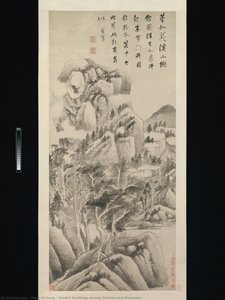
明 董其昌 溪山樾館圖 軸 紙本 Shaded Dwellings among Streams and Mountains (1622) de Dong Qichang

明 董其昌 溪山樾館圖 軸 紙本 Shaded Dwellings among Streams and Mountains

1622 · Ink On Paper

We are looking at 明 董其昌 溪山樾館圖 軸 紙本 Shaded Dwellings among Streams and Mountains, a significant work by the Ming dynasty artist Dong Qichang. Created in 1622, this piece is a vertical Chinese landscape painting, or Shanshui, rendered on paper. It represents a moment in the artist's career when his theories on the Southern School of painting were deeply integrated into his personal practice.

Picturi cu Dong Qichang, clasate de la 11 la 54

11Landscape in the Style of Mi Fu (1612) de Dong QichangLandscape in the Style of Mi Fu1612 · Metropolitan Museum of Art 12Poem in Cursive Script (1622) de Dong QichangPoem in Cursive Script1622 13Poem Commemorating an Imperially Bestowed Feast (1632) de Dong QichangPoem Commemorating an Imperially Bestowed Feast1632 · Metropolitan Museum of Art 14River and Mountains on a Clear Autumn Day (1625) de Dong QichangRiver and Mountains on a Clear Autumn Day1625 · Cleveland Museum of Art 15Poet Commemorating an Imperially Bestowed Feast (1632) de Dong QichangPoet Commemorating an Imperially Bestowed Feast1632 16Poem by Wang Wei (1632) de Dong QichangPoem by Wang Wei1632 17明 董其昌 山水圖 冊 紙本 Landscapes after old masters (1630) de Dong Qichang明 董其昌 山水圖 冊 紙本 Landscapes after old masters1630 · Metropolitan Museum of Art 18Spring Mountains over Warm Greenery (1630) de Dong QichangSpring Mountains over Warm Greenery1630 · Metropolitan Museum of Art 19明 董其昌 山水圖詩 冊 Landscapes and Poems (1625) de Dong Qichang明 董其昌 山水圖詩 冊 Landscapes and Poems1625 · Metropolitan Museum of Art 20English Five character Poem in Running Script (1644) de Dong QichangEnglish Five character Poem in Running Script1644 21Misty Trees and Mountain Range (1670) de Dong QichangMisty Trees and Mountain Range1670 · Minneapolis Institute of Art 22Summer Landscape de Dong QichangSummer LandscapeMetropolitan Museum of Art 23Autumn Mountains de Dong QichangAutumn MountainsMetropolitan Museum of Art 24Du Fu’s Poems in Running Script (1626) de Dong QichangDu Fu’s Poems in Running Script1626 25Calligraphy after ancient masters (1600) de Dong QichangCalligraphy after ancient masters1600 26Epitaph for Wang Jihuan and his Wife, Madame Min (1622) de Dong QichangEpitaph for Wang Jihuan and his Wife, Madame Min1622 27Shaded Dwellings among Streams and Mountains (1622) de Dong QichangShaded Dwellings among Streams and Mountains1622 · Metropolitan Museum of Art 28Steep Mountains and Silent Waters (1632) de Dong QichangSteep Mountains and Silent Waters1632 · Kimbell Art Museum 29Landscape in the Style of Ni Zan de Dong QichangLandscape in the Style of Ni Zan 30Letter de Dong QichangLetter 31River Landscape, in Ming style de Dong QichangRiver Landscape, in Ming style 32"Guitian fu" by Zhang Pingzi de Dong Qichang"Guitian fu" by Zhang Pingzi 33Scene in Jiangnan de Dong QichangScene in Jiangnan 34Letter de Dong QichangLetter 35Eight Views of Autumn Moods-8 de Dong QichangEight Views of Autumn Moods-8China Modern and Contemporary Art Document Research Center 36Eight Views of Autumn Moods-5 de Dong QichangEight Views of Autumn Moods-5China Modern and Contemporary Art Document Research Center 37Calligraphy de Dong QichangCalligraphy 38COUPLET IN RUNNING SCRIPT de Dong QichangCOUPLET IN RUNNING SCRIPT 39CALLIGRAPHY AFTER ZHONG YOU de Dong QichangCALLIGRAPHY AFTER ZHONG YOU 40CALLIGRAPHY IN CURSIVE SCRIPT de Dong QichangCALLIGRAPHY IN CURSIVE SCRIPT 41CALLIGRAPHY IN RUNNING SCRIPT de Dong QichangCALLIGRAPHY IN RUNNING SCRIPT 42LANDSCAPE de Dong QichangLANDSCAPE 43Eight Views of Autumn Moods-3 de Dong QichangEight Views of Autumn Moods-3China Modern and Contemporary Art Document Research Center 44LONELY TREES IN AN ISOLATED VILLAGE de Dong QichangLONELY TREES IN AN ISOLATED VILLAGE 45Eight Views of Autumn Moods-4 de Dong QichangEight Views of Autumn Moods-4China Modern and Contemporary Art Document Research Center 46Eight Views of Autumn Moods-2 de Dong QichangEight Views of Autumn Moods-2China Modern and Contemporary Art Document Research Center 47LETTERS de Dong QichangLETTERS 48COLLECTION OF LETTERS de Dong QichangCOLLECTION OF LETTERS 49CI POEMS IN RUNNING SCRIPT de Dong QichangCI POEMS IN RUNNING SCRIPT 50LANDSCAPE AND CALLIGRAPHY de Dong QichangLANDSCAPE AND CALLIGRAPHY 51ODE TO THE RED CLIFF IN RUNNING SCRIPT de Dong QichangODE TO THE RED CLIFF IN RUNNING SCRIPT 52Eight Views of Autumn Moods-1 de Dong QichangEight Views of Autumn Moods-1China Modern and Contemporary Art Document Research Center 53AUTUMN MOUNTAIN WITH RED TREES de Dong QichangAUTUMN MOUNTAIN WITH RED TREES 54Mountain landscape (1617) de Dong QichangMountain landscape1617 · National Gallery of Victoria

Piesele celebre ale lui Dong Qichang, perioadă cu perioadă

Subiectele care i-au captivat privirea lui Dong Qichang

Cele patru teme care revin cel mai des în aceste opere originale, fiecare având cel mai sublim exemplu.

Muzeele care păstrează originalele lui Dong Qichang

Cele 7 muzee care dețin cele mai multe dintre picturile de pe această pagină.

Muzee Oraș Lucrări lui Dong Qichang Picturi din această listă
Metropolitan Museum of Art, New YorkMetropolitan Museum of Art New York 10 明 董其昌 荊谿招隱圖 卷 Invitation to Reclusion at Jingxi, 明 董其昌 倣倪瓚山水圖 軸 Landscape with Trees in the Manner of Ni Zan (1301–1374), Landscape in the Style of Mi Fu
China Modern and Contemporary Art Document Research Center, BeijingChina Modern and Contemporary Art Document Research Center Beijing 7 Eight Views of Autumn Moods-6, Eight Views of Autumn Moods-8, Eight Views of Autumn Moods-5
Cleveland Museum of Art, ClevelandCleveland Museum of Art Cleveland 2 Mt. Qingbian, River and Mountains on a Clear Autumn Day
Minneapolis Institute of Art, MinneapolisMinneapolis Institute of Art Minneapolis 2 Studies of Traditional Trees and Rocks, Misty Trees and Mountain Range
Yale University Art Gallery, New HavenYale University Art Gallery New Haven 1 Reminiscence of Jian River
Kimbell Art Museum, Fort WorthKimbell Art Museum Fort Worth 1 Steep Mountains and Silent Waters
National Gallery of Victoria, MelbourneNational Gallery of Victoria Melbourne 1 Mountain landscape

Dong Qichang, o pictură emblematică pe deceniu

Lucrări pe deceniu

Alege o deceniu pentru a descoperi opera originală care îl definește.

Picturile lui Dong Qichang: răspunsurile galeriei

Care este cea mai celebră pictură a lui Dong Qichang?Află răspunsul

明 董其昌 荊谿招隱圖 卷 Invitation to Reclusion at Jingxi (1611), Metropolitan Museum of Art, New York. Urmează 明 董其昌 倣倪瓚山水圖 軸 Landscape with Trees in the Manner of Ni Zan (1301–1374) (1622) și Excerpt from Xie Huilian’s Prose Poem “On Snow”.

Ce vârstă avea Dong Qichang când a finalizat 明 董其昌 荊谿招隱圖 卷 Invitation to Reclusion at Jingxi?Află răspunsul

56 ani: 明 董其昌 荊谿招隱圖 卷 Invitation to Reclusion at Jingxi datează din 1611, iar Dong Qichang s-a născut în 1555.

Care sunt cele mai importante 10 picturi ale lui Dong Qichang?Află răspunsul

明 董其昌 荊谿招隱圖 卷 Invitation to Reclusion at Jingxi, 明 董其昌 倣倪瓚山水圖 軸 Landscape with Trees in the Manner of Ni Zan (1301–1374), Excerpt from Xie Huilian’s Prose Poem “On Snow”, Eight Views of Autumn Moods-6, Untitled (AQR4UL), Mt. Qingbian, Reminiscence of Jian River, Studies of Traditional Trees and Rocks, Transcription of the "Prose-poem on Promenading in the Back Garden" by Xie Tiao (464–499) and "Zuoyouming" by Cui Yuan (77–142) și 明 董其昌 溪山樾館圖 軸 紙本 Shaded Dwellings among Streams and Mountains. Clasamentul de mai sus indică anul și muzeul pentru fiecare piesă.

Câte lucrări a creat Dong Qichang?Află răspunsul

Catalogul nostru cuprinde 54 lucrări ale lui Dong Qichang, datate între 1600 și 1632.

Unde sunt expuse cele mai celebrele opere originale ale lui Dong Qichang?Află răspunsul

În principal în Metropolitan Museum of Art (New York), China Modern and Contemporary Art Document Research Center (Beijing) și Cleveland Museum of Art (Cleveland). Tabelul cu muzee de mai sus le enumeră pe toate.

Când a creat Dong Qichang cele mai faimoase picturi?Află răspunsul

În 1620s: 9 dintre cele 54 lucrări de pe această pagină au fost realizate atunci, fiind 明 董其昌 倣倪瓚山水圖 軸 Landscape with Trees in the Manner of Ni Zan (1301–1374) dintre acestea.

Care sunt cele mai vechi și cele mai recente opere celebre ale lui Dong Qichang?Află răspunsul

Pe această pagină, cea mai veche lucrare datează din Calligraphy after ancient masters (1600), iar cea mai recentă este din Poem Commemorating an Imperially Bestowed Feast (1632).

La ce subiecte s-a întors cel mai des Dong Qichang?Află răspunsul

Trees (9), Mountains (8) și Calligraphy (8), din cele 54 lucrări de pe această pagină.

În ce tehnică a lucrat cel mai mult Dong Qichang?Află răspunsul

Ink On Paper, pentru 16 dintre cele 54 lucrări de pe această pagină.

Ce opere originale ale lui Dong Qichang deține Metropolitan Museum of Art?Află răspunsul

明 董其昌 荊谿招隱圖 卷 Invitation to Reclusion at Jingxi, 明 董其昌 倣倪瓚山水圖 軸 Landscape with Trees in the Manner of Ni Zan (1301–1374) și Landscape in the Style of Mi Fu: Metropolitan Museum of Art, New York deține 10 dintre lucrările de pe această pagină.

Dong Qichang: artistul

O viață dedicată cernelei: Lumea lui Dong Qichang

Dong Qichang (1555–1636) a fost mai mult decât un simplu pictor; el a fost întruchiparea funcționarului-erudit din perioada de la sfârșitul dinastiei Ming, un om a cărui existență a fost împletită indisolubil cu caligrafia, pictura și o dedicare profundă teoriei artistice. Născut în Huating, în apropierea actualului Shanghai, într-o familie de intelectuali modeste, ambiția timpurie a lui Dong nu se îndrepta spre căutările artistice, ci spre obținerea unei poziții în birocrația imperială. Primele sale încercări de a trece examenele de serviciu civil s-au dovedit a fi nescuțite, în mare parte din cauza unei stângăci percepute în caligrafie – o ironie sorțiului, având în vedere că, ulterior, urma să fie celebrat ca unul dintre cei mai mari caligrafi ai Chinei. Această piedică l-a impulsionat spre o auto-perfecționare riguroasă, stăpânind nu doar tehnica pensulei, ci și bogatele tradiții ale expresiei literare și artistice chineze.

Persistența lui Dong a dat roade atunci când a trecut de cel mai înalt nivel al examenelor imperiale la vârsta de 34 de ani, lansând o carieră prin care a urcat pe scările ierarhiei guvernului Ming. Totuși, viața sa oficială nu a fost lipsită de turbulențe. El s-a confruntat cu controverse derivate din standardele sale neîmblânzite și de la o personalitate uneori aspră, ceea ce i-a adus perioade de retragere și chiar un incident în care casa sa a fost atacată de o mulțime furioasă, după ce s-a raportat că ar fi insultat femei care căutau dreptate pentru nedreptățile suferite. În ciuda acestor provocări, Dong a rămas neclintit în căutările sale artistice, considerându-le parte integrantă a identității sale și un mijloc de a-și exprima convingerile filozofice profunde.

Cele Două Școli și Idealul Sudic

Cea mai durabilă moștenire a lui Dong Qichang nu rezidă doar în picturile sale, ci în teoria revoluționară a artei pe care a elaborat-o. El a propus o diviziune în cadrul picturii de peisaj chinezească în două școli distincte: „Școala de Nord” și „Școala de Sud”. Această categorisire, sugerată inițial de prietenul său Mo Shilong, nu se baza pe criterii geografice, ci pe fundamentul filosofic adânc înrădăcinat în budismul Chan. Școala de Nord, susținea el, puneva accentul pe detaliul minuțios, pe culorile vibrante și pe o dobândire graduală a tehnicii, concentrându-se pe măiestria tehnică și pe apelul către gusturile publicului larg. În contrast, Școala de Sud prioritiza mișcarea expresivă a pensulei, spontaneitatea caligrafică și o înțelegere intuitivă a esenței, întruchipând spiritul învățaților-amatori care pictau pentru auto-cultivare, nu pentru câștig comercial.

El a apărat Școala de Sud ca fiind adevăratul moștenitor al tradiției artistice chineze, crezând că practicanții acesteia ating o înțelegere mai profundă prin expresia directă. Elementul central al acestui ideal era însă caligrafia însăși – privită nu doar ca un scris decorativ, ci ca o manifestare a caracterului interior și a stării spirituale a artistului. Dong admira maeștri precum Mi Fu și Ni Zan, considerându-i exemplare ale acestui stil individualist. El credea că artiștii ar trebui să construiască pe fundațiile lăsate de acești predeboșeni, transformând tradiția în loc să o imite pur și simplu, atingând astfel o formă de „iluminare bruscă” prin opera lor.

Un stil de peisaj unic: Distorsiune și Expresivitate

Păișajurile pictate de Dong Qichang reflectă profund convingerile sale teoretice. Acesta a evitat în mod deliberat superficialitatea sau sentimentalismul, optând în schimb pentru peisaje caracterizate prin trăsături spațiale intenționat distorsionate și o concentrare pe brushwork expresiv. Deși ancorată în tradițiile maeștrilor din dinastia Yuan – în special în cele ale „Patrui Maștri” – opera sa a fost distinct personală. El nu căuta un realism fotografic, ci mai degrabă evocarea unei atmosfere, a unei stări de spirit și a unei rezonanțe spirituale.

Cartea sa de schițe, ce conține studii timpurii ale pietrelor și copacilor, oferă o privire rară asupra procesului său analitic. Aceste schițe, de o simplitate înșelătoare, dezvăluie observația sa meticuloasă a naturii și explorarea unor posibilități compoziționale diverse. Lucrările de maturitate, precum „Munții de Toamnă”, demonstrează tehnica sa magistrală de lavaj de cerneală, creând peisaje senene care invită la contemplare. Picturile sale prezintă adesea munți impunători învăluiți în ceață, râuri șerpuite și scene cu populație rară – toate randate printr-un echilibru delicat între control și spontaneitate.

Moștenire și Influență

Influența lui Dong Qichang asupra generațiilor ulterioare de artiști chinezi a fost profundă, marcând un punct de cotitură în estetica orientală. Teoriile sale revoluționare privind școlile de Nord și de Sud s-au cristalizat în discursul estetic, modelând direcția picturii de peisaj pentru secolele ce au urmat. Prin viziunea sa, el a inspirat un val de pictori „individualiști”, care au căutat să emuleze stilul său expresiv și abordarea sa filozofică, transformând actul creației într-o călătorie spirituală profundă.

Primele decenii dinastiei Qing au fost martorii ascensiunii mai multor artiști de renume – inclusiv „Cei Patru Monzi” și „Cei Patru Wang” – care au fost direct influențați de opera lui Dong. Colecționorii, în special cei din regiuni prospere precum Sungchiang și Yangchou, au căutat cu ardoare picturile sale și pe cele ale urmașilor săi, consolidând astfel reputația sa de maestru incontestabil. Chiar și în prezent, Dong Qichang este venerat ca una dintre cele mai importante figuri din istoria artei chineze – un funcționar-erudit a cărui dedicare neclintită pentru cerneală și pensulă a transformat nu doar pictura, ci și însăși modul în care artiștii își înțelegeau locul în cadrul tradiției.

  • Teme Principale: Cultura eruditului, Budismul Chan, estetica peisajului, exprimarea individuală
  • Influențe: Zhao Mengfu, Wen Zhengming, Mi Fu, Ni Zan, Maștrii Dinastiei Yuan
  • Caracteristici Cheie: Trăsături spațiale distorsionate, pictus expresiv prin pensulă, tehnica ink wash, spontaneitate caligrafică