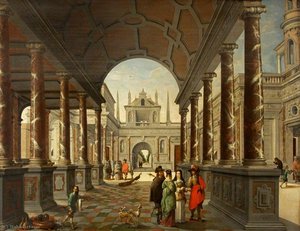
Portretul lui Dirck Van Delen

Picturi Dirck Van Delen: Cele 57 de cele mai faimoase, prin ochii unei galerii

Actualizat Octombrie 2026 · clasat în funcție de scorul nostru de popularitate (căutări, vizite și comenzi pentru fiecare operă) · 57 lucrări ale lui Dirck Van Delen în catalogul nostru

Pe scurt

În ochii galeriei, cea mai celebră pictură a lui Dirck Van Delen este A musical company in a Renaissance hall (1636), a cărei originală este expusă la Museum Boijmans Van Beuningen, Rotterdam. Iconoclasm in a Church (1630) și A colonnade. Part of a seven-part deorative sequence (1630) completează trioul pe care orice ochi îl recunoaște. Dintre cele 57 opere ale lui Dirck Van Delen din catalogul nostru, galeria prezintă mai jos cele 57 cele mai faimoase, fiecare fiind originală, cu anul creării, muzeul de păstrare și elementul care o face unică.

1605 – 1671, Heusden Baroque Cele mai multe lucrări: Rijksmuseum

Cele mai apreciate 10 picturi ale lui Dirck Van Delen din galerie

1
A musical company in a Renaissance hall (1636) de Dirck Van Delen

A musical company in a Renaissance hall

1636 · Oil On Canvas · Museum Boijmans Van Beuningen, Rotterdam

A checkered floor of stone and shadow stretches toward a distant, imagined horizon. In this Renaissance hall, the geometry of the room dictates the movement of the soul. Light spills from unseen windows on the left, catching the sharp edge of a lace collar and the heavy sheen of satin. The air feels still, held in place by massive columns and the weight of dark, polished wood. Figures gather in…

3
A colonnade. Part of a seven-part deorative sequence (1630) de Dirck Van Delen

A colonnade. Part of a seven-part deorative sequence

1630 · Oil On Canvas · Rijksmuseum, Amsterdam

A colonnade. Part of a seven-part deorative sequence is an oil on canvas by Dirck van Delen. The work is dated 1630. It is also known by the title Gallery of a Palace with Ornamental Architecture and Columns. This painting was designed to function as part of a larger whole, serving as one piece of a seven-part wall decoration intended for a room in a palace.

4
The tomb of a Lord from the Van Tuyll van Serooskerken-family (1634) de Dirck Van Delen

The tomb of a Lord from the Van Tuyll van Serooskerken-family

1634 · Oil On Panel · Staatliche Kunsthalle Karlsruhe, Karlsruhe

In this 1634 work, we find ourselves standing within a space that feels both profoundly real and entirely imagined. Dirck van Delen, a painter who specialized in the construction of architectural fantasies, has crafted a monumental funerary monument for a member of the Van Tuyll van Serooskerken family. The scene is defined by a rigorous linear perspective that draws the eye deep into a grand, silent interior. A sense of…

5
An Architectural Fantasy (1634) de Dirck Van Delen

An Architectural Fantasy

1634 · Oil · National Gallery, Londra

The scene unfolds within An Architectural Fantasy, a work painted by Dirck van Delen in 1634. This composition presents an idealised city square, where the mathematical precision of perspective and proportion meets the shifting play of light and shade. The space feels vast and structured, inviting the eye to wander through a world of imagined grandeur and architectural order.

6
The Real Tennis Players (1626) de Dirck Van Delen

The Real Tennis Players

1626 · Oil On Panel

The Real Tennis Players is a work by Dirck van Delen, an artist who emerged from Heusden, Netherlands. This particular piece dates to about 1626, a period during which the artist was establishing his presence within the Dutch Golden Age. Van Delen, who lived from 1605 to 1671, focused his attention on the intricate details of architectural spaces and the social life contained within them.

7
Architectural Fantasy with Figures (1633) de Dirck Van Delen

Architectural Fantasy with Figures

1633 · Oil · Noordbrabants Museum, 's-Hertogenbosch

Architectural Fantasy with Figures emerges from the mind of Dirck van Delen, a painter who crafts grand, imagined spaces that challenge the boundaries of reality. This work invites the viewer into a structured world of palatial scale and mathematical precision. The artist, born in Heusden, Netherlands, in 1605, spent his life building these illusions of stone and light. He remains a significant figure of the Dutch Golden Age, having lived…

8
Gallant Scene in a Palace (1633) de Dirck Van Delen

Gallant Scene in a Palace

1633 · Oil On Panel · Petit Palais, Paris

Gallant Scene in a Palace is a work by Dirck van Delen, executed in 1633. The artist, born in Heusden, Netherlands, in 1605, spent his life crafting the geometry of imagined spaces. He died in 1671, leaving behind a legacy of structured illusions and precise perspectives.

9
An Interior with Ladies and Cavaliers (1629) de Dirck Van Delen

An Interior with Ladies and Cavaliers

1629 · Oil On Canvas · National Gallery of Ireland, Dublin

In the quiet, structured world of 1629, An Interior with Ladies and Cavaliers emerges from the brush of Dirck van Delen. This work invites the viewer into an intimate interior where genre scenes unfold amidst the grandeur of a private space. The scene captures a moment of social grace, pulling us into a setting where the architecture itself feels like a silent participant in the gathering.

10
Architectural Interior at Night with the Priests of Bel (1628) de Dirck Van Delen

Architectural Interior at Night with the Priests of Bel

1628 · Oil On Canvas · Rhode Island School of Design Museum of Art, Providence

Architectural Interior at Night with the Priests of Bel by Dirck van Delen depicts a gathering of priests or religious figures within a large interior at night. The composition is structured around a deep linear perspective that directs the viewer's gaze through a series of receding classical arches and colonnades. These architectural elements lead toward a distant, dimly lit interior. The use of lines is rigorous throughout the scene, with…

Picturi cu Dirck Van Delen, clasate de la 11 la 57

11Architectural Scene: A Palace Court (1627) de Dirck Van DelenArchitectural Scene: A Palace Court1627 · Rhode Island School of Design Museum of Art 12Allegory on the suppression of religious freedom in the Netherlands under the Duke of Alva; the 17 Dutch provincial virgins kneeling for Alva, Granvelle and the pope, in the background the decapitation of Egmond and Hoorne on the market in Brussels (1629) de Dirck Van DelenAllegory on the suppression of religious freedom in the Netherlands under the Duke of Alva; the 17 Dutch provincial virgins kneeling for Alva, Granvelle and the pope, in the background the decapitation of Egmond and Hoorne on the market in Brussels1629 · Museum Catharijneconvent 13Architectural fantasy with figures (1633) de Dirck Van DelenArchitectural fantasy with figures1633 14Fantasy architecture with an elegant couple (1627) de Dirck Van DelenFantasy architecture with an elegant couple1627 · Noordbrabants Museum 15Fantasy architecture with two elegant couples (1633) de Dirck Van DelenFantasy architecture with two elegant couples1633 · Noordbrabants Museum 16Interior of Church (1635) de Dirck Van DelenInterior of Church1635 · Muzeul Regal de Arte Frumoase din Anvers 17Distinguished Dinner Company in an Interior (1631) de Dirck Van DelenDistinguished Dinner Company in an Interior1631 · Nationalmuseum 18A palatial interior with ladies and gentleman feasting, entertained by Carnival mummers (1632) de Dirck Van DelenA palatial interior with ladies and gentleman feasting, entertained by Carnival mummers1632 19Fantasy architecture with four elegantly dressed women on the steps of a ramp (1627) de Dirck Van DelenFantasy architecture with four elegantly dressed women on the steps of a ramp1627 · New York Historical Society 20A Seven-Part Decorative Sequence: An Interior, Dirck van Delen, 1630 - 1632 (1632) de Dirck Van DelenA Seven-Part Decorative Sequence: An Interior, Dirck van Delen, 1630 - 16321632 · Rijksmuseum 21Colonnade with people and playing children (1637) de Dirck Van DelenColonnade with people and playing children1637 22Conversation outside a Palace (1636) de Dirck Van DelenConversation outside a Palace1636 · Statens Museum For Kunst 23Company at a Palace (1645) de Dirck Van DelenCompany at a Palace1645 · Statens Museum For Kunst 24Christ Healing at the Pool of Bethesda (1637) de Dirck Van DelenChrist Healing at the Pool of Bethesda1637 · Statens Museum For Kunst 25Elegant Company in Front of a Palace (1644) de Dirck Van DelenElegant Company in Front of a Palace1644 · Statens Museum For Kunst 26Susanna and the two elders (1640) de Dirck Van DelenSusanna and the two elders1640 · Museum Boijmans Van Beuningen 27A Family beside the Tomb of Prince William I in the Nieuwe Kerk, Delft (1645) de Dirck Van DelenA Family beside the Tomb of Prince William I in the Nieuwe Kerk, Delft1645 · Rijksmuseum 28Baroque church interior with a friar and peasants (1645) de Dirck Van DelenBaroque church interior with a friar and peasants1645 29Courtyard of a palace (1636) de Dirck Van DelenCourtyard of a palace1636 · Staatliche Kunsthalle Karlsruhe 30Church Interior with the Parable of the Pharisee and the Publican (Luke 18:9-14) (1653) de Dirck Van DelenChurch Interior with the Parable of the Pharisee and the Publican (Luke 18:9-14)1653 31Interior of a Gothic Church, Dirck van Delen, 1641 (1641) de Dirck Van DelenInterior of a Gothic Church, Dirck van Delen, 16411641 · Rijksmuseum 32The Great Hall of the Binnenhof in The Hague (1651) de Dirck Van DelenThe Great Hall of the Binnenhof in The Hague1651 · Rijksmuseum 33Great Garden Palace (1640) de Dirck Van DelenGreat Garden Palace1640 · Muzeul Kunsthistorisches din Viena 34A Seven-Part Decorative Sequence: An Outdoor Stairway, Dirck van Delen, 1630 - 1632 (1632) de Dirck Van DelenA Seven-Part Decorative Sequence: An Outdoor Stairway, Dirck van Delen, 1630 - 16321632 · Rijksmuseum 35A Seven-Part Decorative Sequence: An Outdoor Stairway, Dirck van Delen, 1630 - 1632 (1632) de Dirck Van DelenA Seven-Part Decorative Sequence: An Outdoor Stairway, Dirck van Delen, 1630 - 16321632 · Rijksmuseum 36A Seven-Part Decorative Sequence: An Outdoor Stairway, Dirck van Delen, 1630 - 1632 (1632) de Dirck Van DelenA Seven-Part Decorative Sequence: An Outdoor Stairway, Dirck van Delen, 1630 - 16321632 · Rijksmuseum 37A Seven-Part Decorative Sequence: An Outdoor Stairway, Dirck van Delen, 1630 - 1632 (1632) de Dirck Van DelenA Seven-Part Decorative Sequence: An Outdoor Stairway, Dirck van Delen, 1630 - 16321632 · Rijksmuseum 38A Seven-Part Decorative Sequence: A Gallery, Dirck van Delen, 1630 - 1632 (1632) de Dirck Van DelenA Seven-Part Decorative Sequence: A Gallery, Dirck van Delen, 1630 - 16321632 · Rijksmuseum 39Architectural Capriccio with Jephthah and His Daughter (1633) de Dirck Van DelenArchitectural Capriccio with Jephthah and His Daughter1633 40Palace Courtyard with Figures (1635) de Dirck Van DelenPalace Courtyard with Figures1635 · Philip Hahn Collection 41Elegant Figures in a Loggia (1635) de Dirck Van DelenElegant Figures in a Loggia1635 42An Interior with Ladies and Gentlemen Dining (1629) de Dirck Van DelenAn Interior with Ladies and Gentlemen Dining1629 43Tulip in a Wanli Kendi (1637) de Dirck Van DelenTulip in a Wanli Kendi1637 44A church interior (1642) de Dirck Van DelenA church interior1642 · Finnish National Gallery 45Fantasy architecture with steps and columns (1655) de Dirck Van DelenFantasy architecture with steps and columns1655 · Muzeul Kunsthistorisches din Viena 46Conversation outside a Castle (1636) de Dirck Van DelenConversation outside a Castle1636 · Statens Museum For Kunst 47Perspective Fantasy of a Palace, with Elegant Figures de Dirck Van DelenPerspective Fantasy of a Palace, with Elegant Figures 48An architectural fantasy de Dirck Van DelenAn architectural fantasy 49An Imaginary Church Interior, with a Large Pipe Organ de Dirck Van DelenAn Imaginary Church Interior, with a Large Pipe Organ 50A dutch garden scene de Dirck Van DelenA dutch garden scene 51Jupiter and Alkmene in an Architectural Setting de Dirck Van DelenJupiter and Alkmene in an Architectural Setting 52Interior of a Church de Dirck Van DelenInterior of a ChurchFitzwilliam Museum 53Interior of a Renaissance Church de Dirck Van DelenInterior of a Renaissance Church 54Pool of Bethesda de Dirck Van DelenPool of Bethesda 55Christ and the Woman Taken in Adultery de Dirck Van DelenChrist and the Woman Taken in Adultery 56A Conversation in a Palace Courtyard de Dirck Van DelenA Conversation in a Palace CourtyardScottish National Gallery 57The Entrance to a Palace de Dirck Van DelenThe Entrance to a PalaceDulwich Picture Gallery

Piesele celebre ale lui Dirck Van Delen, perioadă cu perioadă

Subiectele care i-au captivat privirea lui Dirck Van Delen

Cele patru teme care revin cel mai des în aceste opere originale, fiecare având cel mai sublim exemplu.

Muzeele care păstrează originalele lui Dirck Van Delen

Cele 8 muzee care dețin cele mai multe dintre picturile de pe această pagină.

Muzee Oraș Lucrări lui Dirck Van Delen Picturi din această listă
Rijksmuseum, AmsterdamRijksmuseum Amsterdam 11 Iconoclasm in a Church, A colonnade. Part of a seven-part deorative sequence, A Seven-Part Decorative Sequence: An Interior, Dirck van Delen, 1630 - 1632
Statens Museum For Kunst, CopenhagaStatens Museum For Kunst Copenhaga 5 Conversation outside a Palace, Company at a Palace, Christ Healing at the Pool of Bethesda
Noordbrabants Museum, 's-HertogenboschNoordbrabants Museum 's-Hertogenbosch 3 Architectural Fantasy with Figures, Fantasy architecture with an elegant couple, Fantasy architecture with two elegant couples
Museum Boijmans Van Beuningen, RotterdamMuseum Boijmans Van Beuningen Rotterdam 2 A musical company in a Renaissance hall, Susanna and the two elders
Staatliche Kunsthalle Karlsruhe, KarlsruheStaatliche Kunsthalle Karlsruhe Karlsruhe 2 The tomb of a Lord from the Van Tuyll van Serooskerken-family, Courtyard of a palace
Rhode Island School of Design Museum of Art, ProvidenceRhode Island School of Design Museum of Art Providence 2 Architectural Interior at Night with the Priests of Bel, Architectural Scene: A Palace Court
Muzeul Kunsthistorisches din Viena, VienaMuzeul Kunsthistorisches din Viena Viena 2 Great Garden Palace, Fantasy architecture with steps and columns
National Gallery, LondraNational Gallery Londra 1 An Architectural Fantasy

Dirck Van Delen, o pictură emblematică pe deceniu

Lucrări pe deceniu

Alege o deceniu pentru a descoperi opera originală care îl definește.

Picturile lui Dirck Van Delen: răspunsurile galeriei

Care este cea mai celebră pictură a lui Dirck Van Delen?Află răspunsul

A musical company in a Renaissance hall (1636), Museum Boijmans Van Beuningen, Rotterdam. Urmează Iconoclasm in a Church (1630) și A colonnade. Part of a seven-part deorative sequence (1630).

Ce vârstă avea Dirck Van Delen când a finalizat A musical company in a Renaissance hall?Află răspunsul

31 ani: A musical company in a Renaissance hall datează din 1636, iar Dirck Van Delen s-a născut în 1605.

Care sunt cele mai importante 10 picturi ale lui Dirck Van Delen?Află răspunsul

A musical company in a Renaissance hall, Iconoclasm in a Church, A colonnade. Part of a seven-part deorative sequence, The tomb of a Lord from the Van Tuyll van Serooskerken-family, An Architectural Fantasy, The Real Tennis Players, Architectural Fantasy with Figures, Gallant Scene in a Palace, An Interior with Ladies and Cavaliers și Architectural Interior at Night with the Priests of Bel. Clasamentul de mai sus indică anul și muzeul pentru fiecare piesă.

Câte lucrări a creat Dirck Van Delen?Află răspunsul

Catalogul nostru cuprinde 57 lucrări ale lui Dirck Van Delen, datate între 1626 și 1655.

Unde sunt expuse cele mai celebrele opere originale ale lui Dirck Van Delen?Află răspunsul

În principal în Rijksmuseum (Amsterdam), Statens Museum For Kunst (Copenhaga) și Noordbrabants Museum ('s-Hertogenbosch). Tabelul cu muzee de mai sus le enumeră pe toate.

Când a creat Dirck Van Delen cele mai faimoase picturi?Află răspunsul

În 1630s: 27 dintre cele 57 lucrări de pe această pagină au fost realizate atunci, fiind A musical company in a Renaissance hall dintre acestea.

Care sunt cele mai vechi și cele mai recente opere celebre ale lui Dirck Van Delen?Află răspunsul

Pe această pagină, cea mai veche lucrare datează din The Real Tennis Players (1626), iar cea mai recentă este din Fantasy architecture with steps and columns (1655).

La ce subiecte s-a întors cel mai des Dirck Van Delen?Află răspunsul

Architecture (28), Columns (26) și People (14), din cele 57 lucrări de pe această pagină.

În ce tehnică a lucrat cel mai mult Dirck Van Delen?Află răspunsul

Oil On Panel, pentru 13 dintre cele 57 lucrări de pe această pagină.

Cu ce mișcare este asociat(ă) Dirck Van Delen?Află răspunsul

Baroque, judecând după originalele de pe această pagină.

Ce opere originale ale lui Dirck Van Delen deține Rijksmuseum?Află răspunsul

Iconoclasm in a Church, A colonnade. Part of a seven-part deorative sequence și A Seven-Part Decorative Sequence: An Interior, Dirck van Delen, 1630 - 1632: Rijksmuseum, Amsterdam deține 11 dintre lucrările de pe această pagină.

Dirck Van Delen: artistul

Dirck van Delen: Arhitectul Iluziei

Epoca de Aur a Olandei a produs o multitudine uimitoare de artiști, dar puțini au captivat imaginația la fel de intens ca Dirck van Delen (1605-1671). Mai mult decât un simplu pictor, Van Delen era un arhitect al iluziei, creând meticulos palate imposibile și interioare de biserici uluitoare care sfidau realitatea. Lucrările sale, în mare parte restrânse la fantasme arhitecturale, oferă o fereastră unică spre aspirațiile și sensibilitățile artistice ale Europei secolului al XVII-lea – o perioadă obsedată de fastul, perspectiva și sublimul.

Născut în Heusden, Țările de Jos, viața timpurie a lui Van Delen rămâne parțial învăluită în mister. Detaliile precise ale său de ucenicie sunt dezbătute de istoricii de artă, cu speculații centrate pe posibilele tutelaje sub Frans Hals și Hendrick Aerts, deși o influență mai plauzibilă provine din studiile sale sub Pieter van Bronckhorst și Bartholomeus van Bassen în Delft. Această conexiune cu Delft este semnificativă, deoarece sugerează o expunere timpurie la tendințele artistice înfloritoare ale Țărilor de Jos – în special la priceperea tehnică meticuloasă și precizia arhitecturală promovate de figuri precum Jan van Londerseel, a cărei grafică a modelat profund limbajul vizual al operei sale.

Cariera lui Van Delen s-a desfășurat în principal în Arnemuiden, unde a servit ca șef al unei case de taxe și ulterior a ocupat o poziție proeminentă în consiliul orașului. Această implicare civică i-a oferit stabilitate, permițându-i să se dedice cu pasiune artei sale. S-a căsătorit de trei ori și, deși nu a avut copii care să supraviețuiască dincolo de copilărie, a lăsat în urmă o moștenire prin elevii săi – Daniël de Blieck și Hans Jurriaensz. van Baden – care au perpetuat elemente ale stilului său distinctiv.

Paleta Artistului: Stil și Tehnică

Identitatea artistică a lui Van Delen este ferm înrădăcinată în perioada Barocului, dar a dezvoltat o abordare individuală. Pânzele sale sunt caracterizate de o atenție aproape obsesivă la detalii, redând meticulos fiecare coloană, cornice și elemente decorative din spațiile arhitecturale imaginare. Spre deosebire de mulți contemporani săi care s-au concentrat pe scene narative sau portrete, subiecții lui Van Delen au fost în întregime auto-conținători – palate opulente și biserici impunătoare proiectate exclusiv pentru plăcerea privitorului.

Paleta sa era remarcabil de consistentă pe tot parcursul carierei sale, favorizând o gamă rafinată dar sofisticată de culori: albastrele și verdele reci contrastează cu ocruurile și roșiile calde, adesea punctate de folie aurie strălucitoare. A manipulat cu măiestrie lumina și umbra pentru a crea iluzia adâncimii și volumului, folosind tehnici împrumutate de la maeștrii flamenzi, dar infuzate cu propria sa sensibilitate unică.

Influența lui Hendrick Aerts este în special evidentă în primele lucrări ale lui Van Delen, caracterizate printr-o redare meticuloasă a detaliilor arhitecturale și o utilizare subtilă a perspectivei. Este important de menționat că Van Delen a lucrat adesea în colaborare cu alți artiști, cel mai frecvent Gonzales Coques și Pieter Codde. Deși natura exactă a acestor parteneriate rămâne dezbătută, se crede că Van Delen s-a concentrat în principal pe pictarea figurilor din interiorul compozițiilor sale, bazându-se pe abilitățile altora pentru a executa elementele arhitecturale. Această împărțire a muncii reflectă o abordare pragmatică a producției artistice – una care i-a permis să se concentreze pe punctul său forte: crearea de iluzii convingătoare și credibile.

Regate Imaginar: Tematici și Simbolism

Fantasmele arhitecturale ale lui Van Delen nu sunt doar exerciții decorative; ele sunt imbricate cu semnificație simbolică. Palatele sale, adesea decorate cu sculpturi elaborate și mobilier opulent, reprezintă idealurile bogăției, puterii și autorității divine – calități foarte apreciate în epoca de Aur a Olandei. Includerea figurilor în interiorul acestor spații – adesea implicate în activități curtei sau ceremonii religioase – sugerează o dorință de a explora relația dintre ambiția umană și aspirațiile spirituale.

Interioarele bisericii sale, la fel de impresionante prin scară și detaliu, evocă un sentiment de uimire și venerare. Aceste spații meticulos pictate, pline de arce înalte, ferestre colorate cu vitralii și ornamente complicate, reprezintă gloria lui Dumnezeu și puterea durabilă a credinței. Utilizarea perspectivei este în special remarcabilă, creând iluzia unei vastități care atrage privitorul în inima spațiului arhitectural.

Un aspect fascinant al operei lui Van Delen este includerea ocazională a naturilor moarte – notabil o singură aranjament floral – care stau în contrast brusc cu subiecții săi predominant arhitecturali. Aceste scene intime oferă o perspectivă asupra unei laturi mai personale a artistului, sugerând o apreciere pentru frumusețea și formele naturale.

Moștenire și Influență

Deși a rămas relativ obscur în timpul vieții sale, opera lui Dirck van Delen a câștigat recunoaștere crescândă în ultimii ani. Pânzele sale fantasme arhitecturale sunt încă captivate de calitățile lor iluzioniste și de portretizarea evocatoare a epocii de Aur a Olandei.

Van Delen este considerat o figură cheie în dezvoltarea picturii baroce olandeze, în special pentru utilizarea sa pionieristică a perspectivei și capacitatea sa de a crea iluzii convingătoare ale spațiului. Moștenirea sa trădează puterea imaginației artistice – un memento că chiar cele mai imposibile vise pot fi reprezentate cu o detaliere uimitoare și măiestrie.