A Legacy of Light and Water
Clara Federica Montalba stands as a luminous figure in the late nineteenth-century art world, a painter whose brush captured the ephemeral beauty of the Venetian landscape with unparalleled grace. Born in Cheltenham, United Kingdom, she was part of a remarkable artistic dynasty, being the eldest of four daughters born to the Swedish-born artist Anthony Rubens Montalba and Emeline Davies. This familial environment, steeped in creativity, nurtured her talent from an early age, as all four of her sisters achieved significant artistic renown. Her journey through the world of fine art was marked by a profound connection to the water, particularly the shimmering canals and bustling harbors that defined much of her subject matter.
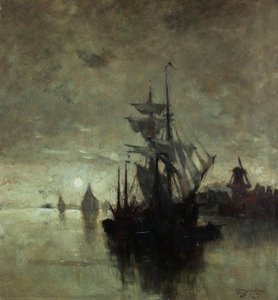
Her formal training took her far beyond her English roots, leading her to study in Paris under Eugene Isabode and later immersing herself in the rich traditions of the Accademia di Belle Arti in Venice. It was within this Italian setting that her artistic voice truly flourished. She became particularly celebrated for her watercolor paintings, which possessed a delicate ability to translate the atmospheric nuances of Venice. Whether capturing the quiet majesty of a moonlit scene or the vibrant energy of a busy port, her work resonated with a sense of place and a deep emotional connection to the environments she inhabited.
Artistic Mastery and Recognition
The breadth of Montalba's technical skill allowed her to move seamlessly between mediums, though her mastery of watercolor remains her most enduring hallmark. Her compositions often invited viewers into a world of movement and light; for instance, her oil on canvas work, such as The Port of Amsterdam, demonstrated an impressive ability to render the bustling activity of a harbor, from the intricate details of sailboats and steamships to the lively presence of people tending to their vessels. This capacity to blend large-scale maritime scenes with intimate human moments showcased a versatility that earned her international acclaim.
Throughout her career, Montalba was a frequent and respected presence in the most prestigious art circles of her era. Her achievements were marked by several significant milestones:
- Exhibition at the Grosvenor Gallery: Between 1879 and 1889, she showcased her talent at this renowned London institution, establishing her reputation among the European elite.
- Royal Watercolour Society: In 1892, in a profound recognition of her technical excellence, she was admitted into the Royal Watercolour Society, styling herself with the prestigious RWS designation.
- International Presence: Her work traveled far beyond the borders of Europe, notably being featured at the 1893 World's Columbian Exposition in Chicago, Illinois, where she presented her art to a global audience.
A Visionary Spirit
Beyond her technical prowess, Clara Montalba was a woman of significant social character. She was an early feminist, recognized by Millicent Garrett Fawcett as one of the accomplished women who provided vital support to the movement. This strength of spirit mirrored the resilience and independence found in her art. Her life, which eventually led her back to Venice where she passed away, was a testament to a life lived through the lens of beauty and purpose. Today, her work remains a vital window into the late nineteenth century, preserving the light, the movement, and the enduring soul of the cities she so lovingly painted.
Întrebări și răspunsuri
Sub ce alte nume este cunoscut/ă Clara Montalba?
Clara Montalba este cunoscut și sub numele de Clara Federica Montalba.
Pot să explorez lucrările lui Clara Montalba în funcție de paleta de culori?
Pentru a găsi lucrări de Clara Montalba într-o anumită paletă de culori, utilizați pagina După palete de culori a artistului.
Ce stări exprimă operele lui Clara Montalba?
Operele lui Clara Montalba pot fi explorate în funcție de starea de spirit pe pagina Spațiu pe stări de spirit a artistului, care organizează lucrările după stările lor de spirit regăsite.