Portretul lui Christopher Pearse Cranch

Cele 34 cele mai faimoase picturi ale lui Christopher Pearse Cranch, fiecare unică în felul ei

Actualizat Octombrie 2026 · clasat în funcție de scorul nostru de popularitate (căutări, vizite și comenzi pentru fiecare operă) · 34 lucrări ale lui Christopher Pearse Cranch în catalogul nostru

Pe scurt

River Running between Pastures (1850) este pictură lui Christopher Pearse Cranch care atrage cele mai multe priviri. După aceasta, privirea se îndreaptă către Sunset Landscape și View on the Catskill River (1846). Dintre cele 34 opere ale lui Christopher Pearse Cranch din catalogul nostru, acestea 34 sunt cele mai celebre, fiecare fiind o piesă unică, prezentată împreună cu anul creării, muzeul deținător și motivul pentru care aceasta rămâne memorabilă.

1813 – 1892, Columbia Hudson river school Cele mai multe lucrări: New York Historical Society

Cele mai importante 10 picturi ale lui Christopher Pearse Cranch, prin ochii galeriei

1
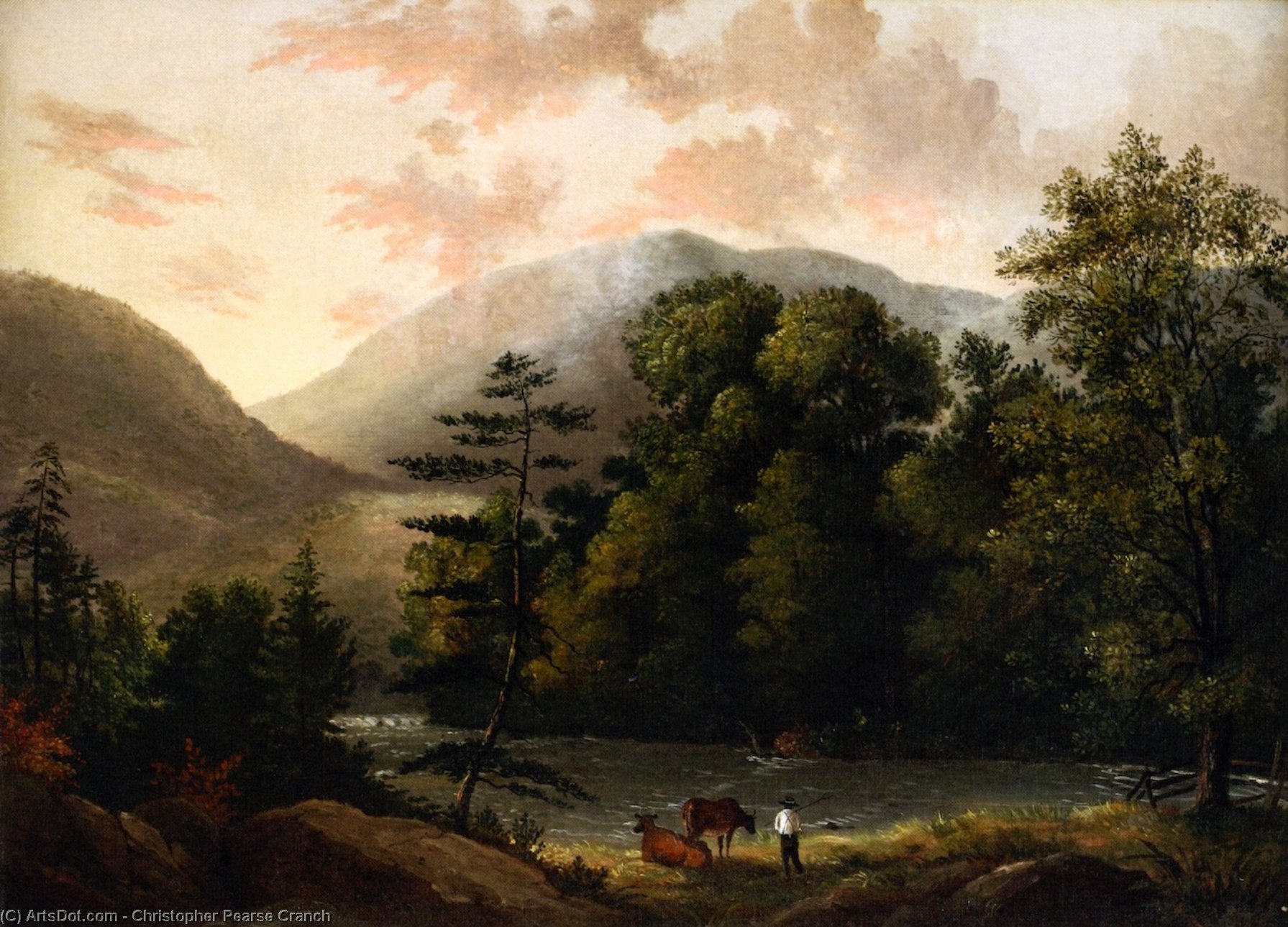
River Running between Pastures (1850) de Christopher Pearse Cranch

River Running between Pastures

1850 · Oil

A river carves a path through a lush valley, flanked by dense, green foliage. In the distance, mountains rise against the horizon, framing a scene of quiet pastoral life. Along the riverbanks, cows graze peacefully, while horses move through the landscape. A solitary figure stands near the center, observing the movement of the water or tending to the livestock. The composition captures a moment of stillness within the natural world.

Păiți celebrele picturi ale lui Christopher Pearse Cranch, de la numărul 11 la 34

Subiectele care i-au captivat privirea lui Christopher Pearse Cranch

Cele patru teme care revin cel mai des în aceste opere originale, fiecare având cel mai sublim exemplu.

Muzeele care păstrează originalele lui Christopher Pearse Cranch

Cele 5 muzee care dețin cele mai multe dintre picturile de pe această pagină.

Muzee Oraș Lucrări lui Christopher Pearse Cranch Picturi din această listă
New York Historical Society, New York CityNew York Historical Society New York City 2 View on the Catskill River, Landscape
Addison Gallery of American Art, MassachusettsAddison Gallery of American Art Massachusetts 1 Sunset Landscape
Fogg Art Museum, CambridgeFogg Art Museum Cambridge 1 View on the Hudson
National Gallery of Art, WashingtonNational Gallery of Art Washington 1 Castle Gondolfo, Lake Albano, Italy
Muzeul de Artă Plastică din Boston, BostonMuzeul de Artă Plastică din Boston Boston 1 San Pietro in Castello, Venice

Christopher Pearse Cranch de-a lungul deceniilor: o piesă unică pentru fiecare

Lucrări pe deceniu

Alege o deceniu pentru a descoperi opera originală care îl definește.

Picturile lui Christopher Pearse Cranch: întrebări pentru galerie

Care este cea mai celebră operă a lui Christopher Pearse Cranch?Află răspunsul

River Running between Pastures (1850). Urmează Sunset Landscape și View on the Catskill River (1846).

La ce vârstă a creat Christopher Pearse Cranch River Running between Pastures?Află răspunsul

37 ani: River Running between Pastures datează din 1850, iar Christopher Pearse Cranch s-a născut în 1813.

Care sunt cele mai celebre zece picturi ale lui Christopher Pearse Cranch?Află răspunsul

River Running between Pastures, Sunset Landscape, View on the Catskill River, Rome, Man with Two Cows, Landscape with Fishermen and Artist Sketching, Tivoli, East of Rome, Mountain Landscape, View on the Hudson și Landscape. Clasamentul de mai sus indică anul și muzeul pentru fiecare piesă.

Câte lucrări ale lui Christopher Pearse Cranch sunt cunoscute?Află răspunsul

Catalogul nostru cuprinde 34 lucrări ale lui Christopher Pearse Cranch, datate între 1844 și 1885.

Unde pot fi vizualizate originalele celor mai faimoși Christopher Pearse Cranch?Află răspunsul

În principal în New York Historical Society (New York City), Addison Gallery of American Art (Massachusetts) și Fogg Art Museum (Cambridge). Tabelul cu muzee de mai sus le enumeră pe toate.

În ce perioadă a creat Christopher Pearse Cranch cele mai cunoscute picturi?Află răspunsul

În 1850s: 13 dintre cele 34 lucrări de pe această pagină au fost realizate atunci, fiind River Running between Pastures dintre acestea.

Care este cea mai veche și care este cea mai recentă pictură a lui Christopher Pearse Cranch?Află răspunsul

Pe această pagină, cea mai veche lucrare datează din Man with Two Cows (1844), iar cea mai recentă este din McIntyre Mountain (1885).

Ce teme prefera Christopher Pearse Cranch?Află răspunsul

Landscape (13), Italy (10) și Sunset (4), din cele 34 lucrări de pe această pagină.

Din ce curent artistic face parte opera lui Christopher Pearse Cranch?Află răspunsul

Hudson river school, judecând după originalele de pe această pagină.

Ce originale de Christopher Pearse Cranch pot vedea la New York Historical Society?Află răspunsul

View on the Catskill River și Landscape: New York Historical Society, New York City deține 2 dintre lucrările de pe această pagină.

Christopher Pearse Cranch: un portret al artistului

The Transcendental Vision of Christopher Pearse Cranch

In the rich tapestry of nineteenth-century American culture, few figures embody the era's intellectual and aesthetic synthesis as gracefully as Christopher Pearse Cranch. Born in 1813 in Columbia, Maryland, into a distinguished legal family, Cranch was destined for a life where the boundaries between the spiritual and the material would perpetually blur. While his early path led him toward the pulpit and the rigorous study of theology at Harvard Divinity School, his soul remained deeply tethered to the visual world. This unique duality—the disciplined mind of a Unitarian minister paired with the observant eye of an artist—allowed him to approach the canvas not merely as a surface for depiction, but as a medium for profound philosophical inquiry.

Cranch’s creative identity was profoundly shaped by his proximity to the Transcendentalist movement. As a contemporary and participant in Ralph Waldo Emerson’s inner circle, he breathed the same intellectual air that celebrated the divinity found within nature. His involvement with Emerson’s transcendental club provided him with a conceptual framework that would forever inform his landscapes. To Cranch, a waterfall or a morning mist was not just a meteorological event; it was a manifestation of the sublime, a visible sign of the underlying spiritual unity of the universe. This connection to the Hudson River School ethos allowed his work to transcend mere topographical accuracy, reaching instead for an emotional and spiritual resonance that mirrored the era's optimism and reverence for the American wilderness.

A Multifaceted Legacy of Art and Letters

The brilliance of Cranch lay in his refusal to be confined to a single discipline. He was a true Renaissance man of the American nineteenth century, weaving together a legacy that spanned painting, poetry, and prose. His literary contributions were as diverse as they were impactful, ranging from the whimsical charm of his "Huggermugger Books"* for children to the sophisticated, contemplative verses found in publications like Emerson’s Dial. This versatility extended into the realm of visual satire, where his caricatures for Harper's Weekly demonstrated a keen wit and an ability to capture the social nuances of his time.

In his paintings, Cranch achieved a delicate balance between the grandiosity of the landscape tradition and a more intimate, impressionistic sensitivity. His works, such as "Landscape with Waterfall" and his evocative depictions of Venice, reveal an artist capable of capturing both the rugged majesty of the New World and the luminous, atmospheric light of the Old. Through his brush, one can trace the evolution of a man who sought to translate the intangible truths of his faith into the tangible beauty of color and form.

The historical significance of Christopher Pearse Cranch resides in his role as a bridge between eras and ideologies. He stood at the intersection of:

  • Theological Thought: Bringing the moral depth of Unitarianism to the visual arts.
  • Literary Innovation: Contributing to the development of American prose and poetry through both scholarly essays and imaginative children's tales.
  • Artistic Tradition: Enhancing the Hudson River School tradition with a uniquely transcendentalist perspective on the natural world.

Ultimately, Cranch’s life serves as a testament to the power of integrated thought. He did not see art and intellect as opposing forces, but as two halves of a single, harmonious pursuit of truth. His enduring contribution to American art remains a luminous example of how the observation of nature can become an act of profound spiritual devotion.