Early Life and Artistic Foundations
Charles Courtney Curran, a name synonymous with the golden age of American Impressionism, was born in Hartford, Kentucky, on February 13, 1861. His early years were shaped by a family rooted in the Midwest—his father, a dedicated schoolteacher, relocated the family to Sandusky, Ohio, shortly after the outbreak of the Civil War. This move proved pivotal, instilling in Curran a deep appreciation for the natural world and a keen observation of rural life – elements that would profoundly influence his artistic vision. Curran’s childhood was marked by exposure to art through his father's amateur painting endeavors, nurturing a nascent passion within him. He pursued formal training at the McMicken School of Cincinnati in 1880, laying the groundwork for his future career. Subsequently, he moved to New York City, immersing himself in the vibrant artistic atmosphere and enrolling at the prestigious National Academy of Design and the Art Students League – institutions that would refine his technical skills and expose him to a diverse range of artistic styles. A particularly significant early achievement was his victory in the Third Hallgarten Prize for Oils in 1888, awarded by the National Academy of Design for his painting “Breezy Day,” a testament to his burgeoning talent and promising future.The Parisian Influence: Mastering Impressionism
Curran’s artistic trajectory took a decisive turn when he embarked on a transformative journey to Paris in 1888. This sojourn proved instrumental in shaping his artistic identity, as he immersed himself in the heart of the French Impressionist movement. He enrolled at the Académie Julian, where he studied under renowned artists such as Jean-Joseph Benjamin Constant, Henri Lucien Doucet, and Jules-Joseph Lefebvre – masters who imparted invaluable insights into capturing fleeting moments of light and color. Curran’s time in Paris wasn't merely a period of observation; it was an active engagement with the core tenets of Impressionism. He absorbed the techniques of plein air painting, learning to work directly from nature and prioritizing the subjective experience of perception over meticulous detail. This immersion profoundly impacted his style, leading him to adopt a looser brushstroke, a vibrant color palette, and a focus on capturing the ephemeral qualities of light and atmosphere – hallmarks of the Impressionist movement.A Distinctive Style: Women in Leisure
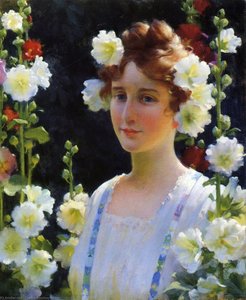
Curran’s artistic style is immediately recognizable for its delicate beauty and evocative portrayal of American life at the turn of the 20th century. He specialized in depicting young women engaged in leisurely activities—scenes of grace, serenity, and quiet contemplation. These weren't grand historical narratives or dramatic portraits; rather, they were intimate glimpses into everyday moments – a woman sketching by a stream, a group of friends enjoying a picnic, or a solitary figure lost in thought amidst a picturesque landscape. His compositions are characterized by a soft focus, a gentle palette, and an almost dreamlike quality, creating a sense of idyllic harmony. His work on “On the Heights” (1909), exhibited at the Brooklyn Museum, exemplifies his ability to capture the essence of American Impressionism—a blend of natural beauty, subtle emotion, and a distinctly American sensibility. Other notable works include "The Lanterns," a captivating piece that masterfully utilizes light and color to evoke a sense of mystery and tranquility, and “Breakfast for Three” (1909), a charming depiction of intimate domesticity. His paintings of Parisian life, such as “Dans le jardin du luxembourg” (1889), showcased at the Terra Foundation for American Art, offered viewers a glimpse into the vibrant culture of the city.A Legacy Forged in Cragsmoor and Beyond
In 1903, Curran’s artistic sensibilities were profoundly influenced by his visit to Cragsmoor, a small village nestled in New York's Hudson River Valley. He was immediately captivated by its stunning landscapes and established a studio there in 1910, dedicating much of his later career to capturing the beauty of this region. The paintings produced during this period—particularly those depicting young women posed against dramatic skies and rolling hills—became synonymous with Curran’s style. These works are celebrated for their serene atmosphere, their luminous colors, and their ability to evoke a sense of timelessness. Curran's legacy extends far beyond his own lifetime; over 1500 paintings – encompassing oil paintings, watercolors, and magazine illustrations – bear testament to his prolific output. His work is readily accessible through platforms like OriginalUniqueArt, ensuring that his art continues to inspire and captivate audiences worldwide.Historical Significance and Enduring Appeal
Charles Courtney Curran’s contribution to American art lies not only in the beauty of his individual works but also in his role as a pivotal figure in the development of Impressionism in America. He successfully adapted the techniques and sensibilities of French Impressionism to an American context, creating a distinctly American interpretation of this influential movement. His paintings offer a poignant reflection on the ideals of leisure, beauty, and the quiet pleasures of rural life—values that resonated deeply with audiences at the turn of the 20th century and continue to hold appeal today. Curran’s work is preserved in prominent museums across the United States, including the Brooklyn Museum, the Terra Foundation for American Art, and the Sheldon Museum of Art, solidifying his place as a significant figure in the nation's artistic heritage. His legacy endures through the continued appreciation of his art and its enduring ability to transport viewers to moments of serene beauty and quiet contemplation.Întrebări și răspunsuri
Cum s-a evoluat creația lui Charles Courtney Curran de-a lungul timpului?
Pagina Cronologie a lui Charles Courtney Curran este o cronologie interactivă, bazată pe derularea paginii, care prezintă lucrările artistului în ordine cronologică, grupate pe perioade reprezentative ale carierei sale.
Unde pot fi explorate operele lui Charles Courtney Curran, organizate pe subiecte?
Atlas pe teme lui Charles Courtney Curran este o pagină care clasifică operele de artă ale artistului în funcție de subiectele acestora.
Există o cronologie a operelor lui Charles Courtney Curran?
Există o cronologie a lucrărilor lui Charles Courtney Curran: pagina Cronologia operelor de artă a artistului ordonează operele în funcție de data creației.