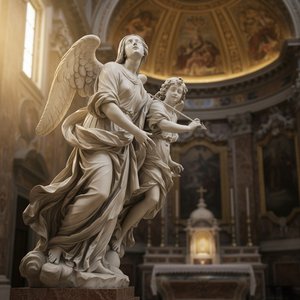
Bernardo Schiaffino: Sculpting the Sensuous Baroque in Genoa
Born in Genoa, Italy, in 1678, Bernardo Schiaffino emerged during a pivotal era of artistic transformation – the height of the Baroque period. His life and career were inextricably linked to his Genoese origins, a city renowned for its rich maritime history, vibrant cultural scene, and burgeoning artistic patronage. Unlike many sculptors who sought fame in Rome or Florence, Schiaffino remained largely rooted in his native land, leaving behind a remarkable body of work that profoundly shaped the Baroque aesthetic within Genoa itself. His story is one of disciplined training, familial legacy, and an unwavering dedication to capturing the dynamism and emotional intensity characteristic of the era.
Schiaffino’s early life was steeped in artistic tradition. He belonged to a family deeply involved in sculpture – his brother, Francesco Maria Schiaffino, also carved his own path as a prominent artist. This familial connection provided him with an invaluable foundation, beginning his training under the tutelage of Domenico Parodi, a respected sculptor known for his mastery of marble and his understanding of Baroque principles. Parodi instilled in Schiaffino not just technical skill but also a deep appreciation for the expressive potential of stone. Beyond his family’s influence, Schiaffino cultivated relationships with other artists within Genoa's artistic circles, including the Piola family, whose workshop provided further opportunities for learning and collaboration. Domenico Piola, in particular, offered design assistance, while Paolo Girolamo Piola, his son, became a close friend, fostering an exchange of ideas and techniques.
The Roman Influence and Artistic Style
Schiaffino’s artistic development was significantly shaped by his sojourns in Rome. During this period, he immersed himself in the grandeur and innovation of the Roman Baroque, absorbing the stylistic influences of masters like Bernini. The dramatic lighting, dynamic compositions, and emotional intensity evident in Roman sculpture profoundly impacted Schiaffino's approach to sculpting. However, he didn’t simply mimic Roman styles; instead, he skillfully integrated these elements with his own Genoese sensibility, creating a unique artistic voice. His sculptures are characterized by their remarkable tactile quality – the way they invite touch and evoke a sense of immediacy. This was achieved through meticulous attention to detail, particularly in rendering drapery and conveying subtle nuances of expression.
Schiaffino’s technique centered around marble sculpture, a medium he mastered with exceptional skill. He demonstrated an ability to coax life from the cold, unyielding stone, imbuing his figures with a remarkable sense of movement and emotion. His works often feature flowing drapery, sensual poses, and dramatic gestures – hallmarks of the Baroque style. He was particularly adept at capturing the human form in moments of intense feeling, whether it be joy, sorrow, or contemplation.
Notable Works and Legacy
Among Schiaffino’s most celebrated works is “Jove as a Swan with Helen and Pollux,” currently housed in the Musei di Strada Nuova in Genoa. This monumental sculpture exemplifies his mastery of marble carving and his ability to convey complex narratives through dynamic compositions. The piece depicts Jupiter, surrounded by the goddesses Helen and Pollux, creating a scene brimming with mythological drama and symbolic richness. Beyond this iconic work, Schiaffino produced numerous other sculptures that adorned churches, palaces, and private residences throughout Genoa.
Schiaffino’s influence extended beyond his own creations; he also served as a mentor to several promising young sculptors, including Francesco Queirolo, who went on to establish himself as a respected artist in his own right. His legacy is deeply intertwined with the artistic heritage of Genoa. His sculptures continue to be studied and admired for their beauty, technical skill, and emotional power, serving as a testament to his enduring contribution to the Baroque art movement.
A Genoese Context
Genoa itself played a crucial role in shaping Schiaffino’s artistic vision. The city's rich history as a maritime republic, its vibrant mercantile culture, and its diverse population fostered an environment of intellectual curiosity and artistic experimentation. Genoa’s historic center is one of the largest and most densely populated in Europe, boasting a remarkable concentration of architectural and artistic treasures. The Pallavicino Collection within Genoa showcases some of the finest examples of art from various periods, including works by Schiaffino himself. The city's strategic location as a crossroads between Italy and other European countries further facilitated the exchange of ideas and influences, enriching the local artistic landscape.
Further Exploration
For those seeking to delve deeper into the life and work of Bernardo Schiaffino, several resources are available. The OriginalUniqueArt website offers a dedicated artist page with biographical information and images of his works. Wikipedia provides a more detailed account of his life and career, alongside references to scholarly sources such as Raffaello Soprani’s “Delle vite de’ pittori, scultori, ed architetti genovesi.” Further research can be conducted through online art databases and museum collections.
Întrebări și răspunsuri
Unde pot fi găsite operele lui Bernardo Schiaffino, grupate pe mișcări artistice?
Operele lui Bernardo Schiaffino pot fi explorate pe baza stilului artistic în pagina Toate mișcările de artă a artistului.
Există o listă completă a operelor lui Bernardo Schiaffino?
Toate lucrările lui Bernardo Schiaffino de pe acest site web pot fi explorate în pagina Toate operele de artă a artistului.
Pot să explorez lucrările lui Bernardo Schiaffino în funcție de tehnică?
Operele lui Bernardo Schiaffino pot fi explorate pe baza mediului utilizat în pagina de Toate tehnicile a artistului.