

The Roots of Rebellion: From Post-War Optimism to Underground Expression
 100 Sources of Pop Art
Explore Peter Blake’s ‘100 Sources of Pop Art,’ a vibrant digital collage bursting with mid-century icons! A unique Pop Art piece, perfect for collectors seeking nostalgic visual overload.
The mid-20th century, following the austerity of war, initially bloomed with a fervent optimism – a celebration of progress and consumer culture embodied by Pop Art. Yet, beneath this glossy veneer lay a simmering discontent, a questioning of societal norms that would soon erupt in a vibrant countermovement. This wasn’t a rejection of popular imagery *per se*, but rather an exploration of its darker undercurrents, its inherent absurdities, and the psychological impact of mass media on the individual psyche. Artists began to look beyond Warhol's silkscreens and Lichtenstein's comic panels, seeking a more personal, often unsettling, expression. This nascent rebellion found fertile ground in the underground comix scene of Los Angeles, where artists like Robert Williams challenged conventional notions of taste and subject matter, laying the foundation for what would become known as Lowbrow Art – and eventually, Pop Surrealism.
The post-war era’s embrace of Freudian psychology also played a crucial role. A fascination with dreams, the subconscious, and the irrational seeped into artistic practice, influencing a generation to delve deeper than surface appearances. This interest wasn't about replicating reality but about excavating the hidden landscapes within it – the anxieties, desires, and fragmented memories that shaped human experience. The initial wave of artists weren’t necessarily seeking gallery representation; their work thrived in alternative spaces, zines, and a burgeoning network of independent publications, fostering a sense of community and artistic freedom.
Defining Pop Surrealism: Blurring Boundaries Between High & Low Culture
Lowbrow, or lowbrow art, is an underground visual art movement that arose in the Los Angeles, California area in the late 1960s. It is a populist art movement with its cultural roots in underground comix, punk music, tiki culture, graffiti, and hot-r...
The term “Pop Surrealism” itself is somewhat contentious. While often used interchangeably with “Lowbrow Art,” it’s important to understand the nuances. Lowbrow, originating in the late 1960s, explicitly positioned itself *against* the established art world, embracing kitsch, cartoon aesthetics, and a deliberately unrefined style. Pop Surrealism, emerging more distinctly in the 1990s, built upon this foundation but incorporated a greater degree of technical skill and conceptual depth. It wasn’t simply about shock value or parody; it was about creating a new visual language that blended the accessibility of pop culture with the dreamlike qualities of Surrealism.
This fusion is perhaps best understood as a deliberate dismantling of hierarchies. Artists drew inspiration from sources traditionally considered “low” – tiki culture, hot-rod customization, underground comics, even advertising – and elevated them to the level of fine art. The result is often unsettlingly beautiful: meticulously rendered paintings featuring bizarre juxtapositions, anthropomorphic creatures, and narratives that defy easy interpretation. It’s a world where innocence and corruption coexist, where familiar icons are imbued with psychological weight, and where the boundaries between reality and fantasy become increasingly blurred.
Key Figures and Artistic Techniques: A Survey of Pioneering Artists
 George Condo
George Condo (b. 1957) is renowned for his 'Artificial Realism,' blending Old Master techniques with Pop Art & psychological depth. Explore his surreal portraits and cultural critiques.
Robert Williams remains a central figure in the history of Pop Surrealism. His paintings, often characterized by their hyperrealistic detail and provocative subject matter, challenged the prevailing artistic norms of his time. He wasn’t merely replicating images; he was creating meticulously crafted worlds that explored themes of sexuality, consumerism, and the American Dream. Another pivotal artist is Mark Ryden, whose work evokes a nostalgic yet unsettling vision of childhood innocence corrupted by darker forces. Ryden's signature style – often described as “Artificial Realism” – blends Old Master techniques with pop culture iconography, creating paintings that are both visually stunning and deeply psychologically resonant.
George Condo’s contributions are equally significant. His portraits, characterized by their distorted features and fragmented forms, explore the complexities of human identity and the anxieties of modern life. Condo masterfully blends abstraction and figuration, drawing inspiration from Cubism, Surrealism, and even caricature. Beyond these central figures, artists like Camille Rose Garcia, with her hauntingly beautiful depictions of fairytale-like worlds, and Todd Schorr, known for his satirical commentary on American culture, have also played a crucial role in shaping the movement’s aesthetic.
Recurring Themes and Symbolism: Decoding the Language of Dreams
Pop Surrealist art is rich with symbolism, often drawing upon archetypal imagery from dreams, mythology, and popular culture. Recurring motifs include eyes – representing perception, awareness, and hidden knowledge; anthropomorphic creatures – blurring the lines between human and animal, exploring themes of instinct and transformation; and distorted figures – reflecting psychological fragmentation and societal anxieties. The use of vibrant colors and meticulously rendered details further enhances the dreamlike quality of these works.
The movement frequently engages with themes of consumerism and its impact on identity. Familiar brands and products are often deconstructed or recontextualized, prompting viewers to question their relationship with material possessions and the values they represent. There’s also a strong undercurrent of nostalgia – a longing for a simpler past that is simultaneously idealized and critiqued. The juxtaposition of seemingly innocent imagery with darker themes creates a sense of unease, forcing viewers to confront uncomfortable truths about themselves and the world around them.
Pop Art 2.0: The Digital Evolution and Contemporary Relevance
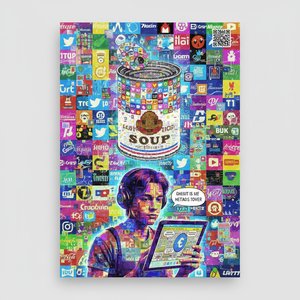 Pop Art 2.0: Recontextualizing Appropriation & Consumerism for a Digital Native Generation
Explore the evolution of Pop Art for today's digital world! Discover how appropriation & consumerism are reimagined by a new generation of artists. Expert insights & collecting tips.
The advent of digital technology has profoundly impacted Pop Surrealism, leading to what some call “Pop Art 2.0.” Artists are now utilizing computer-based tools and techniques – including digital painting, 3D modeling, and photo manipulation – to create increasingly complex and surreal imagery. This isn’t simply about adopting new technologies; it’s about exploring the possibilities of a digitally mediated reality.
The themes explored by Pop Surrealism remain remarkably relevant in today's world. In an age of hyper-consumerism, social media saturation, and political polarization, the movement’s critique of societal norms feels particularly prescient. Artists are continuing to push boundaries, challenging conventional notions of beauty, identity, and reality. The accessibility of digital platforms has also allowed a new generation of artists to emerge, further diversifying the movement’s aesthetic and expanding its reach.
Collecting Pop Surrealism: Investment Potential and Aesthetic Considerations
Investing in Pop Surrealism can be a rewarding experience for collectors seeking unique and thought-provoking artworks. While the market has matured significantly since the movement's early days, there are still opportunities to acquire pieces by established artists at reasonable prices. Key figures like Robert Williams, Mark Ryden, and George Condo command high values, but emerging artists also offer exciting potential.
When collecting Pop Surrealism, it’s important to consider not only the artist's reputation but also the aesthetic qualities of the work itself. Look for pieces that are meticulously crafted, visually compelling, and conceptually engaging. Consider the themes explored by the artwork and its relevance to your personal interests. At OriginalUniqueArt.com, we offer a curated selection of high-quality reproductions of Pop Surrealist masterpieces, allowing you to bring this captivating art movement into your home. Our commitment to authenticity and craftsmanship ensures that each piece is a faithful representation of the original artwork. Explore our collection today and discover the power and beauty of Pop Surrealism.



