The Fractured Mirror: Post-War Trauma and the Genesis of Surrealist Expressionism
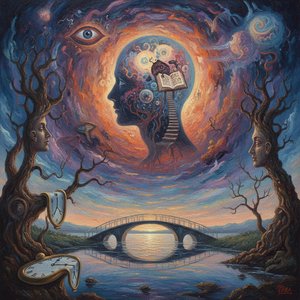 Beyond Reality: The Dreamlike Power of Surrealist Expressionism and the Subconscious Mind
The Shattered Mirror: Post-War Trauma and the Birth of Surrealist Expressionism Surrealist Expressionism's 10 Defining Masterpieces | OriginalUniqueArt Introduction Imagine a world unbound by logic, where dreams spill onto canvas and the subconscious takes vi...
To understand the profound ache within a Surrealist Expressionist canvas, one must first look back at the fractured landscape of the early twentieth century. It was an era defined by the heavy, suffocative shadows of World War I—a period where the established norms of reason, progress, and civilization were violently dismantled by the brutal realities of global conflict. For the artists emerging from this wreckage, the traditional modes of representation felt insufficient, perhaps even dishonest. How could one paint a world that had lost its logic? This collective trauma birthed a revolutionary impulse to reject the external, rational world in favor of an internal, intuitive truth.
Surrealist Expressionism emerged not merely as a stylistic choice, but as a profound psychological response to a shattered reality. While pure Surrealism sought to map the illogical landscapes of the unconscious through psychic automatism, and Expressionism strove to externalize raw, turbulent human emotion, their convergence created something far more visceral. It was an art movement that did not merely depict a dream; it captured the very feeling of a nightmare or a fever dream. By blending the emotional intensity of Expressionism with the unsettling juxtapositions of Surrealism, these artists sought to dismantle conventional thought, embracing the irrational as the only authentic pathway to truth in a world that had become unrecognizable.
The Architecture of the Unconscious: Blending Freudian Theory with Painterly Intensity
--- title: Surrealism - The Metropolitan Museum of Art author: James Voorhies url: https://www.metmuseum.org/essays/surrealism hostname: metmuseum.org description: The cerebral and irrational tenets of Surrealism find their ancestry in the clever and...
The intellectual foundations of this movement were deeply rooted in the revolutionary psychological theories of the era. The Surrealists, heavily influenced by the writings and dream studies of Sigmund Freud, sought a revolution against the constraints of the rational mind and the oppressive rules of a society they viewed as stifling. By borrowing Freudian methods of free association, artists began to draw upon the private world of the mind—a realm traditionally restricted by reason and societal limitations—to produce surprising, unexpected imagery that resonated with the deepest human anxieties.
This cerebral approach found its strength when married to the heavy, textured emotional weight of Expressionism. The resulting aesthetic was a high-voltage collision between the illogical imagery of dreams and the raw, unbridled intensity of human feeling. It is an art form that functions like a glitch in reality, a deliberate disruption of the rational world that forces the viewer to confront something deeper and more visceral than mere representation. In this space, the canvas becomes an arena where the boundaries between the self and the shadow dissolve, allowing for a visual exploration of the psyche that is both intellectually stimulating and emotionally overwhelming.
Dreamscapes and Nightmares: Analyzing the Visual Language of Subconscious Landscapes
--- title: Surrealism and Dreams | MoMA author: Anne Umland url: https://www.moma.org/collection/terms/surrealism/surrealism-and-dreams hostname: moma.org description: Influenced by the writings of psychologist Sigmund Freud, the literary, intellectu...
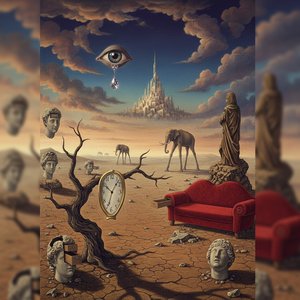
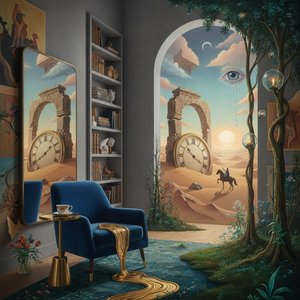
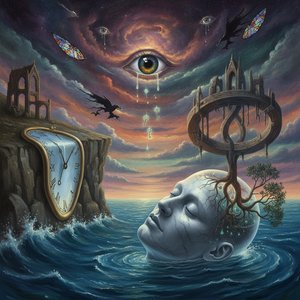
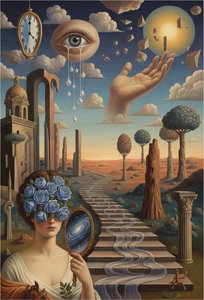
Walking into the presence of a Surrealist Expressionist masterpiece is akin to entering a room where the walls do not just hold up the ceiling, but seem to breathe with the rhythm of a fever dream. The visual language used by these masters relies heavily on the uncanny—that strange, unsettling feeling when something familiar suddenly appears completely alien. Through the use of bizarre juxtapositions and distorted forms, artists like Salvador Dalí or Leonora Carrington created portals to alternate realities, challenging viewers to question the very nature of existence.
The imagery often oscillates between the enchanting and the horrific. One might encounter a landscape that is breathtakingly beautiful yet fundamentally wrong, where organic shapes morph into architectural anomalies, or where time itself seems to melt under the heat of an unseen psychological sun. These works are not merely aesthetic objects; they are atmospheres to be inhabited. They utilize a symphony of bold colors and fluid lines to guide the eye through compositions that feel both chaotic and harmonious, inviting a deep, contemplative interpretation of the symbols hidden within the brushwork.
Beyond the Rational: The Influence of Automatism and Spontaneous Creation
Abstract expressionism in the United States emerged as a distinct art movement in the aftermath of World War II and gained mainstream acceptance in the 1950s, a shift from the American social realism of the 1930s influenced by the Great Depression an...
At the heart of this movement lies the concept of automatism—a technique designed to release the unbridled imagination of the subconscious. Originally emerging from a literary tradition of automatic writing, visual artists adapted this method to bypass the "censorship" of the conscious mind. By allowing the hand to move across the canvas without the interference of premeditated logic, they sought to capture the spontaneous energy of thought and the raw essence of instinct.
This emphasis on spontaneous creation paved the way for later movements, such as Abstract Expressionism in the mid-twentieth century. The influence of Surrealist techniques can be seen in the works of artists like Arshile Gorky and Jackson Pollock, who utilized the radical visual vocabularies of their predecessors to explore the power of gesture and texture. This rejection of the predictable and the boring allowed for a new kind of artistic liberation, where the act of painting became an act of discovery, revealing truths that lay hidden beneath the surface of the rational intellect.
Legacy of the Avant-Garde: How Surrealist Expressionism Shaped Modern Emotional Depth
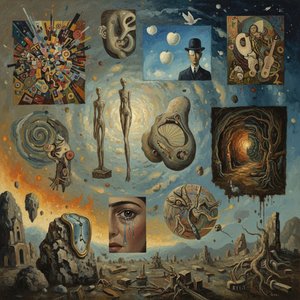 Surrealist Expressionism's 10 Defining Masterpieces | OriginalUniqueArt
Introduction Imagine a world unbound by logic, where dreams spill onto canvas and the subconscious takes vibrant form. This is the realm of Surrealist Expressionism – an artistic revolution born from the ashes of war and fueled by a desire to explore...
The impact of Surrealist Expressionism resonated far beyond the confines of the art gallery, influencing literature, film, and our very understanding of human identity. It taught us that truth is not always found in what is visible to the eye, but often lies hidden within the complexities of our fears, desires, and memories. The movement’s ability to bridge the gap between the cerebral and the visceral continues to challenge contemporary artists and collectors alike.
Today, the legacy of this era lives on in any work of art that dares to embrace the irrational. For those who seek to bring this profound emotional depth into their own environments, the preservation of these masterpieces is essential. At OriginalUniqueArt.com, we honor this history by offering museum-quality, hand-painted reproductions of the world's most significant works. Our master artists use traditional oil techniques on 100% cotton canvas to capture the very texture and soul of these historical movements. Whether you are a student of art history or a dedicated collector, our collection allows you to possess a piece of this revolutionary spirit, meticulously recreated to ensure that the profound ache and vibrant beauty of Surrealist Expressionism endure for generations.