

 Previzualizare
 Trimite
 Distribuie
 Detalii despre lucrare

 Descarcă
 Produse similare
 Radiografie
 Diapozitive automate
Louise Laure Baudot la nouă ani


 Vezi mai mult
Reproducere pictată manual în ulei
Pictură în ulei pe pânză, realizată manual de artiștii noștri la dimensiunea și ramele dorite de dumneavoastră, pe comandă. ( Comandă versiunea tipărită Comută la imagine)




P118B $10

P118H $10

P118W $10

P438Z $10

P508JH $12

P508YH $12

P805H $10

P805Z $10

P919BZ $10

P919G $10

P919XJ $10

P959ZH $10

P968JZ $12

W106C $8

W218G $10

W218JH $8

W218Y $10

W307PJ $10

W316G $10

W316PJ $8

W316Y $10

W398PJ $8

W4111J $10

W500HY $15

W500JH $15

W692G $12

W849H $8

W940BG $15

W953PJ $8




Alegeți dintre dimensiunile noastre prestabilite, care respectă proporțiile originale ale operei de artă.

Puteți introduce propriile dimensiuni pentru a se potrivi unui anumit cadru sau spațiu. Dacă dimensiunea selectată nu corespunde proporțiilor imaginii originale, vom decupa opera de artă sau vom extinde pictura cu elemente suplimentare pictate manual. O simulare digitală vă va fi trimisă pentru aprobare înainte de începerea producției.
Vă rugăm să rețineți că previzualizarea de pe ecran nu reflectă decuparea sau extinderea reală. Doar macheta va arăta cu exactitate compoziția finală.
Deși sunt disponibile dimensiuni personalizate, vă recomandăm să selectați o dimensiune din lista predefinită pentru a păstra proporțiile originale.
După plasarea comenzii, echipa OriginalUniqueArt.com va contacta clientul prin e-mail pentru instrucțiuni și îi va furniza o previzualizare a machetei
Livrare în întreaga lume () în 3-4 săptămâni, în loc de cele 5 săptămâni standard. (9 August). Fără compromisuri în ceea ce privește calitatea.

Livrare expres gratuită la nivel mondial

Pânză de in de înaltă calitate

Asigurare completă pentru transport

Garanție de rambursare a taxelor vamale

Garanția fidelității culorilor

Politica de retur în 60 de zile (doar pentru defecte)

Garanție de rambursare 100%

Ofertă pentru comenzi multiple
 Opțiunea cu sticlă este disponibilă doar pentru dimensiuni de sub 110 cm

Louise Laure Baudot la nouă ani
Tehnică de reproducere
Dimensiune reproducere
-


Preț total calculat
$ 300
Descriere operă de artă
Un Portrait Paisible : Louise Laure Baudot à Neuf Ans de Jean Baptiste Camille Corot
Jean Baptiste Camille Corot, une figure emblématique du paysage français romantique, est né le 16 juillet 1796 dans une famille bourgeoise aisée parisienne. Bien qu’initialement orienté vers une voie commerciale, le destin – et peut-être une sensibilité artistique innée – lui a réservé une autre route : celle de la peinture. Ses premières années furent marquées par une éducation atypique ; confié aux soins d'une nourrice dans les environs de l’Île Adam jusqu’à quatre ans, il développa une connexion profonde avec la nature qui allait façonner son œuvre artistique. Cette immersion initiale dans la tranquillité rurale contrastait fortement avec la vie urbaine palpitante qui lui attendait, mais elle posa les fondations d'une poursuite incessante de la beauté éphémère et de l’atmosphère – une quête qui allait définir toute sa carrière artistique. Ses parents, prospères vendeurs de tissus raffinés, lui fournirent une stabilité financière permettant à Corot de poursuivre son passion pour la peinture après une tentative infructueuse dans le domaine du commerce.La Vision Artistique : Le Romantisme au Service de l’Observation
Le style de Corot est caractérisé par une douce palette chromatique et des coups de pinceau délicats, résultat d'une observation minutieuse et d'une maîtrise exceptionnelle des effets lumineux. Contrairement aux impressionnistes qui cherchaient à saisir l’expérience sensorielle immédiate, Corot privilégiait la transmission d’émotions et d’atmosphères grâce à des nuances subtiles de couleur et de lumière – une approche caractéristique du mouvement romantique auquel il est associé. Cette philosophie artistique se reflète dans “Louise Laure Baudot à Neuf Ans”, où le peintre évite les contrastes marqués pour favoriser une impression de chaleur et de douceur, exprimant ainsi la sensibilité propre à son époque. Il considérait la nature comme une source d’inspiration constante et une véritable école de beauté, fidèle aux valeurs esthétiques du XIXe siècle.Composition et Technique : Une Harmonie Visuelle Raffinée
La composition du tableau est soigneusement pensée pour attirer le regard vers le visage jeune fille, qui occupe la majeure partie du cadre. Positionnée légèrement déséquilibrée, elle attire l’attention sans dominer la scène – une décision esthétique qui témoigne de la volonté du peintre d'obtenir équilibre et harmonie. L’arrière-plan est volontairement flou pour accentuer la présence de Louise Laure Baudot et créer une atmosphère enveloppante. Corot utilise avec précision les techniques de peinture à l’huile, appliquant des couches fines et translucides pour obtenir une luminosité remarquable et une richesse texturale exceptionnelle. Cette maîtrise technique lui permet de capturer avec finesse les détails essentiels du portrait et d’exprimer la beauté intérieure de sa jeune modèle.Symbolisme Émotionnel : Une Expression de Dignité et de Mélancolie
Au-delà de sa représentation fidèle, “Louise Laure Baudot à Neuf Ans” porte en elle une profonde signification symbolique liée aux valeurs esthétiques du romantisme. Le visage sérieux et la posture élégante de Louise Laure Baudot évoquent dignité et mélancolie – sentiments qui résonnent profondément chez le spectateur et témoignent de l’intérêt pour les préoccupations morales et émotionnelles propres à cette période artistique. Cette œuvre est une véritable méditation sur la beauté fragile et la jeunesse éphémère, exprimant ainsi la richesse des expériences humaines et la puissance de l'art romantique.Un Héritage Durable : Admirer une Reproduction Exceptionnelle
Si vous souhaitez faire revivre la beauté tranquille du paysage français romantique et apprécier les qualités artistiques inégalées de Jean Baptiste Camille Corot, envisagez d’acquérir une reproduction haute qualité de “Louise Laure Baudot à Neuf Ans”. Disponible exclusivement chez OriginalUniqueArt.com, cette œuvre permet aux amateurs d'art du monde entier de découvrir la magie de cette peinture emblématique et de bénéficier de l'investissement dans un chef-d'œuvre de la belle époque française. Pour en savoir plus sur Jean Baptiste Camille Corot et son œuvre, consultez /art/list/?Filter=jean+baptiste+camille+corot/.Biografie artist
A Life Immersed in Light and Landscape
Jean-Baptiste-Camille Corot, a name that resonates with the tranquil beauty of 19th-century French landscape painting, was born into a comfortable Parisian bourgeois family on July 16, 1796. Though initially steered towards a commercial path, destiny – and perhaps an innate artistic sensibility – intervened. His early years were marked by an unconventional upbringing; entrusted to the care of a nurse in the countryside near L’Isle-Adam until age four, he developed a profound connection with nature that would indelibly shape his artistic vision. This initial immersion in rural tranquility stood in stark contrast to the bustling city life awaiting him, yet it laid the foundation for a lifelong pursuit of capturing the ephemeral qualities of light and atmosphere. His parents, successful milliners, provided financial stability, allowing Corot the freedom to explore his burgeoning passion for painting after an unsuccessful attempt at mercantile pursuits – a rare privilege for aspiring artists of that era. This support was crucial, enabling him to dedicate himself fully to artistic training without the immediate pressures of earning a livelihood.From Academic Foundations to Plein-Air Innovation
Corot’s formal artistic education began with studies under Achille Etna Michallon and later Jean-Victor Bertin, both esteemed landscape painters steeped in the neoclassical tradition. This grounding instilled in him a meticulous approach to composition and form, emphasizing clarity and structure. However, Corot wasn't content merely replicating established styles; he yearned for something more authentic, a way to convey not just *what* he saw, but *how* it felt to be immersed within the landscape. A pivotal moment arrived with his first journey to Italy in 1825. The Roman Campagna, bathed in golden light and steeped in history, ignited his imagination. He spent years sketching and painting en plein air – directly from nature – a practice that was still relatively uncommon at the time. This dedication to direct observation allowed him to capture the subtle nuances of light and shadow, the delicate atmospheric effects that would become hallmarks of his style. He wasn’t simply recording topographical details; he was striving to evoke a mood, a feeling of tranquility and harmony. His early Italian works demonstrate a clarity of form and bright palette influenced by classical ideals, yet already hint at the softer, more evocative approach that would define his mature style. He meticulously studied the masters, copying their work in the Roman galleries, but always filtered these lessons through his own increasingly sensitive perception of nature.A Bridge Between Traditions
Corot’s artistic development wasn't linear; it was a delicate balancing act between tradition and innovation. He exhibited regularly at the Paris Salon, initially gaining recognition for works rooted in neoclassical conventions. However, as he continued to explore plein-air painting, his style began to evolve. He moved away from highly finished, detailed compositions towards looser brushwork and a more muted palette. This shift wasn’t a rejection of academic principles entirely; rather, it was an attempt to infuse them with the immediacy and emotional resonance of direct observation. He became a master of tonalism, using subtle variations in value to create depth and atmosphere. His landscapes weren't about dramatic narratives or grand gestures; they were about quiet contemplation, the beauty of everyday scenes – a forest glade, a sun-dappled meadow, a tranquil riverbank. This approach resonated with a growing audience seeking respite from the rapid industrialization and social upheaval of 19th-century France. He skillfully blended elements of realism with an almost poetic sensibility, creating landscapes that felt both familiar and deeply personal. His works often featured solitary figures – shepherds, peasants, or women – lost in contemplation amidst the vastness of nature, reflecting a sense of human vulnerability and connection to the natural world. He wasn’t interested in grand pronouncements or political statements; his art was about finding beauty in the ordinary, elevating the commonplace to a realm of serene contemplation.Major Achievements and Influences
Corot's career spanned several decades, during which he produced an enormous body of work – over 800 paintings, numerous drawings, and pastels. He achieved significant recognition throughout his lifetime, winning medals at the Salon and establishing himself as a leading figure in the Barbizon school, a movement that championed plein-air painting and a direct engagement with nature. His influence extended far beyond the Barbizon school; he served as a crucial link between the neoclassical tradition and the emerging Impressionist movement. Artists like Monet, Pissarro, and Sisley deeply admired his ability to capture the fleeting effects of light and atmosphere, and they built upon his innovations in their own groundbreaking work. Corot’s emphasis on direct observation and plein-air painting paved the way for the Impressionists' radical departure from studio-based practices. However, Corot wasn’t simply a precursor to Impressionism; he was a unique and significant artist in his own right. His vast output – encompassing landscapes, portraits, and figure studies – continues to captivate audiences with its serene beauty and emotional depth. His works can be found in major museums around the world, including the Musée des Beaux-Arts in Dunkirk and the Musée Courbet in Ornans, France, as well as the National Gallery in London and the Metropolitan Museum of Art in New York.Legacy and Enduring Influence
Jean-Baptiste-Camille Corot’s influence on subsequent generations of artists is immeasurable. He fostered a spirit of artistic freedom and encouraged younger artists to find their own voice. His legacy extends beyond painting; he embodied a philosophy of observing, feeling, and translating the beauty of nature onto canvas with honesty and sensitivity. The works “The Repose,” “Interrupted Reading,” and “Agostina” remain iconic examples of his mastery, showcasing his ability to capture both the physical world and the inner life of his subjects with remarkable sensitivity and grace. He died on February 22, 1875, leaving behind a body of work that continues to inspire artists and art lovers alike – a testament to the enduring power of light, landscape, and quiet contemplation.
Jean-Baptiste-Camille Corot
1796 - 1875 , Franța
Detalii rapide
- Artistic Movement Or Style: Realism, Impressionism
- Artists Or Movements Influenced By This Artist:
- Monet
- Pissarro
- Artists Who Influenced This Artist:
- Michallon
- Bertin
- Date Of Birth: 16 iulie 1796
- Date Of Death: 22 februarie 1875
- Full Name: Jean-Baptiste-Camille Corot
- Nationality: Francez
- Notable Artworks:
- Repaus
- Cititoare
- Pescari
- Place Of Birth: Paris, Franța
Articole similare
Jean-Baptiste-Camille Corot: A Poetic Realism – Bridging the Barbizon School and Early Impressionism
Explore the life & art of Camille Corot, a pivotal figure bridging the Barbizon School & Impressionism. Discover his poetic realism, signature style, and lasting influence on landscape painting. Learn more at OriginalUniqueArt.
Master of Light: Exploring the Timeless Landscapes and Atmospheric Brilliance of Jean-Baptiste-Camille Corot
Discover the ethereal beauty of Jean-Baptiste-Camille Corot. Explore how this master of light bridged Neoclassicism and Impressionism through his atmospheric landscapes, capturing the timeless essence of the French countryside with unparalleled poetic brilliance.
Jean-Baptiste Carpeaux: Sculpting Passion & Controversy in 19th-Century France
Explore the passionate life & controversial works of Jean-Baptiste Carpeaux, a leading French sculptor of the Second Empire. Discover his realism, iconic sculptures like 'Ugolino,' and lasting legacy as a precursor to Rodin.
Jean-Baptiste Pater: Rococo Charm & Ephemeral Beauty of 18th-Century France
Explore the captivating world of Jean-Baptiste Pater, a master of Rococo painting. Discover his elegant *fête galante* scenes and shimmering portraits – a glimpse into 18th-century French aristocracy. Learn about his legacy & find high-quality reproductions.
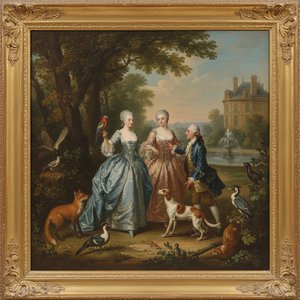
Jean-Baptiste Oudry: Rococo Painter of Aristocratic Life & Naturalistic Detail
Explore the exquisite Rococo paintings of Jean-Baptiste Oudry (1686-1755). Discover his mastery of animal depictions, royal commissions, and tapestry designs. A deep dive into 18th-century French artistry.



