Expressionism
Prophet (Emil Nolde)
Emil Nolde (1867–1956) a realizat Prophet. Face parte din mișcarea Expressionism. Este realizată în Woodcut.
- Woodcut

 Previzualizare

 Tablou în ulei pictat manual
 Trimite prin felicitare
 Distribuie
 Ghid


 Descarcă imaginea
 Produse similare
 Radiografie
 Galerie foto
 Întrebări și răspunsuri

 Statistici
Prophet: esențialul
- Titlu
- Prophet
- Artist
- Emil Nolde (1867–1956)
- Artist născut în
- Nolde, Danemarca
- Medium
- Woodcut
- Mișcare
- Expressionism
- Perioadă
- Modern
- Subiect
- man, face, beard, black and white, portrait, eyes
Ce reprezintă Prophet?
The Portrait of Prophet by Emil Nolde
In Prophet, the German Expressionist painter Emil Nolde captures a man who exists between the physical and the divine. The subject is a portrait of a man likely intended to represent a prophet, a figure carved from shadow and light. His beard and hairstyle suggest a man from a distant past or a religious leader, a person shaped by the weight of revelation. The face is a landscape of heavy lines and stark contrasts.
The man’s intense gaze pierces through the grain of the medium. A furrowed brow carries the imprint of deep emotion, perhaps a mixture of sadness, concern, or a singular, driving determination. This is not a likeness of a person in repose, but a study of a soul under pressure. The features are simplified, stripped of unnecessary detail to reveal the raw essence of the subject's internal state.
Emil Nolde uses the starkness of the form to emphasize this spiritual tension. Every line serves the gravity of the man's expression. The eyes do not merely look; they witness. The stillness of the portrait holds a quiet, heavy ache.
Composition and Visual Elements
The man's face occupies the center, a heavy presence that fills most of the frame. His head tilts slightly, caught in a moment of quiet anguish or deep contemplation. Around him, the background remains largely empty, a void that forces the eye back to the subject's features. There is no horizon, only the weight of the gaze.
Bold, thick lines carve the anatomy of the man. They define the coarse texture of his beard, the sharp ridge of his nose, and the deep-set hollows of his eyes. These lines are not smooth; they are angular and sharp, cutting through the space to shape his hair and facial structure. The geometry is simplified, reducing the man to essential, striking forms.
The color palette is stripped of all distraction. It exists in a narrow world of black and white, bridged only by subtle shades of grey. This lack of color heightens the dramatic tension, turning the portrait into a study of light and shadow. The starkness leaves no room for anything but the raw emotion of the expression.
Technique and Artistic Medium
The work emerges from the physical resistance of wood. This woodcut print relies on the deliberate act of carving lines into a solid block to define its form. Each stroke is a subtraction, a removal of material that leaves behind a sharp, angular topography. The artist works with wood, ink, and paper to translate a vision into a permanent, tactile presence.
Ink meets the paper through the pressure of the press. This contact creates a grainy texture across the surface, a subtle roughness that speaks of the material's origin. The depth of the shadows and the brightness of the highlights depend entirely on the variation of the lines. Thicker cuts hold more ink to create heavy shadows, while thinner, delicate lines allow the paper to breathe through the composition. The result is a stark, high-contrast landscape of light and dark.
The medium demands a directness of hand. There is no blending here, only the immediate impact of the carved edge. The grain of the wood and the weight of the ink settle into the fibers of the paper, creating a surface that feels both raw and finished. It is a quiet collision of tool and grain.
Prophet în înaltă rezoluție
Domeniu public: artistul a decedat în 1956.
Emil Nolde, Prophet. Domeniu public
Un expert digital verifică culorile în raport cu pictura originală și retușează fișierul, respectând fidelitatea brushwork-ului artistului.
Cumpără imaginea la rezoluție înaltăÎntrebări despre Prophet
În ce tehnică este realizată lucrarea "Prophet" de Emil Nolde?
Emil Nolde a utilizat tehnica Woodcut pentru "Prophet". Tehnica definește natura materială a lucrării originale.
Ce reprezintă "Prophet"?
Subiectele din "Prophet" sunt man, face, beard, black and white, portrait, eyes.
Este "Prophet" în domeniul public?
"Prophet" de Emil Nolde este în domeniul public (în domeniul public – drepturile de autor au expirat). Acest statut reglementează modul în care imaginea lucrării poate fi reprodusă.
Cine a creat "Prophet"?
„Prophet” a fost creat de Emil Nolde. Informațiile de pe această pagină descriu opera originală a lui Emil Nolde.
Din ce curent artistic face parte "Prophet" de Emil Nolde?
"Prophet" de Emil Nolde face parte din mișcarea Expressionism. Acest curent oferă contextul stilistic al operei.
Care este motivul statutului drepturilor de autor pentru "Prophet"?
„Prophet” de Emil Nolde este în domeniul public – drepturile de autor au expirat. Termenul de protecție a drepturilor de autor se calculează de la data decesului artistului, iar Emil Nolde a decedat în 1956.
Unde se încadrează "Prophet" în întreaga creație a lui Emil Nolde?
"Prophet" face parte din perioada Expressionism a lui Emil Nolde, ale cărei teme recurente includ post-impressionism, die brücke, religious themes, expressionist style.
Cum se încadrează "Prophet" în rândul temelor recurente ale lui Emil Nolde?
"Prophet" înfățișează man, face, beard, black and white, portrait, eyes, în timp ce temele recurente ale lui Emil Nolde sunt post-impressionism, die brücke, religious themes, expressionist style. Compararea celor două relevă modul în care această lucrare se raportează la subiectele obișnuite ale artistului.
Despre artistul Emil Nolde
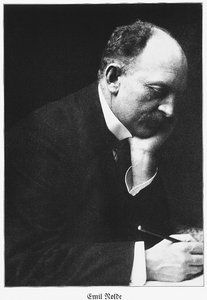
1867–1956, Danemarca
Emil Nolde
Viața și Identitatea lui Emil Nolde Născut sub numele de Hans Emil Hansen, pe 7 august 1867, omul care avea să devină cunoscut sub numele de Emil Nolde, a crescut în apropierea satului Nolde, în Duchia Schleswig. Primii săi ani de viață au fost modelați de viața rurală și agrară a familiei sale, un univers guvernat de ritmurile pământului. Cu toate acestea, el a ales să se îndepărteze de acest destin predeterminat, preferând să lucreze ca sculptor pe lemn și decorator de mobilier. Această muncă tactilă și fizică a fost fundamentul care a precedat transformarea sa către pictură și gravură.
Alte lucrări ale lui Emil Nolde
 Sunset
 Sea with Red Sky
 Couple on the beach1903
 Masks1911
Eseuri despre Prophet
 Stone and Sinew: The Sculptural Foundations of Modigliani’s PortraitsExplore the sculptural roots and structural mastery of Modigliani's portraits. Discover the secrets behind his iconic, carved style now.
 Expressionism vs. New Objectivity: Emotion vs. Precision in German ArtMaster the tension between Expressionist emotion and New Objectivity precision. Explore the soul of German modern art now.
 Emile Nolde: A Journey into Expressionist Nature & the Primal SelfExplore the powerful Expressionism of Emile Nolde – a pioneer of emotive landscapes & spiritual themes. Discover his journey, influences, a…