Art Nouveau
evestar (Alphonse Mucha)
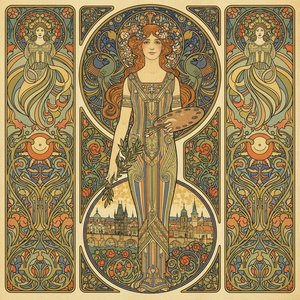
Alphonse Mucha (1860–1939) a realizat evestar. Face parte din mișcarea Art Nouveau. Este realizată în Giclée Print.
- Giclée Print

 Tablou în ulei pictat manual
 Trimite prin felicitare
 Distribuie
 Fișă informativă


 Descarcă imaginea
 Produse similare
 Galerie foto
 Întrebări și răspunsuri

 Statistici
evestar, pe scurt
- Titlu
- evestar
- Artist
- Alphonse Mucha (1860–1939)
- Artist născut în
- Brno, Cehia
- Medium
- Giclée Print
- Mișcare
- Art Nouveau
- Perioadă
- 19th Century
- Subiect
- woman figure, flowing dress, art nouveau, graceful pose, gold frame, allegorical art
Ce reprezintă evestar?
Evostar: A Symphony of Art Nouveau Grace
Alphonse Mucha’s “Evostar,” painted in 1902, is more than just a depiction of a woman; it's an embodiment of the Art Nouveau movement at its zenith. This captivating artwork immediately draws the viewer into a world of flowing lines, organic forms, and a profound sense of movement – hallmarks of Mucha’s distinctive style. The image portrays a figure in a luxurious, billowing dress, arms outstretched as if caught mid-dance or gesture, radiating an aura of serene elegance and poised beauty. The gold frame surrounding the piece isn't merely decorative; it elevates the scene, suggesting a masterpiece worthy of display within a grand salon or private collection.
The Art Nouveau Vision
Mucha’s artistic journey began in Brno, Czech Republic, shaped by early exposure to music and a deep appreciation for nationalistic themes. His time at the Prague Academy of Fine Arts proved formative, though ultimately disillusioning, leading him to Paris in 1887 – a pivotal moment where he forged his own path. “Evostar” exemplifies this self-defined style perfectly. Influenced by artists like Pierre-Auguste Renoir and Gustave Moreau, Mucha masterfully blended classical ideals with a distinctly modern sensibility. The flowing lines of the dress, the delicate rendering of fabric, and the overall composition are all characteristic of Art Nouveau’s fascination with nature's curves and its rejection of rigid academic conventions. The piece speaks to a desire for beauty that transcends mere representation – it seeks to evoke an emotional response through form and color.
Symbolism and Narrative
The woman in “Evostar” embodies the idealized feminine figure so frequently depicted by Mucha. Her posture, with arms outstretched, suggests both grace and invitation, a timeless symbol of beauty and allure. While the precise narrative is open to interpretation, it aligns with Art Nouveau’s penchant for allegorical themes and romanticized depictions of women. The necklace she wears adds an element of opulence and sophistication, further enhancing her captivating presence. The color palette – dominated by golds, creams, and subtle greens – contributes significantly to the artwork's ethereal quality, evoking a sense of twilight or evening, hence the title “Evostar.”
Technical Mastery & Historical Context
Created in 1902, "Evostar" reflects Mucha’s refined technique. He was renowned for his meticulous attention to detail, particularly in rendering fabrics and textures. The layering of paint creates a luminous effect, capturing the play of light on the woman's dress with remarkable skill. This artwork emerged during a period of immense artistic innovation – the Art Nouveau movement was rapidly gaining momentum across Europe. Mucha’s success, largely due to his commissions for Sarah Bernhardt and his innovative poster designs, helped solidify Art Nouveau as a dominant aesthetic. Reproductions like this allow us to appreciate not only Mucha's genius but also the broader cultural context in which he worked, a world captivated by beauty, elegance, and the promise of a new artistic era.
Imagini la înaltă rezoluție ale lui evestar
Domeniu public: artistul a decedat în 1939.
Alphonse Mucha, evestar. Domeniu public
Întrebări despre evestar, răspunsuri
În ce tehnică este realizată lucrarea "evestar" de Alphonse Mucha?
"evestar" este realizat în Giclée Print."
Ce reprezintă "evestar" de Alphonse Mucha?
"evestar" de Alphonse Mucha surprinde: woman figure, flowing dress, art nouveau, graceful pose, gold frame, allegorical art, muchas style.
Este "evestar" în domeniul public?
"evestar" de Alphonse Mucha este în domeniul public (în domeniul public – drepturile de autor au expirat). Acest statut reglementează modul în care imaginea lucrării poate fi reprodusă.
Cine a creat "evestar"?
„evestar” este atribuit lui Alphonse Mucha.
Din ce stil face parte "evestar"?
Mișcarea asociată cu "evestar" de Alphonse Mucha este Art Nouveau. Această clasificare plasează lucrarea printre artiști și opere de artă conexe.
În ce etapă a evoluției lui Alphonse Mucha se încadrează „evestar”?
În cariera lui Alphonse Mucha, „evestar” aparține perioadei Mature Period. Această etapă facilitează compararea sa cu celelalte opere ale artistului.
Care este situația drepturilor de autor pentru "evestar" de Alphonse Mucha?
"evestar" de Alphonse Mucha este în domeniul public – drepturile de autor au expirat. Durata protecției drepturilor de autor se calculează de la data decesului artistului, survenit în anul 1939.
Cum se încadrează „evestar” în temele și stilul lui Alphonse Mucha?
"evestar" face parte din perioada Art Nouveau a lui Alphonse Mucha, ale cărei teme recurente includ renoir, moreau influences, czech national symbolism, bernhardt’s theatrical style, idealized feminine beauty, signature art nouveau work.
Este "evestar" reprezentativ pentru temele abordate de obicei de Alphonse Mucha?
"evestar" înfățișează woman figure, flowing dress, art nouveau, graceful pose, gold frame, allegorical art, muchas style, în timp ce temele recurente ale lui Alphonse Mucha sunt renoir, moreau influences, czech national symbolism, bernhardt’s theatrical style, idealized feminine beauty, signature art nouveau work. Compararea celor două relevă modul în care această lucrare se raportează la subiectele obișnuite ale artistului.
Despre artistul Alphonse Mucha

1860–1939, Cehia
Alphonse Mucha
Early Life and Artistic Beginnings Alphonse Maria Mucha, un nume care a devenit sinonim cu eleganța și exuberanța Art Nouveau, s-a născut într-o mică localitate din Moravia, la 15 iulie 1860 – Ivancice, o regiune aflată astăzi în Republica Cehă. De mic, Alphonse a manifestat un talent vizual evident, o pasiune pentru desen care l-a preocupat de la o vârstă fragedă. Educația sa timpurie nu a fost una convențională; în loc să urmeze un traseu academic strict, tânărul Mucha a găsit inspirație în scenele teatrale locale, unde a lucrat ca decorist, dezvoltând o apreciere pentru culori vibrante și forme organice. Apoi, s-a mutat la Viena, unde a continuat studiile sale artistice într-un mediu mai dinamic, absorbind influențele diverse ale scenei artistice vieneză.
Despre Alphonse Mucha Lucrări remarcabile ale lui Alphonse Mucha
Alte lucrări ale lui Alphonse Mucha
 The Moon
 Nude
 The Apotheosis of the Slavs1926
 Stained-Glass Window in St. Vitus Cathedral
Eseuri despre evestar
 French artworks of the 1880sFrench Impressionist masterpieces by Claude Monet, Pierre-Auguste Renoir, and Georges Seurat. Find museum-quality reproductions on Original…
 The Elegance of Art Nouveau: A Masterclass in Organic Forms, Sinuous Lines, and the Belle Époque AestheticExplore the exquisite world of Art Nouveau. From Alphonse Mucha’s flowing lines to the organic elegance of the Belle Époque, discover the h…
 Alphonse Mucha: A Comprehensive Exploration of Art Nouveau's Master of Decorative SymbolismExplore the life & art of Alphonse Mucha, master of Art Nouveau! Discover his iconic posters, stunning illustrations, and the monumental Sl…