


1


Actualizat Noiembrie 2026 · clasat în funcție de scorul nostru de popularitate (căutări, vizite și comenzi pentru fiecare operă) · 47 lucrări ale lui Jack Butler Yeats în catalogul nostru
Pe scurt
Dintre toate originalele lăsate de Jack Butler Yeats, cea mai faimoasă este The Coast of Clare from Dun Aengus (1925), din colecția Harris Museum - Art Gallery, Preston. Imediat după acestea urmează Singing You Made Me Love You (1949) și Grafton Street Conversation Piece (1923). Catalogul nostru cuprinde 47 lucrări ale lui Jack Butler Yeats; galeria a păstrat cele 46 pe care lumea le admiră cel mai mult, fiecare fiind prezentată împreună cu data, muzeul și povestea sa.


 The Grafter
12
 On the Hazard1911 · Muzeul Național din Varșovia
13
 On Drumcliffe Strand1918 · National Gallery of Canada
14
 Canal at Ashtown1924
15
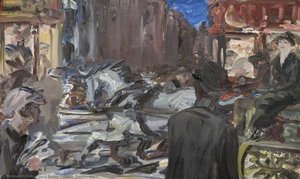 Dublin Night1925
16
 Back from the Races1925
17
 Morning after Rain1923
18
 The Hackney Car1925
19
 Return of the Wanderer1928
20
 The Learner1929
21
 The Two Travellers1942
22
 The Mystery Man1942 · Leeds Art Gallery
23
 The Forlorn Hope1948
24
 An Atlantic Drive1944
25
 People Preoccupied1948
26
 The Death of Diarmuid, the Last Handful of Water1945
27
 Humanity's Alibi1947 · Bristol Museum - Art Gallery
28
 Beautiful City of Sligo1952 · Muzeul de Artă Plastică din Boston
29
 The Talkers1951
30
 The Nights are Closing In1951
31
 Tales Of California Long Ago1953
32
 Green Moss and Water1950
33
 Dublin Evening1946 · Muzeul Ashmolean de Artă și Arheologie
34
 After-Dinner Coffee in a CityThe Phillips Collection
35
 Deer island, Roundstone
36
 Mexican Joe
37
 Man Hearing an Old Song
38
 Sailors in an Office
39
 engravings
40
 Water on Its Way
41
 The Princess of the Circus
42
 Among the Reeds
43
 Darrynane (In the Sun)1927
44
 An Old Timer Reading1947
45
 Race Course Town Galway, Ireland1910
46
 The Riverside (Long Ago)1922
Cele patru teme care revin cel mai des în aceste opere originale, fiecare având cel mai sublim exemplu.
Cele 8 muzee care dețin cele mai multe dintre picturile de pe această pagină.
| Muzee | Oraș | Lucrări lui Jack Butler Yeats | Picturi din această listă |
|---|---|---|---|
 Harris Museum - Art Gallery |
Preston | 1 | The Coast of Clare from Dun Aengus |
 Pallant House Gallery |
Chichester | 1 | The Ox Mountains, Ireland |
 Art Institute of Chicago |
Chicago | 1 | Roadsters Old and Young |
 Muzeul Național din Varșovia |
Varșovia | 1 | On the Hazard |
 National Gallery of Canada |
Ottawa | 1 | On Drumcliffe Strand |
 Leeds Art Gallery |
Leeds | 1 | The Mystery Man |
 Bristol Museum - Art Gallery |
Bristol | 1 | Humanity's Alibi |
 Muzeul de Artă Plastică din Boston |
Boston | 1 | Beautiful City of Sligo |
Alege o deceniu pentru a descoperi opera originală care îl definește.

The Coast of Clare from Dun Aengus (1925), Harris Museum - Art Gallery, Preston. Urmează Singing You Made Me Love You (1949) și Grafton Street Conversation Piece (1923).
54 ani: The Coast of Clare from Dun Aengus datează din 1925, iar Jack Butler Yeats s-a născut în 1871.
The Coast of Clare from Dun Aengus, Singing You Made Me Love You, Grafton Street Conversation Piece, Sligo Bay, The Ox Mountains, Ireland, Landing Cargo, Mayo Coast, An Old Car Driver, A Storm Gaillshion, Roadsters Old and Young și Untitled (Two Jockeys on Horses, Leaping a Stone Wall). Clasamentul de mai sus indică anul și muzeul pentru fiecare piesă.
Catalogul nostru cuprinde 47 lucrări ale lui Jack Butler Yeats, datate între 1910 și 1956.
În principal în Harris Museum - Art Gallery (Preston), Pallant House Gallery (Chichester) și Art Institute of Chicago (Chicago). Tabelul cu muzee de mai sus le enumeră pe toate.
În 1920s: 12 dintre cele 46 lucrări de pe această pagină au fost realizate atunci, fiind The Coast of Clare from Dun Aengus dintre acestea.
Pe această pagină, cea mai veche lucrare datează din Race Course Town Galway, Ireland (1910), iar cea mai recentă este din Roadsters Old and Young (1956).
Irish landscape (4), Coastal scene (2) și Solitude (2), din cele 46 lucrări de pe această pagină.
Impressionism, judecând după originalele de pe această pagină.
Jack Butler Yeats stands as a towering figure in 20th-century Irish art, an artist who defied categorization and forged his own unique path. He was born in London, England, August 29th, 1871, the youngest son of John Butler Yeats (1839–1922), a barrister who became a successful portrait painter, and brother to W.B. Yeats (William Butler), who received the Nobel Prize in Literature in 1923.
Yeats’s early life was marked by familial instability; his father struggled to establish himself as an artist, resulting in frequent relocations between London, Dublin, and Sligo where he grew up with his maternal grandparents. This formative experience instilled within him a profound appreciation for the landscapes and traditions of Ireland.
He attended Chiswick School of Art alongside Mary Cottenham White, whom he married in Surrey in 1894, establishing a home in County Wicklow and later Dublin. His artistic journey began as an illustrator for publications like *Boy’s Own Paper* and *Judy*, honing his observational skills and narrative flair—a skillset that would profoundly influence his subsequent paintings.
Yeats's formal art education commenced at Chiswick School of Art, where he studied alongside Mary Cottenham White. This formative period instilled in him a meticulous attention to detail and a dedication to mastering artistic techniques—skills that would prove invaluable throughout his prolific career.
His father’s unwavering commitment to painting served as an inspiration, shaping Jack's own artistic sensibilities and fostering a lifelong fascination with capturing the beauty of the natural world. The influence of Romanticism is palpable in his early canvases, which depict tranquil scenes of rural life bathed in soft light.
Around 1920, Yeats underwent a dramatic stylistic shift—embracing Expressionism as a reaction to the anxieties of the era. This move wasn’t merely aesthetic; it reflected a deeper engagement with the complexities of modern life and a desire to convey raw emotion.
His canvases exploded with vibrant colors, bold brushstrokes, and distorted forms—a deliberate departure from representational accuracy. Recurring motifs emerged: galloping horses across windswept fields, bustling circus scenes brimming with energy, traveling players embodying both joy and melancholy—each serving as a vehicle for exploring universal themes of human existence.
Central to Yeats’s artistic vision was his unwavering dedication to depicting Irish life in all its multifaceted glory. He rejected idealized portrayals, instead striving to capture the gritty reality of everyday experience—the hardships faced by ordinary people and the enduring spirit of a nation steeped in history.
His paintings are populated with figures who embody this resilience: laborers, musicians, gamblers, and dreamers—rendered with empathy and psychological depth. This commitment was recognized on an international stage when he won a silver medal in the arts and culture segment at the 1924 Summer Olympics in Paris for his painting *The Liffey Swim*, cementing his status not only as Ireland’s leading artist but also as a cultural ambassador.
Jack Butler Yeats remains an enigmatic figure whose work continues to inspire artists today. He was elected to the Royal Hibernian Academy in 1916, solidifying his position within the Irish art establishment. Beyond painting, he penned novels and plays—demonstrating a remarkable versatility that transcended artistic boundaries.
Samuel Beckett lauded Yeats as one of “the great of our time,” recognizing his profound ability to capture the essence of human experience. John Berger praised him as “a great painter” possessing a remarkable sense of the future, highlighting the enduring relevance of his artistic vision.
