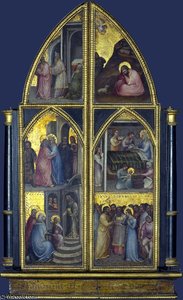
Giusto de' Menabuoi: The Florentine Painter of Paradise
Giusto de’ Menabuoi (c. 1320–1391) was an Italian painter born in Florence, marking the dawn of the Quattrocento – a pivotal era in
Renaissance art history. While definitive biographical details remain elusive, scholarly consensus points to him as a student of
Giotto di Bondone, arguably the most influential artist of his time, establishing a foundational connection between Florentine artistic tradition and
Byzantine iconography. His formative years were spent absorbing the stylistic nuances of
Giotto’s frescoes at Assisi and Padua, shaping his distinctive approach to depicting religious narratives with profound
emotional depth and
meticulous detail.
- Early Life & Training: Precise information regarding Menabuoi's birthdate and family background is scarce. However, he emerged from Florence during the turbulent political landscape of the early 14th century, a period characterized by papal disputes and civic unrest. His artistic training likely commenced in the workshops of prominent Florentine masters, fostering an understanding of both Gothic and Proto-Renaissance techniques.
- Padua & The Baptistery Frescoes: Menabuoi’s career ascended to prominence in Padua, where he undertook monumental commissions that would solidify his reputation as a master craftsman and visionary artist. Notably, between 1375 and 1378, he embarked upon the decoration of the Baptistery of Saint Anthony – a project that exemplifies his innovative blending of Byzantine influences with Florentine artistic sensibilities. The resulting frescoes depict scenes from the Old Testament and depict an astonishing level of realism for the time, showcasing intricate draperies, expressive faces, and masterful use of color.
- The Basilica of Saint Anthony & Venetian Connections: Continuing his artistic endeavors in Padua, Menabuoi further embellished the Basilica of Saint Anthony with equally impressive frescoes—a testament to his unwavering dedication to artistic excellence. Evidence suggests he cultivated connections with Venetian artists during this period, absorbing stylistic cues from the burgeoning Venetian school and contributing to a broader artistic dialogue across Italy.
- Milan & The Visconti Castle: Menabuoi’s travels extended beyond Padua, reaching Milan where he undertook decorative projects for the Visconti castle—a symbol of Lombard ducal power. His frescoes in Pavia's Visconti Castle showcase his ability to adapt to diverse architectural contexts and artistic traditions.
Menabuoi’s Artistic Style & Influences
Menabuoi’s distinctive style transcends simple categorization, reflecting a complex interplay between
Byzantine iconography and Florentine
Proto-Renaissance aesthetics. Unlike many of his contemporaries who embraced the burgeoning
realism championed by artists like Altichiero and Jacopo d'Avanzi, Menabuoi prioritized conveying spiritual emotion over meticulous anatomical accuracy—a hallmark of
Giotto’s artistic vision. His frescoes demonstrate a masterful command of color – particularly gold – creating luminous surfaces that imbue biblical scenes with ethereal grandeur. The dome of the Padua Baptistery exemplifies this stylistic approach, featuring
geometric patterns interwoven with
angelic figures—a deliberate homage to
Byzantine architectural conventions.
- Byzantine Iconography: Menabuoi’s artistic sensibilities were profoundly shaped by Byzantine iconography – evident in his use of tesserae (small colored stones) and the incorporation of stylized draperies reminiscent of imperial mosaics.
- Giotto's Legacy: As a student of Giotto, Menabuoi absorbed Giotto’s expressive technique—characterized by elongated figures and emotionally charged gestures—establishing a crucial link between Florentine artistic tradition and Byzantine influences.
Major Achievements & Historical Significance
Giusto de’ Menabuoi stands as one of the foremost painters of his era, leaving an indelible mark on Venetian
art history. His frescoes in Padua's Baptistery – particularly the Coronation of the Virgin – represent a pinnacle of Florentine
Proto-Renaissance artistry—a testament to Menabuoi’s unparalleled skill and visionary imagination. These monumental works continue to inspire awe and admiration for their beauty, complexity, and profound spiritual resonance. Furthermore, Menabuoi’s stylistic innovations challenged prevailing artistic conventions—demonstrating that conveying emotion could surpass the pursuit of anatomical
realism—establishing a precedent for subsequent generations of artists who sought to elevate art beyond mere imitation of nature. His contribution to
Venetian painting solidified his place as an influential figure in shaping the trajectory of
Renaissance art across Italy.
- The Baptistery Frescoes: Considered among the most important artistic achievements of the Quattrocento, Menabuoi’s frescoes at Padua's Baptistery remain unparalleled for their luminous color palette and expressive depiction of biblical narratives.
Legacy & Rediscovery
Giusto de’ Menabuoi’s burial site was rediscovered outside the
Baptistry in 1874—a poignant reminder of his enduring
artistic legacy. His frescoes continue to captivate audiences worldwide, serving as a beacon of Florentine
Proto-Renaissance artistry and inspiring artists across centuries. Studying Menabuoi's work offers invaluable insight into the formative years of
Renaissance art – illuminating the complex interplay between
Byzantine iconography and Florentine artistic sensibilities—solidifying his place as one of the most influential painters of his time.