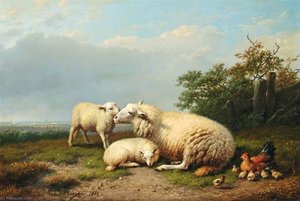
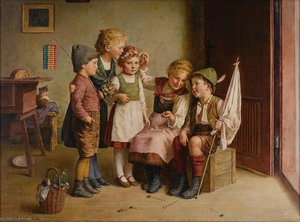
Portretul lui Eugène Verboeckhoven

Picturi Eugène Verboeckhoven: Cele 88 de cele mai faimoase, prin ochii unei galerii

Actualizat Noiembrie 2026 · clasat în funcție de scorul nostru de popularitate (căutări, vizite și comenzi pentru fiecare operă) · 91 lucrări ale lui Eugène Verboeckhoven în catalogul nostru

Pe scurt

În ochii galeriei, cea mai celebră pictură a lui Eugène Verboeckhoven este Bună ziua (1878), a cărei originală este expusă la Nottingham Castle Museum And Art Gallery, Nottingham. Still-Life with a Hare (1844) și Sheep (1840) completează trioul pe care orice ochi îl recunoaște. Dintre cele 91 opere ale lui Eugène Verboeckhoven din catalogul nostru, galeria prezintă mai jos cele 88 cele mai faimoase, fiecare fiind originală, cu anul creării, muzeul de păstrare și elementul care o face unică.

1799 – 1881, Warneton Realism Cele mai multe lucrări: Nottingham Castle Museum And Art Gallery

Cele mai apreciate 10 picturi ale lui Eugène Verboeckhoven din galerie

1
Bună ziua (1878) de Eugène Verboeckhoven

Bună ziua

1878 · Ulei pe pânză · Nottingham Castle Museum And Art Gallery, Nottingham

Good Friends is an oil on canvas work by Eugène Verboeckhoven, executed in 1878. The painting is part of the collection at the Nottingham Castle Museum And Art Gallery. It reflects the artist's focus on the quietude of pastoral existence and the specific interactions between livestock and the landscape.

2
Still-Life with a Hare (1844) de Eugène Verboeckhoven

Still-Life with a Hare

1844 · Oil On Canvas · Muzeul Ermitaj, Sankt Petersburg

Eugène Joseph Verboeckhoven's "Still-Life with a Hare," painted in 1844, is more than just a depiction of animals and hunting paraphernalia; it’s a poignant meditation on mortality, the fleeting beauty of nature, and the inherent sadness within the pursuit of life. This remarkable work, now housed at the Hermitage Museum in St. Petersburg, offers a glimpse into the final flowering of a particular artistic tradition – the idyllic landscapes and…

3
Sheep (1840) de Eugène Verboeckhoven

Sheep

1840 · Oil On Canvas · Grundy Art Gallery, Blackpool

The quietude of a rustic barn settles over the viewer through Sheep, an oil on canvas painted by Eugène Verboeckhoven. Created in 1840, the work captures a specific moment of stillness within a wooden stable. The scene feels immediate, as if the air inside the shelter is still heavy with the scent of hay and the warmth of the animals gathered within.

4
Flock of Sheep Surprised by Thunderstorm (1823) de Eugène Verboeckhoven

Flock of Sheep Surprised by Thunderstorm

1823 · Lithograph

A heavy, gray sky presses down upon the landscape, thick with the scent of impending rain. The clouds are not merely shapes but turbulent, swirling masses that churn with a restless energy. Beneath this celestial upheaval, a flock of sheep moves with sudden, agitated purpose. Their woolly bodies, rendered with meticulous detail, catch the sharp, directional light breaking through the storm. A shepherd moves among them, a small figure caught…

5
Landschap met herder en vee bij een boom (1824) de Eugène Verboeckhoven

Landschap met herder en vee bij een boom

1824 · Oil · Rijksmuseum, Amsterdam

A weathered tree trunk anchors the right side of this 1824 oil painting, providing a vertical counterpoint to the vast, horizontal expanse of a Belgian meadow. Beneath an expansive, cloudy sky, a small herd of cattle—rendered in shades of brown, white, and black—grazes across the grassy plain. A lone shepherd rests at the base of the tree, a quiet human presence amidst the livestock. The composition utilizes a low horizon…

6
goats (1830) de Eugène Verboeckhoven

goats

1830 · Oil

We are looking at goats, an oil painting by the Belgian artist Eugène Verboeckhoven. This work dates to about 1830, a period when the artist was establishing his presence within the European art landscape. It is a quiet, intimate study that captures a specific moment of pastoral stillness.

7
Peasant Asking His Way (1837) de Eugène Verboeckhoven

Peasant Asking His Way

1837 · Ink On Paper

In "Peasant Asking His Way" by Eugène Verboeckhoven, the composition is defined by a vast, expansive sky that occupies the upper two-thirds of the frame. This large area of space creates a sense of openness above the terrestrial scene. In the lower third of the work, the focal point consists of three figures: a man mounted on a white horse, a standing man facing him, and a small dog positioned…

8
Sheep in a Forest (1840) de Eugène Verboeckhoven

Sheep in a Forest

1840 · Oil · Amsterdam Museum, Amsterdam

In "Sheep in a Forest" by Eugène Verboeckhoven, a quiet stillness settles over a dense woodland clearing. The scene unfolds at eye-level with the animals, pulling the viewer directly into this secluded, shaded sanctuary. A small group of sheep rests within the heart of the forest, their presence grounding the composition. In the mid-ground, a single sheep stands in profile, facing right, its body angled slightly toward the observer as…

9
Landscape with animals (1846) de Eugène Verboeckhoven

Landscape with animals

1846 · Oil On Canvas · Museum of Fine Arts Ghent (MSK), Ghent

Landscape with animals is a painting by the Belgian artist Eugène Verboeckhoven. Created about 1846, this work depicts a pastoral scene set within a lush meadow. The composition focuses on a group of livestock positioned in the landscape, including cows, sheep, and goats. A shepherd is situated near these animals, providing a human presence within the rural setting.

10
Self Portrait (1854) de Eugène Verboeckhoven

Self Portrait

1854 · Oil On Canvas · Muzeul Regal de Arte Frumoase din Anvers, Antwerpen

is an oil on canvas work by the Belgian painter Eugène Verboeckhoven. Executed in 1854, the painting captures the artist during a period of significant professional activity in the mid-nineteenth century. Verboeckhoven, born in 1799, was a central figure in the development of Belgian animal and landscape painting, bridging the gap between seventeenth-century traditions and the emerging realism of his era.

Picturi cu Eugène Verboeckhoven, clasate de la 11 la 88

11Een rustend schaap en een lam (1840) de Eugène VerboeckhovenEen rustend schaap en een lam1840 · Amsterdam Museum 12sheep and ducks (1849) de Eugène Verboeckhovensheep and ducks1849 · Museum Tongerlohuys 13Leaving for the Market (1854) de Eugène VerboeckhovenLeaving for the Market1854 · Muzeul Regal de Arte Frumoase din Anvers 14Shepherd (1855) de Eugène VerboeckhovenShepherd1855 · Finnish National Gallery 15A Cavalier at Rest (1849) de Eugène VerboeckhovenA Cavalier at Rest1849 16Outbound herd (1856) de Eugène VerboeckhovenOutbound herd1856 · Alte Nationalgalerie 17Scotch Sheep (1868) de Eugène VerboeckhovenScotch Sheep1868 · New York Historical Society 18Sheep in a Byre (1856) de Eugène VerboeckhovenSheep in a Byre1856 · Laing Art Gallery 19Wood Landscape with Animals (1836) de Eugène VerboeckhovenWood Landscape with Animals1836 · Muzeul Național de Artă, Arhitectură și Design 20Hungry Wolves Attack a Group of Riders (1836) de Eugène VerboeckhovenHungry Wolves Attack a Group of Riders1836 · Rijksmuseum 21Landscape (1836) de Eugène VerboeckhovenLandscape1836 22Gathering the Flock (1839) de Eugène VerboeckhovenGathering the Flock1839 · The New Art Gallery Walsall 23Dutch Sheepfold (1844) de Eugène VerboeckhovenDutch Sheepfold1844 · Colecțiile Statale de Pictură din Bavaria 24Donkey and Sheep (1845) de Eugène VerboeckhovenDonkey and Sheep1845 · Amsterdam Museum 25A Mountainous Landscape with Resting Cattle (1840) de Eugène VerboeckhovenA Mountainous Landscape with Resting Cattle1840 · Amsterdam Museum 26Goats and Sheep (1843) de Eugène VerboeckhovenGoats and Sheep1843 · Colecția Regală 27Bull (1847) de Eugène VerboeckhovenBull1847 · Muzeul Regal de Arte Frumoase din Anvers 28Cattle near a Lake (1842) de Eugène VerboeckhovenCattle near a Lake1842 29The Sign Post (1848) de Eugène VerboeckhovenThe Sign Post1848 30Sheep and Cattle (1843) de Eugène VerboeckhovenSheep and Cattle1843 31Sheep and Cows (1844) de Eugène VerboeckhovenSheep and Cows1844 · Wallace Collection 32Watering Cattle (1845) de Eugène VerboeckhovenWatering Cattle1845 33Goats (1840) de Eugène VerboeckhovenGoats1840 · The New Art Gallery Walsall 34The Twins (1846) de Eugène VerboeckhovenThe Twins1846 · Nottingham Castle Museum And Art Gallery 35Sheep, Goat, and Chickens (1851) de Eugène VerboeckhovenSheep, Goat, and Chickens1851 · New York Historical Society 36Cow in a Pool (1850) de Eugène VerboeckhovenCow in a Pool1850 · New York Historical Society 37Donkey and Lambs (1849) de Eugène VerboeckhovenDonkey and Lambs1849 38A Bull Leaping a Fence (1849) de Eugène VerboeckhovenA Bull Leaping a Fence1849 · National Trust 39Sheep and Dogs (1861) de Eugène VerboeckhovenSheep and Dogs1861 40Bull's Head (1857) de Eugène VerboeckhovenBull's Head1857 41After the Hunt (1865) de Eugène VerboeckhovenAfter the Hunt1865 · Museum aan de Stroom 42Landscape with Sheep (1868) de Eugène VerboeckhovenLandscape with Sheep1868 · Auckland Art Gallery Toi o Tāmaki 43Dune Landscape with Resting Sheep (1871) de Eugène VerboeckhovenDune Landscape with Resting Sheep1871 · Nationalmuseum 44Startled (1864) de Eugène VerboeckhovenStartled1864 45An Extensive Wooded Rocky Landscape with Shepherds and Flock, Cows and a Traveller on a Horseback (1868) de Eugène VerboeckhovenAn Extensive Wooded Rocky Landscape with Shepherds and Flock, Cows and a Traveller on a Horseback1868 46In the Highlands (1869) de Eugène VerboeckhovenIn the Highlands1869 47Sheep, Hen and Chicks in a Landscape (1865) de Eugène VerboeckhovenSheep, Hen and Chicks in a Landscape1865 48Landscape with Sheep and Ducks (1865) de Eugène VerboeckhovenLandscape with Sheep and Ducks1865 49Cattle and Sheep in a Landscape (1874) de Eugène VerboeckhovenCattle and Sheep in a Landscape1874 50Sheep (1876) de Eugène VerboeckhovenSheep1876 · Nottingham Castle Museum And Art Gallery 51A Sheep, Two Lambs, a Cock and a Hen in a Landscape (1876) de Eugène VerboeckhovenA Sheep, Two Lambs, a Cock and a Hen in a Landscape1876 52Landscape with a Herd (1862) de Eugène VerboeckhovenLandscape with a Herd1862 · Muzeul Ermitaj 53bulls on the meadow de Eugène Verboeckhovenbulls on the meadow 54cows + goat in landscape de Eugène Verboeckhovencows + goat in landscape 55white horse before a stable de Eugène Verboeckhovenwhite horse before a stable 56Sheep, Lamb and Ducks by a pond de Eugène VerboeckhovenSheep, Lamb and Ducks by a pond 57Cows in the pasture de Eugène VerboeckhovenCows in the pastureMuzeul Național din Varșovia 58A Sunlit Barn with Ewes, Lambs and Chickens de Eugène VerboeckhovenA Sunlit Barn with Ewes, Lambs and ChickensHaworth Art Gallery 59Group of Sheep (1863) de Eugène VerboeckhovenGroup of Sheep1863 · Towneley Hall Art Gallery - Museum 60Sheep and Hens in a Barn (1874) de Eugène VerboeckhovenSheep and Hens in a Barn1874 · Walker Art Gallery 61Landscape with Sheep (1867) de Eugène VerboeckhovenLandscape with Sheep1867 62Landscape with Sheep de Eugène VerboeckhovenLandscape with SheepDetroit Institute of Arts 63Head of a Horse de Eugène VerboeckhovenHead of a HorseMuzeul Național de Artă, Arhitectură și Design 64Buck's Head de Eugène VerboeckhovenBuck's HeadMusée Alphonse-georges Poulain 65Cows and Sheep de Eugène VerboeckhovenCows and SheepMuzeul Regal de Arte Frumoase din Anvers 66Schafe auf der Weide de Eugène VerboeckhovenSchafe auf der Weide 67sheep in a stable de Eugène Verboeckhovensheep in a stable 68Sheep and Chicken in a Landscape de Eugène VerboeckhovenSheep and Chicken in a Landscape 69A gathering in the pasture de Eugène VerboeckhovenA gathering in the pasture 70Mountainous Landscape with Bridge de Eugène VerboeckhovenMountainous Landscape with Bridge 71Guarding the flock by the coast de Eugène VerboeckhovenGuarding the flock by the coast 72Un pâturage de Eugène VerboeckhovenUn pâturage 73Rider Conversing with a Shepherdess in an Extensive Landscape de Eugène VerboeckhovenRider Conversing with a Shepherdess in an Extensive Landscape 74Sheep grazing by the coast de Eugène VerboeckhovenSheep grazing by the coast 75Sheep in a Scottish landscape de Eugène VerboeckhovenSheep in a Scottish landscape 76Sheep and Chicken in a Landscape de Eugène VerboeckhovenSheep and Chicken in a Landscape 77Crossing the marsh de Eugène VerboeckhovenCrossing the marsh 78A white stallion in a landscape de Eugène VerboeckhovenA white stallion in a landscape 79Guarding the Lamb de Eugène VerboeckhovenGuarding the Lamb 80At the Stable Door de Eugène VerboeckhovenAt the Stable Door 81A farmer at rest with his stock de Eugène VerboeckhovenA farmer at rest with his stock 82A Horse, Sheep and a Goat in a Landscape de Eugène VerboeckhovenA Horse, Sheep and a Goat in a Landscape 83a shepherd and his flock de Eugène Verboeckhovena shepherd and his flock 84The Sheep de Eugène VerboeckhovenThe SheepNottingham Castle Museum And Art Gallery 85A Shepherdess with her Flock de Eugène VerboeckhovenA Shepherdess with her Flock 86Sheep with chickens and a goat in a barn de Eugène VerboeckhovenSheep with chickens and a goat in a barn 87A Horse Feeding in a Stable de Eugène VerboeckhovenA Horse Feeding in a StableUsher Gallery 88Farmhand with Horse and Dog in Landscape de Eugène VerboeckhovenFarmhand with Horse and Dog in Landscape

Subiectele care i-au captivat privirea lui Eugène Verboeckhoven

Cele patru teme care revin cel mai des în aceste opere originale, fiecare având cel mai sublim exemplu.

Muzeele care păstrează originalele lui Eugène Verboeckhoven

Cele 8 muzee care dețin cele mai multe dintre picturile de pe această pagină.

Muzee Oraș Lucrări lui Eugène Verboeckhoven Picturi din această listă
Nottingham Castle Museum And Art Gallery, NottinghamNottingham Castle Museum And Art Gallery Nottingham 4 Bună ziua, The Twins, Sheep
Amsterdam Museum, AmsterdamAmsterdam Museum Amsterdam 4 Sheep in a Forest, Een rustend schaap en een lam, Donkey and Sheep
Muzeul Regal de Arte Frumoase din Anvers, AntwerpenMuzeul Regal de Arte Frumoase din Anvers Antwerpen 4 Self Portrait, Leaving for the Market, Bull
New York Historical Society, New York CityNew York Historical Society New York City 3 Scotch Sheep, Sheep, Goat, and Chickens, Cow in a Pool
Muzeul Ermitaj, Sankt PetersburgMuzeul Ermitaj Sankt Petersburg 2 Still-Life with a Hare, Landscape with a Herd
Rijksmuseum, AmsterdamRijksmuseum Amsterdam 2 Landschap met herder en vee bij een boom, Hungry Wolves Attack a Group of Riders
Muzeul Național de Artă, Arhitectură și Design, OsloMuzeul Național de Artă, Arhitectură și Design Oslo 2 Wood Landscape with Animals, Head of a Horse
The New Art Gallery Walsall, WalsallThe New Art Gallery Walsall Walsall 2 Gathering the Flock, Goats

Eugène Verboeckhoven, o pictură emblematică pe deceniu

Lucrări pe deceniu

Alege o deceniu pentru a descoperi opera originală care îl definește.

Picturile lui Eugène Verboeckhoven: răspunsurile galeriei

Care este cea mai celebră pictură a lui Eugène Verboeckhoven?Află răspunsul

Bună ziua (1878), Nottingham Castle Museum And Art Gallery, Nottingham. Urmează Still-Life with a Hare (1844) și Sheep (1840).

Ce vârstă avea Eugène Verboeckhoven când a finalizat Bună ziua?Află răspunsul

79 ani: Bună ziua datează din 1878, iar Eugène Verboeckhoven s-a născut în 1799.

Care sunt cele mai importante 10 picturi ale lui Eugène Verboeckhoven?Află răspunsul

Bună ziua, Still-Life with a Hare, Sheep, Flock of Sheep Surprised by Thunderstorm, Landschap met herder en vee bij een boom, goats, Peasant Asking His Way, Sheep in a Forest, Landscape with animals și Self Portrait. Clasamentul de mai sus indică anul și muzeul pentru fiecare piesă.

Câte lucrări a creat Eugène Verboeckhoven?Află răspunsul

Catalogul nostru cuprinde 91 lucrări ale lui Eugène Verboeckhoven, datate între 1823 și 1878.

Unde sunt expuse cele mai celebrele opere originale ale lui Eugène Verboeckhoven?Află răspunsul

În principal în Nottingham Castle Museum And Art Gallery (Nottingham), Amsterdam Museum (Amsterdam) și Muzeul Regal de Arte Frumoase din Anvers (Antwerpen). Tabelul cu muzee de mai sus le enumeră pe toate.

Când a creat Eugène Verboeckhoven cele mai faimoase picturi?Află răspunsul

În 1840s: 21 dintre cele 88 lucrări de pe această pagină au fost realizate atunci, fiind Still-Life with a Hare dintre acestea.

Care sunt cele mai vechi și cele mai recente opere celebre ale lui Eugène Verboeckhoven?Află răspunsul

Pe această pagină, cea mai veche lucrare datează din Flock of Sheep Surprised by Thunderstorm (1823), iar cea mai recentă este din Bună ziua (1878).

La ce subiecte s-a întors cel mai des Eugène Verboeckhoven?Află răspunsul

Sheep (13), Sky (9) și Grass (8), din cele 88 lucrări de pe această pagină.

În ce tehnică a lucrat cel mai mult Eugène Verboeckhoven?Află răspunsul

Oil On Canvas, pentru 10 dintre cele 88 lucrări de pe această pagină.

Cu ce mișcare este asociat(ă) Eugène Verboeckhoven?Află răspunsul

Realism și Romantic landscape painting, judecând după originalele de pe această pagină.

Ce opere originale ale lui Eugène Verboeckhoven deține Nottingham Castle Museum And Art Gallery?Află răspunsul

Bună ziua, The Twins și Sheep: Nottingham Castle Museum And Art Gallery, Nottingham deține 4 dintre lucrările de pe această pagină.

Eugène Verboeckhoven: artistul

Maestrul liniștii pastorale

În marea tapiserie a artei europene din secolul al XIX-lea, puține fire sunt țesute la fel de delicat precum cele create de Eugène Joseph Verboeckhoven. Născut în 1798, în orașul belgian Warneton, Verboeckhoven a apărut ca un pictor capabil să unească ecourile trecătoare ale tradiției pastorale din secolul al XVII-lea cu realismul emergent și perspicace al propriei sale epoci. Viața sa s-a desfășurat pe fondul unei perioade de transformări profunde; el a fost martorul Revoluției Belgiene din 1830 și a văzut națiunea sa că își găsește identitatea, exact așa cum el însuși a ajutat la definirea unei identități estetice specifice pentru pictura de peisaj și de animale belgă. A privi o pânză de Verboeckhoven înseamnă a păși într-o lume în care timpul încetinește, unde pășunatul ritmic al oilor și demnitatea tăcută a animalelor de fermă servesc drept ancoră într-o lume aflată în continuă schimbare.

Fundamentul său artistic a fost construit pe o moștenire a măiestriei meticuloase. Studiind inițial sub îndrumarea tatălui său, Barthélemy Verboeckhoven — un sculptor — el a dobândit o apreciere timpurie pentru formă și precizie anatomică. Această instruire a fost ulterior rafinată în centrele artistice vibrante din Ghent și Anvers, unde a lucrat sub îndrumarea unor maeștri precum Louis-pre Verwee și Voituron. Acești ani formativi i-au întipărit venerația pentru Marii Maestri, în special pentru tradițiile olandeze și flamande ale lui Paulus Potter și Rembrandt. El nu a căutat doar să îi imite; dimpotrivă, a căutat să insufleze o viață nouă tehnicilor lor, folosind măiestria lor asupra luminii și texturii pentru a ridica subiectele umile ale vieții la țară la nivel de artă înaltă.

O călătorie prin lumină și peisaj

Artisticitatea lui Verboeckhoven a fost profund modelată de spiritul său neastâmpărat și de dorința de a surprinde nuanțele atmosferice ale lumii naturale. Între 1826 și 1841, el a pornit în călătorii extinse care aveau să devină însămașarea compozițiilor sale. De la frumusețea aspră a Ardennelor, la peisajele însorite ale Italiei, trecând prin pădurile Germaniei și Franței, fiecare regiune a lăsat o urmă indelabilă pe paleta sa. Aceste expediții i-au permis să observe modul în care lumina interacționează cu diferite terenuri — cum îndulcește un dimineață brumoasă într-o pășune belgă sau cum proiectează umbre dramatice peste un pas montan. Această sensibilitate la atmosferă este ceea ce ridică opera sa de la simpla documentare la o narare evocatoare.

Priceperea sa tehnică era cel mai evidentă în capacitatea de a reda texturile regnului animal. Fie că era vorba despre lâna aspră a unei oi, blana lucioasă a unui cal sau trăsăturile delicate ale unui leton, Verbołachoven aborda fiecare subiect cu o acuratețe aproape științifică, însoțită de un suflet romantic. Abilitatea sa era atât de respectată încât a devenit un colaborator râvnit; mulți pictori de peisaj contemporani îl angajau special pentru a furniza staffage — acele animale și figuri vii care insuflau viață decorului lor. Acest spirit colaborativ subliniază rolul său central în piața de artă a secolului al XIX-lea, unde capacitatea sa de a popula o scenă cu creaturi realiste și emoționante era fără egal.

Moștenirea realistului belg

Pe măsură ce cariera sa a progresat, Verboeckhoven a devenit un pilon al instituției artistice europene. Prezența sa frecventă la prestigioasele Saloane din Bruxelles și Ghent, precum și apartenența sa la academii din Anvers, Sankt Petersburg și Amsterdam, vorbesc despre o reputație care a depășit granițele naționale. El nu a fost doar un talent local, ci o figură internațională ale cărei opere au fost colecționate de regali și de cunoscători deopotrivă. Chiar și atunci când mișcările artistice s-au îndreptat către forme de exprimare mai radicale, Verboeckhoven a rămas un păstrător neclintit al idilului, oferind un sentiment de continuitate și confort prin scenele sale frumos pictate de liniște rurală.

Semnificația istorică a lui Eugène Joseph Verboeckhoven rezidă în rolul său de punte stilistică. El a sintetizat cu succes idealurile clasice ale compoziției și ale frumuseții idealizate cu un angajament modern față de realismul observațional. Picturile sale, care continuă să onoreze muzeele din întreaga lume, servesc ca o amintire emoționantă a unei ere pierdute de armonie pastorală. Prin pensula sa, actul simplu al oilor care păscă sau un moment liniștit într-un grajd devin o meditație profundă asupra frumuseții durabile a lumii naturale, asigurându-se că numele său rămâne gravat în analele istoriei artei ca unul dintre cei mai realizați pictori de animale care au trăit vreodată.