Portretul lui Adolph Gottlieb

Picturi Adolph Gottlieb: Cele 54 de cele mai faimoase, prin ochii unei galerii

Actualizat Octombrie 2026 · clasat în funcție de scorul nostru de popularitate (căutări, vizite și comenzi pentru fiecare operă) · 55 lucrări ale lui Adolph Gottlieb în catalogul nostru

Pe scurt

În ochii galeriei, cea mai celebră pictură a lui Adolph Gottlieb este Mariner's Incantation (1945). Small Burst (1961) și Tournament (1951) completează trioul pe care orice ochi îl recunoaște. Dintre cele 55 opere ale lui Adolph Gottlieb din catalogul nostru, galeria prezintă mai jos cele 54 cele mai faimoase, fiecare fiind originală, cu anul creării, muzeul de păstrare și elementul care o face unică.

1903 – 1974, New York Abstract expressionism Cele mai multe lucrări: Muzeul Israel

Cele mai apreciate 10 picturi ale lui Adolph Gottlieb din galerie

7
Spray (1959) de Adolph Gottlieb

Spray

1959

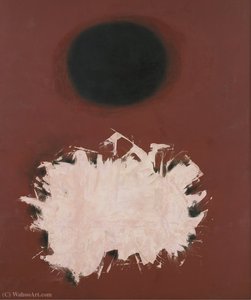
Adolph Gottlieb's Spray, created in 1959, is a commanding example of Abstract Expressionism at its most visceral. Measuring an impressive 229 x 184 cm, this painting doesn’t simply occupy space; it *fills* it with dynamic energy and raw emotion. The work presents a dramatic interplay between form and color, inviting viewers into a world of pure sensation.

Picturi cu Adolph Gottlieb, clasate de la 11 la 54

Subiectele care i-au captivat privirea lui Adolph Gottlieb

Cele patru teme care revin cel mai des în aceste opere originale, fiecare având cel mai sublim exemplu.

Muzeele care păstrează originalele lui Adolph Gottlieb

Cele 8 muzee care dețin cele mai multe dintre picturile de pe această pagină.

Muzee Oraș Lucrări lui Adolph Gottlieb Picturi din această listă
Muzeul Israel, IerusalimMuzeul Israel Ierusalim 3 Eyes of Oedipus, Masquerade, Tangent
Smithsonian American Art Museum, Washington, D.C.Smithsonian American Art Museum Washington, D.C. 2 Sun Deck, Blues
The Phillips Collection, Washington, D.C.The Phillips Collection Washington, D.C. 2 The Seer, Equinox
Art Institute of Chicago, ChicagoArt Institute of Chicago Chicago 1 Untitled (881)
Whitney Museum of American Art, New YorkWhitney Museum of American Art New York 1 Vigil
Muzeul de Artă Plastică din Boston, BostonMuzeul de Artă Plastică din Boston Boston 1 Alkahest of Paracelsus
Detroit Institute of Arts, DetroitDetroit Institute of Arts Detroit 1 Falling Star
Metropolitan Museum of Art, New YorkMetropolitan Museum of Art New York 1 Solitary

Adolph Gottlieb, o pictură emblematică pe deceniu

Lucrări pe deceniu

Alege o deceniu pentru a descoperi opera originală care îl definește.

Picturile lui Adolph Gottlieb: răspunsurile galeriei

Care este cea mai celebră pictură a lui Adolph Gottlieb?Află răspunsul

Mariner's Incantation (1945). Urmează Small Burst (1961) și Tournament (1951).

Ce vârstă avea Adolph Gottlieb când a finalizat Mariner's Incantation?Află răspunsul

42 ani: Mariner's Incantation datează din 1945, iar Adolph Gottlieb s-a născut în 1903.

Care sunt cele mai importante 10 picturi ale lui Adolph Gottlieb?Află răspunsul

Mariner's Incantation, Small Burst, Tournament, Eyes of Oedipus, Labyrinth No. 2, Pictograph, Spray, Untitled (881), Sun Deck și Untitled (Arizona Still Life). Clasamentul de mai sus indică anul și muzeul pentru fiecare piesă.

Câte lucrări a creat Adolph Gottlieb?Află răspunsul

Catalogul nostru cuprinde 55 lucrări ale lui Adolph Gottlieb, datate între 1936 și 1972.

Unde sunt expuse cele mai celebrele opere originale ale lui Adolph Gottlieb?Află răspunsul

În principal în Muzeul Israel (Ierusalim), Smithsonian American Art Museum (Washington, D.C.) și The Phillips Collection (Washington, D.C.). Tabelul cu muzee de mai sus le enumeră pe toate.

Când a creat Adolph Gottlieb cele mai faimoase picturi?Află răspunsul

În 1940s: 14 dintre cele 54 lucrări de pe această pagină au fost realizate atunci, fiind Mariner's Incantation dintre acestea.

Care sunt cele mai vechi și cele mai recente opere celebre ale lui Adolph Gottlieb?Află răspunsul

Pe această pagină, cea mai veche lucrare datează din Sun Deck (1936), iar cea mai recentă este din Pink Ground (1972).

Cu ce mișcare este asociat(ă) Adolph Gottlieb?Află răspunsul

Abstract expressionism, judecând după originalele de pe această pagină.

Ce opere originale ale lui Adolph Gottlieb deține Muzeul Israel?Află răspunsul

Eyes of Oedipus, Masquerade și Tangent: Muzeul Israel, Ierusalim deține 3 dintre lucrările de pe această pagină.

Adolph Gottlieb: artistul

A Pioneer of Abstract Expressionism: The Life and Art of Adolph Gottlieb

Adolph Gottlieb, born in New York City on March 14, 1903, emerged as a pivotal figure in the burgeoning landscape of American Abstract Expressionism. His journey was one of constant exploration—a relentless pursuit to distill universal human experiences into a visual language that resonated with both ancient symbolism and modern anxieties. Growing up as the son of Jewish immigrants, Gottlieb’s early life instilled within him a sensitivity to cultural displacement and the search for meaning in a rapidly changing world, themes that would profoundly shape his artistic vision. He received foundational training at the Art Students League and Parsons The New School for Design, but it was his subsequent travels through Europe during the 1920s that truly ignited his aesthetic sensibilities. Immersing himself in the art and philosophies of Germany and France, he absorbed influences from Constructivism and Surrealism, laying the groundwork for his future innovations.

Early Influences and Artistic Formation

Gottlieb’s artistic development wasn't immediate; it was a gradual evolution away from representational forms toward abstraction. Initially grappling with traditional techniques—primarily realism—he began to experiment with fragmented imagery and symbolic motifs, hinting at the deeper psychological currents that would define his mature style. He sought inspiration in European avant-garde movements like Constructivism and Surrealism, recognizing their willingness to challenge conventional artistic conventions. His exposure to artists such as Piet Mondrian and Giorgio Morandi profoundly impacted his understanding of visual language and compositional principles. These formative experiences instilled within him a desire to move beyond mere imitation—to forge an independent voice that expressed profound emotional and intellectual concerns.

The Founding of “The Ten” and Collaborative Exploration

A crucial moment arrived in 1935 when Gottlieb joined forces with artists like Mark Rothko, John D. Graham, Helen Frankenthaler, William Tucker, Franz Kline, Barnett Newman, Philip Guston, Lester Thomson, Robert Delaunay, and Josef Albers to form “The Ten,” later known as the New York Artists Painters group. This collective was instrumental in establishing a distinctly American voice within the international art scene, challenging European dominance and fostering a spirit of experimentation. Recognizing the power of collaborative dialogue, Gottlieb actively engaged with fellow artists—sharing ideas, techniques, and perspectives—creating a dynamic environment for artistic innovation. The Ten’s commitment to exploring abstraction pushed boundaries and questioned established aesthetic norms, reflecting the anxieties and aspirations of their time.

The Impact of Economic Hardship and Arizona Landscapes

Benefiting from initiatives like the Federal Art Project during the Great Depression, Gottlieb found support for his artistic endeavors—allowing him to pursue his creative ambitions amidst challenging economic circumstances. This period coincided with a transformative journey to Arizona in 1937-1938. The stark landscapes of the American Southwest captivated Gottlieb’s imagination—inspiring him to capture not merely their visual appearance but also their emotional resonance—a sense of vastness, isolation, and spiritual power. He sought to distill the essence of these environments into simplified geometric forms and symbolic colors—reflecting a fascination with primal symbolism and ancient cultures. This experience profoundly influenced his artistic style—introducing elements of flatness, repetition, and chromatic abstraction that would characterize much of his subsequent work.

Iconic Series: Pictographs and Burst Paintings – Universal Themes Embodied

Gottlieb’s most recognizable series, the *Pictographs* (1940s), embodies this exploration. These paintings feature biomorphic shapes and symbolic forms arranged within rectangular fields—resembling ancient hieroglyphs or tribal markings. He deliberately drew inspiration from diverse sources—classical mythology, Amerindian art, African motifs—creating a compelling dialogue between modernity and ancient traditions. The *Pictographs* weren’t simply abstract compositions; they were attempts to tap into universal archetypes—exploring themes of myth, ritual, and the human condition. His meticulous attention to detail—the careful selection of colors and textures—served to heighten the emotional impact of each work. Following the *Pictographs*, Gottlieb embarked on his *Burst Paintings* in the 1950s. These works are characterized by explosive bursts of color and energy—reflecting a more dynamic and emotionally charged approach to abstraction. The “bursts” themselves can be interpreted as representations of primal forces—creation, destruction, or perhaps the overwhelming intensity of human experience. He continued to refine his artistic vision—experimenting with new techniques and exploring uncharted territories within abstract expressionism. ## Legacy and Recognition – An Enduring Influence on American Art Throughout his career, Adolph Gottlieb exhibited widely in both the United States and Europe—gaining recognition for his unique contribution to American art. His work is now represented in major museum collections worldwide—including the Museum of Modern Art (MoMA) in New York City and the Tate Modern in London—a testament to its enduring power and influence. He received numerous awards and accolades—solidifying his place as one of the most significant abstract painters of the 20th century. Gottlieb’s legacy extends beyond his individual paintings—he played a vital role in shaping the landscape of postwar American art—paving the way for future generations of artists to explore abstraction, symbolism, and cultural influences. His commitment to exploring universal themes through a uniquely American lens cemented his place as one of the most influential figures in abstract expressionism—a movement that continues to inspire artists today. His work remains a powerful reminder of art’s capacity to transcend cultural boundaries and speak to the deepest aspects of the human spirit.