Retrato de Zanobi Strozzi

As 25 Pinturas Mais Famosas de Zanobi Strozzi, uma Seleção da Galeria

Atualizado em Outubro 2026 · classificado pela nossa pontuação de popularidade (pesquisas, visitas e pedidos de cada obra) · 26 obras de Zanobi Strozzi em nosso catálogo

Em resumo

De todas as obras originais deixadas por Zanobi Strozzi, a mais famosa é Madonna and Child with Angels (1434), da coleção do Convento de San Marco, em Florença. Logo atrás vêm Camaldolese Friars in Choir (1450) e The Annunciation (1442). Nosso catálogo contém 26 obras de Zanobi Strozzi; a galeria preservou as 25 que o mundo mais admira, cada uma exibida com sua data, seu museu e sua história.

1412 – 1468, Florença Early renaissance Mais obras: National Gallery

As 10 principais pinturas de Zanobi Strozzi: a escolha da galeria

1
Madonna and Child with Angels (1434) de Zanobi Strozzi

Madonna and Child with Angels

1434 · Oil On Canvas · Convento de San Marco, Florença

A Vision of Divine Grace: Zanobi Strozzi's Madonna and Child with Angels To gaze upon this masterpiece by Zanobi Strozzi is to step directly into the luminous heart of the Early Renaissance. The scene unfolds with an almost palpable sense of sacred tranquility, centering on the Virgin Mary cradling the divine presence of the Christ Child. It is more than a mere portrait; it is a profound meditation on motherhood,…

2
Camaldolese Friars in Choir (1450) de Zanobi Strozzi

Camaldolese Friars in Choir

1450 · Tempera On Panel

In this 1450 composition, we find ourselves drawn into a quiet, sacred space where time seems to have slowed. A group of Camaldolese friars is gathered in a choir, their figures arranged with a sense of rhythmic unity. Some monks stand at the forefront, while others recede into the background, creating a subtle depth within the square format. They are dressed in heavy robes that signal their religious devotion, their…

3
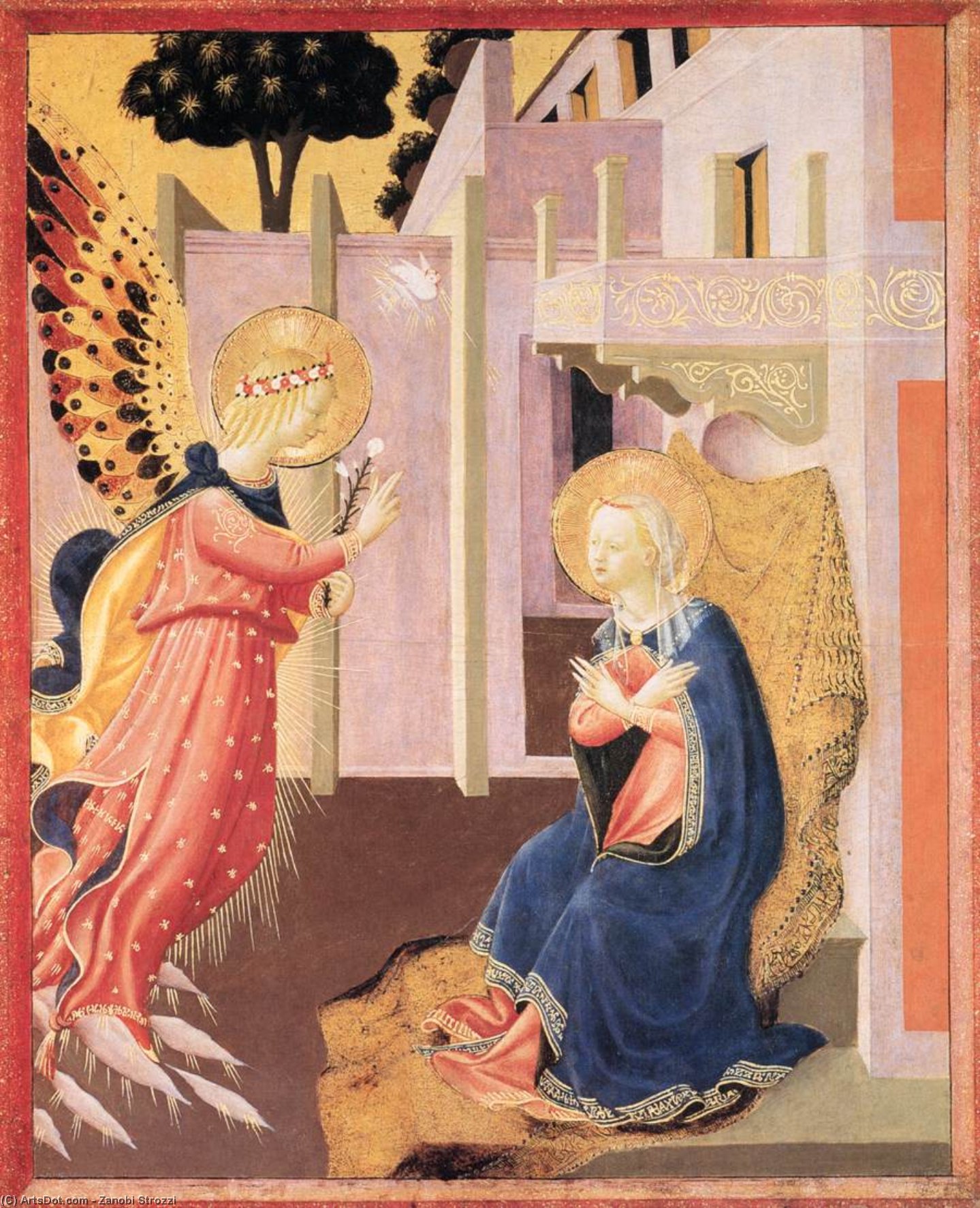
The Annunciation (1442) de Zanobi Strozzi

The Annunciation

1442 · Tempera On Panel · National Gallery, Londres

The Annunciation by Zanobi Strozzi captures a suspended moment of divine interruption. Created about 1440-5, the painting depicts the Archangel Gabriel arriving to deliver a celestial message to the Virgin Mary. A single dove, representing the Holy Ghost, descends with a gilded halo above the angel's head. The scene is framed by the quiet weight of classical columns, separating the celestial messenger from the woman receiving the news.

4
Virgin and Child with Four Angels and the Redeemer (1450) de Zanobi Strozzi

Virgin and Child with Four Angels and the Redeemer

1450 · Tempera On Panel · Brooklyn Museum, Brooklyn

The air within the sacred space feels heavy with the scent of old wood and the silent weight of devotion. At the center of this celestial assembly, the Virgin Mary sits with a quiet, solemn grace, her presence anchoring the entire composition. She holds the Christ Child, whose small form is framed by the deep, ultramarine blue of her mantle and the rich crimson of her tunic. Around them, four…

5
Scenes from the Story of Susanna: Susanna and the Elders (1450) de Zanobi Strozzi

Scenes from the Story of Susanna: Susanna and the Elders

1450 · Tempera On Panel · Musée du Petit Palais, Avignon

The panel stretches wide, a long horizontal sequence of moments captured in tempera. It unfolds like a silent play, divided into three distinct stages of a biblical drama. On the far left, the heavy lines of an interior architectural setting frame the beginning of the tension. The center shifts to an outdoor garden, where a circular structure anchors the composition. Finally, the eye moves to the right, toward a landscape…

6
Saints Zenobius, Francis and Anthony of Padua (1450) de Zanobi Strozzi

Saints Zenobius, Francis and Anthony of Padua

1450 · Tempera On Panel · Yale University Art Gallery, New Haven

This Renaissance-era religious panel painting presents three saints arranged side-by-side in a vertical, frontal composition. The figures occupy a shallow space against a background of patterned gold leaf, which creates a flat, celestial setting. On the left, a figure is dressed in episcopal regalia, including a mitre, and holds a book. The central figure is depicted in a brown monastic habit with hands clasped in prayer. To the right, the…

7
Altarpiece of Saint Jerome (1460) de Zanobi Strozzi

Altarpiece of Saint Jerome

1460 · Tempera On Panel · Musée du Petit Palais, Avignon

The Altarpiece of Saint Jerome is a significant work by the Florentine painter Zanobi Strozzi. Created about 1460, this large-scale panel was originally commissioned for the convent of San Girolamo in Fiesole. The commission for this religious work was awarded by the Medici, reflecting the close ties between the artist and the influential family during the Quattrocento.

8
The Last Judgement (1456) de Zanobi Strozzi

The Last Judgement

1456 · Tempera On Panel · Gemäldegalerie, Berlim

The Last Judgement, also known as Das Jüngste Gericht, is a work by Zanobi Strozzi. Created in 1456, the painting emerged from the hands of Zanobi di Benedetto di Caroccio degli Strozzi. This Florentine artist, born in Florence, Italy, brought a specific precision to the panel. The wood of the support is poplar.

9
The Annunciation (1453) de Zanobi Strozzi

The Annunciation

1453 · Tempera On Panel · Philadelphia Museum of Art, Filadélfia

The artwork depicts the Annunciation scene, a sacred moment of divine communication. The composition centers on two figures: an angel presenting lilies to Mary, who is seated in a state of prayer and sudden awareness. The angel's pink gown features the gold-lettered greeting "Ave Maria" within its folds. Mary is characterized by the deep blue of her mantle and a posture of stillness. A single dove, representing the Holy Spirit,…

10
The Nativity (1436) de Zanobi Strozzi

The Nativity

1436 · Tempera On Panel · Metropolitan Museum of Art, Nova York

The Nativity is a painting by Zanobi Strozzi, an artist born in 1412 in Florence, Italy. He remained in Florence until his death in 1468. This specific work is attributed to Strozzi and is also identified by the alternative title, Adoration of the Child.

A seleção de Zanobi Strozzi continua, de 11 a 25

Pinturas famosas de Zanobi Strozzi, período por período

Os temas que cativaram o olhar de Zanobi Strozzi

Os quatro temas que mais se repetem nestas obras originais, cada um com o seu melhor exemplo.

Os museus que guardam os originais de Zanobi Strozzi

Os 8 museus que detêm a maioria das pinturas desta página.

Museus Cidade Obras de Zanobi Strozzi Pinturas desta lista
National Gallery, LondresNational Gallery Londres 3 The Annunciation, The Adoration of the Magi, The Abduction of Helen
Metropolitan Museum of Art, Nova YorkMetropolitan Museum of Art Nova York 3 The Nativity, Initial B with David in Prayer, The Nativity
Convento de San Marco, FlorençaConvento de San Marco Florença 2 Madonna and Child with Angels, St Agnes
Musée du Petit Palais, AvignonMusée du Petit Palais Avignon 2 Scenes from the Story of Susanna: Susanna and the Elders, Altarpiece of Saint Jerome
Walters Art Museum, BaltimoreWalters Art Museum Baltimore 2 Book of Hours for the Use of Rome (Folios 169v-170r), Book of Hours for the Use of Rome (Folios 14v-15r)
Brooklyn Museum, BrooklynBrooklyn Museum Brooklyn 1 Virgin and Child with Four Angels and the Redeemer
Yale University Art Gallery, New HavenYale University Art Gallery New Haven 1 Saints Zenobius, Francis and Anthony of Padua
Gemäldegalerie, BerlimGemäldegalerie Berlim 1 The Last Judgement

Zanobi Strozzi década a década: a obra original que define cada uma

Obras por década

Escolha uma década para ver a obra original que a define.

Perguntas de colecionadores sobre as pinturas de Zanobi Strozzi

Por qual obra Zanobi Strozzi é mais conhecido(a)?Revelar a resposta

Madonna and Child with Angels (1434), Convento de San Marco, Florença. Camaldolese Friars in Choir (1450) e The Annunciation (1442) vêm a seguir.

Qual era a idade de Zanobi Strozzi quando Madonna and Child with Angels foi feita?Revelar a resposta

22 anos: Madonna and Child with Angels data de 1434, e Zanobi Strozzi nasceu em 1412.

Quais são as dez pinturas mais famosas de Zanobi Strozzi?Revelar a resposta

Madonna and Child with Angels, Camaldolese Friars in Choir, The Annunciation, Virgin and Child with Four Angels and the Redeemer, Scenes from the Story of Susanna: Susanna and the Elders, Saints Zenobius, Francis and Anthony of Padua, Altarpiece of Saint Jerome, The Last Judgement, The Annunciation e The Nativity. O ranking acima apresenta o ano e o museu de cada uma.

Quantas pinturas Zanobi Strozzi deixou?Revelar a resposta

Nosso catálogo contém 26 obras de Zanobi Strozzi, datadas de 1433 a 1463.

Em quais museus estão expostas as obras-primas de Zanobi Strozzi?Revelar a resposta

Principalmente em National Gallery (Londres), Metropolitan Museum of Art (Nova York) e Convento de San Marco (Florença). A tabela de museus acima lista todos eles.

Em que anos Zanobi Strozzi pintou as suas obras mais famosas?Revelar a resposta

Em 1450s: 9 das 25 obras nesta página foram feitas então, sendo Camaldolese Friars in Choir delas.

Quais são as primeiras e as últimas obras originais famosas de Zanobi Strozzi?Revelar a resposta

Nesta página, a mais antiga é The Nativity (1433) e a mais recente é Book of Hours for the Use of Rome (1463).

Quais temas Zanobi Strozzi escolheu com mais frequência?Revelar a resposta

Angels (4), Woman (3) e Child (3), entre as 25 obras nesta página.

Qual técnica Zanobi Strozzi mais utilizou?Revelar a resposta

Tempera On Panel, para 11 das 25 obras nesta página.

A qual movimento artístico pertence Zanobi Strozzi?Revelar a resposta

Early renaissance, a julgar pelos originais nesta página.

Quais obras de Zanobi Strozzi estão expostas no National Gallery?Revelar a resposta

The Annunciation, The Adoration of the Magi e The Abduction of Helen: o National Gallery, Londres detém 3 das obras desta página.

Zanobi Strozzi: vida e obra

O Visionário Florentino: A Vida e o Legado de Zanobi Strozzi

Na era dourada do Renascimento Florentino, onde a luz e a sombra começaram a dançar com uma nova profundidade humanística, o nome Zanobi Strozzi emergiu como um fio vital na tapeçaria artística da cidade. Nascido em 1412 na ilustre família Strozzi, a vida de Zanobi foi moldada pelas profundas mudanças políticas de Florença. Embora sua linhagem o conectasse à nobreza, a morte prematura de seu pai, quando Zanobi tinha apenas quinze anos, impulsionou-o em direção a um destino diferente. Este período de perda pessoal conduziu-o ao abraço transformador de um aprendizado sob a tutela de Battista di Biло Biagio Sanguigni, uma mentoria que eventualmente refinaria sua mão e instilaria nele a precisão técnica necessária para dominar a delicada arte da iluminação de manuscritos e da pintura em painel.

A evolução artística de Strozzi estava profundamente entrelaçada com as correntes espirituais e estéticas de seu tempo. Sua conexão mais significativa, no entanto, foi sua associação com o reverenciado Fra Angelico. Como um pupilo dentro deste círculo influente, Strozzi não apenas imitou o mestre; ele absorveu um profundo senso de devoção e uma abordagem luminosa da cor que se tornariam marcas registradas de seu próprio estilo. Este relacionamento permitiu uma bela convergência estilística, onde a luz etérea e divina característica de Fra Angelico encontrou a atenção meticulosa de Strozzi aos detalhes. Sua obra frequentemente preenchia a lacuna entre os mundos íntimos e em miniatura dos manuscritos iluminados e a presença grandiosa e emotiva dos retábulos religiosos.

Maestria do Detalhe e Beleza Devocional

A amplitude do talento de Strozzi é mais evidente em sua habilidade de navegar por diversos meios com igual graça. Ele foi um mestre da têmpera sobre painel, um meio que exigia imensa paciência e uma mão firme para alcançar os tons vibrantes e semelhantes a joias vistos em suas obras religiosas. Seu repertório incluía vários retábulos significativos e representações comoventes da Virgem e o Menino, peças projetadas para evocar uma profunda reflexão espiritual no espectador. Nestas obras, Strozzi utilizou o estilo do início do Renascimento Florentino para tecer narrativas de fé, usando transições suaves e padrões intrincados para dar vida a figuras sagradas.

Além dos painéis maiores, Strozzi alcançou o status lendário através de suas contribuições para a iluminação de manuscritos. Sua capacidade de comandar pequenos espaços permitiu-lhe criar mundos em miniatura de uma complexidade de tirar o fôlego. Algumas de suas conquistas artísticas mais notáveis incluem:

  • São Cosme e São Damião Salvos do Afogamento: Uma obra-prima de 1435 que captura um momento pungente de intervenção divina, demonstrando sua habilidade em retratar a fé comunitária e o movimento dramático.
  • Santa Inês: Criada em 1448, esta obra exemplifica sua capacidade de renderizar retratos serenos de perfil, inseridos em padrões decorativos e fluidos que destacam a elegância do período.
  • Livro de Horas para o Uso de Roma: Um testemunho de sua proeza como iluminador, onde cada folha serve como uma janela para o artesanato meticuloso do scriptorium florentino.

Uma Impressão Duradoura no Renascimento

A importância histórica de Zanobi Strozzi reside em seu papel como uma ponte entre a tradição medieval da iluminação decorativa e o florescente foco renascentista na emoção humana e no naturalismo. Embora grande parte de seu trabalho fosse destinado à devoção privada nas grandiosas residências de Florença, sua influência reverberou pelas oficinas da cidade. Ele ajudou a disseminar um tipo específico de beleza florentina — uma que era ao mesmo tempo intelectualmente rigorosa e emocionalmente acessível. Através de suas mãos, as histórias sagradas dos santos e da Virgem foram renderizadas com uma clareza e vivacidade que capturaram a própria essência do espírito do Quattrocento.

Embora tenha falecido em 1468, deixando para trás um legado gravado em folha de ouro e têmpera, Strozzi permanece como um símbolo da capacidade do artista de encontrar um significado profundo no que é minúsculo. Sua vida, marcada pela transição de um órfão nobre a um mestre celebrado, espelha a própria transformação de Florença: uma jornada das tradições estruturadas do passado em direção ao brilho luminoso e centrado no humano do Renascimento.