Retrato de William Johnson

As 100 Pinturas Mais Famosas de William Johnson, Cada Uma Única

Atualizado em Outubro 2026 · classificado pela nossa pontuação de popularidade (pesquisas, visitas e pedidos de cada obra) · 564 obras de William Johnson em nosso catálogo

Em resumo

Lincoln at Gettysburg III (1942) é a pintura de William Johnson que mais atrai olhares. Depois disso, o olhar recai sobre Street Life, Harlem (1940) e Going to Church (1941). Entre as 564 obras de William Johnson em nosso catálogo, estas 100 são as mais famosas, cada uma uma original única apresentada com o seu ano, o seu museu e a razão pela qual perdura.

1901 – 1970, Florence Harlem renaissance Mais obras: National Portrait Gallery

As 10 principais pinturas de William Johnson, sob o olhar da galeria

1
Lincoln at Gettysburg III (1942) de William Johnson

Lincoln at Gettysburg III

1942 · Oil On Canvas

In this 1942 work, Lincoln at Gettysburg III, the artist William H. Johnson presents a stylized tableau of a significant historical moment. The composition avoids the literalism of traditional portraiture, opting instead for a theatrical arrangement that reimagines the gravity of the American consciousness. It is a quiet, deliberate staging of memory.

2
Street Life, Harlem (1940) de William Johnson

Street Life, Harlem

1940

The scene unfolds in 1940, captured through the hands of William H. Johnson. In this work, titled Street Life, Harlem, the artist uses oil on plywood to fix a specific moment in time. The texture of the wood provides a sturdy foundation for the figures and the urban environment they inhabit. It is a piece that belongs to the Smithsonian American Art Museum collection in Washington, D.C.

3
Going to Church (1941) de William Johnson

Going to Church

1941 · Oil

is a painting by the artist William H. Johnson. Created in 1941, the work depicts African-American life within the rural South during the 1940s. The composition focuses on a procession of figures moving through a landscape. A man is positioned at the front, guiding a mule, while other individuals follow behind in a wagon.

4
Marian Anderson (1945) de William Johnson

Marian Anderson

1945 · Oil On Canvas

In this evocative portrait of the legendary contralto Marian Anderson, the master of the Harlem Renaissance, William H. Johnson weaves a visual tapestry that transcends mere likeness to capture the very soul of an icon. Painted in 1945, the work serves as a profound tribute to a woman whose voice broke through the barriers of racial injustice to enchant the world. Johnson does not merely depict a singer; he constructs…

5
Harriet Tubman (1945) de William Johnson

Harriet Tubman

1945 · Oil On Paper

In this evocative portrait from 1945, the legendary William H. Johnson invites us into a dreamlike landscape where history and myth converge. The painting presents a striking composition featuring two figures standing resolutely upon a dusty, earthen road. While the title pays homage to the indomitable Harriet Tubman, the visual narrative expands into a symbolic tableau of companionship and vigilance. A man stands prominently in the foreground, his hand gripping…

8
Come Unto Me, Little Children (1944) de William Johnson

Come Unto Me, Little Children

1944 · Watercolor

This arresting piece, "Come Unto Me, Little Children," immediately draws the viewer into a scene steeped in profound spiritual resonance. It is not merely an illustration; it feels like a captured moment of communal grace, rendered with an almost visceral immediacy. The composition centers around an elevated figure whose outstretched arms suggest both blessing and welcoming embrace. Surrounding this focal point are figures depicted in postures of deep reverence—kneeling, attentive,…

9
Army Training (1944) de William Johnson

Army Training

1944 · Oil

In 1944, William H. Johnson produced Army Training, a work characterized by a flattened perspective and a rhythmic, horizontal arrangement of figures. A group of men is positioned in a single line across the canvas, their bodies rendered with geometric simplicity. The composition relies on strong, dark outlines to define the silhouettes of the soldiers against a background of warm, earthy tones. Deep yellows, rich browns, and resonant reds dominate…
Pinturas famosas de William Johnson, números 11 a 100

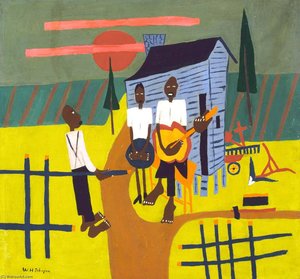
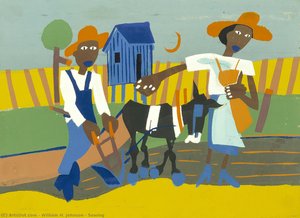
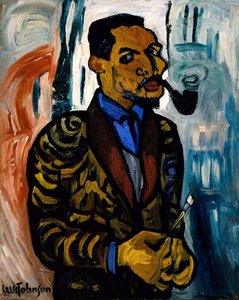
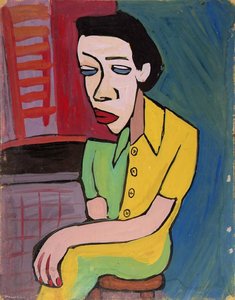
11Volda Fjord, Norway (1937) de William JohnsonVolda Fjord, Norway1937 12Jitterbugs (II) (1941) de William JohnsonJitterbugs (II)1941 13City Street Scene (1940) de William JohnsonCity Street Scene1940 14Jitterbugs (IV) (1941) de William JohnsonJitterbugs (IV)1941 15Mine Scene (1944) de William JohnsonMine Scene1944 16Sowing (III) (1941) de William JohnsonSowing (III)1941 17Off to Market (1941) de William JohnsonOff to Market1941 18Taj, Agra (1880) de William JohnsonTaj, Agra1880 19Art Class Three Men (1940) de William JohnsonArt Class Three Men1940 20Danish Street with Houses and Tree (1934) de William JohnsonDanish Street with Houses and Tree1934 21African Woman Study in Tunis (1932) de William JohnsonAfrican Woman Study in Tunis1932 22Portrait (Danish Boy) (1932) de William JohnsonPortrait (Danish Boy)1932 23City Gates, Kairouan (1932) de William JohnsonCity Gates, Kairouan1932 24Danish Seaman (1932) de William JohnsonDanish Seaman1932 25Tunisian Street Scene with Figures and Mosque (1932) de William JohnsonTunisian Street Scene with Figures and Mosque1932 26Portrait of a Little Boy (1934) de William JohnsonPortrait of a Little Boy1934 27Mother and Child (1945) de William JohnsonMother and Child1945 28Road in Mountains (1938) de William JohnsonRoad in Mountains1938 29Fright (1942) de William JohnsonFright1942 · Smithsonian American Art Museum 30Male Nude Portrait Bust (1940) de William JohnsonMale Nude Portrait Bust1940 31Seated Female Nude in Profile (1940) de William JohnsonSeated Female Nude in Profile1940 32Seated Male Model with Blue Turban (1940) de William JohnsonSeated Male Model with Blue Turban1940 33Female Nude Seated on Chair (1940) de William JohnsonFemale Nude Seated on Chair1940 34Blind Musicians (1940) de William JohnsonBlind Musicians1940 35Jitterbugs (I) (1941) de William JohnsonJitterbugs (I)1941 36Young Farmers (1940) de William JohnsonYoung Farmers1940 37Standing Woman in Red Bathing Suit (1940) de William JohnsonStanding Woman in Red Bathing Suit1940 38Killed in Action (1942) de William JohnsonKilled in Action1942 39Seated Woman in Blue and Red Dress and Hat (1940) de William JohnsonSeated Woman in Blue and Red Dress and Hat1940 40Woman in Green Sweater on Red Bench (1940) de William JohnsonWoman in Green Sweater on Red Bench1940 41Three Dancers (1940) de William JohnsonThree Dancers1940 42Bearded Male Nude Standing in Supplication Pose (1940) de William JohnsonBearded Male Nude Standing in Supplication Pose1940 43Paul Robeson's Relations (1945) de William JohnsonPaul Robeson's Relations1945 44Three Great Abolitionists A. Lincoln, F. Douglass, J. Brown (1945) de William JohnsonThree Great Abolitionists A. Lincoln, F. Douglass, J. Brown1945 45Ezekiel Saw the Wheel (1944) de William JohnsonEzekiel Saw the Wheel1944 46Marcus Garvey (1945) de William JohnsonMarcus Garvey1945 47Maternal (1944) de William JohnsonMaternal1944 48Lift Up Thy Voice and Sing (1944) de William JohnsonLift Up Thy Voice and Sing1944 49Children's Dance (1941) de William JohnsonChildren's Dance1941 50Teheran Conference (1945) de William JohnsonTeheran Conference1945 51Swing Low, Sweet Chariot (1944) de William JohnsonSwing Low, Sweet Chariot1944 52Toussaint l'Ouverture, Haiti (1945) de William JohnsonToussaint l'Ouverture, Haiti1945 53Abraham Lincoln (1945) de William JohnsonAbraham Lincoln1945 54Lamentation de William JohnsonLamentation 55Barefoot Seated Woman in Green Jacket (1940) de William JohnsonBarefoot Seated Woman in Green Jacket1940 56Volunteer Workers (1944) de William JohnsonVolunteer Workers1944 57Farm Couple at Work (1944) de William JohnsonFarm Couple at Work1944 58Nat Turner (1945) de William JohnsonNat Turner1945 59Folk Scene Man with Banjo (1944) de William JohnsonFolk Scene Man with Banjo1944 60Still Life Fruit, Bottles (1939) de William JohnsonStill Life Fruit, Bottles1939 61Sowing (1942) de William JohnsonSowing1942 · Gibbes Museum of Art 62Bust of Man in Blue Jacket and Red Tie (1940) de William JohnsonBust of Man in Blue Jacket and Red Tie1940 63Study for Sun Setting, Denmark (1930) de William JohnsonStudy for Sun Setting, Denmark1930 64John Brown Legend (1945) de William JohnsonJohn Brown Legend1945 65Folk Family (1940) de William JohnsonFolk Family1940 66Bearded Kneeling Male Nude (1940) de William JohnsonBearded Kneeling Male Nude1940 67Bust of Woman with Blue Hair and Green and Red Scarf (1940) de William JohnsonBust of Woman with Blue Hair and Green and Red Scarf1940 68Early Morning Work (1940) de William JohnsonEarly Morning Work1940 69Trees, Fjord and Mountains, Norway (1938) de William JohnsonTrees, Fjord and Mountains, Norway1938 70Henry Lawson (1915) de William JohnsonHenry Lawson1915 · National Portrait Gallery 71Self Portrait with Pipe (1937) de William JohnsonSelf Portrait with Pipe1937 72Jim (1930) de William JohnsonJim1930 73Apple Blossoms, Norheimsund, Hardanger (1938) de William JohnsonApple Blossoms, Norheimsund, Hardanger1938 74Any Person May Kill and Destroy Said Slaves (1798) de William JohnsonAny Person May Kill and Destroy Said Slaves1798 · The Kinsey African American Art - History Collection 75Family Portrait (1944) de William JohnsonFamily Portrait1944 76Historical Scene (1945) de William JohnsonHistorical Scene1945 77Kerteminde Landscape (1932) de William JohnsonKerteminde Landscape1932 78Portrait of a Boy (1938) de William JohnsonPortrait of a Boy1938 79Farm Couple (1940) de William JohnsonFarm Couple1940 80Seated Female Nude in Landscape (1940) de William JohnsonSeated Female Nude in Landscape1940 81Standing Woman in Red Bathing Suit with Hands on Head (1940) de William JohnsonStanding Woman in Red Bathing Suit with Hands on Head1940 82Crispus Attucks (1945) de William JohnsonCrispus Attucks1945 83Farewell (1942) de William JohnsonFarewell1942 84Seated Man in Green Chair (1940) de William JohnsonSeated Man in Green Chair1940 85Seated Semi Nude Woman in Purple Playsuit (1940) de William JohnsonSeated Semi Nude Woman in Purple Playsuit1940 86Going to Market (1940) de William JohnsonGoing to Market1940 87Woman Ironing (1944) de William JohnsonWoman Ironing1944 88Henry Lawson (1915) de William JohnsonHenry Lawson1915 · National Portrait Gallery 89Henry Lawson (1915) de William JohnsonHenry Lawson1915 · National Portrait Gallery 90Seated Female Nude on Brown Chair (1940) de William JohnsonSeated Female Nude on Brown Chair1940 91Portrait of Ilya Bolotowsky (1930) de William JohnsonPortrait of Ilya Bolotowsky1930 92Bazaars behind Church, Oslo (1935) de William JohnsonBazaars behind Church, Oslo1935 93Under Fire (1942) de William JohnsonUnder Fire1942 94Seated Woman in Green and Yellow Dress (1940) de William JohnsonSeated Woman in Green and Yellow Dress1940 95Seated Woman in Red Playsuit (1940) de William JohnsonSeated Woman in Red Playsuit1940 96Peace (1940) de William JohnsonPeace1940 97Midnight Sun, Lofoten (1937) de William JohnsonMidnight Sun, Lofoten1937 98Jolster (1936) de William JohnsonJolster1936 99Women Builders (1945) de William JohnsonWomen Builders1945 100Off to War (1944) de William JohnsonOff to War1944

Os temas que cativaram o olhar de William Johnson

Os quatro temas que mais se repetem nestas obras originais, cada um com o seu melhor exemplo.

Os museus que guardam os originais de William Johnson

Os 4 museus que detêm a maioria das pinturas desta página.

Museus Cidade Obras de William Johnson Pinturas desta lista
National Portrait Gallery, CanberraNational Portrait Gallery Canberra 3 Henry Lawson, Henry Lawson, Henry Lawson
Smithsonian American Art Museum, Washington, D.C.Smithsonian American Art Museum Washington, D.C. 3 Fright
The Kinsey African American Art - History Collection, Los AngelesThe Kinsey African American Art - History Collection Los Angeles 2 Any Person May Kill and Destroy Said Slaves
Gibbes Museum of Art, CharlestonGibbes Museum of Art Charleston 1 Sowing

William Johnson ao longo das décadas: uma obra original única para cada uma

Obras por década

Escolha uma década para ver a obra original que a define.

Pinturas de William Johnson: perguntas para a galeria

Qual é a obra mais famosa de William Johnson?Revelar a resposta

Lincoln at Gettysburg III (1942). Street Life, Harlem (1940) e Going to Church (1941) vêm a seguir.

Com que idade William Johnson criou Lincoln at Gettysburg III?Revelar a resposta

41 anos: Lincoln at Gettysburg III data de 1942, e William Johnson nasceu em 1901.

Quais são as dez pinturas mais famosas de William Johnson?Revelar a resposta

Lincoln at Gettysburg III, Street Life, Harlem, Going to Church, Marian Anderson, Harriet Tubman, The Red Road, Kerteminde Harbor, Come Unto Me, Little Children, Army Training e Kerteminde, Denmark. O ranking acima apresenta o ano e o museu de cada uma.

Quantas obras de William Johnson são conhecidas?Revelar a resposta

Nosso catálogo contém 564 obras de William Johnson, datadas de 1915 a 1945.

Onde se pode ver os originais mais famosos de William Johnson?Revelar a resposta

Principalmente em National Portrait Gallery (Canberra), Smithsonian American Art Museum (Washington, D.C.) e The Kinsey African American Art - History Collection (Los Angeles). A tabela de museus acima lista todos eles.

Em que período William Johnson criou as suas pinturas mais conhecidas?Revelar a resposta

Em 1940s: 70 das 100 obras nesta página foram feitas então, sendo Lincoln at Gettysburg III delas.

Qual pintura famosa de William Johnson é a mais antiga e qual é a mais recente?Revelar a resposta

Nesta página, a mais antiga é Henry Lawson (1915) e a mais recente é Marian Anderson (1945).

Quais temas William Johnson preferia?Revelar a resposta

Portrait (16), African american (15) e Folk art (11), entre as 100 obras nesta página.

Com quais materiais William Johnson mais pintou?Revelar a resposta

Oil On Canvas, para 31 das 100 obras nesta página.

A qual movimento pertence a obra de William Johnson?Revelar a resposta

Harlem renaissance e Modernism, a julgar pelos originais nesta página.

Quais originais de William Johnson posso ver no National Portrait Gallery?Revelar a resposta

Henry Lawson, Henry Lawson e Henry Lawson: o National Portrait Gallery, Canberra detém 3 das obras desta página.

William Johnson: um retrato do artista

William H. Johnson: Uma Voz de Resiliência e Visão

William Henry Johnson (1901–1970) ergue-se como uma pedra angular da história da arte americana, particularmente no rico mosaico do Renascimento de Harlem. Nascido em Florence, Carolina do Sul, sua jornada artística começou em meio às complexidades da era Jim Crow, moldando sua visão de mundo e informando profundamente sua linguagem visual distinta – uma fusão de abstração modernista e tradições folclóricas enraizadas que continua a ressoar hoje. A infância de Johnson instilou uma profunda conexão com a cultura e espiritualidade afro-americana. Ele absorveu influências da música gospel, das tradições orais transmitidas através das gerações e da iconografia da religião Yoruba, elementos que se tornariam integrais ao seu processo artístico. Essa base na tradição oral traduziu-se em telas repletas de imagens simbólicas – espíritos, animais e padrões geométricos – que transmitiam narrativas de luta, perseverança e transcendência espiritual.

Formação Artística e Influências Transcontinentais

O desenvolvimento artístico de Johnson desabrochou através dos continentes, da Europa ao México, onde aprimorou suas habilidades experimentando com várias mídias, incluindo tinta a óleo, aquarela e colagem. Ele abraçou técnicas como o *impasto* – aplicação de camadas espessas de pigmento – para imbuir suas pinturas com textura palpável e intensidade emocional. Essa abordagem refletia o fervor expressivo característico do Expressionismo, mas Johnson manteve uma estética singular enraizada em sua herança pessoal. Sua estadia na Europa, especialmente durante a década de 1920, foi crucial. Inicialmente influenciado por artistas como John Wollaston, ele gradualmente se afastou das convenções realistas, buscando formas mais ousadas e pessoais de expressão. A arte africana que encontrou em museus europeus também exerceu um impacto profundo, despertando uma consciência renovada de suas raízes culturais e inspirando-o a incorporar elementos da iconografia tradicional em seu trabalho.

A Expressão do Renascimento de Harlem

Ao retornar aos Estados Unidos, Johnson tornou-se uma figura proeminente no Renascimento de Harlem, um movimento cultural que celebrou as artes, a literatura e a música afro-americanas. Sua obra é marcada por uma diversidade surpreendente de temas – retratos capturando a dignidade e resiliência de indivíduos afro-americanos, paisagens retratando a beleza da Carolina do Sul rural e visões fantásticas explorando temas de mitologia e espiritualidade. Ele não se limitou a representar a vida cotidiana; buscou transmitir as emoções profundas, os sonhos e as lutas de seu povo. A série “From Slavery to Freedom” (1939-40), talvez sua obra mais conhecida, é um testemunho poderoso da história afro-americana, retratando momentos cruciais desde o tráfico de escravos até a emancipação.

Legado e Significado Histórico

Obras notáveis incluem “The Black Christ” (1938), uma tela monumental infundida com simbolismo Yoruba que comunica poderosamente fé e compaixão; "The Great Spirit" (1964), que incorpora a exploração de imagens xamânicas de Johnson e busca espiritual; e “Black Boy” (1937), uma representação pungente da inocência juvenil confrontando a adversidade. Além de suas conquistas artísticas, o legado de William H. Johnson se estende ao seu papel como educador e mentor, fomentando os talentos de artistas mais jovens que abraçaram explorações estilísticas semelhantes. Sua influência pode ser vista em gerações subsequentes de pintores afro-americanos que buscaram articular experiências de identidade e patrimônio cultural por meio de vocabulários visuais inovadores. Hoje, as pinturas de Johnson estão abrigadas em museus prestigiados em todo o mundo – incluindo o Smithsonian American Art Museum e o Hampton University Museum – testemunho de seu mérito artístico duradouro e significado histórico como emblemas do compromisso do Renascimento de Harlem em retratar a vida negra com honestidade e dignidade. Sua arte continua a inspirar e desafiar, lembrando-nos da importância de celebrar a diversidade cultural e lutar por um mundo mais justo.